Favorites
Design Vault Ep. 23 Private Residence with Ross Padluck
ABOUT THE ARCHITECT:

|
Ross Padluck is a Partner at Kligerman Architecture & Design. He joined the firm under Ike Kligerman Barkley in 2010. Ross’ passion for architecture began with a childhood fascination of historic New England homes. Before joining the firm, Ross worked at Skidmore, Owings and Merrill and Superstructures. He matriculated at the New York Institute of Technology for a bachelor degree in architecture, where he accepted the AIA Henry Adams Medal as valedictorian of the School of Architecture. His work at Kligerman Architecture & design has been featured in Architectural Digest, Luxe, Interiors and Gallerie.
Daniela is also an educator. Since the early 1980’s she has taught at Yale University as a TA, University of Pennsylvania and Drexel University, and has developed and taught Bryn Mawr College’s design studio program. She often serves on juries for professional awards in architectural design and construction quality, as well as serving on academic reviews.
|
|---|
ABOUT THE PROJECT:
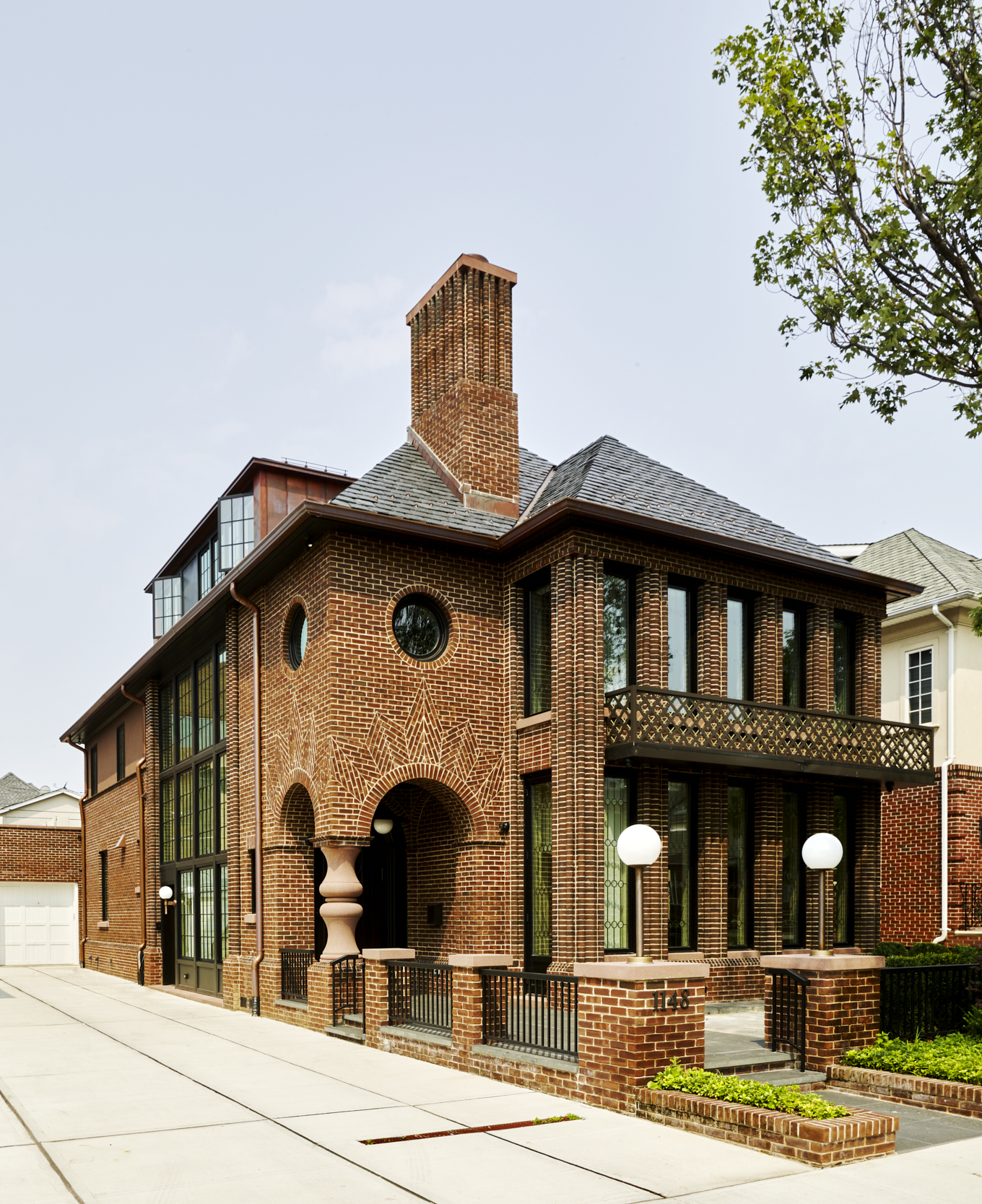
The house is located on a narrow, urban lot. The vernacular of the neighborhood includes many homes from the 1920s that utilize various elements of brick and stone cladding combined with tile roofs and decorative windows.
We drew our inspiration from the Italian Art Deco movement as well as the German Expressionists. We studied the work of Piero Portaluppi, who was preeminent in Italy in the 1920s and 1930s. His architecture is a streamlined Deco Classicism with creative forms and decorative elements. We also looked at German architects such as Fritz Hoger and Henrich Muller, who were creative very experimental forms with brick.
For the exterior design of this home, the goal was to create a very detailed exterior that complemented the established vernacular of the neighborhood while still standing on its own. We created a monochrome color palette of rich colors by using Hunt Valley colored brick from Glen Gery, lilac sandstone, black windows, toned stucco, black slate, and copper. All of the brick designs on the house were made with using standardized special shapes from the catalog, and pairing the shapes together to create unique combinations. This results in the gentle undulation of the columns between the front windows, and the corduroy texture of the chimney. The crown above the entry arch was created all from standard bricks, and is supported by the solid sandstone column, affectionately referred to as the Chess Piece by the masons.
The leaded glass panels in the windows utilized wavy restoration glass and clear roundels. The delicateness of the leaded glass panels is contrasted by the weight and mass of the brick piers. The roof dormers are clad in copper. We kept the detailing on the dormers tight, they appear as objects perched on the roof, invoking the work of the Germans in the 20s.
All of the detailing on the house is subtle. The brick is the star of the design. We’ve molded and shaped and cut it to create a masonry skin, similar to how we use wood shingles. All of these elements gently pull together to create a home that commands a quiet, solid presence on the block.
TRANSCRIPT
00;00;00;02 - 00;00;05;09
Doug Pat (DP)
Let's go inside the vault. The design vault.
00;00;05;11 - 00;00;30;15
Ross Padluck (RP)
What we did on the inside was opened the living room, the dining room and the family room in the back with these pocketing doors so that when the doors are closed, you can have these very private moments in the house. But when they're entertaining, the series of pocket doors opens up. So the property is really open from the front terrace into the living room, dining room and the yard in the back so you can kind of open the house up front to back, or you could close it down from more intimate settings.
00;00;30;17 - 00;03;44;04
DP
This is my guest, Ross Padluck. I'll share more about him shortly. In this episode from the Design Vault, we highlight an Italian art Deco private residence designed by Ross. The private residence we're discussing today is located on a narrow urban lot in a neighborhood which includes many homes from the 1920s. These homes feature various elements of brick and stone cladding combined with tile roofs and decorative windows.
The new home was inspired by the Italian art deco movement, as well as the German Expressionist. It draws from the work of Piero Portaluppi, a preeminent architect of streamlined art deco classicism in Italy in the 1920s and thirties. Other inspirations include German architects Fritz Hogar and Heinrich Muller, well-known for creative and experimental forms constructed with brick.
The exterior of the home is composed of details that decidedly complement the vernacular of the neighborhood. The construction palette of masonry includes brick, lilac sandstone, black windows, black slate and copper. Interestingly, the brick shapes, which appear to be custom, are actually all standard Glen-Gery modules. The course work is detailed and unique. The leaded glass panels in the windows are restoration glass and the roof dormers are clad in copper.
The details of the house are mannerist yet subtle, and the brick is creatively patterned in coursed to give the house a unique personality. Hi, I'm Doug Pat and this is Design Vault. Ross Padluck is a registered architect and partner at Kligerman Architecture & Design in New York City. Ross has a Bachelor of Architecture degree from New York Institute of Technology, where he received AIA Henry Adams medal as valedictorian of the School of Architecture.
Ross’s passion for architecture started young. Back then, he remembers being fascinated with the historic homes of New England. He joined Kligerman Architecture & Design in 2010. His work has been featured in Architectural Digest, Lux Interiors, and Gallery. His firm is known for design, rooted in tradition, but modern in its sculptural forms, precise details, material integrity and liberal use of glass.
The firm still creates presentations by hand and uses the latest digital technologies, including 3D printers and VR. So welcome, Ross. It's nice to have you with us today. So tell us a little bit about Kligerman Architecture & Design in New York City. So where are you guys located in the city? What size is the firm? How long has it been around and what type of work do you do?
00;03;44;06 - 00;04;29;13
RP
Well, thank you for having me. Kligerman Architecture & Design, we’re actually just up the street from the Brickworks Studio. We're on the corner of 42nd Street and Fifth Avenue across the street from the library. We're in 505th Avenue, which is a Shreve, Lamb and Harmon Building which is, I guess, considered the sister building to the Empire State Building. They were built at the same time with the same architect and 505th was completed first before the Empire State Building.
And at the time it was the tallest building in the world. Before it was surpassed by its sister, the Empire State Building. We're about a 40 person architecture and interiors firm. We do high end residential architecture, mostly single family. We were known as Ike Kligerman Barkley when I joined the firm. We went through an ownership transition last year when I became a partner.
00;04;29;20 - 00;04;39;06
DP
Well, interestingly, as an aside, I do high end residential architecture. I worked with a gentleman named Joe Moore for about 20 years. He's up in the Greenwich area.
00;04;39;14 - 00;04;40;27
RP
Okay. That's a great neighborhood.
00;04;41;02 - 00;04;48;24
DP
Yeah, that's really cool. So tell us a little bit about yourself. So how long have you been practicing architecture and what's your role in the office as partner?
00;04;49;01 - 00;05;20;11
RP
I always knew I wanted to be an architect. Since I was in preschool. I was sort of drawing houses and building them out of blocks when I was in preschool. So it was just a natural career. And I come from a family of architects, so it just sort of all made sense. My first job actually, I started of working for an architect when I was 14 years old.
Yeah, I did. After school drafting for an architect in high school and kind of had various internships and stuff from there at Kligerman, as a partner there, I run a studio, oversee probably about a dozen projects at the moment.
00;05;20;18 - 00;05;24;27
DP
Tell me about your family. Family of architects. That's interesting. Both mom and dad?
00;05;25;01 - 00;05;41;03
RP
No, my uncle is an architect who was a kind of huge influence and resource on me. And I have a cousin who's an architect and one is an engineer. I have another cousin who's a graphic designer. So there's this sort of creative energy in the family. My grandmother was a painter, too.
00;05;41;06 - 00;05;43;27
DP
That's really cool. I mean, architects are pretty rare.
00;05;44;01 - 00;05;50;05
RP
It's kind of a not a common profession in families, but it sort of comes naturally to us, I guess.
00;05;50;12 - 00;05;56;01
DP
Very cool. So let's dig in here and talk about the home. So how did your office get the project?
00;05;56;07 - 00;06;05;15
RP
So it's a community that we've done a lot of work in over the years. We have a long history of doing work in that community and it was a referral from another client that we got the project.
00;06;05;17 - 00;06;07;09
DP
So you didn't know the clients?
00;06;07;09 - 00;06;10;09
RP
Did not know them, but they were friends of one of our other clients.
00;06;10;16 - 00;06;13;06
DP
And what about the location? So was there a house there?
00;06;13;13 - 00;06;23;24
RP
There was a house there. It was sort of a turn of the century house that had been badly renovated in the eighties. You know, we were growing family and it was time for a new house. So they turned to us to design it.
00;06;23;28 - 00;06;32;13
DP
So the location, there are lots of homes from the 1920s era and are they still there and simply getting renovated or is it turning over?
00;06;32;16 - 00;07;03;27
RP
There's not many left, the kind of vernacular of that neighborhood. There were a lot of homes built in that sort of 1920s timeframe that were kind of brick and stone and had slag glass windows and tile roofs like you mentioned. And there's kind of very Spanish and Moorish ornate feeling to them. Unfortunately, a lot of them have been torn down.
They've been replaced with newer and larger homes, but there's still a few left in the neighborhood. And the neighborhood is sort of maintains that character, even though the homes have been replaced of the sort of 1920s buildings.
00;07;04;00 - 00;07;16;20
DP
So that ultimately did impact the esthetic of the home that you design. We'll talk about that in a little bit. So what was the scope of the project? That is, what were the programmatic requirements for the project?
00;07;16;23 - 00;07;31;06
RP
It's a single-family home, so it had to have entertaining space and living space on the first floor for them. They do a lot of in-house, entertaining large parties and then enough space for the clients and their children on a very small lot.
00;07;31;09 - 00;07;39;08
DP
Yeah. So what were the project restrictions in terms of the height of the building and the size of the building on the lot? Were they pretty stringent?
00;07;39;08 - 00;07;55;03
RP
Yeah. The zoning in that neighborhood is pretty restrictive, so you have to fit a lot into a very small envelope. So you have to be really creative of how you use floor space and how you configure the building envelope to fit within the zoning requirements and the floor area restrictions.
00;07;55;05 - 00;08;01;13
DP
And you couldn't go over two and a half stories or okay, so I nailed that. That was the restriction. Two and a half stories?
00;08;01;13 - 00;08;07;03
RP
There's actually not a restriction of stories, it's a restriction of height. So that's what limits how far you can go.
00;08;07;10 - 00;08;10;02
DP
And FAR restrictions, is that what they call them.
00;08;10;02 - 00;08;13;02
RP
Yea, floor area ratio, it's pretty tight there.
00;08;13;04 - 00;08;41;24
DP
So let's talk a little bit about the building design. Stylistically, we talked a little bit about this already, the Italian art deco influence and of course the reference that I made earlier to the German architects. Interestingly, I was looking at Portal Whoopi's work online. I know it sounds a little bizarre, but it almost seemed like a modern cross between Palladio and Boulay, right?
I mean, it's just the symmetry is gorgeous. Some of the buildings that this man designed were unbelievable.
00;08;41;26 - 00;09;16;27
RP
Yeah, they're really incredible. I've had the fortune of being in a few of them in Italy, and Porto Lippi was sort of off the radar up until a couple of years ago. And now it's, you know, there's all these books out about them and everyone's sort of looking at it. But he just did really incredible sort of forward thinking work in Italy in that timeframe that was still sort of rooted in tradition, not too dissimilar from the work that we do at the firm.
So it sort of just seemed like a natural influence for us. A lot of his work was urban, a lot of it was in Milan, so it sort of had that urbanity to it like this house does.
00;09;17;04 - 00;09;22;27
DP
So tell us a little bit about the building plan. Looks relatively straightforward, like a large rectangle.
00;09;23;05 - 00;09;52;11
RP
Yeah, the sort of narrow rectangular lots. So there's not much you could do with it. What we did on the inside was opened the living room, the dining room and the family room in the back with these pocketing doors so that when the doors are closed, you can have these very private moments in the house. But when they're entertaining, the series of pocket doors opens up.
So the property is really open from the front terrace into the living room, dining room and the yard in the back so you could kind of open the house up front to back or you could close it down from more intimate settings.
00;09;52;14 - 00;10;00;17
DP
That's a really nice idea for a relatively narrow house. Who came up with that idea where the client's like, Whoa you guys showed it to them and they thought, Wow, this is really neat.
00;10;00;24 - 00;10;05;14
RP
You know, they were really kind of happy with it. We sort of hit it on the first shot, I guess you could say.
00;10;05;21 - 00;10;08;28
DP
So how large was the team that was working with you on the.
00;10;09;00 - 00;10;11;25
RP
It was me and at the time, John Ike.
00;10;11;27 - 00;10;19;17
DP
So let's talk a little bit about the facade, which is very interesting. All brick, who decided on brick?
00;10;19;23 - 00;10;31;19
RP
It's the vernacular in that neighborhood. Just about every house uses brick or stone or a combination of them. The natural choice to use. So we wouldn't recommend anything else in that neighborhood.
00;10;31;26 - 00;10;33;02
DP
And what about the color?
00;10;33;05 - 00;10;39;26
RP
So we wanted to create something that was a little richer, a little darker, a little moodier. And that's how we ended up with that color.
00;10;39;28 - 00;10;59;28
DP
I want to back up a little bit. I always ask our guests about the town reviews, like how long that process took was a challenging historical neighborhood, that sort of thing. What did you guys go through in terms of presentation? So you meet with the client, you show more schematic design. Then ultimately you've got to go to the town and get this thing approved.
00;11;00;07 - 00;11;05;15
RP
There wasn't any sort of historic or architectural review board there, so it was just the building department.
00;11;05;21 - 00;11;12;22
DP
And in terms of zoning requirements, the building had to be relatively narrow rights for the setbacks. Were they restrictive or?
00;11;12;25 - 00;11;24;10
RP
Restrictive on the sides? The biggest challenge is the floor area, which is very restrictive. You kind of have to fit a lot into a very small footprint. So there's very little wasted space in the floorplan.
00;11;24;12 - 00;11;42;01
DP
So let's talk about the facade. What I loved about this house was the figuring in the brick, right? So there were all stock sizes and shapes used by your company and was that intentional? You didn't want to spend extra money having these custom shapes made?
00;11;42;04 - 00;12;16;04
RP
Yeah, we wanted to have that in mind of trying to do this with stock shapes. We wanted to do an all-brick house, which is inherently a little more expensive. And instead of doing custom shapes, we looked through the Glen-Gery catalog to see what was available, sort of quote unquote in stock that wasn't custom made. And then we took these different shapes and create a different patterns and modules with them.
And that's how we created those sort of columns that are between the windows. And we created that corduroy texture that's on the chimney all out of Glen-Gery shapes.
00;12;16;06 - 00;12;27;19
DP
Yeah, I found that really beautiful. The piers in between the windows are figured, right? So when you guys design that, did you ultimately do mock ups in the fields to see what these things looked like?
00;12;27;25 - 00;12;40;03
RP
We 3D printed the brick shapes and then sort of put them together almost like Legos to see what makes sense and what makes an interesting shape. And we did mockups on our 3D printer with those brick shapes to kind of lay it out.
00;12;40;10 - 00;12;52;27
DP
And what about some of this interesting coursing that I found as I looked around the exterior elevations, for example, at the entrance, right? The coursing above that entrance is almost done in a star shape or a crown like shape.
00;12;53;04 - 00;13;16;03
RP
Yeah, it's sort of a star shape or a crown, as you say. And we had originally designed that in stone, and the owner had wanted the house to feel a lot more monochrome. So I said, Well, why don't we do it in Brick? And it sort of created that crown shape out of, it's just modular standard brick that's laid at different angles and it sort of radiates around the arch to create that pattern.
00;13;16;10 - 00;13;19;06
DP
To remind me some of the other details on the house.
00;13;19;13 - 00;13;58;12
RP
The house is about that arch. It's the entrance. It's very subtle because it's all done out of the brick. It doesn't really stand out, but it's a detail that you notice right away just the way the mortar joints are run to create that pattern. And then we have, as I mentioned, the special piers between the windows, which are created of three different pieces of brick special shapes that create that.
And there is the chimney, which is the corduroy texture. We also used some of the sill pieces to create a water table or sort of base around the house. And then we experimented with different patterns of brick running bonds and stock bonds to create different patterns and sections of the house to break up the mass of it a little bit.
00;13;58;19 - 00;14;01;11
DP
And the dormer is done in copper, which is really cool.
00;14;01;16 - 00;14;15;03
RP
I like when Dormers feel like objects on a roof. I don't like when the metal roof comes out. So we created them to feel, you know, like these copper boxes sitting on the roof, which is a very German kind of mannerism of going about that.
00;14;15;05 - 00;14;23;16
DP
So on a project like this, it's obviously really important to find a good mason. So you guys clearly found somebody liked. What was that process like?
00;14;23;22 - 00;14;37;18
RP
We worked very hand-in-hand with the Mason to create that. You know, we're very specific about all these different patterns and layouts. So it was a lot of site visits and working one on one to make sure our vision came to reality on the house.
00;14;37;20 - 00;14;47;28
DP
So you were talking about having a 3D printer and making these that must have been a really fun process, right? I mean, that's like the awesome stuff that architects get to do.
00;14;48;01 - 00;15;02;08
RP
Yeah, it is. The 3D printer itself is kind of a pain to use. It's finicky, but once you get it to actually do what you want it to do, being able to just sort of create these shapes and put them together was really satisfying. That's sort of how we create our vision.
00;15;02;08 - 00;15;04;20
DP
Did you guys do the building in Revit?
00;15;04;26 - 00;15;09;13
RP
The building was actually done in CAD, believe it or not, all 2D.
00;15;09;17 - 00;15;11;00
DP
So no 3D renderings?
00;15;11;02 - 00;15;12;27
RP
Nope. Except for hand renderings.
00;15;12;29 - 00;15;14;29
DP
Is that pretty typical for your office?
00;15;15;02 - 00;15;38;11
RP
Most of our projects are in Revit now. For me, the intricacies of the house, I felt more confident doing it in 2D. It's just the way my brain thinks. I still think of old school drafting and that's kind of what CAD does. And the house was small enough that it was manageable. A lot of our other houses that are much larger than this, it makes sense to do them in Revit, but I felt kind of old school doing it in CAD, but it worked out.
00;15;38;19 - 00;15;42;14
DP
And did the clients get to see these little models, the little modules or?
00;15;42;18 - 00;15;50;21
RP
Absolutely. We showed them, you know, this is the pattern and these are the different shapes of brick and they got a kick out of it, but they were excited.
00;15;50;24 - 00;15;59;05
DP
Yeah, very cool. So, we talked about the size of your team. There were two people that worked on the project essentially and start to finish. How long does that take for your office?
00;15;59;13 - 00;16;19;23
RP
Search to finish a house of the skills is about three years. We're about a year for design from when a client first hires us to get through schematic design construction documents, permitting, all of that. And then construction is about two years, which seems like a long time. But our houses are very custom and we're doing very one off sort of things.
00;16;19;28 - 00;16;22;05
RP
It takes time, but it's worth it in the end.
00;16;22;07 - 00;16;31;08
DP
Yeah, you know, that process can be pretty interesting for people that haven't done it before, the clients. Have these clients been through a custom home before?
00;16;31;14 - 00;16;38;06
RP
Not to this scale. They had renovated a home before, but they hadn't built a home like this before, so it was a first time for them.
00;16;38;09 - 00;16;40;17
DP
Well, I'm sure that we're very happy, the house is beautiful.
00;16;40;24 - 00;16;44;01
RP
Thank you. They were very happy. So we did our job.
00;16;44;03 - 00;16;50;10
DP
Awesome. So the column in the front. Very cool. Reminds me a lot of Frank Furnace.
00;16;50;16 - 00;16;50;28
RP
Yes.
00;16;50;28 - 00;16;53;11
DP
Whose idea was that? Where did that come from?
00;16;53;17 - 00;17;15;21
RP
That was mine. We wanted to create something special on that corner. Since it is the main entrance to the house. And it was inspired by a lot of the work that Portaluppi did, where he uses more classical elements and we didn't want to do another piece of brick there. It was time to do some stone. It is solid lilac sandstone that's supporting that brick arch.
00;17;15;24 - 00;17;18;00
DP
So was that difficult to have made?
00;17;18;02 - 00;17;25;01
RP
We had it custom made, unlike the brick, we did have the column custom made. It was milled in Canada.
00;17;25;03 - 00;17;36;04
DP
Did your team learn anything interesting through the design and construction process? It's clearly a pretty unique home, so there were a few new things for you guys, I would assume.
00;17;36;11 - 00;17;55;25
RP
Yeah, I think working through the brick shapes and the course thing, we try and get Windows to line up with brick coursing or if the windows are off, you adjust the stone sills to make up for the difference in brick. And I think we learned a lot about just making sure that the brick lines up everywhere.
00;17;55;28 - 00;18;06;19
DP
So were there any instances of we drew it this way, but then you get in the field and you're working with a mason, They're like, no, you know, we're not going to be on course here and we're going to have to adjust things.
00;18;06;19 - 00;18;32;16
RP
There were a few instances where the cursing under the windows was ever so slightly off, but we were able to adjust that with the stone sills and make it work. I was very exact when I drew it to make sure that everything mathematically worked out just because the design was so important to us and to the clients, we really wanted to make sure you could actually build it the way we intended it.
The drawings were pretty precise, and that led to a fairly smooth construction process.
00;18;32;18 - 00;19;03;09
DP
That's great. It is one of the most important things to me. After the house has been designed, we sign up the GC, we get rolling on the project, the project managers get to know one another. This would be the architect and the project manager for the general contractor. Those first couple meetings between those two people are really important because at that point you get to spend a lot of time explaining, okay, this is why I drew it this way and I need you to keep this in mind when we build it, right?
00;19;03;16 - 00;19;25;09
RP
Yeah. We were fortunate to have a really good contractor. He was really a craftsman. Very hands on approach, like we have with design and construction. He understood our design goals for the house and the quality goals, he really paid attention to the details and worked with us throughout construction to make sure the vision was carried out.
00;19;25;11 - 00;19;37;20
DP
So Ross, before you go, you've been an architect for a little while now. Based on what you know about being an architect today, do you have any words of advice for your younger self or even young architects getting started?
00;19;37;22 - 00;20;11;11
RP
I do. You know, the advice is to stick with it. A lot of people that I went to school with did not end up pursuing a career in architecture. For me, it's something I love doing. I'm very passionate about it and it's not an easy educational process. It's not an easy career. I think a lot of people get discouraged by that, but if you love it and you care about it, just stick with it because it's very rewarding and we get to do really unique and special things.
There's not a day that goes by that I don't regret my career choice.
00;20;11;16 - 00;20;24;07
DP
Well, that's really cool. Being a high-end residential architect can be extremely challenging, but also very rewarding long term because you're working on a singular typology and you can get really good at it.
00;20;24;11 - 00;20;56;25
RP
Yeah, well, you're designing for the end user and you're spending their money. So it's a high stakes process, but it's also very creative and you get to work with unique materials and work with craftsmen and people who are really good at what they do. So in that respect, yeah, it's really rewarding and we're creating things that people and families are going to use for the rest of their lives.
They're going to live in them. They're going to have their friends over. As challenging as it can be to work in that environment, we're just creating such special things. It's wonderful.
00;20;56;27 - 00;21;02;03
DP
Yeah, I like to say that we've got to know a lot about a lot to be a high-end residential architect.
00;21;02;05 - 00;21;13;16
RP
Yeah, you have to be an architect. You've got to be a plumber. An extra installer, a lawyer, an accountant, a marriage counselor. You have to be everything. A materials scientist.
00;21;13;17 - 00;21;27;01
DP
I like that. Marriage counselor. Marriage counselor, for sure. My goodness. So Ross, it's been great to have you here. Thanks for your time. Where can people go to learn more about Kligerman Architecture & Design and yourself?
00;21;27;03 - 00;21;31;21
RP
Check out our klingermanad.com. And you can also look at our Instagram account [@kligerman.ad].
00;21;31;24 - 00;21;34;00
DP
And do you have your own Instagram account as well?
00;21;34;01 - 00;21;38;06
RP
Yes, that's @RossPadluck.
You May Also Be Interested In
We Can Help With Your Next Project
Discover the latest + greatest in design trends, industry news & pro tips from pros.
For all of your project needs, you’ll find everything you need at a Supply Center.
Let Us Know How We Can Help!
Design Vault Ep. 25 102 Bainbridge with Michelle Todd
ABOUT THE ARCHITECT:

|
A design firm specializing in progressive and innovative designs that enhance the environment and existing urban fabric. * Our focus is to design and develop projects that are sensitive and responsible to social wellness, cradle to cradle architecture and the planet. * Better buildings. Better change.
Michelle Todd is an architect and urban community activist who has a longstanding passion for socially responsive, innovatively progressive, and restorative preservation design. Michelle grew up in Brooklyn’s Bedford-Stuyvesant neighborhood in the 1970s before it was hip, in one of Mayor John Lindsay’s modular housing developments. She knew she wanted to be an architect at ten and had big plans for the empty lot across from her apartment building.
It was the beginning of her interest in Urban Planning and how socially responsive architecture can do something positive for people and the planet. After a brief stint at Perkins Eastman, she opened her own firm in 2008. Since then, she has worked for small and large corporations such as Snapple, the New York City agency Office of Emergency Management and private residential projects. Since 2008 she has since set up her own studio in Brooklyn, New York and focuses on historic renovations and additions to collaborate more directly with clients and be closer to the construction process. She has worked on landmark designated buildings, bakeries, restaurants, school projects and completed dexterous renovations which push the envelope of the expected, creating simple beautiful spaces. Michelle has a Master of Science from Columbia University GSAPP in Architecture and Urban Design, where she was awarded the Lucille Smyser Lowenfish Honors Award for work in Urban Design. Master Planning of Community Developments is an initiative she is well versed in accomplishing. She is certified as a consultant with the International Institute of Building Enclosures (IIBEC) and Living Future Accredited (LFA) with the International Living Future Institute. She also studied at the famous École de Beaux-Arts in Fontainebleau, France. She is an adjunct Professor at New York City CUNY College and a licensed architect in New York State and Maryland State. You can find her gardening and planning programming with the AIA Brooklyn COTE Committee and AIA National Regional & Urban Design Committee.
|
|---|
ABOUT THE PROJECT:
Residents of New York City take immense pride in their city, renowned for its vibrant energy, rich culture, and remarkable history. Among the numerous neighborhoods, Brooklyn's Bedford-Stuyvesant, fondly known as Bed-Stuy, stands out with its collection of over 8,000 buildings pre-dating the 20th century.
One of those buildings immersed in this historical tapestry is the beautiful home of 102 Bainbridge Street located in the Bedford Stuyvesant original Stuyvesant Heights Historic District which was designated on September 14th, 1971. It was built within a row of building Nos. 76-104 and is a long group of houses planned to form seven freestanding architectural units, consisting of fourteen paired houses plus a single house at the eastern end. These unusual two-story houses, designed by W. F. McCarthy, are of red brick laid in Flemish bond, and were built in 1919 for Samuel Willen, treasurer of the Prosser Construction Company. 102 Bainbridge itself is a modified Spanish Renaissance style with a triple arch loggia surmounted by a group of five (5) double hung windows. The roof parapet rises at the center in an arch supported on concave shoulders. The house is set back behind brick terraces with brick balustrades and are approached by L-shape stoops set back at a common wall.
The initiation for the restoration for this building was due to the exterior façade along the roof parapet on the west and north elevation were buckling with severe step cracking occurring along masonry segments in the façade with patches of damaged stucco. Within the west façade along the base of the stepped parapet were damaged steel tie rods. At the north façade, the center stone pediment needed to be supported correctly and coping stones above it had to be repaired. At grade, the front façade along the brick terraces walls showed signs of masonry buckling and deterioration. The entire existing roof, skylights, roof hatch and areas of limestone and blue stone above and below the windows were in dire need of repair.
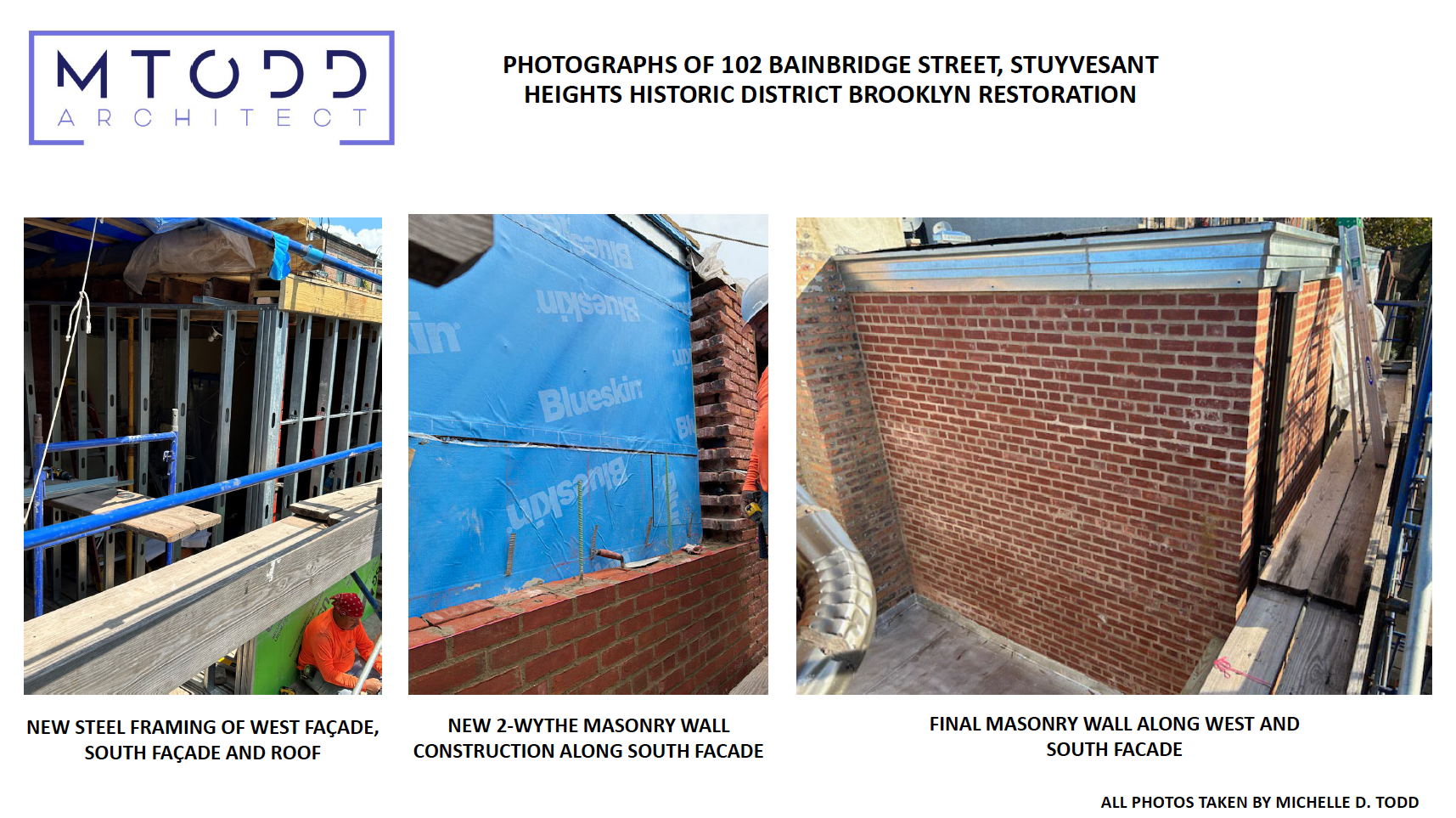
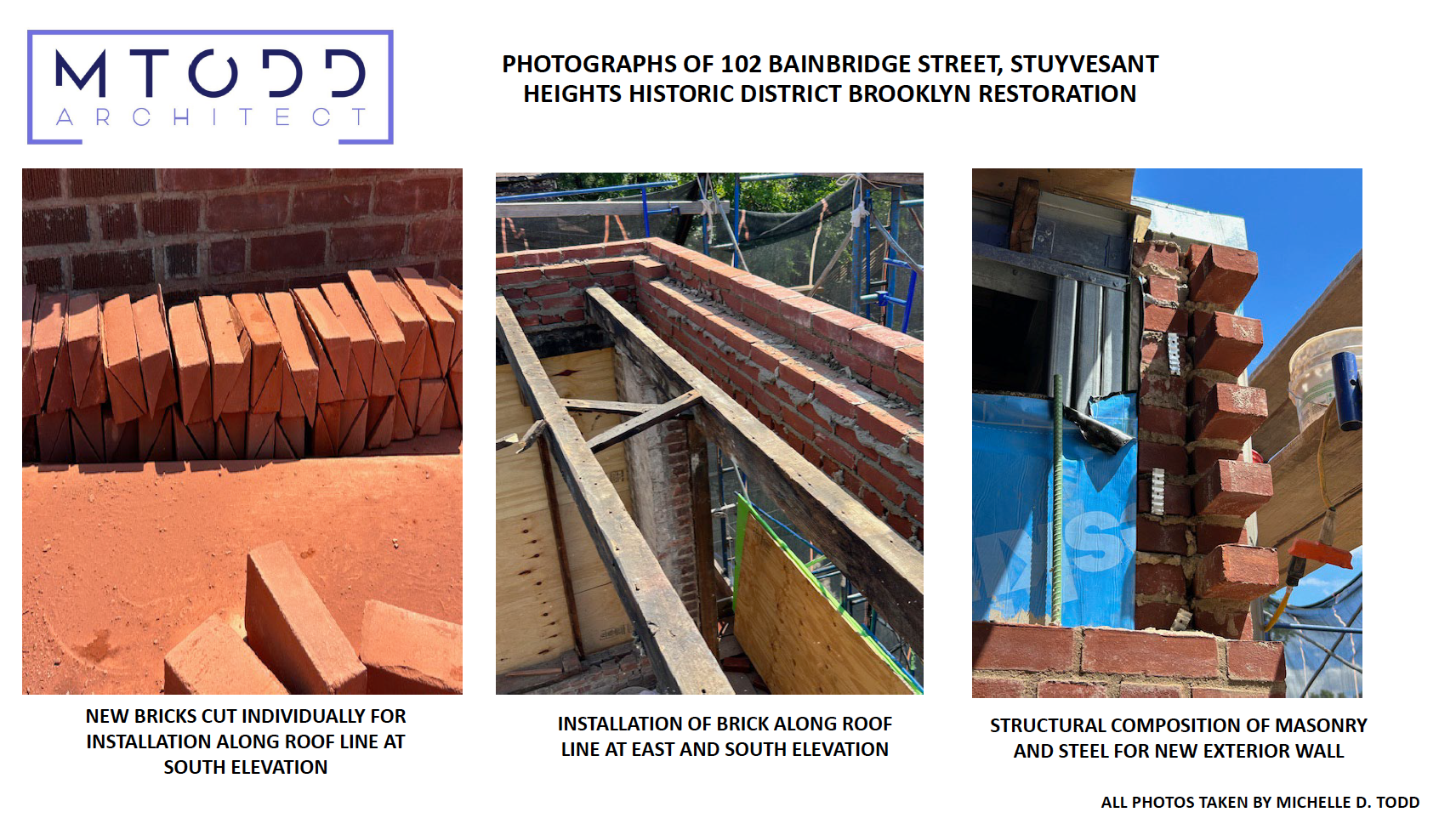
The premise to rectify the structural conditions of the home began early in the design to utilize sustainable means and methods to restore the building. A major step taken was not to replace the areas along the façade again with new stucco. Stucco accounts for 8.2% of carbon emissions and is a material that is hard to maintain due to temperature change effects, dealing with moisture and freezing. During the removal process of the existing stucco along the rear east elevation the homeowners genuinely liked the appearance of the natural brick underneath. The advantage of keeping the natural brick exposed was its resilience to harsh climatic resistance, durable, low-maintenance, fireproof, noise cancelling, energy efficient and just made the building more attractive. The existing brick under the stucco in the rear of the home was a different brick color and style from the original masonry brick along the front east elevation and north elevation. We therefore chose a brick like the underlining brick called Glen Gehry Cushwa Calvert Series Middle Plantation Brick 52-DD along with 403 mortars to match masonry bond style.
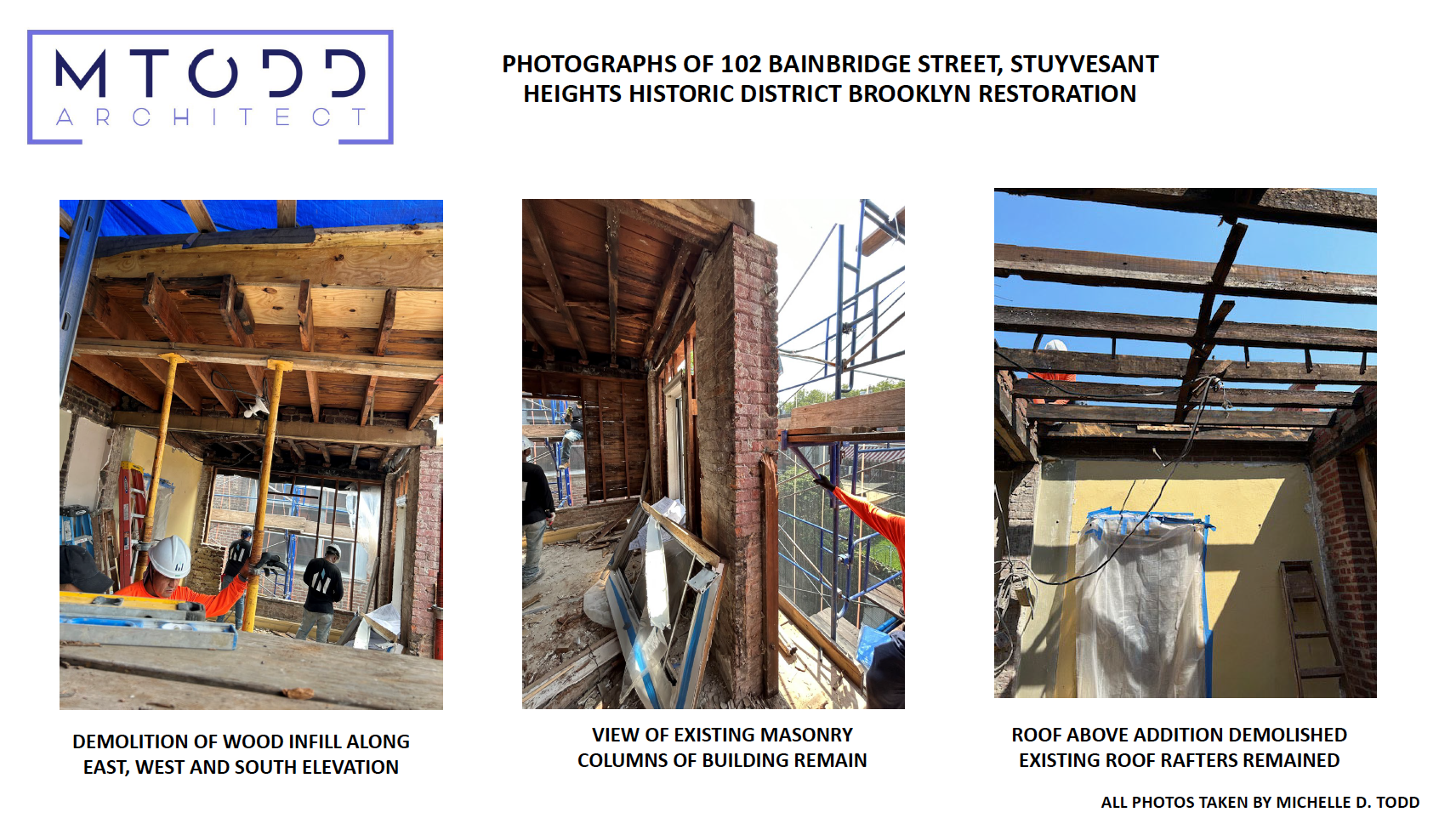
As the construction project continued upon removal of the stucco face, it was revealed that a 1956 addition to 102 Bainbridge Street along the second-floor rear east and south façade was framed with wood along the exterior instead of masonry as per the original blueprints and approval submitted. Even though this construction was done before the landmark designation in 1971, the use of wood was illegal back then and present-day NYC building code because the building is along a shared property line with an adjacent building. This plot twist made the project move from being an exterior renovation to a demolition and reconstruction of a new addition.
To address this issue, the structural engineering firm Silman Structural Engineering was brought in to provide consultation on the next steps. Their recommendation was to reuse the existing steel lintels that were located under the wood along the exterior façade where the original windows were located and the roof structure. An entirely new structural design was created to merge the old methodologies of the 2-wythe masonry wall with the new steel framing from Marino\WARE. Scott Hughes Principal Director of Structural Engineering at Silman stated he specified Marino-Ware products because of the wealth of publicly available published information about them and their sustainable qualities of steel being robust, long-lasting, and 100% recyclable, making it unmatched by most other building materials in terms of its lifecycle. The new wall construction entailed the structural steel from Marino Ware which has the environmental product declaration from UL, USG glass mat sheathing made of recycled material and is 100% recyclable, the Blueskin vapor barrier to contribute the energy efficiency of the home and Glen Gehry bricks for the 2-wythe exterior wall. The existing steel lintels rediscovered remained to install the original style windows back at those locations along the east and south façade.
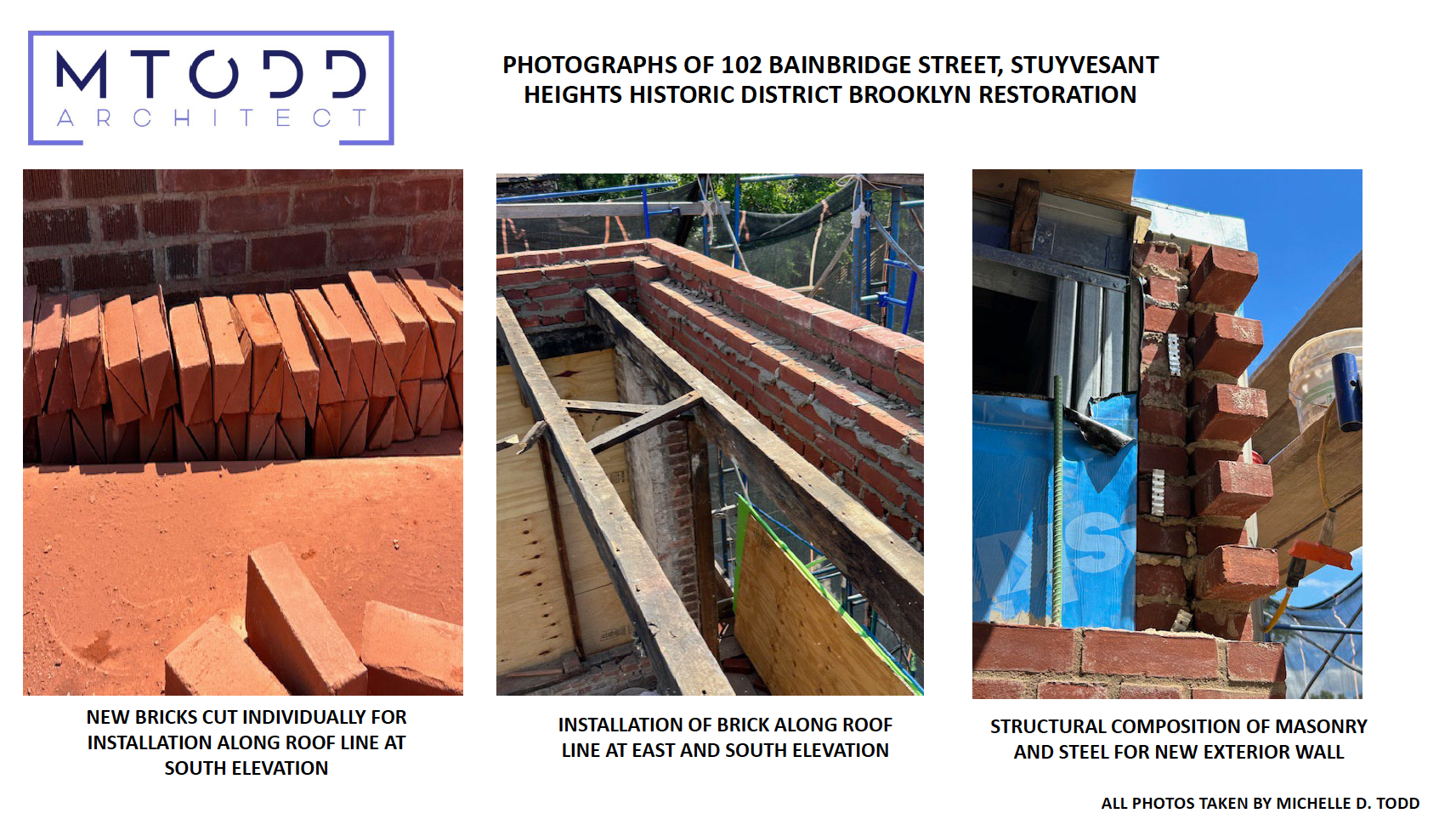
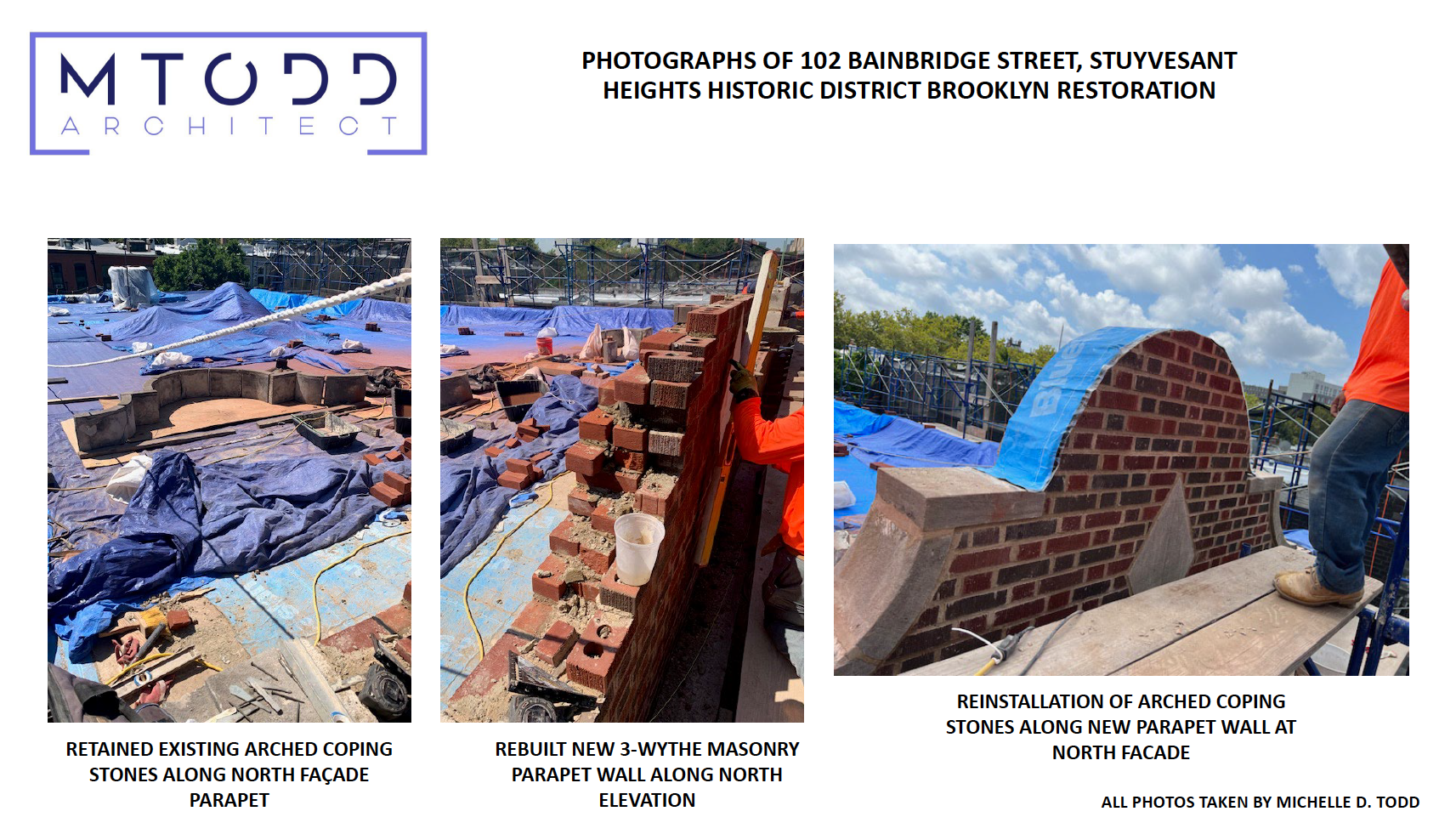
In correcting the existing parapet at the roof, we replaced the existing steel tie rods with the assistance of a local steel maker in Brooklyn who created each unique piece separately. This became handy when we had to go back to him again to create additional steel tie rods, upon the demolition of the top parapet along the north façade. There it was discovered the masonry construction was three wythe and within it were steel tie rods hidden from view to support the center of the arch with the stone pediment along with the concave shoulders.
The masonry wall along the front porch during the demolition process existing bricks were analyzed closely to see which ones could be salvaged and reused. This helped to maintain the budget of the project but also to have less impact to add to the wasteful construction materials to landfills which brick encompasses about 6.54% sadly. Areas within the masonry façade that were in decent shape stayed and dilapidated areas were replaced with new bricks. The entire roof was professionally abated and replaced using Siplast roofing system which uses reusable insulation to bright white liquid-applied roof membranes and granule surface that helps reduce atmospheric pollution. The environmental and sustainable goals were met with the reduction of building energy use, increase roof longevity and reduction of urban heat island effect. The large skylight was replicated and replaced. The small skylight on the roof was replaced with an operable solar skylight which aids natural light and ventilation to come into the building.
All existing coping stones were cleaned, repaired, reused, and restored. New limestone and blue stone used in the restoration was advocated from quarries and manufacturers who met ANSI/NSC 373 Standard.
Completing the exterior façade restoration entailed the replacement of the steel window lintels for some of the existing windows. The steel used was recyclable. The homeowners desired to have all the windows replaced for the home to save energy, save money obtain ultimate insulation, climate control, more light, less noise, dust, and outside pollutants. The windows was provided by Norwood Window and Doors because of their strong advocacy of their products created from sustainable harvested lumber and NRFC rating.
TRANSCRIPT
00;00;00;02 - 00;00;05;10
Doug Pat (DP)
Let's go inside the vault. The design vault.
00;00;05;12 - 00;00;34;05
Michelle Todd (MT)
So the whole idea was to fix the parapet and also to fix all of the step cracking within the facade. It was a beautiful building of brick in the front and the original status was that it had stucco on the very rear portion. We wind up finding out that this particular building, it wasn't brick behind it, it was actually wood.
So that therefore became more of an extensive project in which it wasn't just a renovation of the exterior facade, it was now a whole new addition and also an entire new rebuild.
00;00;34;07 - 00;01;01;23
DP
This is my guest, Michelle Todd. I'll share more about her shortly. In this episode from The Design Vault. We highlight Michelle's restoration project at 102 Bainbridge Street in Brooklyn's Bedford-Stuyvesant neighborhood. The Bainbridge Street renovation project is located in the Stuyvesant Heights Historic District. It was built within a row of buildings, which is a long group of houses planned to form seven freestanding architectural units.
00;01;01;28 - 00;03;46;13
DP
102 is situated at the end of the row. It's a modified Spanish residential style home with a triple arched loggia made of red brick laid in Flemish pond. The roof parapet rises at the center in an arch supported on concave shoulders. The restoration was begun to repair a buckling roof parapet, deteriorated walls, damaged pediment and cracking stucco facade.
Renovation work was extensive and a decision was made early not to replace the stucco, but rather leave and repair the natural brick masonry. The building scope also changed during construction from an exterior renovation to demolition and reconstruction due to construction material issues. Structural engineers were also consulted to create a necessary and unique wall construction method. The existing roof skylights, roof hatch and areas of limestone and bluestone were also repaired.
The project was also recently awarded the 2023 Lucy G. Moses New York Landmark Conservancy Award. Hi, I'm Doug Pat and this is Design Vault. Michelle Todd is an architect and principal of M.Todd Architects in Bedford-Stuyvesant, New York. Michelle has a master of science from Columbia University in architecture and urban design. She also studied at the École des Beaux-Arts in France.
Michelle grew up in Brooklyn's Bedford-Stuyvesant neighborhood in the 1970s. She knew she wanted to be an architect by the age of ten. Her interests today focus on urban planning and socially responsive architecture. After a brief stint at Perkins Eastman, she opened her own firm in 2008. Since then, she's worked for small and large corporations such as Snapple, the New York City Agency Office of Emergency Management, as well as private residential projects.
Her studio in Brooklyn, New York, focuses on historic renovations and additions, collaborating directly with clients and working closely with the general contractor during construction. Michelle's worked on Landmark designated buildings, bakeries, restaurants, schools and renovation projects. She's an adjunct professor at the New York City CUNY College and a licensed architect in New York State and Maryland. She's certified as a consultant with the International Institute of Building Enclosures, and Living Future accredited with the International Living Future Institute.
Welcome, Michelle. It's nice to have you with us today. So tell us a little bit about M.Todd Architects in Brooklyn. So where in Bed-Stuy are you located? What's the size of the firm? How long have you been around? And tell us a little more about project types.
00;03;46;16 - 00;04;19;19
MT
The firm is in the heart of Bedford-Stuyvesant on the whole Z Street. Been around since 2008 was almost 15 years as of March of this year, 2024. And basically the firm is small, is about three people, we specialize specifically in historical preservation, as well as residential private editions, commercial projects such as restaurants, bake houses and also schools. So basically you have a realm of achievement in different areas, which is commercial, residential and also business.
00;04;19;21 - 00;04;26;09
DP
So tell us a little bit about yourself. How long have you been practicing architecture and what's your role in the office as principal?
00;04;26;12 - 00;05;00;18
MT
I've been practicing architecture since 2008, when I received my license. However, I do have decades of experience before then in working at previous larger offices, in smaller offices to gain the experience I needed. Because, as you know, as an architect, you have to have at least three years working first in the field and then afterwards you're able to take the examination.
So once I did that, then just made initiative to just start my own practice. And basically I am the principal where I do a lot of marketing as well as clients in order to obtain business.
00;05;00;20 - 00;05;02;15
DP
And you said you have some employees?
00;05;02;21 - 00;05;13;16
MT
I do have employees. They're basically consultants. So basically I have a expediter. I have a drafts person. I have also my consultants, such as structural engineer, mechanical engineers.
00;05;13;19 - 00;05;21;08
DP
That's interesting. So you have an expediter that you guys use. And is that to make the process working with the city a little easier?
00;05;21;11 - 00;05;33;17
MT
It really does make it easier because as a person with a small firm, your hands are in everything. So to have somebody to be on the outside, to be able to do that type of work is appreciative and helpful.
00;05;33;19 - 00;05;46;05
DP
That's really cool. I mean, just as an aside, I hadn't really thought about the need for an expediter in a firm like that, but that makes perfect sense. So let's dig in here and talk about the home. How did your office get the project?
00;05;46;07 - 00;06;08;01
MT
I received the project in regards to as a dear friend, where I'm on the New York City Landmark Committee for Bedford-Stuyvesant specifically, and Community Board three, and he was a good member, Fred Jones, rest in peace. He had a friend who was in need of architectural services, so he recommended me to the client, which is the richest family, about this project.
00;06;08;03 - 00;06;10;01
DP
So you didn't know the clients before you got the job?
00;06;10;06 - 00;06;18;04
MT
I didn't know the clients. It was a friend of a friend, and he just talked highly about me and said that you should work with me in regards to this project.
00;06;18;06 - 00;06;24;26
DP
So give us a little history about the location. And was I correct in stating that the unit is an end unit?
00;06;24;29 - 00;07;08;00
MT
It is. It's in the beautiful, original, historic district of Bedford-Stuyvesant, which is known as Stuyvesant Heights, and it was established as a landmark district in 1971. So this set of buildings, it's literally between Stuyvesant and Lewis on Bainbridge. There's about 14 series of the buildings, and it's at the end row and there are Spanish style Renaissance buildings. That was created by W.f. McCarthy, who was an architect back in 1919.
And the unique thing about these buildings is that it's the only buildings I've ever been in with it has two staircases inside where there's one in the back and one in the front. So I guess back in those days they would have the servants come through the back and then the owners come through the front.
00;07;08;03 - 00;07;10;14
DP
Roughly, what's the square footage of the project?
00;07;10;16 - 00;07;13;09
MT
It's about 1200 square feet.
00;07;13;11 - 00;07;17;05
DP
And what was the scope and the programmatic requirements from the owner?
00;07;17;07 - 00;10;08;12
MT
Well, the original scope and program was that it was in terrible need in regards to the existing structure, the parapet was buckling. So on the north facade as well as the south and west facades, it was just crumbling. They were scared that it was going to fall down in some way. So the whole idea was to fix the parapet and also to fix all of the step cracking within the facade.
But then as we went along, we started to think also, it was a beautiful building of brick in the front. And the original status was that it had stucco on the very rear portion. Once we started to do the renovation was like, you know, we don't really need the stucco. It really looks beautiful with the brick itself. So we started to expose all the stucco, and by exposing all the stucco, we wound up finding out that this particular building, it wasn't brick behind it, it was actually wood.
So that therefore became more of an extensive project in which it wasn't just the renovation of the exterior facade, it was now a whole new addition and also an entire new rebuild. So we found out the history, and that was the nice thing about it. We really had to go back in the history of it. This is where the assistance of the expediter really came into play, because basically we found out that back in 1956, the building itself had a permit to actually do a addition because all of these beautiful houses.
What makes them so special in this neighborhood, too, is that they have their own private driveway, which many people don't have in that area. And also they have a garage. But then also on the second floor of each of these houses, they have a beautiful sunroom with a balcony. The person who owned the property at 102 Bainbridge, he basically wanted to make an addition.
So he eliminated that balcony and extended the whole square footage of the building so it can be enclosed. When we removed the stucco, we found out that instead of it masonry, he had it wood. So that was back in 1956. So we had to go back all the way to the building department to find out what the original drawings were, which we found out which were these beautiful blueprint drawings that you don't see anymore.
And it said that year they were legally supposed to have an addition, but it was supposed to be made out of brick, not wood. So that's where the whole expedition kind of came in. I had to go back to New York City building department, as well as the landmarks, because everyone was like shocked that it was wood versus masonry.
And we basically had to do a whole reconstruction. And that's where I guess the product of Glen-Gery came into play, because what happened to you is that on the back of the facade, all the bricks in the building weren't the same. The bricks in the front of the building were made out of Beldon, and it was a different type of color scheme.
But then when we removed the stucco in the back, it was a beautiful match with the Glen-Gery Kushwaha Calvert Plantation Middle Plantation, 52DD. It was a perfect match to it. Again, we had to go back to landmarks to make sure that they were approve of that brick to match what was in the rear facade that was being used.
00;10;08;15 - 00;10;17;12
DP
So what's interesting about the photographs that you sent is that the building looks as though some of these walls were completely taken down.
00;10;17;18 - 00;10;59;01
MT
It was because due to the fact it was stucco and I'm an architect that's very conscious about the environment. And stucco is something I concrete and it adds to the carbon footprint. So the whole idea was that this project specifically was to eliminate that process in really being more progressive and more enhancing to the environment. So that's why we didn't use stucco.
We wanted to just expose the beautiful masonry itself. And therefore, by eliminating the stucco, we saw the building was in need of much deeper repair than we expected. That was the thing, because in 1956 you figured that the contractors would be honest and they would do what they were supposed to do. But he wasn’t. And therefore that made this more of an adventure to get it right.
00;10;59;03 - 00;11;05;27
DP
So I would imagine there are a number of other buildings on that block that were also made of wood, that the interior wall construction. Is that correct?
00;11;06;00 - 00;11;44;10
MT
I don't know. That's the whole thing. What happened is, what makes this special is that this is the only house that has the addition. That's it. Everybody else has the sunroom. So this once in particular you thought that you would put it in masonry, but it's in it makes sense. First landmarks had to come and see it.
They were, like, shocked. Then I received the structural engineer, which was SOMA Engineering Firm, which is a great engineering firm. They came, they were shocked. The construction company that we work with, Naim Construction, all of us was basically shocked that this was behind the stucco because it looked like everything was fine. But when exposed, that's when we all gathered together as a team to like how we can resolve this.
00;11;44;16 - 00;11;52;22
DP
Interesting. Let's back up and talk a little bit about the plan of the building. I would assume it's just a large rectangle, two storey rectangle.
00;11;52;24 - 00;11;54;23
MT
Exactly. It was a two storey rectangle.
00;11;55;00 - 00;11;59;29
DP
And had you been contracted to design the interiors as well?
00;12;00;04 - 00;12;20;18
MT
I have for later date because what happens is based on the fact that now the photographs that you have here show of what it was existing. We went back to the premise of what it was back in 1919 when the solarium had these beautiful corner windows. So the design now is encompassing back the original style of that format.
00;12;20;20 - 00;12;25;05
DP
So you had to work with the city. How long did that process take?
00;12;25;08 - 00;12;53;21
MT
This is how it began. The project began in May 2020, during the pandemic. Then we actually had approval to start construction in April of 2021. Then all of these items, open issues about the facade not being what it was, and reconstruction, we basically spent about two years after that, and it was completed around October 20, 23. So it was back and forth with New York Landmarks as well as New York City Building Department.
00;12;53;27 - 00;12;55;09
DP
And the client had somewhere to live.
00;12;55;16 - 00;13;08;12
MT
He lived on the first floor. So the top floor. It was a blessing that he was able to live on the first floor while all this construction was going on. And in the top floor, basically, he had tenants, but then they moved out. When this major construction of us doing the rebuild.
00;13;08;15 - 00;13;09;07
DP
A lot of noise.
00;13;09;13 - 00;13;11;04
MT
It was a lot of noise.
00;13;11;04 - 00;13;11;23
DP
Very dusty.
00;13;11;24 - 00;13;15;00
MT
But it was fun.
00;13;15;02 - 00;13;24;10
DP
That's great. I'm interested as an architect about the drawings that you created in the very beginning. Did you work in 3D or just 2D?
00;13;24;12 - 00;13;33;28
MT
I worked in 2D, but then afterwards, when we started to look at what this condition that was taking place in the rear, I started looking at it in 3D and how it would be.
00;13;34;05 - 00;13;38;05
DP
And did you have to present drawings to a historic commission?
00;13;38;07 - 00;13;47;14
MT
Yes, we present it to Brian Blazak, is one of the senior preservationists on in New York City Landmarks. We had to show the drawings of what we planned to do.
00;13;47;16 - 00;13;48;26
DP
Exterior elevations?
00;13;49;03 - 00;13;50;24
MT
Yeah, exterior elevations.
00;13;50;26 - 00;13;58;25
DP
So again, backing up a little bit, you removed the stucco on one facade and replaced masonry on another. Is that correct?
00;13;58;28 - 00;14;25;03
MT
It's on the same facade. What happens is, is that the entire facade was placed in stucco. But then when we looked at the south elevation, so the windows were there, but it was infilled with wood. And that's what was shocking to everybody because basically it was really dilapidated and it also kind of made sense for the owner later on because he said his tenants always felt cold in that part of the room.
And it made sense because it was the wood and that masonry, there was no insulation whatsoever.
00;14;25;06 - 00;14;30;17
DP
So tell us a little bit about the new wall system that you guys had to create because of that condition.
00;14;30;19 - 00;15;17;03
MT
So the new wall system was still going back to what was historically done in regards to the rear facade was made out of three widths of brick, which basically is like three layers. And what we had to do is that we had to abide by what the actual, once we removed the stucco, what the actual pattern was, because it was a common bond, because as I stated in the beginning, the pattern in the front of the house was completely different than the pattern in the back of the house.
So once we established that, then we wanted to really make it structurally sound and we incorporated steel within the wall. So basically you have the three whiffs of brick on the outside, then you have the steel. It was stainless steel that made sure it was resource sustainably. And then we have our insulation and then our finishes in the inside.
00;15;17;06 - 00;15;26;25
DP
So the project sounds really interesting. Did you guys learn anything new about construction technologies or about building typologies in working on this project?
00;15;26;27 - 00;15;58;06
MT
Yes, the use of materials because again, was very selective about which materials we're going to use because since this building was already historically landmarked since 1919, we wanted to make sure that it lasts for another 100 years. So was very selective on who the steel came from, where the insulation came from, where the bricks came from. All of these were really mindful things and I think moving forward with other projects, I continue doing that, making sure that they are friendly to the planet as well as to the people who are going to live and utilize the buildings.
00;15;58;08 - 00;16;04;18
DP
So did the client bring the general contractor to the project or did you interview a number of contractors?
00;16;04;20 - 00;16;10;09
MT
We did interview a number of contractors, but then the client himself selected Naim Construction for it.
00;16;10;12 - 00;16;15;19
DP
And clearly there's a lot of masonry work. Did you have any challenges finding a good mason?
00;16;15;21 - 00;16;45;27
MT
Oh no. He has very excellent masons and they were very accommodating because we had to go back and forth with New York City Landmarks when we were selecting the bricks where we had to actually do a sample of the wall where the wood infill was of how the brick was going to look. So one of his masons, George, was really who's one of the oldest ones there.
It has most experience. He was very patient. We went on the scaffolding and it was a really cold day, but we did the whole mock up and it came out beautiful. And therefore Landmark said, Yes, go with it.
00;16;45;29 - 00;16;49;16
DP
So you did the mock up and the city came out and took a look at it?
00;16;49;19 - 00;16;56;05
MT
No, we took photographs and then afterwards they were like, because it was cold.
00;16;56;07 - 00;17;05;24
DP
So the city doesn't like to go out on cold days? I think we’ll leave that in there. That's good. So I assume the client's living there now?
00;17;06;02 - 00;17;09;17
MT
He is. He's living in the bottom floor still, but he's happy with the work.
00;17;09;20 - 00;17;12;25
DP
So is it complete? And he has a tenant on the second floor?
00;17;13;00 - 00;17;22;21
MT
He doesn't have a tenant on the second floor. And it's not quite complete yet because now we're just waiting for the historical windows to come in. So that is the last crème de la crème.
00;17;22;23 - 00;17;24;27
DP
And who is the manufacturer of the windows?
00;17;25;03 - 00;17;36;10
MT
It is Norwood Manufacturers, a Canadian company. And again, it was very selective on them because the way they use and harvest wood in order to make the windows, we're really mindful about that.
00;17;36;17 - 00;17;39;23
DP
Interesting. Are they double glazed? Triple glazed?
00;17;39;25 - 00;17;49;03
MT
They're triple glazed, low e glass index and they're quite beautiful. They're the original to what was there before of the windows? So they're replicating those.
00;17;49;05 - 00;17;57;00
DP
So I'm curious in terms of color, you were able to find a brick that you were happy with. You said that matched on the exterior.
00;17;57;02 - 00;18;12;16
MT
The contractor has suggested he was like, this will be a perfect break. I did research and was a Glen-Gery Kushwaha Calvert 52 DD Middle Plantation. That was the one that was selected. And when we put it in place, it was perfect to what was there from 1919.
00;18;12;22 - 00;18;15;27
DP
So do all these row homes, they all must look the same?
00;18;16;02 - 00;18;45;16
MT
They basically all look the same. And the other fascinating thing too, with the project, when we were doing the demo for the wood infield, all the bricks, I learned this like recently from my practice that the bricks that we were removing, that were there all had the names of the brick companies on there. And you don't see that anymore in which they were actually etched into the brick.
I was like, Wow, It's like, fascinating. So it was like an archeological project in the same way of doing something better for the building for another hundred years.
00;18;45;19 - 00;18;52;24
DP
So when you guys put these new windows in, what about the color? Can you do whatever color you want or the colors have to match the other homes.
00;18;52;26 - 00;18;57;13
MT
The colors have to match. It is going to be made out of wood, but they're going to be of a white finish.
00;18;57;16 - 00;19;00;10
DP
And they have to be traditional in style to match the others.
00;19;00;16 - 00;19;01;06
MT
Exactly.
00;19;01;06 - 00;19;11;17
DP
Interesting. So, Michelle, you've been an architect for some time. Based on what you know today about being an architect, you have any words of advice for your younger self or maybe architects coming up in the ranks?
00;19;11;19 - 00;19;41;21
MT
I would say don't quit on yourself. That's for me personally, as a woman and a woman of color in this industry, to always just believe in yourself, that what you find really interesting and powerful within yourself will just keep working at it and you'll get recognition. But it's not really about the recognition. I've always known I wanted to be an architect.
I feel architecture is like a stewardship. You are helping other people to obtain their desires and dreams and designs, but then also, too, helping the planet.
00;19;41;24 - 00;19;49;23
DP
So, Michelle, it's been great to have you here today. Thank you so much for your time. Where could people go to learn more M.Todd Architect and yourself?
00;19;49;26 - 00;19;56;06
MT
You can find me on my website at MToddArchitects.com and then also I'm on LinkedIn.
00;19;56;08 - 00;19;58;10
DP
Well, thank you very much. It has been great to have you.
00;19;58;17 - 00;20;00;24
MT
Thank you so much. Appreciate the opportunity.
You May Also Be Interested In
We Can Help With Your Next Project
Discover the latest + greatest in design trends, industry news & pro tips from pros.
For all of your project needs, you’ll find everything you need at a Supply Center.
Let Us Know How We Can Help!
Design Vault Ep. 21 Brick of Chicago with Will Quam
ABOUT THE ARCHITECT:
|
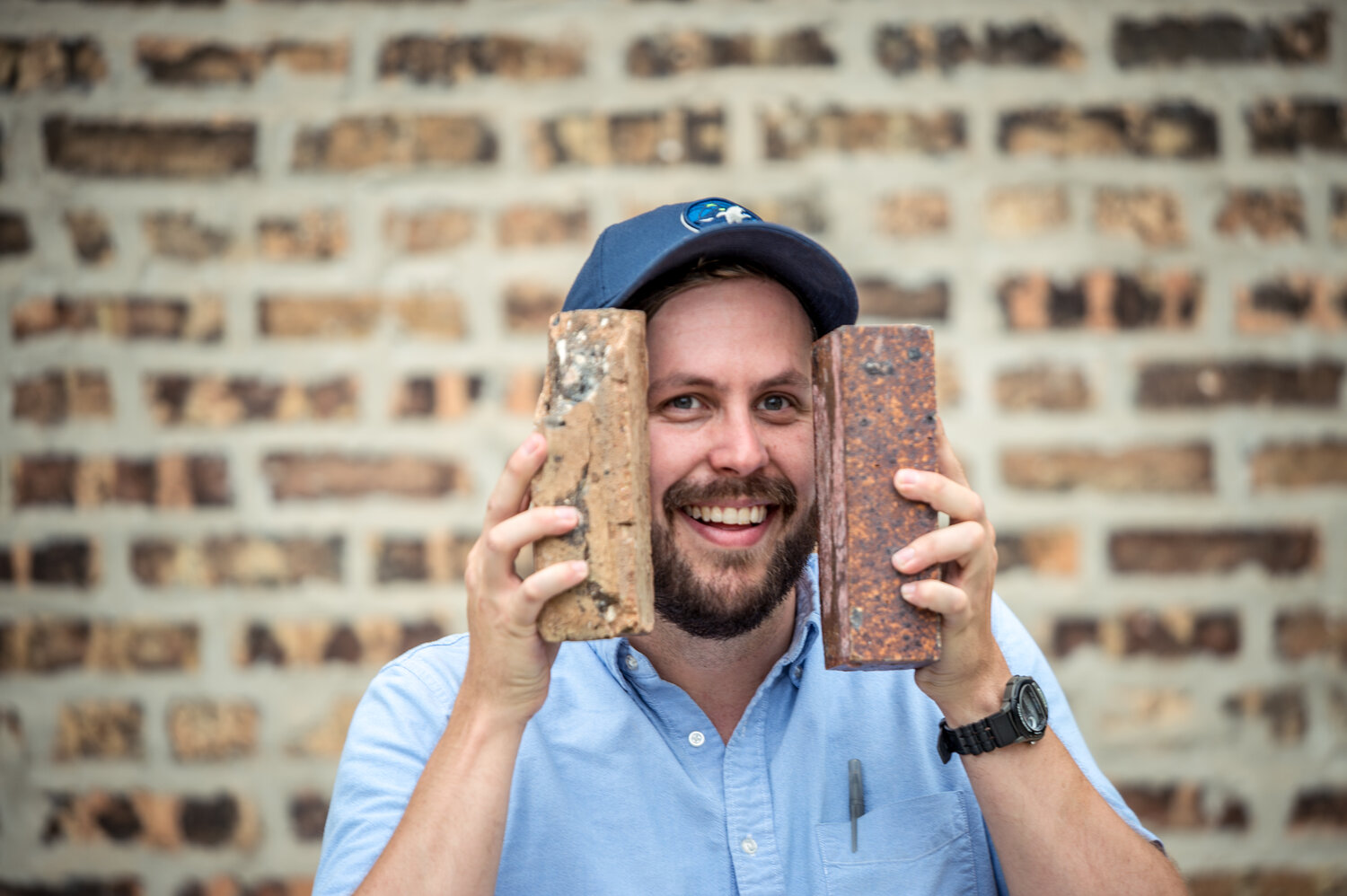
My name is Will. I live in Chicago, I’m an architecture photographer, architecture writer, and researcher. And I love bricks.
|
|---|
TRANSCRIPT
00;00;00;02 - 00;00;05;12
Doug Pat (DP)
Let's go inside the vault. The design vault.
00;00;05;14 - 00;00;30;24
Will Quam (WQ)
The Fulton Market area, I think, is the place where some of the best brick architecture in Chicago is currently happening, because it's a place where you have a lot of these historical buildings and you have a lot of people coming in there building offices, residences, restaurants, and they want to make it feel like it's part of that history.
And so they're using brick. And then you have a lot of architects who are really pushing the limits on what they're able to decoratively do with the brick.
00;00;30;26 - 00;01;42;04
DP
This is my guest, Will Quam. I'll share more about him shortly in this bonus episode from the Design Vault. We talked to Will, an architecture photographer, writer, researcher and man who was fascinated with brick.
Hi. I'm Doug Patt and this is Design Vault. Will Quam lives in Chicago. He's currently writing a book for the University of Chicago Press on the history of brick architecture in the city.
He documents brick as a way to pay more attention to the world around him and encourages others to do the same. He believes it's been like learning a whole new language and a means to discovering great texts hidden in the buildings that surround him in his own words. Everything built is designed and has impact, good or bad. It's easy to walk by something like a brick building and pay it no mind.
But the world is so much more interesting when you ask the question, What is that and why is it the way it is? Above all, he believes nothing is boring and everything can be interesting and exciting, even bricks. So welcome Will, it's nice to have you with us today.
00;01;42;07 - 00;01;43;29
WQ
Thank you so much, Doug. It's great to be here.
00;01;44;02 - 00;01;50;09
DP
So tell us a little bit about where you're from and how you became so interested in brick and brick architecture.
00;01;50;16 - 00;03;52;24
WQ
I became interested in bricks through a very circuitous route. I am from Saint Paul, Minnesota, originally, which is a good brick town, a smaller brick town. I studied theater, I directed, I did set design. I acted, and I moved to Chicago originally to be a theater teacher, and that's what I did for about nine years. I taught middle school theater.
I taught afterschool programs, in school residencies. I wrote and directed plays with middle schoolers. The great thing about that work, besides just, you know, it was so fulfilling working with kids is my work brought me all over the city in the suburbs of Chicago, and Chicago is massive. The south side of Chicago alone is the size of Philadelphia.
And so coming from a place like Saint Paul, it was an introduction to a much larger built world. And so through my work, I was, you know, on the north side in the morning, the south side in the afternoon, the west side, in the evening, the suburbs the next day. And going around Chicago, you start to see that there are these very repetitive building types, the bungalow, the two flat, the courtyards style, the apartment hotel, and they're all made of brick pretty much exclusively.
You get some stone, you get the very occasional wood, but brick is the defining material. And I started to notice that it was the brick and specifically the face, the bricks on the front of these buildings that made them all unique. And they weren't just these red rectangles that I'd always thought of a brick as being. There's texture, there's color, there's pattern, there's usage.
And so I started taking pictures on my phone. And then one day in the basement of a theater where I was running a middle school theater camp, I started Instagram and posted them and people started asking me questions. And so I said, Well, I better research this, dove down the rabbit hole and then seven years later, here I am.
It's become my full time job, taking pictures for architects and suppliers and engineers. And then I lead these brick tours to such a natural spinoff of my earlier work. Taking that excitement and giving it away. I think that's the biggest thing about my work is I'm not trying to gate keep anything. I don't have a background in this.
I'm just a very passionate learner. And then on, my goal is just to give everything away in the most interesting and exciting way possible.
00;03;52;26 - 00;03;55;08
DP
Do you ever think to yourself, I should have been an architect?
00;03;55;14 - 00;04;36;20
WQ
I'm very lucky in that my great grandfather was an architecture journalist and instilled a lot of that in my dad. My great grandfather's the great John Entenza, who did the case study houses. I never met him, but my dad knew him well. So we grew up going on a lot of architecture tours, a lot of historic home tours.
And really the importance of the built world was instilled to me as a young man, but it was always something I thought, you know, I would just enjoy. And maybe that is I'm very lucky that I grew up playing trombone and singing in choirs, and I went to space camp and I was encouraged to have all these very multifaceted interests by parents who had these very multifaceted interests as well.
And so I was very lucky to be able to feel like I could explore things.
00;04;36;25 - 00;04;58;26
DP
It sounds really cool. I mean, it's almost like you're walking down the street and you see a building and it's made of brick, and it occurs to you, you get this thought like, Hey, that's kind of cool. I wonder why that looks like that. And then the next day gets a little more important. The next day gets a little bit more fascinating, and all of a sudden you've got this interest in something that sits so far outside of your wheelhouse. In a way, it's amazing.
00;04;59;02 - 00;05;37;16
WQ
Exactly. You know, it starts with somebody asking, What's that pattern? And me, I guess I'll look on Wikipedia and then I'm emailing a brick dealer, and then I'm finding books on the history of brick architecture to the point where now last week I spent a whole day at the University of Illinois Library reading through old copies of the brick and clay record from the 1970s.
And what makes it so great in Chicago, too, is you truly can walk down any street and you'll find great brick architecture, any residential street anywhere in this entire city. And the city is so big and changing so much so constantly that you can go down the same street again ten years later and you can have so many new things to discover.
00;05;37;19 - 00;05;41;03
DP
Yeah. As an aside, have you been to the Monadnock Building?
00;05;41;10 - 00;05;42;19
WQ
Love the Monadnock Building.
00;05;42;26 - 00;05;59;14
DP
Right? When I was in architecture school and I learned about that building and the fact that the base is six feet thick of brick masonry as the load bearing structure. The first thing I did when I got to Chicago was go to that building. I'm I just couldn't believe it. Right. It's amazing.
00;05;59;17 - 00;06;40;15
WQ
It's an unbelievable it's one I found has such lasting power as well as I interview architects. So many times, I'll ask them, what's your favorite brick building in the city? And I'd say 50% say the Monadnock Building. It's so honest with its material and so inventive at the same time. You know, one of the things as I've looked at it and photographed it, I've noticed is there's no hard lines on the building.
It's all using this molded brick made by the Chicago Anderson Brick Company. You get the sort of the plinth that rises up and then curves into the building and that it's not a sharp edge from a brick to another brick that's turning; there's a rounded brick to bridge that gap at every point. So the lines are kept incredibly smooth throughout the whole thing through this really intentional use.
00;06;40;17 - 00;06;41;27
DP
Yeah. Now, how about the cornice?
00;06;42;03 - 00;07;31;18
WQ
Oh, tremendous. Every piece of that was intentionally planned that way. There's nothing was done on accident, and that's still true today. You know, one of the things I try to push back on a lot is, you know, in my work, I'm a lot of times focusing and studying and photographing historic buildings and they're amazing. But people sort of feel that permission to say, oh, well, we just don't make them like we used to.
And there's only crap being made today and it's just not true. There's a lot of really amazing buildings being built today. The way we make them is different. The style we make them is different, but that's because so much has changed in the materials we use, making things efficient, making labor safe. And there's a lot of really great design out there that if we just say we don't make them like we used to, we neglect the work that architects and designers are still doing today with the same intentionality they were doing in the 1890 and the man was built.
00;07;31;25 - 00;08;38;20
DP
Well, it's a great segway. So we're going to talk about a few pieces of architecture today, two Chicago pieces and one New York City and then maybe some other buildings. So let's dig in here and learn a little bit more about brick architecture. First, let's talk about the Chicago Park District HQ Building by John Ronan Architects in Chicago.
The Chicago Park District headquarters is a 78,000 square foot building comprised of headquarters office space for the Chicago Park District Staff and Field House on a 17 acre park. The headquarters building is a two story circle in plan, with two courtyards. The building has a unique facade with individually curved metal panels, curtain wall glazing and a light brown brick facade with brick patterning.
An interesting fact that Will points out about the building, and in regard to the brick masonry set, the bricks used are all Chicago common bricks which were made locally. So Will, let's start out with that. Tell us a little bit more about the bricks of this building.
00;08;38;23 - 00;12;56;07
WQ
Yeah, they're made of Chicago common bricks which are the bricks made locally in Chicago and most cities in the 1800s and for part of the 1900s were producing their own brick, both common brick and face brick, face brick being the nicer, more intentionally made brick used on the fronts of buildings and common brick, the cheaper stuff to go in the guts.
What made Chicago unique is that we only made common brick. Our clay, which we had in massive abundance thanks to this glacial lake that you cover all of this dry land in Chicago, Lake Michigan used to extend far over what's now dry land. The still waters of that lake allowed all this clay to settle, but all this other stuff settled in that clay as well.
The perfect mix for making bricks. But it made bricks that were, frankly to those architects of that era, very ugly. They weren't predictable in any way. The levels of mineral in them were really varied, but one batch might come out yellow, one brown, one pink, one red, all these chunks of limestone in them. But the clay was right there and it was super cheap to make.
And so we made a ton of that and threw it in our buildings. But then we would import other bricks, nicer bricks from Saint Louis or Milwaukee or Pennsylvania or Texas to put on the fronts of buildings. But Chicago kept making these common bricks, and we made a massive amount of them. In 1871, the year of the Great Fire of Chicago, Chicago produced about a hundred million of them a year.
And part of what makes the timing of the fire so good, a little ironically, is that the year of the Fire, 1871, the Chicago brick industry had really finished mechanizing pretty much by that year. And so when the city burned down, the city was in, the brick makers of Chicago were in a unique position to help rebuild the city out of brick.
So that fire code, a new fire code could be met in a way that other cities like Boston, Boston's burned down several times because they kept having to rebuild out of wood. Chicago had this local brick making machinery to make it possible to rebuild with brick. So the year the fire reproduced about 100 million of them a year.
Ten years later, Chicago was producing 200 million of these a year. And by 1916, Chicago was producing just shy of 1 billion common bricks a year. And that's the year Chicago actually surpassed the Hudson Valley of upstate New York, which provided all the common brick for New York City. By 1916, Chicago's producing more common bricks than the entire common brick area of New York City.
About 11% of all the brick made in the United States in 1916, face brick or common brick was Chicago, common brick and more by about 100 million than all the brick made in Missouri, Wisconsin, Iowa and Indiana combined that year. So we made a ton of brick in these surface plants all over the city, and we kept it all local for the most part.
And so you go around Chicago into alleys and sides of buildings, and this is the brick that you see, this messy looking brick. And it was always covered up because it was considered too unpredictable, too ugly. But what happened was, starting in the 1960s, as we're entering this era of bright glazed bricks or these sort of sleek, smooth, sort of noisy and modern bricks, you get a generation of architects who start to be really drawn to the antique accidental look of these bricks, the variation on them.
This is the time as urban renewal was sort of ravaging Chicago, when all these buildings are being torn down all over the place and people start to save these common bricks and put them in new buildings because they can add the sense of antique ness and age to buildings in a way that a modern market and this new market of reclaimed brick is born.
And then by the 1982, when the last Chicago common brick manufacturer shuts down, there's suddenly this massive market for these reclaimed bricks. First for an antique look to a building in the seventies and eighties as people are really drawn to these earth tones, browns and rough sort of creamy whites of brick. But then today, especially, and in the case especially of this new Chicago Park district headquarters, these bricks, they've embodied carbon in them and so they get you a lot of lead points and they're much more eco friendly material to use.
And so you start to see a lot more use of this reclaimed material because of the way it ties in to a greater focus on ecological buildings. And it's perfect for this building. It's a gorgeous building sitting on this massive park and having this really earthy brick that's full of color variation, full of all these stones, full of all this stuff.
It makes it feel like it really is growing out of the park and a part of the park rather than a lot of park buildings that feel like they’re just placed down into the park.
00;12;56;09 - 00;13;07;03
DP
So I'm curious, just to back up, why did Chicago stop producing common brick? Was it because brick masonry was no longer load bearing? We were using steel and iron.
00;13;07;10 - 00;15;23;04
WQ
Yes. So Chicago and the country stopped using common brick, mostly after the Second World War when cavity wall construction became prominent. Concrete block is just a lot larger and a lot cheaper. In 1952, in Chicago, a 77 square foot wall of Chicago commons would cost about $120 to lay parts and labor. The same size wall out of concrete block was about $45.
And so this cost savings were huge. As labor then became more and more expensive and concrete became more and more affordable, people started moving away from the common brick. Then what happened is in 1970, Congress passes the Clean Air Act, forms the EPA and brick plants all over the country are putting tons of sulfur dioxide and ozone and smog into the air.
And for a lot of those companies, it was not too difficult to get into compliance. You know, you have a big beehive kill or tunnel kill, and you could put a scrubber on your vents and start to clean up your operation. These common brick manufacturers, by that point, there were just two left in the Chicago area. They were using what are called Pskov kilns, which basically you take a bunch of unfired bricks, make them into this massive pile with channels running through it.
You cover it in fired bricks and set it on fire from the inside. It's a super cheap way to make bricks that don't need to look nice but are effective. But the comparison I like to make is a traditional kiln works like an oven. You take your turkey, you put it in the oven, you close the door, you turn it on.
A Pskov kiln that the Chicago commons were made in. You take that same turkey, you put it on your countertop, you stick a gas jet in the butt you cover it in deli meat and light it on fire. It's a lot more messy. It does the same job, but it's a lot more messy and it's a lot harder to clean up.
And so the Chicago common plants looked at the economics. They were losing market share. They looked at the clay. They had left the Illinois brick company in Blue Island decided, we've only got about three years clay left or just shut down. And then they looked at the environmental impact. One of these companies in Muncie, Indiana, on days that they were burning there were certain intersections you just couldn't drive because they were so smog filled. To the credit of the American beer company who was in that last company, they spent tens and tens of thousands of dollars trying to find ways to come into compliance and to make it a cleaner operation and continue this business.
But it ultimately just wasn't economically viable.
00;15;23;10 - 00;15;34;11
DP
So back to the Chicago Park District headquarters building, did you ever read anything about why John Ronan Architects ultimately used common brick for the exterior of New York?
00;15;34;14 - 00;16;42;04
WQ
Yeah. A friend of mine supplied those reclaimed bricks for him. A big part of it was that environmental impact using that embodied carbon, using a local material, not needing to create any new emissions through the creation of material, and also the fact that it's a reclaimed material taken from demolished buildings nearby. It's taking that local material and using it for a local purpose, making it something more true to that place.
Then a different kind of imported brick. And John Ronan is an architect who really loves brick and has used brick in really creative ways. In Chicago, he did a high school at South Shore International Academy where he was very specific about these different colors or slightly different tones of brick, sort of a creamy white and a little bit more of a beige and figuring out exactly where he wanted these bands to go on the building.
He had a house on the north side that uses these super long format bricks in a really interesting way to enliven up this very geometric or rectilinear facade. So someone who's super intentional about brick and so the Park District headquarters is another example of him using brick in that really intentional way.
00;16;42;07 - 00;17;36;17
DP
Yeah, the building's really unique and it sounds like a very thoughtful office. So next, let's talk about McDonald's HQ in Chicago. The architect of record was Gensler. When I sat down to do a little bit of research online, I really couldn't find a whole lot of pictures which describe this building. There are many exterior pics that are kind of further away shots.
The interior photos that I did find on a variety of websites, really quite stunning with wood clad interior, gracious curves and a very contemporary feel. The exterior is also quite interesting. The building almost seems inverted with a steel and glass base and square glass curtain wall openings framed in brick above. So these brick frames are really actually quite beautiful.
And you sent me a couple of photos of these. Let's talk about those.
00;17;36;20 - 00;19;44;07
WQ
Yeah. So it's a big steel and glass building, but it does have these large brick frames that surround two stories of windows each. It's all precast thin brick made by a company in Germany. And to get to the importance of what that brick is on the building and why it's there, I think it's important to talk about the neighborhood it's in.
It's in an area called Fulton Market, part of the West Loop of Chicago, which a lot of people have probably heard of as sort of Chicago's new restaurant and tech hub. It was an area of meatpacking and warehouses and manufacturing for many, many years. In the last 15 years, it's become this massive area for some of the best restaurants in the city.
Google has a building there now, and so it's full of all these big brick buildings, these big old brick warehouses or storage buildings with large windows. And so I think it's so wonderful that this new steel and glass building made the intentional choice to embrace that brick material. But the other thing I love about it is that we talked about with Chicago common brick brick is no longer really being used as a structural material in the United States.
And so buildings like this that take that nature, that brick is no longer a structural material. They take it and use it instead as a purely decorative material. And I think they do such a wonderful job on this building because it's the thin brick that runs around these windows, sort of blue ish and golden and orange colors with a rolled edge and a little bit of sort of a knock or sort of bumps and stuff on the face of it.
It describes this herringbone and zigzag pattern through these spandrels and these mullions that run along the building in a way that serves no structural purpose at all. But it is beautiful to look at and tie in through the use of that brick. It ties it into the neighborhood. I think that's just such a wonderful thing to do at a time when a lot of new construction and here I've said earlier, there is a lot of great new construction, but there is a lot of construction that's using brick and really uninspired ways it's just slap at a bunch of structures up on a wall or between windows. And so to see a building like this, a really prominent building in a really prominent location, in a historic location, I love that they're using brick in such an interesting way.
00;19;44;09 - 00;20;03;15
DP
Yeah, I'd love to see the studies in the architect's office for all of these or for the variety of brick patterns where you get soldier coursing. You've got stacked herringbone, as you stated, you almost have something that looks close to a Greek key as well. It's really quite beautiful and the color is stunning in the sun.
00;20;03;22 - 00;20;29;01
WQ
It really is. I captured it in those photos I sent you. It faces the north side of the street. And so you get this beautiful raking light on it in the summer evenings and in the shadow, it's still got this sort of lovely warm orange to it. So it really is very present and there's so much going on.
It's the sort of thing where you look at it and you trace it along and you to start to, like you said, start to find all those little details, different details scattered throughout the brickwork.
00;20;29;08 - 00;20;54;03
DP
You know, it's really nice too. It's almost as though they're expressing the structural system on the exterior with these super tall piers which frame these windows. One starts to think, okay, well, maybe the structural steel system is hidden within that. I don't know whether or not that's actually the case, but it does remind one of an industrial building in Chicago 80 or 90 years ago, right?
00;20;54;09 - 00;21;49;09
WQ
Yeah. And those are the buildings that surround it there. And another little twist. I like that they idea is that those brick frames are not surrounding every single window or they don't run on every single story that you do get these big frames that surround two or three stories I can't quite remember. And so it still gives it this very light feeling, this very open feeling, while having that strong brick tie into the neighborhood.
And the Fulton Market area, I think is the place where some of the best brick architecture in Chicago is currently happening because it's a place where you have a lot of these historical buildings and you have a lot of people coming in there building offices, residences, restaurants, and they want to make it feel like it's part of that history.
And so they're using brick and then you have a lot of architects who are really pushing the limits on what they're able to decoratively do with the brick. And the McDonald's was a pretty fairly early example of that. But there are many more that have come in since they're in the area.
00;21;49;11 - 00;21;58;24
DP
That's an interesting point. So early McDonald's structures across the United States, do you know if they utilize brick pretty heavily?
00;21;58;26 - 00;23;58;26
WQ
You know, I've researched this. I have emailed with a fast food historian to find some answers. So, yeah, the early McDonald's drive ins were clad in ceramic tile, whites, bright whites, bright red, and then they made a very intentional choice. In 1975 or so, they did a big redesign sort of as the baby boomers who were driving there are now buying homes.
And what they did was they started putting these dark brown bricks. They redesigned their restaurants using this very dark, earthy brick and adding that classic McDonald's double mansard roof. And this is the era when like Wendy's ads for solariums, the restaurants become these very earthy buildings. The first one of those was in Matheson, Illinois, in the south suburbs.
And that was the time too where McDonald's actually built their first corporate headquarters in Oakbrook, Illinois, designed by Dirk Lohan. Mies van der Rohe's grandson, like those restaurants, is a building very much, it's covered in this wonderful sort of earthy iron, spotted brick and surrounded by a manmade lake and all these trees and very much engaging with nature at a time when they're trying to push away from that kind of bright colors, machine age, looking stuff into a more earthy thing.
And then you get into the 1990s and McDonald's does another major rebrand, adding these sort of pastel colors or a lot of painted white brick that I think a lot of people my generation are familiar with as well. And then now a lot of those McDonald's, they've torn them down. They've rebuilt them using smooth grays and blacks and whites.
And so McDonald's, you can really follow you know, one of my big passions is following how people have used brick throughout every decade of history that you can look at a building and based on the color, the texture, the use of the brick to tell when it was built and McDonald's in specific is a great way to do that.
You can look at the restaurants and see how they've changed the restaurants, and that gives you sort of a bellwether of how ideas about what purpose bricks should serve has changed. That's a very long answer to say, yes, McDonald's has used a lot of brick in their restaurants throughout the country.
00;23;58;29 - 00;24;08;04
DP
The building is really interesting because it's also kind of flipped, right? I mean, so the base should be masonry and the upper portion should all be glass and windows.
00;24;08;07 - 00;24;41;18
WQ
I hadn't really noticed that until you brought that up. It is pretty unusual in that way. It's about a two story big steel and glass expressed base story within the brick rising up above, and I don't know why that choice was made, but it is pretty striking and it creates maybe a much open feeling based story. And the base story, they have a restaurant where you can order, you know, all the traditional McDonald's things, but you can also they have a rotating list of items that you can get at McDonald's around the country. So you can get sometimes like a curry burger or something like that that they'd have in McDonald's, India, or I guess it wouldn’t be a burger, a curry chicken sandwich.
00;24;41;25 - 00;24;43;02
DP
The McRib, maybe.
00;24;43;02 - 00;24;46;12
WQ
Yeah, the McRib. All year long. Who knows? We can dream.
00;24;46;15 - 00;25;57;18
DP
Oh, you know, can dream. Oh, that's great. The final building that I'd love to talk about is the Grand Mulberry in New York City by Morris Adjmi Architects. I got to meet Morris Adjmi in the city. We talked a little bit about the Grand Mulberry that evening. The building is absolute stunning. It's incredibly creative. This is paraphrased from their website.
So traditionally, Italianate tenement buildings featured a tripartite white facade that consisted of a base, middle and top with different details and brickwork. The Grand Mulberry facade consists of banding at the building's base, pediment windows at the middle and arched windows and a cornice at the top with coin details defining the base. While the facade pattern is traditional, the application of the hand molded domed bricks is modern, the molded bricks representing an offset window pattern to the real ones.
The red orange color pays further homage to the red brick buildings found in the neighborhoods. So this building is really unique, not only because of its aesthetics, but because they used some custom brick.
00;25;57;20 - 00;28;13;22
WQ
Yeah, it's one of my favorite new brick buildings in the United States and one that I had on my radar for a long time. And I took a trip to New York this summer specifically to go photograph several buildings, and it was one of the first ones I hit because it's just such a striking building and I think a perfect use of brick as a modern material in a couple of ways.
One is that color, that beautiful reddish orange color, and talking about, you know, the history of what kind of bricks are people using in areas and those Italianate tenement buildings, that was an era where they were using this very smooth pressed red brick, and that was sort of the predominant material. So first, that color pays homage and two, like I mentioned before, embracing the brick as a decorative material in an age when it doesn't need to be structural anymore, it could have very easily just been a red brick punched opening building, but then using those specifically hand molded bricks to create that design on the building is such a simple, yet unbelievably inventive way to create design across the facade.
It reminds me a lot of one of my favorite buildings here in Chicago. There's a church, many Chicagoans, they know it. It's Saint Stanislaus Kostka. It's right next to the expressway. It's a big brick church right next to the expressway that you've probably driven by. It's built in 1881 for what came to be the largest Polish Catholic congregation in the country, maybe even the largest Catholic congregation in the country at the time.
It's a huge church made entirely of Chicago common brick. So using the cheapest brick they had available. But what the architect, Brooklyn based architect named [Patrick] Keeley, did, the front of the building, the main central window is very small and it's got wood tracery. But he took that common brick and by pushing it out and turning it created this much larger arc that surrounds it with smaller round sort of bull's eyes and these bands of densely and creates on the facade just through the movement of the brick, the illusion of a much grander central window, a much grander central design using that same material.
And I'm seeing the Grand Mulberry. That's what it immediately ties me back to, it's using that same material in just a slightly different way to create the appearance and the remembrance and the reminder of something different all through the use of the same material, but just in a slightly different way.
00;28;13;25 - 00;28;54;06
DP
Yeah, the building essentially has two facades, right? It has a facade that's made out of brick, and then it has a facade or a facade that's articulated in brick and then the real facade with glass and metal windows. It's a really creative piece of architecture. You know what I love? There are some really great shots of this building online from further away and up above, and the building matches all of the other architecture and yet is completely set apart.
It's like this little wonderfully articulated orange red cube which sets itself apart and yet kind of fits into everything around it. It's a really wonderful building.
00;28;54;09 - 00;30;25;04
WQ
It absolutely is. And the other thing I want to praise about it is the use of those hand molded bricks. They could have done any other sort of thing. They could have, you know, done a projecting header or something to create that design. But again, in this era when brick can be sort of freed as a purely design detail and it is a ceramic material that is made of earth sculpted by people and fired in fire.
We see more and more these days projects taking advantage of specifically that hand process. There's a couple projects here in Chicago, a couple of homes like in Lincoln Park that are using these sculpted hand sculpted bricks that brick companies have these artisans who will take that same material and apply this more sculptural treatment to it in all sorts of different ways, and bring the handmade process back into the fold.
You know, you don't have to get rid of your extruded modulus, but we now have the ability to use brick more decoratively. And let's bring a little bit of the handmade process back into it. And I think that's what is so great about this tool. Also, one of the thing is it could have been so easy for them to have those two facades line up the real and the false.
And it's just so spectacular to me that there is that offset, that offset to them also that the building has you know, it's this tripart, the tenements, but they're sort of the two pushed together and then there's it's almost as if another one kind of got built in later with a thick party wall. Again, it's not a perfect repetition of the same form over and over again.
It looks more realistic to how the city would have organically been built.
00;30;25;07 - 00;30;28;00
DP
Well, you talk just like an architect.
00;30;28;02 - 00;30;32;26
WQ
Listen, I'll take it. I'll take it. This is what you get if you don't have hobbies for many, many years.
00;30;32;29 - 00;30;40;02
DP
That's great. So I know you give tours. Do you do any teaching? Because you'd be an amazing teacher if you're not already.
00;30;40;08 - 00;33;10;13
WQ
I appreciate that. Yeah. So I don't do any teaching. I have taught photo classes and I have given a lot of talks with groups on the history of brick architecture, both for you know, architecture classes but also for things like various interest groups. But then I give these tours. I started about five years ago. A friend of mine who runs a great tour company here in Chicago called Chicago for Chicagoans basically slipped in my DMs and was like, You've got to do tours, you got to do it.
And I was like, okay, I guess I will. It's been perfect. I love doing it. It takes advantage of the teaching background I have. And like I said, I'm a guy who I like to see things and I like to tell people about them. I never want to and similar, you know, I do all this research for these two words using all these databases and newspaper archives and things.
And whenever anybody asks me how I do my research, I just can't wait to tell them I don't want to keep anything. I want you to be able to do all this research and dive into your own things as well. And the great thing about the tours is, you know, when I first started them four years ago, they were very solely brick focused.
You know, I'm teaching you about rowlock, soldier, shiner and all these things, but now as they've grown to eight different neighborhoods around the city and hopefully ten by next year, I treat brick as the beginning. If I can get you excited about a brick, I can get you to look closer at anything. You're going to look way too close to the brick, but you're also going to see the other ways in which the built environment or even the invisible environments change our city.
And Chicago's this amazing city because it has so much history and so many generations of history with 77 official neighborhoods. All of those are Brooklyn sub neighborhoods, and all of those have had several different generations of people and stories there. So every single place you go, you can find all this depth to dive into. If I can give one of my favorite examples that ties to brick when I tell people about Chicago common brick, you know, I talk about these clay pits that were all over the city.
There's a big one on the north side here. There's three small clay pits, these three small companies, and by 1900 they had formed into one large company, mining one big pit. By 1915, they moved out to Blue Island in the south suburbs. The city bought that pit from the city, filled it with garbage to get it back to ground level, paved it over.
And in 1929, they built Lane Tech High School on top of it, which is one of the largest high schools in the country and one of the most prestigious high schools in Chicago. It's this huge, beautiful gothic revival, high school built on this former clay pit that you wouldn't even know was there. And that's a wonderful example of all these things that are just hidden all over Chicago.
And you really don't have to look too hard to find them.
00;33;10;16 - 00;33;44;17
DP
Well, it's been a real pleasure to have you here today. You know, as much more than any architect or architectural historian about the subject of brick. And you're incredibly intelligent and articulate and what blows me away is that you do talk just like an architect. So it's been a real pleasure to have you here before you go, you're a guy with many varied interests.
Do you have any advice for someone who's passionate about so many things or maybe just about one thing and doesn't really know where to start?
00;33;44;23 - 00;34;22;16
WQ
I mean, I would say it can be hard. It can be difficult to start, but just the thing to do is start small and start somewhere. I'm someone who very much once I find something I want to know about, I can get way in my own way of like, Well, this can be too hard to learn everything, so it's not worth it.
You start somewhere. You know, for me, it was Wikipedia. It truly was just Wikipedia. And I started getting answers to questions. And then I start getting more questions. And that let me keep asking more questions and keep getting more answers and keep getting more questions and more answers. So I think it's just choose to start in a way that is simple and accessible to you and to dive down as deep as you can.
00;34;22;22 - 00;34;37;24
DP
Yeah, I think what's challenging for most people is they overthink it and wonder where everything's going. And it would seem to me that your experience has been so organic that it's worked out for you in many ways that you never really anticipated it.
00;34;37;26 - 00;35;09;21
WQ
Exactly. And something that is also really important to me is saying when I don't know the answer to something, you know, if someone asked me a question I don't know, just saying I don't know, because I think so often the instinct is to if you are want to be an expert in something, to try to pull things together, to create an answer to something you don't necessarily know.
But I think from my teaching days and working with kids and young people, it's so valuable not to do that, to be able to admit when you don't know the answer. And that often will lead people to their own curiosity and finding those answers for themselves. And then you can go off and do your research, too.
00;35;09;28 - 00;35;17;11
DP
Will, it's been great to have you here. Thanks for your time. Could you tell us about your websites and how people can find you?
00;35;17;17 - 00;35;53;22
WQ
Yeah. So my website is BrickofChicago.com. And that's where I have information about, you know, you can learn about brick bonds, you can learn about the history of Chicago common brick and my tours and I make a calendar as well and my website WillQuam.com, and that's for my architecture photography work.
I take pictures for architects and engineers and landscape architects and all sorts of people and organizations are around Chicago, so you can see my work there. And then I'm on Instagram, @bricksofchicago, posting different bricks from around Chicago, and then my travels every single day.
00;35;53;27 - 00;35;54;17
DP
Thanks, Will.
00;35;54;24 - 00;35;59;14
WQ
Thank you so much. It's been a delight.
You May Also Be Interested In
We Can Help With Your Next Project
Discover the latest + greatest in design trends, industry news & pro tips from pros.
For all of your project needs, you’ll find everything you need at a Supply Center.
Let Us Know How We Can Help!
Design Vault Ep. 20 MarketPlace at Fells Point with John Hutch
ABOUT THE ARCHITECT:
|
As one of the founding partners and principal of JP2 Architects, John Hutch plays an active role in the professional development and awareness of sustainable design within the firm. He brings 30 years of experience leading the design process and employing project management with an emphasis on project delivery. His background in both the public and private sector provides a diverse experience to meet the needs of any project. John is a talented architect with an international portfolio of mixed-use projects which includes corporate, hospitality, retail, multi-family, and entertainment facilities.
|
|---|
ABOUT THE PROJECT:
Located in Historic Fells Point, Baltimore, MD, these new urban lifestyle apartments feature open rooms maximizing exterior daylight and views. The bulk of the units open onto a private courtyard space complete with fire pits and water features. Many of the units are rehabbed historic buildings from the late 1800’s with large windows and unique special features. The apartment buildings have direct access to over 100 community retail and entertainment venues on the Fells Point waterfront. In addition to the private courtyards, the project also features a club room, lounge, fitness center, and secured parking for the residents.
MarketPlace at Fells Point
Designed by JP2
View ProjectTRANSCRIPT
00;00;00;02 - 00;00;05;08
Doug Pat (DP)
Let's go inside the vault. The design vault.
00;00;05;10 - 00;00;22;07
John Hutch (JH)
One of the missions was to continue to keep the character of Broadway, of Fell's Point through those storefronts and set back the building's mass so that it was not present or felt when you're walking along the sidewalk.
00;00;22;14 - 00;02;25;12
DP
This is my guest, John Hutch. I'll share more about him shortly. In this episode from The Design Vault. We highlight John's Project Marketplace at Fell's Point. Marketplace Fell's Point is located in historic Fell's Point, Baltimore, Maryland. The new urban lifestyle apartments feature open rooms that maximize exterior daylight and the views. The bulk of the units in the marketplace project open onto private courtyard space, complete with firepits and water features.
Many of the units are rehabbed historic buildings from the late 1800s with large windows and special features. The apartment buildings have direct access to over 100 community retail and entertainment venues on Fell's Point waterfront. In addition to the private courtyards, the project also features a club room, lounge, fitness center and secure parking for the residents.
Hi, I'm Doug Pat and this is Design Vault. John Hutch, one of the founding partners and a principal at JP2 Architects in Baltimore, Maryland. John has a Bachelor of Science degree in architecture from the University of Cincinnati. He plays an active role in the professional development and awareness of sustainable design within his firm. He brings 30 years of experience leading the design process of employing project management with an emphasis on project delivery.
He has a background in both public and private sector work, which provides diverse experience for all of the projects the office takes on. John has an international portfolio of mixed use projects which include corporate hospitality, retail, multifamily and entertainment facilities. So welcome, John. It's nice to have you with us today. So tell us a little bit about JP2 Architects, where you guys are located in Baltimore? What's the size of your firm? How long have you been around and what kind of work do you do?
00;02;25;14 - 00;03;00;16
JH
Great. Thanks, Doug. We are about a 20 person firm, and we're located in the Canton area of Baltimore, which is adjacent to Fell's Point, where this project is located. We founded JP2 Architects in 2006 and I have two other founding partners, Jamie Pett and Gordon Gaudet. The three of us have been working together for almost 30 years now.
When I moved here in 1995, I got to know the two of them and we've been friends and colleagues and now partners ever since.
00;03;00;18 - 00;03;02;12
DP
Wow, That's really cool. How did you meet?
00;03;02;13 - 00;03;19;23
JH
So we all met at the large international firm of our RTKL, and we were each in the commercial group. Although I tended to bounce around between groups, which gave me a diverse experience. But we were still young, rising up through the ranks and learning a lot.
00;03;20;00 - 00;03;23;19
DP
That's really interesting. Did you guys always know that you wanted to start a firm together?
00;03;23;21 - 00;03;54;10
JH
No. We each probably had different starting points. I'd say it was always my dream to start a firm and I can thank my parents for saying hold on, hold on, hold on, you need more experience. So when I moved here to Baltimore, met the two of them, I spent about ten or 12 years there prior to the three of us starting, and I couldn't ask for better partners.
We each fulfill a different niche and role in the firm and bring different experience and complement each other very, very well.
00;03;54;13 - 00;04;05;00
DP
That's wonderful for our listeners. Sean and I were talking before we got rolling here, and I used to work in Baltimore, Maryland for Zeiger Sneed. I guess I'm wondering if you ever ran into them.
00;04;05;06 - 00;04;11;06
JH
I haven't met them in person, but we still run into them every once in a while, competing on a project.
00;04;11;11 - 00;04;19;27
DP
I'm sure you do. I'm not sure how involved they both are in the firm at this point, but they certainly did something really wonderful in Baltimore.
00;04;19;29 - 00;04;37;14
JH
They have and they've won a lot of awards in the area. And why I plan to my roots here in Baltimore was because the design and architectural community is strong, thriving. It's a livable city. And I really love the passion that everybody brings to their projects and profession here.
00;04;37;17 - 00;04;45;04
DP
That's great to hear. So tell me a little bit about yourself. How long have you been practicing and what's your role in the office as a partner?
00;04;45;06 - 00;05;38;09
JH
Sure. So I graduated from Cincinnati in ‘91. That was probably not the best time to be graduating and looking for a job, but I struggled through those first few years gaining experience. And so when we started JP2, as I mentioned, as I think it's always been my dream to start a job. So a lot of the business planning, the oversight of the firm in general, my background is probably more design delivery heavy.
But I think one of the beauties of the practice we've established is that we have an amazing group here that all overlaps and has a terrific sense of projects and project management and design from beginning to end. So I will take on some master planning and some design roles, but I can tell you that my partners can draw circles around me.
00;05;38;11 - 00;06;22;00
DP
We talk a lot about this with our guests, our university experience. So you go to college and you learn about design, you know, structures and HVAC equipment and all those kinds of things. But you never really think about everybody's going to be good at something different, right? Or they're going to be good at a few things and then somebody else is going to be.
And so you really need that if you're going to have a partner, if you're not going to run your own office, you're going to have partners. It's really important to overlap. It's important to complement one another and then allow those people to do a good job in the areas that they're good at. Right? It's not something that anybody ever discusses in college. You get out and it becomes reality where you got to run a business and make money.
00;06;22;02 - 00;06;50;20
JH
Exactly. It's amazing how many hats and projects I may touch in a day, but having a team around us and having colleagues that I work closely with allows that overlap. What it does is it extends those initial ideas of a project and allows the whole team to be on board throughout the process so they know the vision, they know what we're executing when you go from a design concept to actually detailing a project and how to deliver it.
00;06;50;26 - 00;06;58;09
DP
So true. Okay, so let's dig in here and talk about Marketplace at Fell's Point. So how did you guys get that project?
00;06;58;11 - 00;07;58;06
JH
It's a wonderful, wonderful history. And we actually made contact through an ex RTKL employee who was in the landscape department and he got out of the design profession and started purchasing and renovating a lot of row houses here and Fell’s Point and Canton area. And he and another developer, David Holmes, the person I was speaking about is Dan Winter, and the two of them started realizing that they had properties near each other.
So that became a genesis amongst the two of them. They were pursuing a strategy of basically a garage with office above it, and it was seven or eight stories tall and the community fought them all along the way. And Dan, knowing that we had just started our practice and respecting our design skills, said, Hey, can you guys give me some advice?
Take a look at this. What should we do here? That was how we landed the project.
00;07;58;06 - 00;08;00;07
DP
And essentially the function changed?
00;08;00;09 - 00;08;51;22
JH
There you go. So I'd say I'm probably a frustrated developer because I love to look at something and say what belongs, what fits, and also how do you make it financially viable? The project, as initially conceived, wasn't penciling out from a financial standpoint, and it was a lesson of less is more. Why fight what should be here, which is a dense, residential neighborhood of two and a half, three and a half story tall row houses.
There are lot lines throughout, so we being old school, put pencil to trace and started sketching some ideas and they started to look at it and lo and behold, they started to peak their interest. They started to put some performance together and look at it and said, You know what, this works. That was a big change.
00;08;51;25 - 00;08;55;09
DP
Yeah. So the architect sold the developer in a way.
00;08;55;10 - 00;08;59;07
JH
Exactly. We brought an idea.
00;08;59;10 - 00;09;06;17
DP
Yeah, you brought in a great idea. So give us a little history of the location because you guys use some of the existing buildings, correct?
00;09;06;19 - 00;09;59;11
JH
That is correct. The site is fantastic. As you know, Fell’s Point is rooted in history going all the way back to the late 1700s and early 1800s. It's a waterfront community here on the harbor in Baltimore. And is known for shipbuilding sales, it's a port. So the establishments, bars, restaurants, all of that catered to folks who were in that industry.
Fell’s Point at the time, which would have been 2008, was what you probably hear about Baltimore, boarded up windows and storefronts. And a lot of these properties were not worth much. And so as Dave Holmes and Dan Winter were purchasing these, they had to have some kind of hope and vision that they could transform them.
00;09;59;13 - 00;10;05;18
DP
Okay. So tell me a little bit about the scope of the project and the client's programmatic requirements.
00;10;05;20 - 00;11;05;28
JH
Sure. The scope of the project, the buildings have historic storefronts, even though many of them, think about it is the 1800s, they were not historic, they were new. And so over time, they go through a transformation that was anything but historically sensitive. So one of the missions was to continue to keep the character of Broadway, of Fell's Point through those storefronts and set back the buildings mass so that it was not present or felt when you're walking along the sidewalk.
I'm starting from a massing standpoint to tell you about the program because the storefronts then would still be, and there's about 28,000 square feet of retail and and entertainment. And then there are in total, there are two blocks. There's one on the east side and one on the west side of Broadway. And they total 160 apartment units.
00;11;06;00 - 00;11;16;17
DP
I'm trying to picture what this looks like because we got some existing buildings down here and we do have some new architecture as well in plan form. What am I looking at?
00;11;16;20 - 00;11;59;23
JH
You're looking at like an amoeba. Unfortunately, apartment units don't like that shape, but the West block touches all four streets around it, so it almost has tentacles and reaches out. So along this storefront were basically 2 to 3 stories and we were able to do that and then set back. But the setback piece is more of a U-shape so that you didn't again have a mass of a building just lurking behind these.
You only had the ends of the U-shape. A lot of the use of brick and color and materials in that area was so that they felt like they fit in.
00;11;59;25 - 00;12;03;02
DP
So the retail space, is that all new architecture?
00;12;03;04 - 00;12;52;10
JH
It is. So the whole block has new storefronts, but they're restored. So they're restored to the historic significance. We went through many photos and did a lot of research. The Historical Society was incredibly helpful in that front. The depth of this storefront or what was behind those is new. When you go out into, say, the suburbs, you're used to a concrete podium with, say, four levels of stick frame construction above it.
That is essentially what we did in this project. We have a concrete podium that separates the retail use from the residential use above that's needed by code, but also makes laying out the apartments above much more easily.
00;12;52;12 - 00;13;03;09
DP
So let's talk a little bit about stylistic choice for the new architecture and then what you guys ultimately did to restore to the exteriors of some of these existing buildings.
00;13;03;12 - 00;14;21;23
JH
Terrific. Yeah, we had a good dialog with the Historic Preservation group here. One of the concerns is always when you create new are you competing or you're trying to match the historic facades. And we literally had on the west block two missing teeth that were non contributing and it was obvious they were not contributing to the historic fabric of the community.
So our challenge was how to blend in. And this is where Glen-Gery was incredibly helpful with the brick choices, the brick style and how we detailed it. So we went with a more simplistic detailing of soldiers and roll locks than a brick facade on both of the missing infill pieces. So you had a character that was still there but not trying to replicate, and that's how we worked on the Broadway facades. Around the perimeter, if you want to look, there are two alleys on either end of the buildings. Those are brick buildings. They fit in, but took the same approach where we use bricks so that it became part of the urban fabric without trying to mimic the historic aspects of the existing.
00;14;21;26 - 00;14;28;02
DP
Did Glen-Gery have bricks that matched the original bricks from that long ago? From the 1800s?
00;14;28;05 - 00;14;55;02
JH
No. But we had some that fit really well. There were molded bricks. We use the Catawba, which is a Cushwa line on the Broadway faces. In the back, we used 56-DD brick, which is more of a monolithic brick. So that one, it's still molded, but it was more uniform. So you did have a little bit more of a contemporary feel or use to the brick than you do on the historic facades.
00;14;55;05 - 00;15;10;13
DP
Interesting. So back to the planning process for a second. So you guys, you sit down, you do some sketches, you got some ideas, you talk with the developers, and then when did it turn into a project and how long did it take from beginning to end?
00;15;10;20 - 00;17;56;28
JH
How long do you have? I think the process started in early 2008. We started our firm in 2006, so this was a significant project for us. We worked very close with Dan Winter and Dave Holmes through this process. They had been working with the neighborhood groups, listening then what they want. So we took these bum wad sketches and floor plans and stuff like that, and then it started to become real.
And then we could start to put together some imagery of the facades. We could start to look at how we were affecting adjacent neighbors and start showing them a reduced massing than what was proposed before we started this project. And that started to win over some converts. And so that process and going through, which you may have heard in this area called CHAP, which is the Commission for Historic and Architectural Preservation, was that historic piece probably took a year.
So we were still in a design process for a good year after we started and then I'd say about another nine months to a year after that, we got into construction documents again, history, right? So now we're into 2009 and we all know what happened in that era with the real estate market. So we had finished construction documents as a recession, The Great Recession was happening and the thought process was, let's file for permit. So again, I'm glad you're sitting because it is a long story. I'll try to keep it somewhat short and there are details to fill in that are fascinating. We did file in 2009. It sat for years for a number of reasons. For one, they couldn't get financing.
You can imagine paying 2006, 2007 prices and then suddenly the bank takes a look at your property and says it's worth a 10th of that so you don't have equity in the project anymore. And so they were running up against hurdles for this. So the project sat and they were then looking for partners that could help with the project.
So enter Klein Enterprises and Dolben is out of Boston, Massachusetts, and Kline is a local developer here. So they came in and basically took over the project with a little bit of revisioning. So it was probably two years after that. And the construction wound up, I think it was 2012, 2013 when we finally had substantial completion.
So you're looking at four or five years.
00;17;57;00 - 00;18;05;18
DP
Yeah, that's a long time to hang with the project, especially when you're done with the drawings and then everything just sits here like, what am I going to do now?
00;18;05;19 - 00;18;44;19
JH
Right, right. It was interesting. I learned a lot about developers along the way as we took the plans, took the idea to a number of other developers to partner with. Some of them didn't want anything to do with the retail piece. They love the residential, but they don't do retail. And I think that's where this partnership and where it landed was a great fit.
Dolben has tens of thousands of apartment units. Klein, there's a lot of mixed use, and so they were not afraid and they know the neighborhood and started to have a vision for what they could create in terms of an atmosphere and a buzz in that part of Fell's Point.
00;18;44;22 - 00;18;57;22
DP
So back to construction. So you're under construction. Any unique construction details that you guys came across using brick or anything else, especially with all these existing buildings out there, right?
00;18;57;25 - 00;20;23;26
JH
It was probably one of the most challenging projects you’re going to look at. I'm sure you've talked to a number of architects that when you do an urban infill, it's a challenge. We touch over a dozen property lines on the west block and over a dozen on the east block. Each one of those neighbors needed to be notified.
You had to figure out how you're going to close the gap on those property lines, how you're going to flash onto other people's party walls. Essentially, as boring as the back of the place was. We had wall sections at every property line because each one was a unique condition on the west block, where we have almost 100 apartment units, we also have an underground parking garage.
So we have about 60 parking spaces underground and all the initial readings or that we have a water table. So here you're creating a bathtub, you've got a water table. And I think it was Hurricane Sandy that had a storm surge that pushed water up to that block as well. So now you're thinking, okay, how do I prevent water from above and below from filling this garage?
And so we had to create under-floor and remediation for the ground water as it swells and being able to pump it, that water table rises and lowers. So when it rises, you're pumping 24/7.
00;20;23;28 - 00;20;31;06
DP
So how did you guys resolve this? You're still pumping water out of there. When the groundwater rises up and it's like a bathtub that you built.
00;20;31;11 - 00;20;33;07
JH
Exactly. You are.
00;20;33;09 - 00;20;35;17
DP
Unbelievable. That's expensive.
00;20;35;19 - 00;21;07;07
JH
It's expensive. And again, you can imagine, I mean, now we're 12 feet below all the properties around us as well. So there was an incredible amount of documentation of the properties adjacent to this project. To be sure these 1800 structures don't settle, don't crack, and then making deals with each one of them that if that happens, we'll repair it.
So there was an incredible amount of liability on the contractor owner and architects and engineers as well.
00;21;07;09 - 00;21;30;06
DP
Wow. You guys have a real constitution. I don't think I could handle that. Just way too much responsibility. You know, interestingly, I did some work with Habitat for Humanity when we lived in Baltimore. And I remember these brick buildings, these row homes, they were crumbling. When the brick is that old, did you guys run into issues like that?
00;21;30;09 - 00;22;27;06
JH
We did. The interesting part of this was finding a right contractor that could deal with this. You weren't looking at a suburban stick frame guy. They'd look at it and were scared. So we needed somebody that had some chops. We ended up with Lendlease and they did a terrific job supporting the historic facades during this time. And so we had every ten feet, a steel column going up the front of the facade and then being supported laterally with other beams and huge cement blocks to keep them from falling as things were excavated behind it.
So it was painstakingly slow at that point. But then also the timing had to be right in order to get the concrete slab there to then reinforce and support those walls and to tie them back in to the concrete slab so that they wouldn't, you know, fall out or fall in.
00;22;27;08 - 00;22;52;19
DP
It takes a special kind of person and firm to do this kind of work, to be involved in that stuff. Architects do all different kinds of jobs, right? And this is one of them working with historic architecture. So what about drawings? What kind of drawings did you guys put together for the architecture? Was it 2D, 3D, lots of details? And then of course, you had to hire engineers and do drawings for the existing condition work.
00;22;52;25 - 00;24;05;19
JH
That's correct. And early on there's a bit of surveying that you do. I would say that it was also incredible working with a civil engineer, because if you think each one of these properties also has utilities coming in and out of it, making sure that we're staying away from all of these. So the underground piece of this became incredibly complicated. The three dimensional aspects, my partners and I are not old, but, you know, we still do a lot by hand. So a lot of the three dimensional stuff in order to get information out there quickly was by hand a lot of two dimensional facades around the project to see how it would relate to the adjacent properties. A lot of wall sections. This would have been wonderful if we had the technology today and, you know, have a drone or something scan the existing conditions in three dimensions. There was a lot of back and forth. Fortunately, it's only a half a mile from our office, so it could be down there in a heartbeat as soon as they discovered things during construction. And that was a vital way of solving some of the problems that came up because so many of them you can't anticipate.
You can only suggest a solution until things get uncovered.
00;24;05;21 - 00;24;14;11
DP
Yeah. Instead of getting in your car and driving a half hour, you walk right out onto the street and walk down the street and you can take a look at whatever challenge you face that day.
00;24;14;14 - 00;24;15;08
JH
That's correct.
00;24;15;15 - 00;24;23;27
DP
So did your team learn anything interesting through the design and construction process? That's a loaded question.
00;24;24;00 - 00;26;07;16
JH
It is. And I'd say, you know, even just this discussion, you can see I mean, all of these things are something new. And I think that's the beauty of the profession. As you mentioned, you work on so many different types of projects. And what I love about how we work as a firm that we don't have these vertical silos, we work across different typologies and bring that knowledge base to each project, which lends itself to something like this where you have mixed uses.
So the retail spaces on the ground floor needed to have If I'm going to put a kitchen in there for a restaurant, I need exhaust. That's got to go up through a couple stories of apartment buildings. So that kind of coordination, anticipating the needs of each component so that each of them stood alone and was able to be successful on their own rather than handicapping one.
One of the things we were not able to do is create what would be normal for a retailer today in terms of ceiling heights. We had to hit the second floor windows of the facades. So sometimes that meant that a retailer could only have maybe a nine or ten foot ceiling in there in order to get all the ductwork and lighting and everything else below the concrete slab.
I'd say what we really learned was from a design perspective, how to work with the community. I think that was the big success here, that we were able to revitalize an area of Fell's Point, bring life to it, bring housing for people, for more activity, and to do that successfully where the community was extremely happy with the end result.
00;26;07;18 - 00;26;24;04
DP
So I'm curious, some of these brick buildings, the existing brick buildings, how did you guys handle the new interior wall systems insulation and how did that work and did that decrease then the interior space? Because some of these buildings are probably pretty narrow.
00;26;24;09 - 00;27;18;17
JH
That's correct. Working with a different module that you're basically given was different and you ended up with almost a wall within a wall in order to get the proper insulation and which made for some unique conditions out the windows where you notice how, you know, like suddenly you've got a big inset that's about a foot and a half to the window.
There were some cases where we had to bump up the ceiling or bump down the floor a little bit where some of these windows were as as much as we tried. There were some things we just couldn't change. So this section is what was fascinating on these projects in that front facade along Broadway, we had to ramp down a couple of feet in order to get to the level that was needed for those apartments.
So it was both in section and then also horizontally in terms of laying out apartments that utilize the existing facades.
00;27;18;19 - 00;27;30;22
DP
Yeah, a lot of site specific challenging conditions. I can see why being out there, being in person was really important because every building's going to be just a little bit different.
00;27;30;29 - 00;27;31;28
JH
That's correct.
00;27;32;00 - 00;27;46;16
DP
Before you go, John, you've been an architect for some time. Based on what you know today about being an architect, do you have any words of advice for either your younger self or maybe young architects coming up in the profession?
00;27;46;18 - 000;29;02;11
JH
I'd like to just call it dumb luck, but I was really, really fortunate to land in a dream job in the late eighties, and it set me on a course for a career that was, this has been phenomenal and a journey. Going to the University of Cincinnati, having a co-op program was fascinating. Your third year, you're going to work for a firm for three months and nobody wanted to work in New York City.
And so I said, I'll go. And that firm happened to be KPF. So I cut my teeth in college with six months working at Kohn Pedersen Fox working on international high rise structures. That set me on a course that took me from there to Disney Development to the West Coast, then back to Ohio before I even graduated college. So I tell that story because that's my advice to folks.
Go for it. Don't be shy. Try to find a path that speaks to your heart. And you know, it's one of the beautiful things about the United States is you can travel, you can go to another location where the jobs are, where you want to be, where you fit.
00;29;02;18 - 00;29;07;04
DP
Well, that's a really interesting point. I think we forget that. I certainly do.
00;29;07;06 - 00;29;11;03
JH
Got a little international connection that reminds me of it quite a bit.
00;29;11;05 - 00;29;18;18
DP
So, John, it's been great to have you here today. Thanks for your time. Where can people go to learn more about JP2 Architects and yourself?
00;29;18;21 - 00;29;37;17
JH
Well, we are active on social media, so your normal spots of LinkedIn, Facebook and Instagram. Our website is JP2architects.com. And as with a lot of folks, we're looking for people to grow with us. It's an exciting time right now.
00;29;37;20 - 00;29;41;11
DP
That's a great little plug. Awesome, man. Well, it's been great to meet you, John.
00;29;41;17 - 00;29;51;29
JH
I'll do one more plug. Part of this project is an isolated corner of the 600 block of Broadway, and that is where Brickworks is located.
00;29;52;00 - 00;29;53;04
DP
Get out of town.
00;29;53;07 - 00;30;27;18
JH
So that is one of the main reasons we wanted to use this project, not only because of the incredible history and everything else associated with it. We thought for sure that corner was made for a Starbucks, a first floor and a second floor seating. But that is not going to happen in Fell's Point. Fell's Point is about local businesses, local restaurants and Brickworks Studio there is phenomenal. I love it. It is such a great fit and we love having them a resource that's just down the street.
00;30;27;25 - 00;30;52;07
DP
Yeah, it's kind of perfect.
You May Also Be Interested In
We Can Help With Your Next Project
Discover the latest + greatest in design trends, industry news & pro tips from pros.
For all of your project needs, you’ll find everything you need at a Supply Center.
Let Us Know How We Can Help!
Design Vault Ep. 19 The Rogers Condominiums with Peter Miller
ABOUT THE ARCHITECT:

|
Peter Miller is a Partner of Palette Architecture, which he co-founded in 2010. He is a Director of the Executive Board of AIA-NY and a Design for Freedom Working Group member. Peter is a registered architect with 20+ years of experience focusing on designing and implementing innovative building systems and components. His notable projects include Grace Farms in New Canaan, CT; The National WWII Museum in New Orleans, LA; the Revitalization of Forest Park in St. Louis, MO; the Con" uence Master Plan of Missouri/Illinois; and NYC-HPD’s Small Lots Development Program. Peter’s work has won many design awards, including several AIA National Honor Awards and the Mies Crown Hall Americas Prize. His work has been featured in many publications, including Architectural Record, Elle Decor, Fast Company, Wall Street Journal, and the New York Times. Peter is originally from rural Indiana and is from a family of craftsmen, engineers, entrepreneurs, and tinkerers. He treasures the creative process of turning ideas into physical form. He is grateful for the privilege of making space for others and its effects on their lives. Peter holds a BS in Architecture from Washington University in St. Louis and a Master’s degree from the Graduate School of Architecture, Planning, and Preservation at Columbia University.
|
|---|
ABOUT THE PROJECT:
Three adjacent lots in Prospect Le# erts Gardens are the project site for a new eighteen unit multi-family mixed use building. The massing is largely driven by the desire to create a building that ! ts bridges between the existing neighboring three story brick walk-ups and taller multi-family buildings of the future. This is realized by the creation of two masses—one smooth and the other ‘chunky’. The smooth mass is understated, more closely relating to the scale of existing urban fabric, while the chunky mass sits atop and in contrast, articulated and expressive. The articulations of the chunky mass form unique outdoor spaces for each two or three bedroom unit, a necessary and desirable program in the age of social distancing. The ground $ oor has ample space for commercial or community facility tenants.
The Rogers Condominiums
Designed by Palette Architecture
View ProjectTRANSCRIPT
00;00;00;02 - 00;00;05;12
Doug Pat (DP)
Let's go inside the vault. The design vault.
00;00;05;14 - 00;00;30;13
Peter Miller (PM)
Gentrification is always an issue in New York City, and trying to deal with that in a responsible way as an architect is something we often think about. Some people, you know, have a problem with larger buildings, but we're not talking about towers. The most bulk is on avenue is where I think people are a bit more comfortable. And because we're bringing residential into the neighborhood, that's usually something that's appreciated.
Everyone in New York believes rents and housing prices are too high and we need a greater supply.
00;00;30;18 - 00;01;00;18
DP
This is my guest, Peter Miller. I'll share more about him shortly. In this episode from the Design Vault we highlight Peter's project 625 Rogers Avenue. 625 Rogers Avenue is the site for a new mixed-use building with a primary use of residential ground level, commercial and community facility uses with a below grade enclosed parking lot. The architectural design for the building divides the overall mass into two distinct volumes a lower and upper.
The lower is a rectilinear form that relates to historic buildings in the area. This volume is meant to create a more contextual streetscape and a friendly residential feel. In contrast, the higher recessed form is articulated to relate to the new character of the neighborhood. It steps back and recedes as it rises, making it more private and less visible from the street.
The lower form is brick, the upper is stucco, the lower is dark, the upper is light. A side yard is included along the south elevation for more daylight glass and a restaurant terrace. Hi, I'm Doug Pat, and this is Design Vault. Peter Miller is a partner of Palatte Architecture, which he co-founded in 2010. He holds a B.S. in architecture from Washington University in Saint Louis and a master's degree from the Graduate School of Architecture, Planning and Preservation at Columbia University.
Peter is a director of the Executive Board of AIA New York and a Design for Freedom Working Group member. He's a registered architect with 20 plus years of experience focusing on designing and implementing innovative building systems and components. His notable projects include Grace Farms in New Canaan, Connecticut, The National World War Two Museum in New Orleans, The Revitalization of Forest Park in Saint Louis, the Confluence Masterplan of Missouri and NYC HPD's Small Lots Development Program.
Peter's work has won many design awards, including several AIA National Honors Awards and the Mies Crown Hall America's Prize. His work has been featured in Architectural Record, Elder Corps, Fast Company, The Wall Street Journal and The New York Times. He's originally from rural Indiana and is from a family of craftsmen, engineers, entrepreneurs and tinkerers. He treasures the creative process of turning ideas into physical form.
So welcome, Peter. It's nice to have you with us today. So tell us a little bit about Palatte Architecture in New York City. So it was founded in 2010. Where are you guys located In the city. What's the size of the firm? What type of work do you do?
00;03;17;08 - 00;04;01;09
PM
So we're located in the, I like to say the Union Square area. We're on 16th Street and Sixth Avenue. We are 11 people in total, three partners and eight architects. The work that we primarily do is residential in nature. It spans from multifamily, residential in the mid-sized range. 50 dwellings is probably an average size for a mid-sized development to custom residential townhouse projects within the city and custom houses ground up outside of the city.
In addition to the residential work, we do a variety of other things early education is a big part of what we do. Preschools, daycares, things of that nature, and some other commercial projects spanning from retail to restaurants.
00;04;01;12 - 00;04;02;08
DP
How's business?
00;04;02;14 - 00;04;30;04
PM
Businesses up and down. You know, when you own your own business, it's always a rollercoaster. I would say we're busy. There is a lot of work being constructed right now. We have a lot of projects in construction. Design work continues to come in. It's not quite as strong as it was a year ago. I think interest rates are affecting particularly the custom residential side of our business, but the multifamily business continues to be booming. We stay busy.
00;04;30;07 - 00;04;31;28
DP
Has the firm grown?
00;04;32;01 - 00;04;52;08
PM
We try very hard to stay the same size. We have a team of people that we really like and we trust them. And I think a big part of who we are is the consistency within our office. So when times get slow, we find ways to keep those people productive, and when times are busy, they go the extra mile for us and they put in the extra work.
00;04;52;10 - 00;04;59;17
DP
So tell us a little bit about yourself. So how long have you been practicing and what's your role in the office as a partner?
00;04;59;20 - 00;06;10;10
PM
So I've been practicing since early 2000s. I attended Columbia University for graduate school and finished in 2006 and spent a better part of a decade working for well-known firms, doing international projects, particularly of like museums and high end residential. We formed Palatte Architecture. I had two business partners, John Sunwoo and Jeff Wanders, and then we met at Columbia in studio, and there was always an idea that we wanted to work together.
It took a while. We had our own careers in other firms for a while and came back together and formed the office in 2010, but it took a little while to get off the ground. Within the firm my role is partner. We are fairly equal. It's one of our core elements at Pallet architecture, the three partners. We have complementary skills, but we all can perform anything within the office.
Projects are organized where each partner is in charge of one, and then beyond that, we have some other roles. One of my roles is sort of business management and human resources, so I do that in addition to all the design work, the construction administration.
00;06;10;09 - 00;06;15;17
DP
All right, so let's dig in here and talk about 625 Rogers Avenue. So how did your office get the project?
00;06;15;19 - 00;07;07;25
PM
So this is with a client we've been working with for a while is a little bit of background on Palette Architecture. We really started this firm fairly early in our careers. As such, we didn't have as many connections. A lot of things started out as they do in sort of those classic ideas of architecture. You're doing somebody's bathroom, somebody's kitchen, and then you do a good job and you end up doing their house and eventually you work your way up.
So it's been that way. We met this client when we were doing a lot of houses and they were looking to turn a house into a residential building, a multifamily four. So it was to turn like a big townhouse into a four family. And so we did that project for them and we built a relationship that's led to, I think, ten different projects with them now.
And this is the latest one. And so they've grown in scale each time. And this one's, I think, 25 units.
00;07;08;02 - 00;07;14;29
DP
The project is considerable size. So give us a little history of the location and what was there prior.
00;07;15;01 - 00;08;17;11
PM
This is in the Prospect Lefferts neighborhood of Brooklyn. So that is on the northeast side of Prospect Park. We've done a number of projects in this area. The site before this was largely vacant, there was a couple of dilapidated houses in that area. It was mostly a small demo and clearing the project is near the corner of Parkside and Rogers Avenue.
Rogers is the major thoroughfare through the Prospect Lefferts neighborhood. We do not have the actual corner lot, which was kind of an unusual situation in terms of design. There is a small brick building on the corner that has a bodega in the ground floor. Adjacent to them there was an easement in place for them to have access to the back of their building.
So we have a minimum of eight feet that we needed to keep open between us in their building. So we ended up with a building that had two facades, even though it wasn't on a corner because of the easement.
00;08;17;13 - 00;08;22;24
DP
So tell me a little bit about the scope of the project and the client's programmatic requirements.
00;08;22;26 - 00;09;08;03
PM
So the scope of the project is largely multi-family residential. As with any case, working with a developer, you know, it's maximizing units and floor area for the residential use. However, because it's on Rogers Avenue, which is a major thoroughfare, there was an overlay for commercial. So there was a desire to try to put as much commercial in here as was viable in terms of sales. On the ground floor we have two commercial spaces. One is designed to be a restaurant and the other is a bit more flexible, likely to be more of a retail establishment. And then in addition, there is a small community facility space on the ground floor. There is a lobby also on the ground floor that leads up to the residential spaces. And there is five floors, two through six, that is residential apartments above.
00;09;08;05 - 00;09;12;03
DP
So building plan. Could you describe that on the site shape?
00;09;12;05 - 00;09;27;04
PM
Yeah. So it's L-shaped, I would say, with one of the major legs being across Rogers Avenue and the other leg running parallel to this easement that I mentioned before. And then there is a courtyard in the back portion of the L.
00;09;27;06 - 00;09;33;10
DP
So project restrictions, zoning codes. What were you guys dealing with out there other than the easement?
00;09;33;12 - 00;10;21;05
PM
One of the things that has generated a lot of our work in Prospect Lefferts Gardens is there was a zoning change probably about a decade ago that allowed for larger bulk in the area. So a lot of the buildings along Rogers Avenue and in other parts of the neighborhood, are suddenly getting a lot bigger. And in some cases you're seeing full tear downs.
In some cases you're seeing vertical enlargements. In our case, it was important to have this contextual approach that some of the smaller buildings were going to remain for decades and others were going to instantly become larger. So we wanted something the span between those. That meant having a form that followed the context of those smaller buildings. So it's larger up to a setback, and then it sets back at the height of our neighbors and then becomes something a bit more fanciful above.
00;10;21;07 - 00;10;28;09
DP
I'm thinking about the neighbors, right? And I'm thinking about the neighborhood. And you said these buildings are getting bigger. Is that driving anybody crazy?
00;10;28;12 - 00;11;09;05
PM
Oh, certainly. It's a mixed neighborhood and gentrification is always an issue in New York City. And trying to deal with that in a responsible way as an architect is something we often think about. And it's certainly an issue in this neighborhood as well. Some people, you know, have a problem with larger buildings, but we're not talking about towers.
The bulk has risen from like four stories to six or seven stories. So it's a bit bigger. The most bulk is on avenues where I think people are a bit more comfortable with it. And because we're bringing residential into the neighborhood, that's usually something that's appreciated. Everyone in New York believes rents and housing prices are too high and that we need a greater supply. So there isn't a lot of tension, I think, on that.
00;11;09;08 - 00;11;17;22
DP
What is the city do in terms of review, esthetics and building height? Is there an open meeting and you guys are just about to go into construction?
00;11;17;29 - 00;13;21;19
PM
We are in construction. We've been in construction for almost a year. The superstructure is in place. A lot of the interiors are framed out and the building is fully enclosed. At this point, we are about to clad the exterior, so we're pretty far along in construction in terms of the city's take on the shape and the zoning of the building.
New York City is fairly as of right city. If you are following the zoning code, zoning text in the building code, you can largely do what you want, but it is fairly constrained, especially if you want to maximize the floor area, maximize the amount of units. So you often find yourself into these rectilinear envelopes if you're trying to maximize, but there's room for play.
And I think that's really what we were trying to do with this lower mass, is to build that out, make it very tight and taut and follow the context of the neighborhood. It was a bit more challenging on our site because we also had to deal with this easement. And so the easement is a whole swath of the property that you can't use.
You're probably aware, but in New York City, the amount that you can build is a factor of the lot size. So the larger the lot, the more you can build. However, if you're not allowed to build on a portion of the lot, then that same amount of area has to fit into a smaller envelope and so it gets tight.
That's kind of what led to the L-shape, is that we couldn't simply do it in a bar building across the main avenue. We had to put some sort of extension on to the back. But we were fortunate that that extension could follow the easement. So we get a lot of natural light and air from that. It's not legal light and air, which I think people from New York will be familiar with, which is something is a requirement for all apartments.
But we were able to get that through our courtyard and through our rear exposure. And so this was really like bonus windows and bonus light and air that we could get because of the easement. In addition, this corner building is quite a bit smaller, so we are afforded a lot of wonderful views over the top of it.
00;13;21;21 - 00;13;37;24
DP
So tell us a little bit about the design process. I just typed in 625 Rogers Avenue and there's a nice website that comes up and there are some great three dimensional images there that tell me a little bit about the design process. How does that work in your office and how long did it take for this project?
00;13;37;27 - 00;14;19;02
PM
The design process is usually quite rapid in New York City. I would say the actual meat of the process, which is kind of something that a lot of times you learn in school, you spend some time, you make some models, try out a few renderings and you come up with something and then you say, Well, we're not going to do this part.
Let's change it like that. That part of like coming to a form and a floor plan was probably an 8 to 10 week process. And then, of course, there's many stages after that coordinating with structure and mechanical and doing all the fine details and then that sort of thing, Then that's probably another couple of months.
00;14;19;04 - 00;14;21;21
DP
So were the clients excited about the project?
00;14;21;23 - 00;16;41;07
PM
Yes, they do value design a lot and so they were quite excited about it. I think there was always a question of how were we going to deal with this easement? And I think they were very excited about this idea of this lower box that is contextual. We weren't formally contextual. I think that's also probably important to mention.
It is a black brick, so it's not your traditional New York red brick or yellow brick that you might find in there. It is a black brick, so it is meant to pop a bit. What was important to us as a firm was to make something that was formally contextual, didn't look bigger than the neighbors didn't look imposing.
We're not interested in a building that like sticks out like a sore thumb. I think a lot of architects think that you need to make something flashy in order to be noticed, and then for people to come and want you to design another flashy thing that wasn't necessarily what we were after. We wanted something that had a calm facade to it and felt a bit like the neighborhood.
But this isn't the early 1900s, like the context was built in, so we can't do exactly that. So we were looking for something that was formally similar but materially different. And so we went with this black brick along the lower volume. And then of course we had more area to use and we had to put it somewhere. So we set it back and we gave it more articulation.
It's a bit of push and pull of rectangular volumes above, but it's a very light color and the idea was always to be set back enough to where it wasn't initially visible. It was more of a second look sort of thing that when you see the building, you're like, Oh, that feels like the size of other buildings in the neighborhood.
And then when you look a second time, you’re like actually it is not. And what's going on up above is really articulated and interesting. And why did they do this sort of thing? And the reason why we did a lot of that on the upper volume was to create outdoor spaces. This was a project that was conceived during the pandemic and then finalized throughout that process.
There was a lot of interest in our office about making outdoor spaces, particularly private outdoor spaces, beyond the size of balconies, spaces that were more of room size so that you could actually spend time outside with others and you could work outside when the weather is good. So a lot of the articulation on this upper volume was about trying to create private outdoor spaces for each of the interior units.
00;16;41;10 - 00;16;45;07
DP
So were there any unique construction details throughout the project?
00;16;45;09 - 00;18;20;15
PM
Certainly. And we are talking about brick, I'm sure, today. So I think that has a lot to do with it. We've been finding that thin brick has been really advantageous to us throughout the process. New York City is all about every inch. Every inch matters. Real estate agents will tell you that. So the thin brick does afford us a thinner wall thickness, which allows every unit to be a little bit bigger, the sales area to be a little bit bigger.
So that's something we'd like to do. But what we found great about the true brick system, which is what we used, is that it's a mechanically fastened thin brick which affords us new types of details. When you see the classical full brick, you can do corbelling, you can have some bricks, project out from others to create shadow lines and other types of articulation, which wasn't initially available in thin brick because everything just had to sit inside of a tray and anything that projected out would become too much of a load and either pop out.
And so what we were really excited about with this thin brick system, the true bricks, is that we could have a variety of brick depths while still saving these inches. And so there was a lot of thought about that in terms of details. We used different depths of thin brick to articulate slab edges and also areas of pattern and texture.
So within this brick volume on the base, there are strip windows. In between each strip window. We do have a textured brick that creates a bit of interest. It creates a patterned shadow on the facade, and then that is all captured in between these sort of expressed slab edges.
00;18;20;17 - 00;18;24;29
DP
So could you go through a wall section for me? Exterior to interior.?
00;18;25;01 - 00;19;29;12
PM
So we have on the exterior a variety of different depth thin bricks that snap into the true bricks tray system, which is sort of like a channel shaped system that is then attached into a kingspan karrier panel. So this is sort of an all in one cladding waterproofing insulation panel. I believe it's an XPS insulation that's wrapped in a metal panel.
And these are tongue and groove panels that come together and they're flashed at their tongue and groove. So the metal panel on the outside acts as waterproofing, especially when the joints are flashed. Then there is this completely separated other metal panel on the interior, the separated by this XPS installations that provides your insulation and then that interior panel allows you to attach to the studs.
So there's no need for sheathing or waterproofing layer or another set of insulation. It's all in one. So we have that karrier panel and then that is attached to the stud. And then on the interior of the stud we have our finishes, which is general sheetrock.
00;19;29;14 - 00;19;33;06
DP
And the installation values of the walls?
00;19;33;06 - 00;19;36;24
PM
Two and a half inches. So I'm guessing that's probably about R 14.
00;19;36;26 - 00;19;46;17
DP
That sounds really interesting. And using thin brick, I mean it's a veneer like anything anyway, so whether or not you're going to use something that's three and 5/8 thick or it's a half inch thick, it’s still a veneer.
00;19;48;19 - 00;20;22;13
PM
100% agree. We live in a world now where energy code and sustainability issues are vitally important. And for the most part we know Brick classically is like a veneer as a cladding and a structural system, but it's just really not done that way anymore. It's mostly a cladding system now because we need to have this rain screen where where air can move behind the facade, and we need continuous insulation.
So if it's going to be mostly a veneer. Now I'm a fan of the thin brick systems because it saves you that extra couple of inches.
00;20;22;16 - 00;20;40;15
DP
Yeah, I totally agree. And you touched on this a little bit. Just back to the esthetics. So tell us about the style choice. The building is contemporary. When I read about the architecture you guys talked about as statically trying to work with the existing architecture in the neighborhood. Tell us a little bit about that.
00;20;40;17 - 00;22;28;22
PM
I think it's largely about scale. So as I mentioned, we are trying to create a datum that matches with the neighbor. In terms of height. I think the concern back to what you mentioned before is that people are going to feel like their neighborhood is growing rapidly and that it feels much more urban than it used to. And so that was really important to us in terms of context to make the scale feel as if they had always known this building.
Beyond that, we felt that Brick was an important choice. There's a lot of brick in the neighborhood. We felt that other materials might feel too distinct from the rest of the context. I don't think it's important that we try to look exactly like the neighbors because we're in a different era, a different technology. But there needs to be some tie to the way it is.
And it was also sort of important to us that the windows had some sort of gridded logic to it to match the neighbors. So there's a nod to that. Beyond that, we felt freedom to go a different way. And so we relied on sort of a color choice as one way to do that, to create this darker volume on the lower part would sort of emphasize the height of the building that it matched the others because it's so present in its darkness.
The other thing we liked about the darkness is that it made all the details a bit more subtle. It gave us a little more freedom to do things like these patterned bricks and these shadow lines that indicated that this was a newer building and that it has some innovative techniques and details to it. But wasn't flashy to the point of look at me and forget everyone else in the neighborhood.
00;22;28;25 - 00;22;39;02
DP
That's well explained. So when you guys did drawings for the architecture, for the construction process, all 2D, 2D and 3D, Revit, what are you guys working out?
00;22;39;02 - 00;23;05;06
PM
Yeah, well, Revit. Our office is 100% BIM. We are an office that was founded since 2010. So the partners, all the employees, we all grew up in this, so we're 100% BIM. We use Revit as our software. So everything is done in Revit from beginning to end. We found this really beneficial with some of our clients too, because we can get the visualizations a lot quicker and that just makes them feel comfortable.
00;23;05;08 - 00;23;16;07
DP
Yeah, clients love that. Yeah, for sure. So do you guys learn anything interesting through the design in what you're currently in construction process? Anything new for you as you've been working on the architecture?
00;23;16;09 - 00;24;17;03
PM
Well, let's see things that I would want to talk about. Usually the lessons are the things that like you didn't see coming or you feel like you could have control. I think one thing that we really learned on this project is moving to this Kingspan panel that I mentioned before is a new thing for our office. We're doing it on two projects or two simultaneously.
We knew a lot about the details going into it and we really believed in it and we love it, but our contractors were not familiar with it and so there was definitely a lot of lessons in how to communicate these details because a lot of them came in and were like, They see these new Legos for the first time and they're like, Oh, they must go together like this.
And then you arrive at a site and you say, No, actually you put that piece on wrong. It should be like this. There was a lot of back and forth and learning about how to communicate, when to come in in the process with somebody that hasn't used the technology before and really get them up to speed on it.
00;24;17;06 - 00;24;42;15
DP
That's funny, yeah, GCs love that when you walk out into the field and you tell them they're wrong. Yeah, sure. Before you go, Peter, you've been an architect for some time based on what you know today about being an architect, do you have any words of advice for your younger version of you, or maybe for some students or young architects that are just getting rolling?
00;24;42;17 - 00;25;03;01
PM
Well, that's a great question. It's easier for me to advise my earlier self than advise a generic architect in school, and I hope this advice applies for me. I was always an introverted sort of person. I come from a very conservative rural background and it took me a while to learn how to really speak my voice to people.
And I think in school there's this sense that your work is always out there for critique and that you should be careful about everything you do. I think I've learned over time that as long as you follow your own voice and your own beliefs, that those things will fall in place. And so I would advise myself, when I was younger, to not be concerned about whether or not your voice is going to land perfectly amongst your audience.
I think as long as you believe in it passionately and you talk about it strongly and you think about it all the time and you critique yourself, that that will lead to stronger work and it will lead to people wanting to see your work and interact with your work and make sure that it gets built in the way that you had always imagined it.
00;25;03;02 - 00;25;51;16
DP
Yeah, I think that's a really beautiful way of looking at things right that it will land in the right location. You're just responsible for finding your voice and expressing it as best you can within the framework of the work that you do. That's great. So, Peter, it's been great to have you here. Thanks for your time. Where can people go to learn more about Palette Architecture and yourself?
00;25;51;19 - 00;26;13;22
PM
Well, certainly you can go to our website, PaletteArch.com, or they can follow us on Instagram also @PaletteArch.
00;26;13;24 - 00;26;29;26
DP
Well, Peter, thank you very much. It's been great to have you.
You May Also Be Interested In
We Can Help With Your Next Project
Discover the latest + greatest in design trends, industry news & pro tips from pros.
For all of your project needs, you’ll find everything you need at a Supply Center.
Let Us Know How We Can Help!
Design Vault Ep. 18 The Lively with John Zimmer
ABOUT THE ARCHITECT:
|
John has been a practicing architect for over thirty years. He combines a passion for design with a deep knowledge of construction technologies, building codes, and project management.
John has taught a senior-level design studio at Cornell and has been a guest design critic at both Cornell and Parsons. John has designed a variety of award-winning public and private sector works that range in size from whole city blocks to small studio apartments. His resume includes dozens of cultural, educational, commercial, and residential projects, and is balanced between ground-up new construction and renovations. Guided by a belief that the best results are achieved when equal attention is paid to both concept and craft, his process is open, flexible, collaborative, and tailored to suit different clients’ particular needs.
|
|---|
ABOUT THE PROJECT:
Jersey City’s liveliest neighborhood is the Powerhouse Arts District. It’s no coincidence that luxury rental, The Lively, offering studios to three-bedrooms, is named so, given the breadth of cultural, recreational, and social activities taking place inside and outside the building. In fact, the Nimbus Dance Company is housed within the mixed-use podium and is situated behind a glass curtain wall along with a 150-seat black box theater, dance studio, rehearsal space, and triple-height lobby that doubles as an event space. The top floor of the tower is equally active and offers resort-like amenities, including a fitness room, communal dining space, library, game room, lounge, co-working space, children’s playroom, roof deck with pool and dining areas. The building is distinguished by its ivory brick and glass facade accented by a bronze frame motif. The façade exudes its own energy created by the multi-story window bands that are arranged in a syncopated pattern.
The Lively
Designed by Fogarty Finger
Read Case StudyTRANSCRIPT
00;00;00;02 - 00;00;05;13
Doug Pat (DP)
Let's go inside the vault. The design vault.
00;00;05;15 - 00;00;34;07
John Zimmer (JZ)
And they had this requirement for the black box theater. You know, the project came with this with its approval, but it got a zoning bonus for having the theater in the base of extra height. It was a give back to the community that was written into the zoning. And we always knew it was going to be a theater and we always knew it was going to be for a nonprofit arts group.
And that arts program, as part of the building was in the DNA of the project from the very beginning and informed a lot of the decisions moving forward became part of the personality of the building throughout, not just the theater itself.
00;00;34;10 - 00;02;37;20
DP
This is my guest, John Zimmer. I'll share more about him shortly. In this episode from The Design Vault, we highlight John's project in Jersey City, New Jersey, called The Lively. The Lively is a mixed use 18 story tower in Jersey City's Powerhouse arts district. The building features residential living situated above retail and public art spaces. The entry portals at the base define the black box theater and residential portions of the building.
Double and triple height lobbies open up to the street through curtained glass walls at the base. The building's deep and varied openings and bronze windows and frames give a wonderful complexity to an otherwise familiar building form. The structure features a custom white brick with darker mortar, which gives the edifice a warm residential appearance. The bricks well scaled modularity complements the organized and complex facade.
The project's esthetic and exterior elevations are reserved yet elaborate, familiar but novel, unpretentious, yet elegant. Hi, I'm Doug Pat and this is Design Vault. John is a partner and director at Fogarty Finger Architecture and Interiors in New York City. He's a graduate of Cornell University's School of Architecture. He's been practicing for over 20 years. He focuses on design, construction technologies, building codes and project management at the firm.
John spent the early part of his career in San Francisco. He later moved to New York City, where he worked for architectural firms and owned a small practice. He designed a wide variety of award-winning public and private sector works that range in size from studio apartments to city blocks. His resumé includes dozens of cultural, educational, commercial and residential projects and is balanced between new construction and renovations.
So welcome, John. Nice to have you with us today. So tell us a little bit about Fogarty Finger Architecture in New York City.
00;02;37;25 - 00;03;42;16
JZ
Sure. Thank you for having me. Pleasure to be here. So Fogarty Finger was founded just 20 years ago, pretty much on the nose. We're celebrating our 20th anniversary, and it was founded by two SOM alumni, one of whom Chris Fogarty was a kind of ground up corn shell guy at SOM. And the other Robert Finger was commercial interiors.
They got together and that basic structure has kind of defined the DNA of the firm ever since. It's very much a firm that offers both ground up architecture and interiors, and you'll find many firms that offer one or the other, but not both and not both in equal proportions. So our firm is very serious about both. The firm is about 130 people right now, has grown a lot in the last ten years.
The size of the projects has grown a lot, and I think that's a testament to the work we've been doing, but also the attitude of client service that comes initially from Chris and Robert and from SOM. just trying to deliver for our clients the product that they need while at the same time creating an architecture that satisfies us.
00;03;42;23 - 00;03;44;13
DP
And what kind of projects do you guys take?
00;03;44;19 - 00;04;19;25
JZ
On the ground up side? We're happy to take a look at anything. Most of our portfolio is multi-family residential, although we have a handful of commercial office buildings as well. We do building repositioning on all the ground up stuff. We also offer the interiors as well on the commercial interior side, and I don't work on that side of the office, but they do work for some of the largest landlords in town and do both test fits and build the suit spaces.
There's a strong hospitality element developing, so really a multi-disciplinary practice looking at a lot of different project types.
00;04;19;27 - 00;04;21;12
DP
And you guys have more than one office.?
00;04;21;19 - 00;04;27;06
JZ
We do. There's an office in Atlanta and also a small office in Boston as well.
00;04;27;10 - 00;04;29;11
DP
And where are you guys located in New York City?
00;04;29;17 - 00;04;35;23
JZ
We're in Tribeca on Walker Street. Been there for ten years or so. Eight years, something like that.
00;04;36;00 - 00;04;38;09
DP
So what's your role in the office currently?
00;04;38;11 - 00;04;53;05
JZ
So I'm a director. We are divided into somewhat of a studio system, a loose studio system, and there are two ground up studios. I lead one of them. I have a team of about 20 people. I'm involved in all aspects of the projects from day one to CFO.
00;04;53;07 - 00;04;58;14
DP
Basically, I would imagine your hours are pretty long with people working for you.
00;04;58;16 - 00;05;05;12
JZ
They still are, although obviously there is a team of very hardworking people with me that put in even longer hours than I do.
00;05;05;14 - 00;05;12;08
DP
So let's dig in and talk about the building. Tell us about The Lively in Jersey City. How did your office get the project?
00;05;12;10 - 00;05;50;20
JZ
The project had gotten a preliminary approval with a different owner and a different architect. The people that became our client, when they took on the project, looked at the planning and also the facades. But I would have to say more than anything, the planning of the building and thought it was problematic. It's a difficult site to do residential floorplans and it's got an acute corner there at one.
So, challenging site to get efficient residential layouts and we put an alternative plan in front of them that really increased the efficiency of the building and the commodious ness of the residential layouts, basically.
00;05;50;23 - 00;05;52;28
DP
So it wasn't a competition to get the project?
00;05;53;06 - 00;05;59;16
JZ
It wasn't a competition, it was an invited RFP, But I think it was the strength of the proposal that we put forward that got us the job.
00;05;59;18 - 00;06;02;08
DP
So could you give me a little history of the location?
00;06;02;11 - 00;06;55;27
JZ
Sure. The Powerhouse arts district in Jersey City is so named because there is a somewhat iconic Powerhouse there. It had been an industrial area that was targeted for redevelopment, and they had design standards for the entire district that were meant to maintain that character, not necessarily industrial, but loft style focus on the arts. The entire district has a strong focus on the arts, which is part of the reason we have the black box theater in the lively.
It's experienced a lot of new development over the course of the last decade and it's pretty great today. When I first started going over to the Powerhouse ten years ago. I get out of meetings and the sidewalks would be deserted. And today it feels like Brooklyn. It feels like the East Village. I mean, it is incredibly, for want of a better word, lively.
So it's a great neighborhood now, and it's all happened in the last decade. It's an exciting thing to have been a part of, honestly.
00;06;56;04 - 00;07;00;27
DP
So scope of the project, what were the client's programmatic requirements?
00;07;01;00 - 00;07;57;24
JZ
Well, 180 residential units. Lennar is one of the biggest home builders in America, but they were mostly doing suburban subdivision work. They got into the urban markets. I can't tell you exactly one, but they were still a little bit new to it when we took this project on. And they were ambitious. They wanted to be at the absolute top of the market for a residential building in Jersey City.
And obviously, as any developer does, they wanted to maximize rentable square footage and get the most bang for their buck. And they had this requirement for the black box theater. And the project came with this with its approval, but it got a zoning bonus for having the theater in the base of extra height. It was a give back to the community that was written into the zoning, and we always knew it was going to be a theater and we always knew it was going to be for a nonprofit arts group.
And that arts program, as part of the building was in the DNA of the project from the very beginning and informed a lot of the decisions moving forward became part of the personality of the building throughout, not just the theater itself, really.
00;07;57;26 - 00;07;59;13
DP
How long's the building been finished?
00;07;59;20 - 00;08;00;21
JZ
It's about two years.
00;08;00;24 - 00;08;02;07
DP
Is the theater getting used?
00;08;02;09 - 00;08;03;10
JZ
It does, yeah.
00;08;03;13 - 00;08;10;11
DP
That's great. So let's start with a site. I would imagine there are no unique topographic features. Relatively flat or. Or not?
00;08;10;17 - 00;08;36;02
JZ
Well, it's relatively flat. The unique topographic feature would be that it's below the 100 year flood elevation. That's always a big deal. And the sidewalks there, I think, are about five feet above sea level. So flood protection, resiliency, ground floor uses. How do you enter the building? How do you avoid nuisance flooding when it's not a 100 year storm?
Those were all big aspects of the design of the ground floor of the pedestrian experience.
00;08;36;05 - 00;08;37;17
DP
So break away walls?
00;08;37;24 - 00;09;07;04
JZ
There are deployable flood barrier systems designed in. So the flood elevation is seven feet above the sidewalk. In the event of a massive, take a Hurricane Sandy kind of thing. They would deploy these flood barrier systems. Don't know if you're familiar with them, but they keep them in storage and they come out and they both enter the building or they spread them around the building.
They can be self-supporting and they have to be deployed in a certain amount of time because it's an emergency response system. So a big part of all the projects in this area.
00;09;07;09 - 00;09;11;20
DP
And what about zoning code? You had mentioned you had a height issue.
00;09;11;22 - 00;09;54;13
JZ
Yeah. So the building got, I think, 65 additional feet for having the black box theater in it. That was one zoning aspect. You can see the cantilever here over the sidewalk. There was a sidewalk widening requirement in the zoning, so that made it obviously challenging. You've got 17 stories of residences coming down over a cantilever that allows the sidewalk to be wider at the base.
That was an interesting challenge. There's a little bit of parking in the building that came from the zoning. So obviously some structural challenges there as well. Whenever you're putting that many residences over the top of a parking garage. The second floor here that you see through the window, that is also designated art space in the zoning, also a requirement.
00;09;54;16 - 00;09;59;26
DP
So I don't do tall buildings. How many extra floors does 65 feet get you?
00;09;59;29 - 00;10;26;28
JZ
I think it was basically five because the top floor amenity space, rooftop amenity, which was specifically permitted by the zoning bonus, I think it really made the building, the massing and the expression of these mid-range buildings is a little bit tricky. They're not as tall as they want to be, to be a tall building, and they're not as low rise as they want to be, to be a low rise building.
And I think the extra stories really helped to give it a little bit more verticality. It's a better piece of architecture for it.
00;10;27;01 - 00;10;30;19
DP
So tell us about the building plan. You said there's a sharp corner.
00;10;30;21 - 00;11;14;06
JZ
Yeah, very acute corner. There's two lot lines and it has a corner lot. So right where you have your corner window with two exposures, there's a very acute corner and I can't remember the actual degrees, but anytime you have a building and it's not just a corner that's a problem. And in fact the corner isn't really a problem.
You may not be able to put a sofa in that corner, but the corner per se is not a problem. It's kind of a cool room to be inside of. But what it means is that the apartments on each of those two different streets are on different geometries. And so if you're going to have a rectilinear apartment on streets that are at such different geometries that all crashes into each other at the corner and at the corridors and at the courtyard.
So it becomes very challenging to plan buildings that feel sensible and projects that have this kind of site.
00;11;14;09 - 00;11;21;01
DP
So how long do the planning process takes? So City Review design to construction, what was kind of start to finish?
00;11;21;04 - 00;11;31;17
JZ
I would say it was probably 14 months, maybe 15 months from RFP to groundbreaking, something in that range, which is kind of typical for a building this size.
00;11;31;19 - 00;11;33;17
DP
And construction. How long did that last?
00;11;33;22 - 00;11;37;10
JZ
That was about 24 months, I think.
00;11;37;13 - 00;11;49;12
DP
So let's talk a little bit about esthetics style. What did the client say to you? Did they have any ideas? Were they showing you images that they'd like, buildings that they wanted you to look at?
00;11;49;14 - 00;13;38;12
JZ
Our main client point of contact was also an architect, so he didn't want to impose a specific sensibility. He wanted to see what we would come up with in our office does this kind of work. We don't really do much historicist work. It's all modern. And in fact, a contemporary design is part of the zoning in the Powerhouse Arts District.
They're not looking for a recreation of a 19th century Main Street because that's not what this part of town ever was. From its get go, there was never any question it was going to be a contemporary building as far as where we drew our inspiration from and what we were looking at. You know, I mentioned the difficulty of the massing for these midnight buildings.
I think the gathering together, the window openings into these vertical slots helps to emphasize the verticality of the building. We have this prominent gold portal for the black boxes here and the building entrance. And that became an idea that we repeated throughout the facade frame, these moments on the facade. And I think generally we try to be pretty rigorous about how the facades are designed.
Obviously you've got structural continuity, but then you've got what always happens in residential design is you've got living rooms that are one width and you've got bedrooms that are a different width. And so a strictly rational grid is probably not going to serve you well for a residential building the way it does for a commercial building. So you're often trying to find a way to manage that if your interest is fundamentally in having a kind of rigorous and rational facade, you're trying to find a way to manage those partitions hitting the wall.
And what does that mean? And at the same time, I think creating a facade with movement and interest and dynamism and that play on the facade I think was always an important part. And you could say it is part of the emphasis on the arts and the theater and dance, but also obviously just an interest in creating something fresh.
00;13;38;15 - 00;13;40;27
DP
So was there a city review of the esthetic?
00;13;40;29 - 00;14;04;29
JZ
There was, yeah. They loved it. They loved it from the get go. Honestly, it was great. I think the planning board there has seen a lot of different things and was quite happy to see a building that was elegant and carefully composed and well-made. I'm pretty sure we got a uniform unanimous vote of approval at the Planning Board and there were no negative comments about the esthetics.
00;14;05;01 - 00;14;08;20
DP
What did you guys bring in? Did you bring in boards with images or 3D?
00;14;08;22 - 00;14;40;18
JZ
They weren't set up to have digital presentations back when this was going through. They are now obviously everyone, all of the local jurisdictions became fully digital because they had to. Back then it was easels and boards and you sat there with a couple of easels and flipped the pages and described what you were doing. And we had renderings certainly full 3D visualizations of the building that we presented and a palette of materials.
They're very interested. In fact, in Jersey City, they require you to bring the actual physical materials you intend to build with to the planning approval.
00;14;40;25 - 00;14;46;24
DP
So why did you guys choose Brick? You probably could have used another material for the exterior facade.
00;14;46;27 - 00;16;37;10
JZ
We could have certainly. You know, there's many things we do do facades out of lots of different materials, obviously. But for residential buildings in particular, I think the scale and the intimacy of brick are a sure way to give the building a residential character. It makes people both potential tenants and non tenants on the street and everyone have a very warm response to Brick almost instinctively.
It's one of those things that the mind already knows, right? People respond to it quite well. I think the flexibility of brick was part of it for this. Obviously that acute corner right there is a custom shape. You can just do that in brick, right? You can just say, okay, I've got a corner that is 72 degrees and you just do it.
You just make it. So that part of it I think is pretty great. And the flexibility, the color in this particular case, this is a custom colored brick, semi-custom. We had a lot of flexibility. It's a coated brick. So we had a lot of flexibility with the coating and coming up with the exact color that we wanted, which was a lot of trial and error.
There were actually months of back and forth and getting it just right. And, you know, I do think color is incredibly important and you can spend a year and a half designing a building and two years building it, and then you get the color wrong and all anyone sees is the fact that the color is wrong. So it's incredibly important to get right.
It allowed us to do that. You know, if you're going to do a porcelain, here are the three porcelain, you know, and this is what you're going to get. It also helps in the way brick turns corners. We wanted to have these gold shrouds in some areas and not in others that frame certain openings Doing returns in window openings in brick is incredibly easy because it's a brick.
You just turn the corner in porcelain or terracotta or other materials. It becomes quite difficult. Is it just a shadow gap at the corner or is it two flat panels coming together to meet? So I think having that ease of turning corners supported the design concept of these intermittent gold shrouds.
00;16;37;17 - 00;16;40;18
DP
Now, was that correct? The window frames are bronze?
00;16;40;21 - 00;16;43;24
JZ
With a painted aluminum, but yeah, they're bronze colored.
00;16;43;26 - 00;16;46;29
DP
There are a series of framed out window openings as well.
00;16;47;01 - 00;16;47;17
JZ
Yeah.
00;16;47;18 - 00;16;49;01
DP
And what material is that?
00;16;49;03 - 00;16;53;27
JZ
That's also aluminum. Okay. Yeah. We have yet to do a building with actual sheet bronze.
00;16;53;29 - 00;16;56;12
DP
When I read it, I was like, Is that just the color?
00;16;56;16 - 00;17;06;01
JZ
Which is the great thing though, actually is color is usually free if you're going to do something out of aluminum, the one thing you can afford to do is change the color.
00;17;06;03 - 00;17;20;23
DP
That's a great point. Colors free. What I really like about this and the use of masonry is it afforded you the ability to make some of these window openings really deep? Yeah, it's really beautiful, especially with curtain, wall, glass. I mean, it's really pretty.
00;17;20;26 - 00;17;48;09
JZ
I think you get that play of light and shadow, you know, in a curtain wall building, you're struggling to get a couple of inches of depth, right. The economics of that and the construct ability of that are unrelenting, but between the depth of a brick cavity wall automatically gets you seven or eight inches and then he shrouds project, I forget, but let's just say it's another six or seven inches. Now you've got 15, 16 inches of depth, which creates a wonderful shadow on the facade and really helps to punctuate the facade.
00;17;48;11 - 00;17;54;06
DP
That kind of plays into my next question. So what were some of the unique construction details on this building?
00;17;54;13 - 00;18;20;10
JZ
Yeah, certainly the shrouds, I think you see them more now. I think they were less common when we first did them. They are quite deep, which made the attachment to the building. I'm like say more difficult, but it had to be done differently. A lot of times these will be clipped on to the window extrusion and the window manufacturer can simply provide them.
You know, obviously the wind wants to tear these things off of the building. So there's a decent amount of load on these that required some careful detailing around the attachments of them.
00;18;20;13 - 00;18;23;15
DP
So there's some structure on the interior that gets tied back.
00;18;23;17 - 00;19;13;03
JZ
Yeah. These buildings basically go back to structural studs as opposed to the window and there's a heavy-duty anchor clip extends into the shroud that helps to make it rigid and attach it to the building. These deep soffits at the overhangs, you know, obviously something that had to be looked at fairly carefully. Generally speaking, a brick cavity wall is a well known thing.
Builders know how to build it, architects know how to detail it. But when you start introducing these kinds of deep shrouds, the corner windows in order to make those successful, what the window manufacturers want you to do is take a big square window and put it next to a big square window and all of a sudden your corner window has 12 inches a middle in the middle of it, and it looks like a column instead of a window.
And so detailing that to make it keep the sightlines narrow and keep it elegant, that was a detail in challenge that took a lot of time making sure the flood protection doesn't become too intrusive. That's a detail challenge. There were a handful of things.
00;19;13;05 - 00;19;15;21
DP
And what about sustainability for the building?
00;19;15;23 - 00;19;49;09
JZ
Well, it's a P-TECH building, P-TECHS are the the through wall air conditioners. They're environmentally not great. So starting from that, you have a difficult time making it the most sustainable building in the world. Unfortunately, electric P-TECHS, but there are other green features in the building. Certainly you see this in a lot of buildings at this point, but a super efficient lighting, formaldehyde free, no off gassing materials, locally sourced brick, natural material, locally sourced green roof, significant stormwater management features. It's not a leader in environmental design.
00;19;49;09 - 00;19;53;09
DP
Sure it is. I was I guess I was wondering if it was something that the city was looking for.
00;19;53;15 - 00;20;00;06
JZ
It was not a requirement, but I think there's enough consciousness about it at this point that people want to incorporate these features if they can.
00;20;00;09 - 00;20;03;24
DP
So when you consider the building, you're working in 2D and 3D.
00;20;03;29 - 00;20;08;14
JZ
Yeah. So this was drawn in AutoCAD. We weren't working in Revit back when this was first drawn.
00;20;08;14 - 00;20;09;15
DP
Are you now in Revit?
00;20;09;18 - 00;20;22;07
JZ
We are, yeah. We model absolutely everything, but we would do that mostly in SketchUp, Google, SketchUp, and that would be a parallel. You know, you would be doing both. You'd be modeling it SketchUp and drawing it in 2D AutoCAD at the same time.
00;20;22;09 - 00;20;24;26
DP
So you guys haven't been in Revit for a long than?
00;20;24;28 - 00;20;25;07
JZ
Couple of years.
00;20;25;07 - 00;20;34;25
DP
The more people I talk to, I'm an ArchiCAD working in 2D and 3D. I never learned Revit. I was lucky to learn how to use a computer, frankly. I mean.
00;20;34;28 - 00;20;44;23
JZ
Yeah. So, I mean, I don't know Revit, but the team does. I certainly learned AutoCAD along the way and micro station randomly enough. I don't even know if that's still around, to be honest.
00;20;44;26 - 00;20;49;25
DP
I don't know either. But most of the people that come through here are on Revit.
00;20;49;25 - 00;20;51;23
JZ
Yeah, it feels like a done thing.
00;20;51;26 - 00;20;54;08
DP
So do we see any masonry on the interior of the building?
00;20;54;13 - 00;21;28;21
JZ
Not in the interior walls. I will say one thing, since this is Brick works, the client led the decision that anything people could see from their windows would also be brick. So the interior courtyards, a lot of times what you see is brick on the facades and EFIS or something like that, something cheaper on the interior elevations or the lot line elevations, the courtyard facades are brick.
We have like, well, that's all brick because the client wanted to make sure that any time someone was looking out a window, what they saw was brick and they were happy to pay for it. They felt quite strongly that that's what it needed to be.
00;21;28;24 - 00;21;42;29
DP
So John, you've been in New York City for quite some time. You worked for a number of firms, including having your own office at one time. What advice might you give a younger version of yourself now that you know it?
00;21;43;01 - 00;22;07;09
JZ
Now that I know everything, I think you go, your heart leads you. There are so many ways to be an architect. There's not just one way and there's not one right way. And I see over and over again that people find ways that make them happy to do this job. And I do my thing. Other people do their thing.
There's not one answer. And don't be afraid to not pursue that other answer for yourself.
00;22;07;11 - 00;22;33;02
DP
Yeah, it's interesting too, what you learn in school and then what you learn as a practicing architect. You can take those skills and do an awful lot of things that aren't just architecture. I say that a lot. I have a teaching YouTube channel and I've been talking about that for years. We learn how to do so many things and you got to do so many things well and you've got to know so many things about so many things, right? It's a really challenging business and you're always learning.
00;22;33;02 - 00;22;59;06
JZ
The synthesizing of a lot of different pieces of information, I think is a skill that has broad application, and looking at things from a design perspective is an exceedingly rare quality out there in the world that I think has broad application. So it's great to be trained as an architect even if you don't stick with it. And look, I've always loved it.
I would encourage young people to stay in the profession because it's a great thing to do with your life, but people make their own choices.
00;22;59;08 - 00;23;07;13
DP
Well, John, it's been great to have you here. Thanks so much for your time. Where can people go to learn more about Fogarty Finger Architecture and Interiors and yourself?
00;23;07;16 - 00;23;20;04
JZ
Go to our website for sure. FogartyFinger.com, and look at our portfolio and there's all kinds of interesting information there. Of course, we have an Instagram page and every other thing that's available out there in the world to learn about a firm. You can find it online.
00;23;20;06 - 00;23;22;02
DP
Well, great, John, thank you very much for being here.
00;23;22;08 - 00;23;26;26
JZ
Thank you. It's a pleasure to be here.
You May Also Be Interested In
We Can Help With Your Next Project
Discover the latest + greatest in design trends, industry news & pro tips from pros.
For all of your project needs, you’ll find everything you need at a Supply Center.
Let Us Know How We Can Help!
Design Vault Ep. 17 Westlake with Eric Pros
ABOUT THE ARCHITECT:

|
Eric has passionately dedicated his career to architectural design excellence. As Director of Design, Eric embeds himself with project teams and collaborates with end users to identify design opportunities and explore prospects for innovative solutions. As an educator, Eric has served as a professor at Kent State University teaching design studio and digital application courses and inspires future generations of designers through engagement and mentorship.
|
|---|
ABOUT THE PROJECT:
Contextual Background
The quarter-coffer brick detail was developed for the new City of Westlake Senior Community Center to bring new life to a classic style. The City of Westlake, Ohio has adopted a distinctive Western Reserve traditional style of architecture. All public buildings throughout Westlake are comprised of a traditional sandstone watertable, a blended red brick veneer, and a pitched roof with reverse gables over their entries. Additionally, it was strongly suggested by the city that all buildings in Westlake incorporate the same “Olde Detroit” red/brown blend of brick in a standard modular size. Although the new building was encouraged to exhibit vernacular building materials and traditional forms, the articulation and arrangement of the building materials offered some flexibility and left room for creative intervention. The design team took on the challenge, choosing to re-imagine the standard running bond pattern of brick through the lens of an ancient roman ruin which has stood the test of time for over 2000 years.
Program Requirements
The Westlake Senior Center is a facility designed for an aging population to celebrate their lives, share stories and create new memories. The building needed to express the idea of timelessness and warm familiarity for the users. The coffered dome of the pantheon is often referenced as a precedent for many classic structures, and the design team looked to it for inspiration. The Massiveness of the form projects strength and stability, the volume of the space is welcoming, the light that streams through the oculus is inspiring, and the manner in which shadows spill over the coffered ceiling of the dome alludes to timelessness of the design. The passage of time is expressed in the pantheon by the light that enters the space through an oculus and streams natural daylight across the surface of the dome’s interior. Like the pantheon, the Westlake Senior Community Center affords its occupants an awe inspiring experience with an open air courtyard which brings natural light deep into the interior of the building, and a expansive volume on the interior where visitors are encouraged to linger around the perimeter of the courtyard.
Conceptual Expression
The exterior of the building however, is where the quarter-coffer brick detail expresses the strength and depth of the mass of the building. The coffered dome of the pantheon has been abstracted into a vertical pattern that repeats across the facade of the building in a rhythm of solid and void that exudes the same timeless sense of depth. The repeating forms of the detail establish a predictable rhythm that is modulated across the surface of the building from a 15’-0” high veneer on one side, and 18’-0” on another. The articulation of the brick detail allows for openings in the perimeter which not only are practical, but also support the pattern. Punched window openings allow light to enter the building around the perimeter and provide views out of the offices into the landscape where the staff can keep a watchful eye on the patrons as they come and go.
Contemporary Vernacular
In this way a very traditional vernacular material was used to bring contextual continuity to a new project, yet re-imagined in a new way which provides a much more meaningful experience for the users of the building. The awe-inspiring volumes on the interior of the building are echoed in the tranquil courtyard serenity garden. The dynamic sequence of experiences continues onto the exterior of the building where light interacts with the facade throughout the day while patrons play bocce ball, participate in yoga sessions, and make use of the extensive hiking trails that depart from the Westlake Senior Community Center.
Detailing the Concept
Looking to the Pantheon as a classic example of architectural beauty, the team decided to express massiveness and depth to the 28,000 SF building through a unique masonry detail. Making note of the solar paths on the site, the design team decided it would be unnecessary to construct the exterior of the building with symmetrical four sided coffers, Instead by using only ¼ of the coffer, the most expressive portion of the coffer that reveals the deepest shadows and details can be captured and repeated across the surface in a regular 8’-0” or 12’-0” module. Both modules permitting a 4’-0” wide window or doorway through the pattern without interruption. The exterior wall assembly is a structural steel bearing wall which allows for the masonry veneer to be deeply expressive without structural concerns. The design team allowed for a full wythe of movement in the wall to create deep reveals in the facade. To bring further movement to the surface of the building, the corner of the coffer is further expressed with a running bond brick pattern in a soldier brick orientation. These vertically oriented brick transition to a horizontal orientation as they turn the corner of the coffer. Using the standard 8” nominal unit, a ⅓ step in the masonry allows for the brick to gracefully turn the corner. The vertically oriented brick low in the wall expresses the verticality and expansive volume of the building, while the horizontal banding at the top of the wall maintains the buildings cohesiveness and brings closure to the facades’ composition.
Modularity
Although the texture that is generated across the face of the building appears to be intricate, the repetitive module of the masonry detail makes constructability of the system quickly repeatable and simple to construct on site. Using a jig as a template, the depth of the wall can be rapidly replicated around the perimeter of the building. The design team specified for a mock up wall panel to be constructed on site to work out any of the intricate details and serve as a reference for any tradesmen who are on site.
Sustainability
Although the Westlake Senior Community Center is not pursuing LEED accreditation, sustainable strategies were employed throughout the design process to ensure an environmentally sensitive response to the project. The single story structure offers natural light to every inhabited space within the building thanks to expansive glazing around the perimeter and a glazed central courtyard that permits sunlight to penetrate deep into the interior of the building. Specifying High efficiency mechanical equipment with LED lighting and a high performance envelope ensures that the building will have a minimal impact on the environment. The building’s response to sustainability doesn’t end with the building systems however, the skin of the building itself was carefully considered. The longevity and durability that masonry affords was of utmost importance to the design team. Because this building is designed to serve the citizens of Westlake for generations to come, a low-maintenance, long-lasting material was needed to provide this degree of longevity. Furthermore in a northern climate with perpetual moisture issues, buildings with a carefully detailed masonry envelope can perform for generations with little or no maintenance.
Conclusion
In this way, the Westlake Senior Community Center will serve as an example for the use of vernacular building materials in a contemporary cultural context to recall inspiring structures from antiquity that have inspired visitors for thousands of years.
Westlake Senior Center
Designed by DS Architecture
View ProjectTRANSCRIPT
00;00;00;02 - 00;00;05;10
Doug Pat (DP)
Let's go inside the vault. The design vault.
00;00;05;12 - 00;00;37;12
Eric Pros (EP)
The previous facility really just wasn't suiting their needs at all. They didn't have large gathering spaces. They didn't have places for fitness or any kind of wellness. So understanding all of those needs and trying to come up with a layout for the building that made all those spaces very obvious and making circulation to those spaces very easy. So we laid the building out as kind of a big donut.
So the circulation pass around the core. You can't get lost if you make a wrong turn, you just do a loop around the building and you're right back where you started.
00;00;37;14 - 00;03;04;27
DP
This is my guest, Eric Pros. I'll share more about him shortly. In this episode from the Design Vault, we highlight Eric's new City of Westlake Senior Community Center. The new City of Westlake Senior Community Center was designed for senior citizens. The building is quite large at 28,000 square feet, and the building typology is more and more familiar across the United States.
With that said, the design team used design restrictions as an opportunity. The City of Westlake, Ohio, adopted a distinctive Western reserve traditional style of architecture. All public buildings throughout Westlake are comprised of a traditional sandstone water table, a blended red brick veneer and a pitched roof with reverse gables over their entries. At the outset, it was strongly suggested by the city that all buildings in Westlake incorporate the same old Detroit red brown blend of brick in a standard modular size.
With these stipulations in mind, the finished building reimagines the standard running bond pattern of brick through the lens of an ancient Roman ruin. The team created a unique quarter coffer brick detail to make both the construction process repeatable and the facades uniquely textured. The resulting esthetic is innovative and quite elegant.
Hi, I'm Doug Pat and this is Design Vault.
Eric is Director of Design at DS Architecture in Cleveland, Ohio. He has a bachelor's and master's degree in architecture and MBA all from Kent State University. Eric has also served as a professor at Kent State teaching Design Studio and digital application courses. His focus at DS Architecture is creating accessible and inclusive design, which has led to numerous award winning projects and successful partnerships across the country.
He was recently awarded the American Institute of Architects 2022 Young Architect Award at the national level. He was included in the 40 under 40 class of 2022 by Building Design and Construction Network. He was also chosen as the 2022 recipient of the International Masonry Institute's Young Architect Innovator in Masonry Award. Welcome, Eric. Nice to have you with us today.
So tell us a little bit about DS Architecture in Cleveland, Ohio. Where are you guys located? What's the size of the firm and what type of work do you do?
00;03;05;03 - 00;03;31;16
EP
Thanks, Doug. It's great to be here today. DS Architecture is headquartered in Cleveland, Ohio, and we are growing to be 20 people. We're actually making a hire very soon. We're actually celebrating our 40th year in business this year. So David Summers founded the firm in 1983, and it's been growing ever since. So I've been with the firm for about 12 years now.
August was my 12-year anniversary at the firm, and it's just been really incredible to see the growth over that time and to be a part of it.
00;03;31;19 - 00;03;34;25
DP
Had you worked at any other firms before DS Architecture?
00;03;35;01 - 00;04;13;18
EP
Yeah, I had an opportunity to intern as a high school student for a small design firm out on the west side of Cleveland in Vermillion and learned a lot there. They were a little bit more of a traditional firm in hadn’t fully embrace technology, so even had a chance to draw by hand and run blueprints the old way.
So gave me a great background into the design profession. Then as I went into college, you know, I had an opportunity to intern at a couple different firms and get a good experience learning about the industry, learning about different typologies. When I graduated, the opportunity to join DS Architecture presented itself. I've been there ever since.
00;04;13;20 - 00;04;16;12
DP
So what's your role in your current position?
00;04;16;15 - 00;04;58;26
EP
I'm the Director of Design at DS Architecture. That means a lot of different things. I have some influence and some input on all the design decisions we make at the firm. Some projects I get a lot more involved with and run through some of that project management as well. On other projects, I'm a little less involved and just there to provide feedback or to be a sounding board for the team.
So every project is a little bit different. The Westlake Senior Community Center Project is one of those projects where I was embedded in the team throughout the entire project. So the interview process to the ribbon cutting ceremony, I was there for the whole step. That project presented a lot of opportunities for us. It was the right one to really get involved with. So it was a pleasure.
00;04;58;28 - 00;05;10;21
DP
It clearly did and I'm really looking forward to digging in here. So let's talk about the building. Tell us a little bit more about the new City of Westlake Senior Community Center. So how did your office get the project?
00;05;10;23 - 00;06;06;25
EP
So it's a public project. Obviously, our client was the City of Westlake, so we went through a typical RFQ process where we submitted our qualifications. We put together a great team for this project. We had two engineers that we partnered with quite often on these public projects. We also brought in a subject matter expert, a firm called Lifespan Design out of Cincinnati, to serve as our senior center design consultant.
So they have a wealth of knowledge on designing senior centers and all the details that go into that. So that team is the reason why we won. I think our passion for design and the team we had built really gave us a chance to win that one. So again, went through the interview process, was awarded the project. The City of Westlake was our client and we had the end users.
A win by anybody. Agad is the director there. So she was sort of our client in a way. But we're working with the City of Westlake is our point of contact.
00;06;06;28 - 00;06;10;23
DP
So you guys did not know the clients before you submitted the RFQ?
00;06;10;26 - 00;06;31;11
EP
That's correct. This was our first project with the city. Like so brand new client. That's part of the fun with the public projects. We always meet new people, and even though it's a similar project to maybe another community, every community has a different character. They have a different vision for how they'll use the space. So it's always a new relationship that we get a chance to build.
00;06;31;14 - 00;06;34;11
DP
So how far was the location from your office?
00;06;34;14 - 00;06;45;25
EP
Not too far. About 20 minutes. Just near west side of Cleveland. So there's a highway that connects the two pretty closely. So very easy to get there, and we're proud to be working in our community.
00;06;45;27 - 00;06;48;28
DP
Could you give us a little history of the location?
00;06;49;01 - 00;07;27;01
EP
Sure. The senior center is located in the recreational campus for the City of Westlake . They have a parking space that they've designated for the public to use. It has a rec center. It has baseball fields, pickleball courts, a fishing pond, even sledding hills. So it's a place for the community to gather. This project wanted to be a part of that overall campus, but have its own identity.
Before this, the senior center was located in an old golf clubhouse and it really wasn't suited to their needs, wasn't designed for the uses there. So they wanted to be a part of that overall civic campus. What have their own space?
00;07;27;04 - 00;07;33;05
DP
So the scope of the project is pretty obvious. Could you give us a little bit more about the client's programmatic requirements?
00;07;33;07 - 00;09;09;09
EP
Absolutely. Working with the senior center and understanding the users and the types of spaces that they would be using there gave us an opportunity to really get an insight into the daily operations of the senior center and learning all of the wonderful programs that they have. The previous facility really just wasn't suiting their needs at all. They didn't have large gathering spaces.
They didn't have places for fitness or any kind of wellness. So understanding all of those needs and trying to come up with a layout for the building that made all those spaces very obvious and making circulation to those spaces very easy. So we laid the building out is kind of a big donut. So the circulation pass around the core, you can't get lost. If you make a wrong turn you just do a loop around the building and you're right back where you started thinking about visibility and in views through the building from the building to the building were really critical for us. The wayfinding that we did for the project made it so that anyone who was coming to that building for any of the programs they have has a very clear path to get from the parking lot to the building and to the program safely.
We located the administrative offices right in the front of the building near where there is a drop off and clear view of the parking lot. So in Cleveland, our winters can be pretty rough and we wanted to make sure that there was visibility out into the parking lot in case a car were to get stuck or someone would have trouble getting from their car to the building.
So thinking about the views and that connection between the staff and the patrons was really critical.
00;09;09;12 - 00;09;19;18
DP
So let's back up a sec and talk a little bit about the site. It seems to me there were no unique topographic features for the building. The land is relatively flat other than the sledding hill.
00;09;19;18 - 00;10;09;18
EP
Correct. It's a very flat site and because of the users with possible mobility issues, thinking about making the site as level and as flat and is easy to navigate as possible was critical for us. We did introduce some landscape elements, some kind of mounting to provide some interesting views to the building, provide a little privacy from some of the other users in the recreational campus, and also to provide a bit of a buffer between this facility and the neighboring residences because it's in this park, we have a lot of activity on one side of the building.
On the other side, there are people's homes. So we wanted to make sure we were good neighbor. The nature of this building, it's not loud, doesn't stay open late, but we did want to make sure we had that proper separation between the uses here and people's backyards.
00;10;09;20 - 00;10;21;10
DP
And what about project restrictions? You've got the job. Now you've got to look at the zoning codes and building codes, etc. Anything unique or special regarding like ADA, for example?
00;10;21;15 - 00;11;16;20
EP
With this project, because we were designing for seniors that may or may not have mobility issues, we took ADA compliance very seriously and even went into more of a mindset of universal design where we didn't want to have any slopes more than 20%. We wanted to make sure that we had handrails around the perimeter of the building for someone who's walking, it may need to take a break between two locations.
So we really thought a lot about the types of people using the space, how to give them dignity while they're using it, and to make it a space where people feel comfortable. One of the biggest challenges is getting seniors to come out, connect, feel comfortable, create those relationships. And that was one of the challenges that this building had, was finding ways to make all that happen without making it look geriatric or like a senior home or a hospital, but having those features there when you need them.
00;11;16;27 - 00;11;24;23
DP
So I'm sure the city reviewed the design. How long did the planning process take the City Review and design and construction kind of start to finish?
00;11;24;25 - 00;12;37;02
EP
Yeah, that's a good question. The city was very involved as our client, obviously the city engineer, were our main port of contact, so they helped us through the process. They were there to sort of lead that design because it was a high profile public project for the community. We got a lot of feedback from the community, especially those that the neighbors that abutted the property had concerns and we certainly wanted to address all of those.
So the process was involved. We got a lot of feedback. We had many, many public meetings trying to find the right way to position it on the site, trying to find the right way to make sure respecting the neighbors, making the building visible. A lot of parameters there to navigate. Ultimately did we got through and even the style of the building was something that people felt very passionate about.
As you mentioned at the beginning, it's in this campus that has a Western Reserve style to it. We wanted the building to fit into that campus, but also have its own identity, and that gave us certainly a design challenge. How do we make something that feels traditional but doesn't feel too dated or has new energy in life, which is what the seniors need out of this building? So it was a challenge, certainly was.
00;12;37;04 - 00;13;36;06
DP
So the City of Westlake set up some restrictions, obviously, what material the buildings made out of, but they didn't say how to form those brick modules on the exterior. Correct? And so you guys decided we've got 28,000 square feet in the buildings, a giant donut. So we have these large facades and you're thinking about what the heck can we do with a building that most architects would simply probably not spend a lot of time thinking about these exterior elevations?
When I saw these photos, I got to tell you, I was blown away. This is a gorgeous series of details and it must have taken quite some time for the office to put these together. So let's talk a little bit about start to finish. Who came up with this idea and how did you guys start thinking about the fact that we're going to use an ancient Roman ruin?
And where do you go with that and how do you articulate that in the office and how many different passes did it take, etc.?
00;13;36;08 - 00;15;26;14
EP
Thank you for appreciating the challenge that that presented. As you mentioned, you know, we sort of inherited a kit of parts, the tools of the materials that we needed to use for the project. But as you indicated, how they come together is really what's interesting. As an architect, you can take a brick and detail that a number of different ways and get a lot of other results out of it.
Then what might be expected. So as you indicated, the Pantheon was sort of our inspiration for this project. The layout of the building is focused around this courtyard, which brings natural light into the building, makes it a focal point for people to gather. Even if the weather's not cooperating, you can still go outside and be under these covered canopies, so you can at least get some fresh air.
Enjoy the weather in Cleveland when it is appropriate to do so. So the Pantheon became sort of a inspiration for the overall way that the buildings felt, the way that light came into the space, energized that space, created a focal point and really made that volume inspiring. People that are familiar with the Pantheon, the most dramatic spaces when you get into that covered dome and you have the lake coming into the oculus in the way that light spills over those coffers is just incredible.
Every time you're there, the light looks differently. The shadows that are cast on those coffers are just truly inspiring. So we took that idea and instead of making it part of the interior, we express that on the exterior. So we took the idea of a coffer and developed a detail out of bricks that accomplished those shadows, the as light across the surface and detailed it in a way that we could get as much drama out of those details as possible.
So as you indicated, the quarter coffer we kind of took that coffer detail and took a corner of it and use that as the inspiration for the exterior.
00;15;26;21 - 00;15;32;17
DP
For those that are listening who don't understand what a coffer is. Could you describe that to people?
00;15;32;20 - 00;16;06;15
EP
Yeah. So a coffer, particularly in the pantheon, it's a concrete dome and these are recesses that are carved into that mass. The Pantheon has a series of kind of steps to their coffers too. So there's even more shadow, there's more depth to that material. And the massiveness of that concrete is really celebrated in that way. You can get a sense of how much depth and how much mass there is to that form.
And then the way that light interacts with that space just really energizes it and creates that dramatic effect we wanted to capture.
00;16;06;18 - 00;16;26;22
DP
If I recall correctly. So the coffers create a kind of structural grid. And there also the concrete is thinned out toward the center in order to make the concrete lighter so that it actually works. So it's a really interesting idea. I can't wait to get into how these masons and you guys work this whole thing out.
00;16;26;25 - 00;17;52;15
EP
But again, yeah, using the idea of the coffered dome as a way to catch light, in a way to show the passage of time, but also to create something that's massive and feels permanent and feels welcoming in a way too, because of the volume of the space that became sort of our inspiration for the exterior, we made many iterations on exactly how we can capture so depths out of an otherwise flat wall.
Some of the spaces of this building are large. There's an auditorium space that has a very tall volume of space, and we didn't want any windows on the exterior of that. So what do you do with an 18 foot high brick wall? We had some ideas. We had some great ideas on how to make some depth, how to make the building feel enticing, and to take light differently in the morning than it would in the afternoon.
The colors change as light conditions change across it. So we took that detail and wrapped the entire building with it. Once we came up with the one that we liked, we just used that module in a number of different ways. It gave us a chance to explore the depths of the wall. There's was only four inches from the outside base of the brick to the back, but the subtlety of how we either could build the brick or slope them and step them back gave us opportunity to get nuances out of the shadows that you wouldn't think were possible out of a four inch gap there.
00;17;52;17 - 00;18;02;29
DP
So there's a lot to talk about here. I guess my first question is, did you have to make the exterior walls four inches deeper in order to accommodate that four inch dimension?
00;18;03;01 - 00;18;43;15
EP
We did, yeah. We took our typical brick cavity of maybe an inch to two inches and pushed that to more like four inches. So we had the ability to still have that drainage plain, still have proper brick detailing, but we also then had that depth to work with. So the base of the building is a calcium silicate sandstone looking product.
And behind that we just had some for CMU to help build out that mass, the typical Western Reserve style, you'd see a sandstone base. We embraced that idea kind of let that be the place that everything else would be housed on and then use that brick to start to articulate the facade and explore that depth.
00;18;43;18 - 00;18;47;19
DP
So when you guys drew this, did you draw it in both 2D and 3D?
00;18;47;22 - 00;20;01;13
EP
We sure did. And in fact, we went a step further and actually built a physical model. We were still in lockdown from COVID at this point, so maybe had a little more free time on my hands than I normally would have. But I thought it would be a great opportunity to take our digital models, our sketches, some of our inspiration images, and actually build a physical mockup of what that detail could look like.
So I went on Amazon and bought some small little bricks that I think are used to build dollhouses or maybe model train environments and actually built it. I built a whole panel of the quarter coffer detail and I had fun with it. I learned some ideas about how to detail it more appropriately. I think the Masons laughed a little bit when I brought it out on site to show them what I was thinking, but I think they also respected the fact that I took the time to try to communicate our ideas in that way.
But we use building information, modeling software called Revit that helps us visualize the materials in our digital environment. But building it in a physical sense, gave us opportunity to really kind of see the way light shines on it in a real world. So we built it at one inch to a foot scale. So it was about two feet tall, not a small model, but they had a lot of fun with that.
00;20;01;15 - 00;20;22;01
DP
It sounds really cool. You know, one of the things that's really elegant about this detail, I don't recall how many steps are in the coffers at the Pantheon, maybe two or three, but this has many as a series of steps. And each one of those what's the distance on each one? A quarter of an inch or a half of an inch?
00;20;22;03 - 00;20;23;29
EP
It's about a quarter of an inch. Yeah, you're right.
00;20;24;02 - 00;20;26;18
DP
Yeah. So it's super subtle.
00;20;26;21 - 00;20;55;16
EP
Yes, exactly. And then certain points the day you don't even appreciate the fact that they are going up, other times a day when the sun's more an oblique angle, you get lots of shadow, lots of kind of linear lines that come out of that that completely change the look of the building and that's what we really enjoyed is from the morning light to the evening light, sort of subtle and soft.
And then by the afternoon you really get some stark shadows and some really striking depth out of that detail.
00;20;55;23 - 00;21;21;27
DP
What I love about this show is the guests that we have, they're architects, but they're doing what we're taught to do in school, right? I mean, that's really think about what you're doing. So another architect in my mind, most architects would take this project and do, as I said earlier, something very straightforward, right? They just take the easy way out and do a really simple facade. But you guys really thought through this to an absolutely beautiful detail.
00;21;22;01 - 00;21;22;13
EP
Thank you.
00;21;22;19 - 00;21;26;13
DP
So was sustainability an issue ever for the building's design?
00;21;26;15 - 00;23;32;11
EP
It was. We didn't pursue LEED certification for this project, but we certainly wanted to be mindful about sustainability, the longevity of this building, hopefully being in service for many decades. We wanted the building to be an asset to the City of Westlake and something that they can be proud of for the long term. So as I mentioned before, you know, accessibility users had to come first, but we saw it a lot about natural light.
For instance, how do we bring light into all those spaces in ways that enhance the user experience and avoid glare and make the building kind of energized in that way? So lighting was one of the really great tools that we used in this project to just flood the spaces with light in different ways that make the spaces more exciting and at the same time more sustainable.
We have a light harvesting, daylight harvesting system in the building. So if there's enough natural light to the exterior, the interior lights dim automatically. So in the evenings obviously the lights come back up to provide the lighting the way we needed to. You know, thinking about resiliency, Masonry is a wonderful product for public buildings. This building, as I mentioned, will be in service for 50 years, hopefully.
So throughout that time, we really hope that the bricks will serve them well and be a good investment in the future in that building. So the envelope of building behind the masonry veneer, we really invested in a fluid wall system that provides that thermal barrier that we need. We had a sheeting product that has a factory applied weather barrier, so the whole system came together great.
We had a rigid insulation continuous around the entire building and even filled the cavity of the metal studs behind it with spray foam. So we have a really tight envelope there. We have a lot of masonry in the buildings, kind of these two flanking bars that are mostly masonry. And in the middle of the building is very transparent, very open.
So we have a lot of glazing through the middle of the building. We found a glazing product that had high energy performance for us there to mimic the performance in the masonry.
00;23;32;14 - 00;23;41;07
DP
So you guys clearly learned a little bit more about using brick masonry. Have you guys used this idea again in other projects or something similar to it?
00;23;41;14 - 00;24;18;20
EP
That's a good question. We try to be unique. We try to have each project be a new challenge and a new opportunity to try to use Masonry in a new way. So in some ways we learned some detailing, we learned some constraints, we learned some construction methodologies that we've certainly taken forward. But I don't know that we'll use this exact same detail again.
I think we'll find a way to continue to innovate. For me anyways, I'd like to do something a little new. Each project. I think that's what architects can do for a project too. If we did another senior center, I think we would take a completely new look at it. I don't think we would try to replicate really anything. It's a new adventure.
00;24;18;25 - 00;24;24;17
DP
That's great to hear. Spoken like a true architect. So did you guys have any trouble finding a good mason?
00;24;24;19 - 00;25;45;08
EP
The contractor we worked with had a mason that was under their umbrella. They self perform masonry. So when they were building the project, they had a lot of questions and we had a lot of good conversations with them very early on. And really happy with the product. We got Mason's insight. They were passionate about their craft, they were excited for the challenge.
We had a lot of good collaboration back and forth. They were calling me throughout the day asking me, Are we doing this right or understanding what you're looking for? Or even, Hey, you know, we've got an idea that can make it even better. Or what about this? So having that energy, having that connection with the craftspeople that are doing the work I think is really important.
You know, a lot of times as architects, we do our drawings, they go out the door, somebody else builds it, and there's really never that opportunity to kind of interface with the folks that are actually doing that work. In this case, though, we built a great relationship. I'd be very happy to work with those guys again. They were wonderful.
They were even some younger apprentices that were on the job that I think had never really done any projects before, let alone something with this amount of care. So I think they learned a lot. I think the foremen on the job had a chance to teach a lot, so I hope they were inspired by the project and would move forward with a renewed passion for the profession.
00;25;45;11 - 00;26;01;27
DP
I hear a lot about how difficult it is to find people to learn masonry, so it's good to hear that there are people out there learning the craft. So back to the mock up real quickly. So you clearly did a mock up. Did these guys then do one giant panel for you before they got rolling?
00;26;01;29 - 00;28;05;16
EP
That's a great question. So the International Masonry Institute, first of all, they are wonderful resource. The people. There are just a wealth of knowledge and they're there to help you answer questions, help you work through details. So I engage with them quite often when we're looking at some of these details, it's always good to get a second set of eyes, or many of those people actually were Masons or worked in the trades in some capacity.
So they may have some wisdom on other means and methods of how to install that. But in this particular project we engage them and asked if we could build a mock up very early in the design process to test out some ideas. We had some thoughts about can we make precast lintels with bricks formed into a concrete beam to accomplish some of those steps that we had?
Could we run stainless steel rods through the brick cores and kind of build a structure that way? But we ended up doing a little more traditional lintels to accomplish that goal. But we did have a chance to explore those ideas. And so the great thing there they have apprentices that are coming through the training program that are available to help build mockups.
So as an architect, I get a chance to interface with the future of the masonry profession. They get a chance to work with an architect very early in their trainings and look at drawings and start to understand how to read drawings and how to interface with design professionals. So very thankful for that resource and it's actually very close as well.
It's only maybe a half hour away. So we had the Masons that were building the job look at some of the photos we did of the mockup. We had some diagrams of how those bricks could come together and we had the trainers out there at the center available to answer any questions about how big do our anchors need to be or how are we detailing the flashing at some of these connections or interfacing with the international Masons, who is just a wonderful opportunity.
I don't think they're sick of me coming out there yet and borrowing their apprentices. So I'll keep taking them up on the opportunity.
00;28;05;23 - 00;28;17;27
DP
Great to hear. So switching gears, Eric, you're a young and successful guy. Do you have any advice for young architects out there that's been helpful to you along your journey?
00;28;18;00 - 00;29;41;27
EP
Boy, how much time do we have? I guess, you know, for me, I think you brought up a good point earlier that sometimes the easy thing to do is kind of what's expected. We always have budgets, we always have schedules. We have all these constraints that seem to limit our ability to create and be creative and innovate on, you know, brick.
We used a modular brick unit and got a really different result out of it than maybe otherwise could have been possible. So I think it's important to remember what we passionate about and trying to find the time to make that a priority in the project. You know, the client didn't come to us necessarily and say we want a really cool brick detail. We want something that's different. We had to kind of convince them that this building is worth investing in. It's worth doing something a little bit different. It wants to have its own identity and it also wants to fit into the context from a couple thousand feet away. You wouldn't really notice some of those details as you get closer to the building and more intimate with the spaces, that's when you really start to appreciate some of the richness.
And the end users of the building are what it's all about. They're the ones that are going to this building, hopefully being inspired by the brick by the other details of the project. To me, that's what it's all about. So we certainly could have taken the easy road and just made it a flat brick wall. But we wanted to do a little better for those people.
00;29;41;29 - 00;29;50;11
DP
There are going to be people that want me to ask, Did it cost more because you ended up making the exterior detailing more challenging?
00;29;50;14 - 00;30;47;03
EP
I would have to say that the material cost was about the same. We still use the same quantity of brick as we otherwise would have. The labor that went into it, I think was a little more time consuming. So again, having that early opportunity to collaborate with those Masons explained to them the goals, explained to them that he once you do this detail, once it repeats around the building, figure out a methodology to accomplish this and then just keep doing it.
So they came up with some pretty interesting ways. It's always fascinating to see the Masons out there in the field working, but using plumb bobs and using some wooden kind of jigs to help establish some of those flat planes that are pushed in. How do we measure the corbels that are coming out? They had built some jigs that would help repeat that pattern, so they got innovative out there in the field as well and found some ways to speed up that process, but certainly was more time consuming than just your typical one on top of two.
00;30;47;09 - 00;30;54;12
DP
Yeah, but it didn't break the bank, right? I mean, it was something they thought, hey, let's just do this. And it was well worth it in my opinion.
00;30;54;14 - 00;31;27;04
EP
It took a little convincing. I had to prove to them that this effect, this detail, would be something that is worth investing in. And I think, you know, if more people were to put some challenges out there to the Masons and maybe help them make this more the norm, it wouldn't take quite as much convincing. But I think at the end of the day, the Masons went into it with a little bit of concerns.
They were a little unsure, but it was really awesome to see throughout the project. They really start to take pride in it and really get excited about the project. It was a great relationship.
00;31;27;06 - 00;31;34;05
DP
Eric it’s been great to have you here today. Thanks so much for your time. Where can people go to learn more about DS Architecture and yourself?
00;31;34;07 - 00;32;50;03
EP
We have our web site, DSArchitecture.com. We're located downtown Cleveland in Playhouse Square on the ground floor. So we actually have the model I was describing to you in our window there. So anybody is walking by downtown, Cleveland, pop by and take a look at it and some other fun details we've developed. Stop in. I'd love to talk with you more.
Just a quick anecdote, too. As I was talking earlier, you know, the end users of these buildings are really what it's all about. And someone who goes this facility in Westlake happened to be downtown, saw a logo in our lobby area and actually came in just to thank us. And in this particular detail, he was thanking us for is the way we built in some handrails into the walls of a donut kind of hallway that we built in it.
And you don't know that it's a handrail, It's a flat panel. It's kind of rounded top to it and a little bit of a recess. And again, it's to give people dignity. If you're walking from the classroom to the bathrooms and you need to take a break for a moment to catch your breath, you've got a way to do that that doesn't make you feel feeble or like you're meeting assistance.
And this gentleman just came into thank us for being that thoughtful. And, you know, it's those kind of details and those kind of moments that just really made this profession so enjoyable.
00;32;50;10 - 00;33;02;05
DP
Wow, great story. I can't imagine many architects get to say somebody stopped in to tell them how excited they were about a detail or about something about their building. I'm sure that made you feel great.
00;33;02;08 - 00;33;02;27
EP
It was incredible.
00;33;03;02 - 00;33;05;23
DP
Well, thank you very much, Eric. It's been a pleasure having you today.
00;33;06;00 - 00;33;09;06
EP
Thank you, guys. I appreciate it.
You May Also Be Interested In
We Can Help With Your Next Project
Discover the latest + greatest in design trends, industry news & pro tips from pros.
For all of your project needs, you’ll find everything you need at a Supply Center.
Let Us Know How We Can Help!
Design Vault Ep. 12 50 Nevins Street with John Woelfling
ABOUT THE ARCHITECT:

|
John Woelfling is committed to creating sustainable and resource-efficient designs, using an integrated and holistic approach that reduces impacts on the environment and positively effects the health and comfort of building occupants. He leverages his broad experiences working across project typologies, from education and recreation to healthcare and infrastructure, to inform his leadership of the firm's mixed-use residential projects. A recognized Passive House expert, John's focus on sustainable design practices is guided by proactive education of evolving green technologies and incorporating them into his design work.
He frequently lectures about affordable housing and sustainability, speaking at the Center for Architecture, AIA NYS, Urban Green and GreenBuild, Forum for Urban Design, Reimagine Conference, and the PHIUS Passive House Conference. John holds a Bachelor of Architecture from Virginia Tech. |
|---|
50 Nevins Street
Dattner Architects
View ProjectTRANSCRIPT
00;00;00;02 - 00;00;05;14
Doug Patt (DP)
Let's go inside the vault. The design vault.
00;00;05;17 - 00;00;33;16
John Woelfling (JW)
We looked at that rectangle and where the opportunity was to expand the building horizontally, and then really started to figure out where the best units would be located, where the best apartment layouts would be in the existing building. It was actually a challenge. We were not going to change the fenestration where the windows are located or the size of the windows.
So that really dictated a lot of the apartment placements and the size. So I think we were pretty clever about putting all the like fundamentals and figuring out how the floorplan would come together.
00;00;33;23 - 00;03;17;20
DP
This is my guest, John Woelfling. I'll share more about him shortly. In this episode from the Design Vault, we highlight John's project 50 Nevins Street. 50 Nevins Street is located in downtown Brooklyn. It literally appears to be two buildings in one. The approach was to reinvigorate a century old building through gut renovation and addition, which provides affordable housing, housing for formerly homeless individuals and mental health services.
The historic site, with its new ten story addition, features 129 new apartments. The building was originally designed by famed Brooklyn architect Frank Freeman, opened in 1913 as a YWCA. In the early 1930s an extensive portion of the building was shaved off to enlarge. Schermerhorn Street and make way for the subway line. That adjustment resulted in an imbalance to the original Colonial Revival building.
The new couple design ascribes value to the existing building and helps restore the balance it had lost. The existing red brick building remains shorter with a classical cornice. The new building sits slightly taller, flush and adjacent with a recessed connector which visually separates the architecture. The contrast in masonry color, dark connector and stylistic changes to the forms and facades set the two buildings apart esthetically, though clearly their co-combined.
Hi, I'm Doug Pat and this is Design Vault. John Woelfling is a partner at Dattner Architects in New York City and holds a Bachelor of Architecture from Virginia Tech. John leverages his broad experiences working across project types like education, recreation, health care and infrastructure to inform his leadership of the firm's mixed use residential projects.
John is a recognized passive house expert. His focus on sustainable design practices is guided by proactive education of evolving green technologies and incorporating them into his work. John's committed to creating sustainable, efficient designs that use an integrated, holistic approach. He frequently lectures about affordable housing and sustainability. Speaking at the Center for Architecture, the New York State AIA, Urban Green and Green Build, Forum for Urban Design, Reimagine Conference and the Phius Passive House Conference.
So welcome, John. Nice to have you with us today. So tell us a little bit about Dattner Architects in New York City. Where are you guys located? What's the size of the firm and what type of work do you do?
00;03;17;22 - 00;05;20;11
JW
So Dattner Architects is a firm that's been around for close to 60 years. We are located in Midtown Manhattan, just like a ten minute walk from the studio, so it's nice and easy to get over here. We've been there for a little over a year and a half, but our offices have been in New York City for our entire life of the firm, we’re about 110 people now.
I just met with a few people and we're looking at hiring some more people. So it's a good time to be practicing in New York City and working on housing and the wide variety of work that my firm does. We do a mixed bag of cornucopia of project types. We do housing, which is what we're going to talk about today.
We do subway stations, we do marine transfer stations for garbage, we do a salt shed here or there, medical health care, schools, libraries, a whole mixture of projects. I'm going to talk about some of the advantages that gives us a little bit further on if we can.
One of the projects that you or maybe some of your listeners know is a project that's on the West Side Highway at Spring Street. It is a salt shed. These types of projects that you might normally see that are a salt shed are very utilitarian domes, and they just protect the salt from the elements. But our project, we did something kind of clever, which was we created this shell that was inspired by the crystal and shape of the salt. So it's this kind of crystal that sits along the water along the West Side highway.
So if you're going up and down the West Side Highway, you've probably seen this. Keep your eyes open for it now. But that's an example of how my office has this sensibility of taking these very civic things that could be very plain and very understated and look for those opportunities. And sometimes we hit a home run, sometimes, you know, we get on base.
But each one of those projects is a real opportunity to take a civic piece of architecture, which is what we do. We do civic architecture, and we look to make the city, the city that we live in the best that it can be. So I'm very proud to be part of the work that we do. It's a large group of people, as I said, 110 people. It's inspiring every day to be able to go into the office and work with such a great group of people.
00;05;20;14 - 00;05;37;25
DP
That's so great. I mean, you're doing exactly what you're taught to do in architecture school, right? You're taking advantage of the project at hand, you're being creative, you're being thoughtful, you're impressing the client, you're making beautiful things for people that live in the city. It sounds fun and it's a good time to be working. You said you're busy.
00;05;38;02 - 00;06;15;19
JW
Yes, we are busy. We've had some ups and downs. But I do think one of the advantages of our firm is that we have this mixed group of typologies. So, you know, when housing was like going gangbusters a couple of years ago, we were really busy and a lot of our work was housing. But as things have shifted over to more infrastructure, which is actually what we're seeing, we're seeing a lot more investment in infrastructure.
We're having those subway type projects, those marine transfer stations, those types of utilitarian transportation and infrastructure projects are taking over a greater percentage of our work. So we're continuing to stay busy. So the old adage of diversifying your portfolio applies to many, many things.
00;06;15;21 - 00;06;20;29
DP
So you are a principal in the firm. How long have you been there and what's your role in the office now?
00;06;21;01 - 00;08;13;19
JW
So I have been a principal there for 20 years. I've been practicing as an architect in the city for 30 years. So I landed at Dattner relatively early in my career and found it to be a great place to stay and work. So I've been there for that long. One of the things that I focus on now is our housing work, our housing studio.
As I mentioned a few minutes ago, the housing work has been a great source of workload in the past decade, 15, ten years. As that work became more and more important in the office, we needed to have leadership to take over and really guide that practice. And one of the things that me and others in the office have been focusing on is integrating really innovative, sustainable design strategies into our housing.
And this, I think, has its biggest benefit in affordable housing. The way housing often gets developed in dense urban environments like New York City is that it is the harder to develop sites that are most likely to be affordable housing because they are the less desirable sites, the sites that are either adjacent to a highway, adjacent to a subway, difficult geometry, a lot of rock, some sort of challenging situation, which thank you for the recognition that my firm and me personally are doing what architects are trained to do looking at these challenges and finding the opportunities.
So that's what we do. We often are faced with challenging sites that maybe are right near infrastructure that is really adding to pollution and environmental degradation. So this idea of sustainable, affordable housing I think is really in our work translated into environmental justice, taking people who might normally live in these underserved communities that have this infrastructure and a real inequity for environmental considerations and trying to make that better. And one of the ways we do that is through Passive House.
00;08;13;21 - 00;08;20;04
DP
So let's dig in here and talk about our building. Tell us a little bit about 50 Nevins Street. So how did your office get the project?
00;08;20;06 - 00;10;13;14
JW
So one of our clients, ICL, which stands for Institute for Community Living, and they are a not for profit organization that does just tremendous, phenomenal work in the city, serving really at-risk underserved people in New York City. They owned this building. They purchased it in 1986. As you mentioned in the intro, it was originally designed as a YWCA as an SRO, a single room occupancy building.
So all the rooms were like single bedded rooms. There was a common cafeteria and kitchen and common bathing facilities. So it was like really stacking people in. And this was like an old model of housing people that was, you know, appropriate at a certain time in the city's history. But not really contemporary residential standards, what we would expect today.
So that was kind of the history of this building. You also mentioned the shaving off of the north end of the building, which actually we suspected that through some research, but we didn't really get it confirmed until we got into the building and started doing the demolition and saw, oh, this is where they replaced this column with a different type of steel that was in the original building.
It was riveted steel. In the new portion it was rolled sections. We'd see the back up wall or actually the composite wall. And the original building was all brickwork. It was all bonded brick wall in the new building in the modified part that happened when they widened the street, it became a terracotta block back up with then the finished brick in front, the window details were different. So it was actually really interesting to have that kind of confirmation and see it once the demo all happened. The building has this legacy of being modified and I think serving the greater good, the widening of the street and the shaving off of 20 feet of the building was done so that there would be this greater public amenity of the subway station that would be improve the life of all New Yorkers.
00;10;13;16 - 00;10;18;24
DP
Yeah, interesting. It's all related. So what was the building next to your building?
00;10;18;27 - 00;11;33;13
JW
The building next to our building was a recently constructed hotel, which was a very different building type, superstructure type construction techniques, and much taller than the existing building as well. So it was a really dominating presence. So one of the things that we tried to do and I think we were pretty successful is kind of mitigate that presence.
It was just to the west of our site. But yeah, we wanted to kind of bridge that more contemporary with the traditional classic building that was retained on the site. The strategy that we employed for the redevelopment was to expand the building both vertically and horizontally. The horizontal piece was easy. You just, you know, you build next to the building.
There was a parking lot. Basically a service area for the existing building, which is, you know, very handsome pre-war building. But that pre-war building kind of vintage came with a lot of burdens or a lot of legacy issues that made the building more difficult to use as a contemporary building that needed to be handicapped accessible.
The systems were out of date really at the end of their service life. So we had to do some major kind of heroic things to this existing building to keep it.
00;11;33;13 - 00;11;34;14
DP
And you wanted to keep it?
00;11;34;21 - 00;12;03;18
JW
Yeah, absolutely. It was such a handsome building also, I've mentioned sustainable design, but one of the most sustainable things that you can do if you're doing a project is to keep an existing building, keep the shell, keep as much as you can. Now, obviously, you've got to like do some demolition and throw some materials away. But if you can keep that building out of the landfill, keep that building from having to be shipped to the landfill and all the energy that goes into that retaining that energy that was originally used to build the building, that's one of the most sustainable things that you can do of all.
00;12;03;24 - 00;12;06;09
DP
So tell me, is the subway system still there?
00;12;06;11 - 00;12;21;03
JW
Oh, yeah, yeah, yeah. It is. We don't quite feel it rumbling in the building when it goes by, but there were some really special supportive excavation considerations that we had to do. We had to be really concerned about settlement. So there was a lot of thought put into the foundations of this building.
00;12;21;03 - 00;12;22;27
DP
Yeah, the new foundations.
00;12;23;00 - 00;13;57;28
JW
So the new foundations were complicated. The existing building foundations were also complicated. When we did this vertical expansion above the existing building, I mentioned earlier the term heroic, and it really was heroic. I mean, when I look back on this, I think, Oh my God, what was I thinking? And we actually convinced somebody to do this. We convinced a contractor to do this.
We convinced our client, which, you know, there are great clients. I don't want to make it sound like I've deceived them, but it was a really courageous project to both undertake by all parties. In the existing building we built above, there was additional load that we were superimposing on the existing superstructure in that building. We had to brace one of the columns so that we could lower the footing and increase the size of the footing.
And the way we did that was and when I say we, I mean it's really the contractor that did this. We came up with the concept, but they executed it. There was a huge beam that was spanned from one column to another that supported this column temporarily, that we were going to lower the footing on, and they jacked that beam up and supported that column so that the existing footing that was undersized could be pulled out, excavated further down, and then a new footing could be introduced and an extension of the column.
So gutsy acrobatics to do this. And the way they tested whether that beam, a temporary beam that was put in, whether it separated the footing from the column, was they took a piece of paper and they slipped it between the footing and the base plate of the column to see if it was actually separated. So they wanted to test that to make sure there was daylight before they pulled out that existing footing. Phenomenal construction sequencing and logistics. It was a gutsy project I'm very proud of.
00;13;58;01 - 00;14;00;21
DP
So what were the project restrictions like for you guys?
00;14;00;26 - 00;15;33;11
JW
So there were a couple of restrictions. When we first started looking at this, we wanted to increase the density of the project because it was a rare kind of once in a building's lifetime opportunity to increase the amount of affordable and supportive housing that could be provided in downtown Brooklyn. So our client ICL, knew that this was kind of their one chance.
So we looked at a couple ideas, a couple of options, and to get to 129 units, we had to bend, maybe break the rules of the New York City zoning resolution. And the way you do that is you go through something called a ULURP. It's a process that involves community engagement. It involves talking to city planning, New York City city planning departments, and doing something that is not as of right.
The current zoning resolution and building code allow you to build certain things. As long as you get approval from the Department of Buildings, you can build those. But we needed to bend the rules here or break the rules to make this actually happen. So we went to the various city agencies, went to community boards and made this proposal to expand the building vertically, to increase the floor area ratio, the amount of floor area that you can build on the site.
And we were successful in that because I think a lot of these stakeholders recognized that this project was going to really make a difference to so many people's lives and be a community asset. So normally we've all heard the term NIMBY, not in my backyard. Normally. That's one of the things that we bought up against when we do these types of projects and there was some of that, but I think it was much more toned down because people recognized the benefit of this project.
00;15;33;18 - 00;15;37;18
DP
So did you guys have the building completely designed when you went to the people?
00;15;37;21 - 00;15;48;12
JW
No. We had the vision. We kind of had a good idea how many units were going to go into the building. We knew what the program was going to be. We had some of the renderings completed because that's really important to making that pitch to stakeholders.
00;15;48;18 - 00;15;51;24
DP
What about height requirements for you guys? What limited you?
00;15;52;00 - 00;16;15;09
JW
I'm going to try not to get too much into the weeds and the zoning resolution, but this is it actually falls into a limited height district in downtown Brooklyn, which we adhered to, but we needed the increased floor area. The height was somewhat limiting, but there were other limitations on the building as well. We could only add so many floors onto the existing building before we kind of maxed out on what we could really feasibly do with the existing foundations and the existing superstructure.
00;16;15;11 - 00;16;24;13
DP
So let's talk a little bit about the building plan. So the existing building is like a long rectangle. So what did you guys do with your additions?
00;16;24;15 - 00;17;55;23
JW
So one of the really critical things for affordable housing in most housing, all housing is efficiency. And the efficiency was really driven by the desire to maximize the number of units that we could put here so we could serve the most people. So we looked at that rectangle and where the opportunity was to expand the building horizontal lean and located our cores, our elevator and our stairs in a spot that worked best for that, and then really started to figure out where the best units would be located, where the best apartment layouts would be. In the existing building, it was actually a challenge. We were not going to change the fenestration where the windows are located or the size of the windows. So that really dictated a lot of the apartment placements and the size. New York City has something called light and air requirements for the apartments, you need to have a certain size window for a certain size room, and you can't go below that for both light daylight and ventilation.
So the existing building’s layout was determined largely not completely, but largely by the existing fenestration layout. And then we had more flexibility in the new building portion, but that was also a challenge because it was a very limited floor plates and it really had to integrate with the existing building. We had corridors that we had to figure out.
We placed the elevator in the inside corner where the two buildings meet, because that's a place where you can't really put apartments because there's no windows there. So I think we were pretty clever about putting all the, like, fundamentals and figuring out how the floor plan would come together.
00;17;55;25 - 00;18;01;04
DP
How did the apartment sizes compare from the old building to the new building? Are they exactly the same?
00;18;01;06 - 00;18;57;09
JW
No, it is dramatically different. The original SRO, the single room occupancy, I mean, the rooms were eight feet wide, ten feet deep. So really puny and not in any way contemporary or fair housing model for the residents that were going to come back. So we basically blew out all those interior partitions and relaid out the building interiors.
The original building was actually a double loaded corridor. And when I said below the corridor, I mean there's a hallway down the middle and it's got apartments on either side, fairly efficient way to do it. But it was such a narrow building and the site is so narrow that when we redid the building in this more contemporary model of apartments, we couldn't fit a double loaded corridor in there.
So it's really a single loaded corridor in the existing building. In the new building, we had more flexibility in the site dimension, so we were able to do a double loaded corridor in that portion. But it was, yeah, a real challenge to adapt the existing building. But as I said, you know, it's one of the most sustainable things you can do.
00;18;57;16 - 00;19;01;06
DP
Are the apartments a lot larger in the new building and the windows taller?
00;19;01;12 - 00;20;38;07
JW
I would say in the new building, no, they're not significantly larger. They're just kind of what they are. I think the windows are maybe a little bit taller, certainly wider. We wanted to have some affinity between the two buildings. We didn't want to have like completely different fenestration sizes, which really I think would be inequitable to the people who would move into this building.
But we did in many ways, we made the new building distinct from the existing building. You go around New York City or any other city that's been around for a while and you see these buildings that are historic and have been adapted. You know, there's a couple of ways you can do it. You can either be matchy matchy about it and try to replicate in new construction and new materials a very similar thing.
And that's usually pretty apparent. It's never seamless, even if you could make it perfectly matching, I just don't think that's genuine. I don't think it's a truthful representation of where we are in the construction and it's not necessary. There may be times when it's merited, but it shouldn't be your knee jerk reaction. It shouldn't be the starting point.
So one way is to be absolutely seamless about it. One is to put a cap on top of the building. But we wanted to make this building really tell a story about the history of it. So we basically wrapped this new piece of contemporary construction up in around the existing building and allowed it to kind of finish off the existing building.
You mentioned earlier some of the adaptations that have happened to the building that I think really compromised the original integrity of the design, the symmetry and the way the building ended. So I think we kind of rectified that with this new construction that comes over the top and helps finish the building in a way that I think looks more appropriate.
00;20;38;12 - 00;20;42;27
DP
So tell me about the cornice on the existing building. Is that new or was that there?
00;20;43;02 - 00;20;51;14
JW
That's actually a really interesting question. The cornice we thought from the street level. Oh, that's the original cornice. It looks very detailed and looks contemporary on the building.
00;20;51;16 - 00;20;52;11
DP
It's gigantic.
00;20;52;11 - 00;21;05;12
JW
It's gigantic. Yeah, it's probably four feet tall and overhangs three feet. It's yeah, it's enormous. But we got up there and when we started to do that demolition that I mentioned earlier, it's made of fiberglass. So it was actually done some time, I think in the…
00;21;05;12 - 00;21;06;06
DP
Sixties or so?
00;21;06;06 - 00;21;27;27
JW
I think it was actually in the eighties. I think after ICL originally bought the building, they did a couple modifications to make it better suit their needs, not to the extent that we'd most recently renovated, but they, I think, replaced the existing cornice with a fiberglass one. The fiberglass one is in great shape. We kept it. We like took it off where we had to for construction sequencing and logistics, but then put the thing back and just re-caulked it. It's done now.
00;21;27;28 - 00;21;40;09
DP
But it's a great cap to the existing building and it really sets the two buildings apart. And when you look at the additions, it all kind of makes sense. And that cornice I think does a lot to do that.
00;21;40;14 - 00;21;53;23
JW
Yeah, it's a very formal gesture, that retaining it and then allowing that to be part of this kind of bridge. In this reveal that you also mentioned earlier, the reveal is very intentional to help make that separation very visible and legible.
00;21;53;29 - 00;22;01;25
DP
So did you guys have to make many structural changes to the existing building? You gutted it and it's steel? On the interior?
00;22;01;25 - 00;22;06;18
JW
Steel frames, multi exterior wall. We did do window replacements.
00;22;06;20 - 00;22;08;26
DP
Changed the way the walls are insulated?
00;22;08;29 - 00;23;14;11
JW
We did, yeah. We did a spray-on insulation. I know there's some critique of spray on insulation, but it really was the right material for this because it gave us our vapor barrier and our improved insulation all in one shot. But yeah, we did that on the inside of the building. One of the principles of Passive House, which is a system to really decrease the building's energy requirements, you significantly drive down the energy loads in a building using the system.
And the way you do that is a high performance building exterior. That's one of the strategies, is you make a high performance building exterior, which is both your windows and your insulation and your continuity of the insulation and your air vapor barrier. So in historic buildings you're somewhat limited with what you can do with that continuous insulation because you've got your slabs coming in, the slabs are buried on the exterior wall or the steel, but there's thermal bridges that just can't be avoided in these buildings of this timeframe.
But we did the best we could. And on balance, with the insulation on the inside and the new building’s envelope, we were able to get a building that could easily comply with the energy code. So yeah, we had to insulate the existing buildings walls and that's how we dealt with that.
00;23;14;18 - 00;23;22;17
DP
You guys had to replace some of the existing brick. So talk a little bit about that and then tell us what kind of brick you used on the new addition.
00;23;22;20 - 00;24;41;25
JW
Sure. Yeah. The existing brick, we had to undo some sins of the past at lintels the repairs that were done previously. Not quite sure when they were done with maybe a little bit less sensitivity to matching the brick and the mortar. So that was some of the repair work that we did at the existing building. The existing building also has a base, a very formal base.
It's a very classical design to have that base. So we wanted to, that was another one of these affinity points that we wanted with the new building. So we created this base, which was a dark grounding brick that's a Glen-Gery product, it's a Black Hills velour. The velour is the finish on the brick. So that kind of established the base of the building.
Then above that, we did a much lighter, more contemporary brick, also a Glen-Gery product, White Plains velour. Again, the velour is the finish of the texture of the face of the brick, and we did similar coursing, the mortar is very different. The mortar in the White Plains is its own mortar. The existing buildings, mortar repairs were their own mortar, so they would match that building's texture and coloration.
But through a combination of the same brick size, the same coursing, and also picking up on that limestone detailing that's in the existing building we did kind of create this affinity between the two buildings. So they're definitely distinct from each other, but they're also kind of of a family.
00;24;42;01 - 00;24;48;23
DP
Yeah, it's a nice touch. It ties the two buildings together. So how long did this whole process take from beginning to end?
00;24;48;25 - 00;26;00;29
JW
That is a good question. So the ULURP is something that you don't normally undertake. The ULURP is a discretionary approval process, so that added about a year to the design time. So I would say it took about 18 months to design the building, and the construction of it was also really complicated. It took, I think, 30 months to build it, and that included demolition, it included the excavation, and a global pandemic.
So it was one of these projects where, you know, we had to figure out how to do this, how to work remotely, work with the contractor, with all these site safety considerations. So we were fortunate enough that in the city there was a program that allowed for affordable housing to proceed. So it was told to the Department of Buildings that this is an affordable housing project and they give you a special permit that you post on the construction barricade.
And that allowed us to proceed. Now, it doesn't mean that we could proceed business as usual. Before the pandemic, there were all sorts of hand-washing stations and protocols for staff to be, you know, separate. And we would show up on site, we'd have masks, we wouldn't walk between crowds of people. So the fact that it got done in two and a half years is kind of a real testament to the partnership between ICL, the contract and the design team.
00;26;01;05 - 00;26;21;21
DP
So you'd mentioned the unique construction detail with this steel column that you guys had to alter the foundation for. What about some of the masonry on the exterior? Were there any unique construction details that you guys had to come up with? For example, for the connector, how did you guys end up doing that? I mean, is it all pretty straightforward?
00;26;21;23 - 00;27;03;24
JW
Well, yeah, I guess straightforward is a real simplification of what's involved. But yeah, we had to figure out where the steel was going to go, where we were going to break that new steel versus the existing steel. There's got to be some tolerances for movement and construction tolerances. That bridge was really made through that recessed metal reveal that you see separating the two buildings.
So we made it easier on ourselves by doing it in that different material that allowed for a lot of tolerance. It could be pushed back 18 inches and if, you know, was 16 inches in one place and a little bit different on the other side, you couldn't really tell because it was a very different material. So I think we're smart about making our lives in the contractors' lives a little bit easier.
00;27;04;01 - 00;27;08;11
DP
And how does the new additions touch the building next to it?
00;27;08;11 - 00;27;12;07
JW
There is a seismic joint.
00;27;12;07 - 00;27;13;06
DP
Really? Is that pretty typical?
00;27;13;06 - 00;27;41;21
JW
It's pretty typical, yeah. And it's based upon the various heights of the building. For every 50 feet it's one inch. So I think we had a setback from the property line three inches because we were just over 100 feet. So for every 50 feet you got one inch. So if you're 110, you got three inches. So we had something called an MCO joint, which is just a squishy finished joint that you kind of stuffy in after everything else is up and constructed. And that allows for any sort of seismic movement in case there's an earthquake.
00;27;41;23 - 00;27;45;28
DP
So tell me a little bit about the Enterprise Green Communities Program.
00;27;46;00 - 00;31;03;17
JW
It is a program that any affordable housing project that is going to be using public funds needs to adhere to. It's a little bit like LEED, LEED is a very broad system. So Enterprise and LEED are broad. They talk about community connected communities, recycled materials, water usage, energy usage, healthy interior environments. So that system is really helpful and I think it helps there be a consistency through all of the affordable housing that's being built now that there is this level of sustainability that is not only about carbon, it's about water, it's about interior indoor air quality.
So that's a really important system. The Passive House system that I've touched on a little bit earlier takes one piece of that, the energy piece of it and really ramps it up. So Passive House is about investing in that building exterior. You have a high quality envelope with continuous insulation, continuous air barrier that allows for very little air to come in or out of the building.
And that continuity is also part of the windows. And the windows are usually high performance windows that are either triple glazed or just high performance glazing. And what that really allows the envelope of the building to do is to be almost like a winter jacket. I think a good analogy aside from the winter jacket analogy, is like a thermos, an insulated cup versus just the standard deli coffee cup.
Your deli coffee cup is going to lose the heat in the coffee pretty quickly. If you've got the thermos, it's going to retain that heat for a lot longer. So what that allows you to do in the building is retain interior internal heat gains. And the internal heat gains are lighting, appliances, people occupying the space. So those internal heat gains that you can gain passively and retain in the building allow you to really drive down those heating loads in the building.
So in a building built in New York City, similar to 50 Nevins on its scale and its size and its number of occupants, you can heat the apartment with a hand dryer, so you really drive down those heating loads. You've got to cool the building too. So that high performance envelope also helps keep that cooled air, that energy that's invested in the air, keep that inside the building.
It's not leaking outside the building. You're not getting hot, humid air bleeding into the building when you're exhausting the bathrooms and the kitchen. So Passive House is really taking the energy component of any affordable housing building and really ramping up the stakes and making it a much more high performance building. There's more to it than that. The mechanical systems need to be designed and balanced for that.
There's domestic hot water that needs to be taken into consideration, but it's an area of practice that we are really pushing for and advocating with our clients for not only just being democratic and equitable for the buildings and the environments that they're often located in, but there's also regulatory pressures that are coming down the pike. There's something called Local Law 97, which is going to fine buildings if they don't have certain energy performance, if they emit too many emissions, whether it's carbon or sulfur dioxide or whatever, there's metrics for buildings of certain types and their sizes. And if you are not meeting those standards, there's going to be penalties to pay.
00;31;03;19 - 00;31;04;26
DP
So that's coming down the pike.
00;31;04;26 - 00;31;42;01
JW
That's coming down the pike. I think 2025 is the first threshold or maybe it's 2026. But we're designing buildings now that are going to take a year to design, two years to build. So by the time they're operational, we're in Local Law 97. So we're advising clients to not put your heads in the sand on this. You know, a lot of people aren't doing this.
The intense heat that we've been feeling, the wildfires in Canada, the fires and migration, we're starting to see the stuff hit the fan. So our clients are reading the writing on the wall. Local Law 97. There is a Local Law 154 that's banning gas usage.
00;31;42;04 - 00;31;43;20
DP
Natural gas.
00;31;43;20 - 00;31;53;10
JW
Yeah, natural gas. And you've actually done something that I want to check you on. Yeah, sure. It's natural gas, but who told you it's natural gas? It's fossil gas. The idea of that, it's natural. Okay.
00;31;53;10 - 00;31;55;02
DP
I was distinguishing from propane.
00;31;55;06 - 00;32;17;11
JW
Okay, well, it's kind of all the same stuff. It's all carbon that goes into the atmosphere and affects our climate. So I don't mean to be a jerk about it. And I find myself kind of being programmed by certain, you know, sales pitches and how they want you to perceive these things. So, yes, there's a natural gas ban, however nice you want to say it. So there's all these regulatory pressures.
00;32;17;11 - 00;32;20;23
DP
When you say local law. So this is New York State, New York City?
00;32;20;26 - 00;33;06;12
JW
Local law is just New York City. There's state legislation that's also banned gas fired equipment. And California's doing a similar thing. So it's amazing how much the landscape is shifting under our feet. There's a building in New York City not too far from where we are right now that was designed six or seven years ago. And one of the really innovative, cutting edge technologies that they used was to use a gas turbine to produce all of their electricity.
There was a cogen plant, so on the top of the building on the 73rd floor, they've got a gas turbine. And I believe it's also producing domestic hot water for the building's use, which seems, you know, at the time innovative, were going to be more independent. But I can't imagine trying to propose that sort of strategy now. So it's really amazing how much the landscape is shifting under our feet.
00;33;06;14 - 00;33;12;19
DP
So you've been an architect for 30 years. If you could give your younger self some career advice, what would it be?
00;33;12;21 - 00;33;55;23
JW
Knowing what I know now, I wish I would have been more thoughtful about sustainability and how important that is, because I think the decisions that we're making now, we're only really going to see the benefits of that or the implications or the results of that down the road and when I think about how much carbon has been put into the atmosphere since, like I think 1992, I think 50% of the carbon that's in the atmosphere was produced I think since the nineties. So it's not climate change, global warming. It's often thought about as something that's occurred in over a century. And a lot of the legacy emissions were from the beginning of the industrial revolution, but it's really not the case. It's really in this compressed time frame that's in the last 30, 40 or 50 years.
00;33;55;25 - 00;34;02;22
DP
John, it's been great to have you here. Thanks for your time. Where could people go to learn more about Dattner Architects in New York City and yourself?
00;34;02;25 - 00;34;18;20
JW
It's really easy. We've got a website, Dattner.com, I think we have a good representation of our work there. You'll see that all of our work is basically in the city and we can ride the subway to get to our site. So it's a pleasure to have spoken to you today and glad to be able to share some of my experience.
00;34;18;23
DP
Thank you very much and great to have you here
You May Also Be Interested In
We Can Help With Your Next Project
Discover the latest + greatest in design trends, industry news & pro tips from pros.
For all of your project needs, you’ll find everything you need at a Supply Center.
Let Us Know How We Can Help!
Design Vault Ep. 24 Sansom5 with Gabe Deck
ABOUT THE ARCHITECT:

|
Gabe Deck grew up in Central Pennsylvania before doing his BArch at Temple University (class of 2007) in Philadelphia. He is a big-time Philadelphia guy, and stayed in Philly after college and have lived and worked in most areas of central Philly. He recently relocated to the suburbs with his wife Alex and 2 young boys, ages 3 and 5. Gabe began his early career working for Wallace Roberts and Todd working on a variety of project types all over the country. After the 2008 recession, he got his real estate license where he made a number of contacts in residential development. Over the next few years, these relationships lead to a number of small residential design projects moonlighting on the side of his full time job. Once he got his arch license in 2013, he quit his job and started his own residential design firm out of a spare bedroom in his house. Gabe’s focus of work was mostly urban, small scale residential additions which quickly grew into new construction townhouse developments and then larger adaptive reuse residential projects. The scale of work grew over the first few years, as did the business. Gabe hired and then partnered with Derek Spencer and together they rebranded to Gnome Architects in late 2018.
The Philadelphia based Gnome Architects team is currently nine people and is operated out of an amazing repurposed public high school called BOK in south Philadelphia. The firm focuses on residential design with context driven solutions, with 400+ projects to date, mostly in Philly but also in other parts of the country as far reaching as Colorado and Maine. The current focus of Gnome Architects is 2 pronged:
|
|---|
ABOUT THE PROJECT:
The Client wanted a collaboration between a team of well versed Philadelphia and New York developers. The site is a 5,000 SF rectangular parcel with 3 street frontages that previously contained a 1 and 2 story nondescript office building. Site is located in center city Philadelphia, very close to the Rittenhouse and Fitler squares, and within 2 blocks of the Schuylkill river. The neighboring context is a mixture of commercial and residential use buildings. Much of the nearby residential vernacular spans in scale from modest 3 story trinities to 4 and 5 story brownstone mansions. Some challenges of the site included a 5' grade change across the main frontage and also being within a flood zone adjacent to the Schuylkill river. The developer team challenged Gnome to design 5 high end townhouses which would maximize the square footage potential while avoiding any zoning variance process and also meeting flood zone regulations. By-right parking was a challenge - the zoning district only allowed for underground parking so we were able to lean on the zoning definition for underground which included space below the floodplane base flood elevation (BFE). The homes themselves are very luxurious - each home contains 4BRs, 6 bathrooms, elevator, 2 car parking, 3 outdoor spaces in and 5000+ GSF across 5 stories and a pilot house level. Although the building massings are 5 stories + a pilot house level (reads as 6 stories), the brick is held to the top of the 4th floor with a projecting cornice in an effort to reduce the visual feel to the massing in comparison to the neighbors. Most neighbor buildings are primarily brick masonry which was the biggest driver for the materiality of the Sansom5.
Nearby brick and facade colors are a bit all over the place so Gnome chose a beige/brown tone which would fit in with the nearby colors while also could move the aesthetic towards the contemporary feel that the developers wanted to achieve. Much of the design inspiration came from the neighboring context of traditional row-home brick facades with strong cornice lines. Brick selection is Stonington Gray Velour. Other facade materials include large format nutmeg cast stone panels to complement the earth tone brick, gray flatlock metal panel, warm wood accent cladding, and a mix of black and brown clad slim profile windows. The windows within the masonry are brown to complement the earth tones while the windows in the other cladding areas are black. Plan driven windows made for challenges to organize the facade elements between the ground and upper floors - we landed on a language of brick pattern changes and cast stone accent pieces that would extend horizontally flanking the upper floor windows to create alignments with the lower floor window language. The field brick is a traditional running bond where the brick accent elements are a mixture of recessed and projected stacked bond detailing.
A lot of design interest was created at the home entry doors where we had to mitigate 5-6' of grade change from the sidewalk to the front door sill due to the flood level coordination. Gnome accentuated the entry by partially recessing the facade around the front door to make a 2 story tall "portal" framed in cast stone. Within the portal, a cast stone feature wall behind a built in brick planter wall as well as a wall flanking the exterior entry stairs with a dimple brick pattern creates multiple layers of masonry texture as you proceed to the front door. Grade change stepping and control joints were minimized on the front elevation by way of recessed metal channels between the homes. This also helped the front facades of the homes read independently.
Sansom5
design by Gnome Architects
View projectTRANSCRIPT
00;00;00;02 - 00;00;05;10
Doug Pat (DP)
Let's go inside the vault. The design vault.
00;00;05;12 - 00;00;30;08
Gabe Deck (GD)
We wanted to make sure we could fit as many units while making them as wide as possible. So five ended up being kind of the magic balance point to get them feeling pretty wide, really maximizing at least four bedrooms, five plus bathrooms, elevators and then roof deck spaces are pretty key for Philadelphia Center City townhouse developments. These houses each contain three roof deck spaces.
00;00;30;10 - 00;03;16;07
DP
This is my guest, Gabriel Deck. I'll share more about him shortly. In this episode from the Design Vault, we highlight Gabriel's Sansom5 Project in Center City, Philadelphia, Sansom5 is a collaborative venture between Philadelphia and New York developers. The site is a 5000 square foot rectangular parcel with three street frontages that previously contained small office buildings. The site is in Center City, Philadelphia, close to the Rittenhouse and Fittler's Squares.
There's a five foot grade change across the main frontage, and the parcel sits within a flood zone adjacent to the Schuylkill River. Most neighborhood buildings are primarily brick masonry with strong cornice lines, which drove esthetic and material choices. Each townhouse features entry door locations where grade changes mitigated and the facade is recessed within a portal of capstone. The project, which is light brown brick, also features facade materials that include gray, flat block, metal panels, wood, accent cladding, and a mix of black and brown clad, slim profile windows.
The project includes five high-end townhouses which maximize square footage. Each home contains four bedrooms, six bathrooms, an elevator and three outdoor spaces. Hi, I'm Doug Pat, and this is Design Vault. Gabriel Deck has a Bachelor of Architecture from Temple University. He describes himself as a big time Philadelphia guy, having stayed in Philly after college and continues to do business there.
He began his career working for Wallace Roberts on a variety of project types. After the 2008 recession, he got his real estate license, where he made a number of contacts in residential development over the next few years. These relationships led to a number of small residential design projects. He eventually started his own small firm. His work was mostly urban, small scale residential editions, which quickly grew into new construction townhouse developments and then larger adaptive reuse residential projects.
The scale of work grew over the first few years, as did the business. The firm was rebranded GNOME Architects in 2018. The team is currently nine people operating out of a repurposed public high school in South Philadelphia. The firm has 400 plus projects to date, mostly in Philly, but also in other parts of the country as far reaching as Colorado and Maine.
Welcome Gabe. It's nice to have you with us today. So tell us a little bit about GNOME Architects in Philly. Where are you guys located? What's the size of the firm? How long has it been around and what type of work do you do?
00;03;16;09 - 00;04;27;27
GD
So GNOME Architects has been around since about 2018 after a rebrand of my previous business. We're currently a team of nine people comprised of myself and my business partner, Derek Spencer, and a handful of designers. So the business started back in 2013. Originally when I quit my job at WRC to focus on some small residential projects that I had acquired from developer contacts that I had made working in real estate.
Philadelphia is a small town in terms of the industry. Word spreads and quickly I was able to get a lot of project work by way of these developer contacts. Most of the projects were third floor additions, small townhouse, new construction, infill projects. And once I partnered with Derek Spencer, we started focusing a bit more on larger multifamily work.
The team grew, the project scale grew. Now we are working on developer driven business on one end of the firm doing large multifamily work, low rise podium buildings. Most are 30 to 50 units in scale. And then on the other side, we're doing custom single family homeowner projects with interior design as well.
00;04;27;29 - 00;04;41;10
DP
So Gabe you had your real estate license, which is pretty interesting for an architect, and you use that, I'm assuming, for a few years during the recession and then kind of moved back into architecture. When did you get your architectural license?
00;04;41;13 - 00;04;58;08
GD
So architectural license came around 2012, couple of years after the real estate license, and kind of was doing the two in tandem, you know, working nights and weekends trying to do sales. I got burned out pretty quickly, doing a full time job with an architecture firm, and then that on nights and weekends, it was a lot.
00;04;58;11 - 00;05;15;06
DP
What's so interesting to me is over the course of my career, I have met a lot of architects that end up doing lots of different jobs because architects aren't always busy all the time and they're one of the first people hit by recessions.
00;05;15;08 - 00;05;36;28
GD
Yes. And that's exactly kind of what happened to the big firm that I was with. I wasn't sure of my future there, wasn't sure what I was going to do. And real estate. I had a number of friends that were in the business. I went in that direction and I figured it was somewhat parallel to an interest in residential design.
So it seemed like a natural fit and thankfully it led to a lot of good relationships and some work to start the business.
00;05;37;05 - 00;05;42;19
DP
Yeah, it certainly sounds fortuitous. So what is your role in the office as a principal?
00;05;42;25 - 00;06;01;00
GD
I share the burden of running of the office with my business partner, Derek Spencer. I would say my role is more in the CEO traditional sense, while also the design director of the firm, where my business partner is handling more of the technical development of things and more overseeing the design development of things.
00;06;01;02 - 00;06;06;14
DP
So it's always interesting to find out how people end up working together. How'd you meet Derek?
00;06;06;17 - 00;06;40;10
GD
Derek and I started working together. He was my first employee, actually. I met him through mutual contacts when I realized I was spread too thin, working out of a spare bedroom in my home in the early days of my business. Derek was currently working for a firm across town, that’s, I'd say, one of our competitors. He was looking for something new, and it was the infancy stages of the business, so he came to start working with me.
And fast forward to three years later, we had a team of four of us and we were ready to rebrand and create GNOME Architects.
00;06;40;13 - 00;06;57;06
DP
So let's dig in here and talk about the project. This is really beautiful and I would imagine it took some time to get done in Center City, Philadelphia. So how did your office get the project? And you did mention obviously that you had some relationships or acquaintances that were developers.
00;06;57;09 - 00;07;23;25
GD
This project actually came from one of my very first clients that I had who was connected with the real estate office where I hung my license at that time. It was a partnership between that long existing client and a couple of developers from New York City that purchased the property, and we assisted them to take it through all of the permitting process and all the hoops we had to jump through as it's a pretty sensitive site.
00;07;23;27 - 00;07;28;02
DP
So could you give us a little history of the location before your buildings?
00;07;28;04 - 00;07;57;09
GD
So the site is on the western end of Center City, Philadelphia, about a block away from the Schuylkill River, sits in a floodplain about five feet or so below the FEMA flood zone line. It was a three sided site. So we had challenges to create, drive all access and building entrances and maximizing the use of both Center city and looking west towards the river.
So it was a challenging yet a site that had a lot of great opportunity as well to work with it.
00;07;57;12 - 00;08;03;10
DP
Yes, So unusual to get a piece of property in the city with three street frontages.
00;08;03;13 - 00;08;18;27
GD
Yeah, it's pretty uncommon, but it actually allows for some benefits as far as how you apply the zoning code and how city planning orients. The frontages actually worked to our benefit to get a driver on the back and five houses fronting the broad side of the site.
00;08;18;29 - 00;08;43;06
DP
So, Gabe, what was the scope of the project and what were the programmatic requirements for the townhouses?
00;08;43;09 - 00;09;09;12
GD
So the scope of the project was to try to maximize as many townhouse units as we could across the site, while also ensuring that they felt large and spacious and wide with Philadelphia townhouse development. You're often dealing with very narrow properties, so anything that's built new construction is typically somewhere between 14 and 20 feet wide or so. So we wanted to make sure we could fit as many units while making them as wide as possible.
00;09;09;12 - 00;09;30;29
GD
So five ended up being kind of the magic balance point to get them feeling pretty wide. The developer wanted to make sure we could provide as much parking as possible, so each unit has a two car garage and then really maximizing at least four bedrooms, five plus bathrooms, elevators, and then the big thing here also is just outdoor spaces.
00;09;30;29 - 00;09;42;01
GD
So roof deck spaces are pretty key for Philadelphia Center City Townhouse developments. These houses each contain three roof deck spaces.
00;09;42;04 - 00;09;45;02
DP
And how many stories has the project has had? Four or five.
00;09;45;04 - 00;09;59;18
GD
It's technically five stories by way of the code. However, there is a pilot house on top of each house, which also contains some livable or habitable space, which makes the buildings read as six stories interesting.
00;09;59;18 - 00;10;21;08
DP
So let's talk a little bit about the style, the architecture, some of the buildings that surround it. I had mentioned that we had some pretty strong cornice lines locally and you probably picked up on that in terms of brick courses. And then we've got some really beautiful, tall, decorative patterning on each one of these facades.
00;10;21;15 - 00;10;45;02
GD
We typically like to do our best to work in some contextual elements into our projects. So with this site, there's a lot of surrounding context that has primarily brick material, very strong cornice lines at the rooflines. So inserting a new development that is essentially six stories adjacent to a lot of three and four story buildings, we had to kind of get creative to make things fit in.
00;10;45;05 - 00;11;08;23
GD
So we kind of struck a line at the top of the fourth floor for the brick material. Coming up to that, a chorus line at the top of the fourth floor. And then we selected a kind of a gray, brown, beige tone brick, as a lot of the neighboring buildings are a variety of colors. So there's not really a strong predominance of red brick or white brick or brown.
00;11;08;23 - 00;11;16;20
GD
It's kind of all over the place. So the gray brown tone of the selected brick that we used kind of was a nice middle ground for it.
00;11;16;22 - 00;11;34;10
DP
So let's go back to the zoning for a second. So these buildings step back as they move up above that third story. Plus they're up at least on one end, at least five feet, creating these stoops. Did you have to step the buildings back? I know you clearly did that for functional reasons to have these roof gardens up there.
00;11;34;17 - 00;11;57;18
GD
Yes. So it was, again, just a way to kind of fit within the context of the lower height buildings around us. The zoning code didn't really require us to set the buildings back where we did. We did it more for the outdoor spaces, but the fourth floor line was kind of the natural place to do a material transition to make the massing fit well with the vernacular nearby.
00;11;57;20 - 00;12;00;28
DP
Were there any historical reviews by the zoning board?
00;12;01;00 - 00;12;31;12
GD
Surprisingly, this was not a historical designated site, so we were not subject to any historic review. I would say the biggest hurdles we had or really within meeting the flood zone regulations. So it was a challenge to make sure we maintained all the FEMA regulations so these buildings don't have basements. We have flood doors on all facades and the challenges related to keeping your habitable floors above the flood plain were the big driving elements for this.
00;12;31;15 - 00;12;45;24
DP
Okay, so first floors above the floodplain, the base, the plinth, I'll call it, is masonry, is brick masonry. So you have these doors. Do they have to be a certain size? And I would imagine they're breakaway or is that the way it works?
00;12;45;26 - 00;13;06;23
GD
So each structure had to have a number of flood vents on at least two sides of the exterior walls. The size of these denser, I believe, one square inch per square foot of building footprint. They allow for the passing of flood water going in and out of the building just to relieve the flood pressure that the building would be subject to.
00;13;06;28 - 00;13;21;11
GD
So we did our best to hide them in kind of inconspicuous areas along the front facade where they were required, as well as the back of the building where the dry is. That's not really seen from the public right of way. So it was a nice place to hide these vents.
00;13;21;13 - 00;13;32;09
DP
So tell me about the apartments and plants we get along rectangle and each one of these is more squarish in plan. And I'm also wondering, I don't see the two car garages.
00;13;32;11 - 00;13;56;26
GD
Yeah. So the garages are all facing a rear drive aisle that we were able to hide. It's like a one way drive I'll access that comes in off of one of the small side streets, exits on the far end of the other side street. And then there are two car garages at the rear of each home are facing this drive while the driveway is also covered by a series of exterior decks, each deck serving one of the houses.
00;13;56;26 - 00;14;01;13
GD
So it's a covered drive aisle with a garage door. At either end of it, you never actually see it.
00;14;01;19 - 00;14;04;11
DP
And the buildings in plan are the each rectangles.
00;14;04;13 - 00;14;17;17
GD
Yes. So they're roughly, I'd say, 22, 23 feet wide by 40 to 50 feet deep with the drive at the rear and the main entrance at the opposite side facing the street frontage.
00;14;17;20 - 00;14;23;24
DP
So what was the building review like with the city of Philadelphia? Was that challenging? Was it time consuming?
00;14;24;01 - 00;14;45;16
GD
So it had a bit of back and forth. Our office handling primarily projects in Philadelphia. We've made a lot of good relationships with different plans examiners, different city agencies. I've gotten to know the process pretty well, as it is rather daunting for anyone who's unfamiliar with it. So I would say this project had a number of rounds of verifies from the plans.
00;14;45;16 - 00;15;10;14
GD
Examiner is mostly related to the interpretation of the parking that was implemented as well as kind of the interpretation of the roof deck access structures and that type of things. And typically it's a dialog with them to make sure everyone's kind of on the same page and there's a middle ground you need to find. But I would say we got through it in a couple of rounds, which was better than we had expected given the sensitive features of the site.
00;15;10;16 - 00;15;25;02
DP
So building materials you guys used primary Li Brick, I mentioned to you before we got rolling, it's a light. It appears to be a light brown brick. It's actually called Stonington gray velour. It's got a wide variety of values or shades in it.
00;15;25;08 - 00;15;46;03
GD
This was a really beautiful brick that worked well for our goals to kind of strike a line between the various masonry colors of the surrounding buildings. So it actually has a nice amount of variety in it. Some of the bricks are a lot more brown and darker. Some of the bricks are very light kind of in the the off-white color range.
00;15;46;03 - 00;16;06;16
GD
So once you get close, you really see the variety of color that's in there, which is really nice. And then at different times of the day, it also reads a little bit differently in the morning in direct sunlight. It kind of has a more of a warm brown tone to it and kind of in the twilight hours of the sun going down, there's a lot of reflectivity is caught.
00;16;06;16 - 00;16;13;14
GD
And when you look closely at it, so it really speaks well to the contemporary approach that the building esthetic has.
00;16;13;16 - 00;16;42;09
DP
What I love about this project is the brick pattern. You guys really spent a lot of time working on all the different patterning that's happening at the Stoops and around the windows, at the cornice lines. So tell us about how you did that in the office. Right? Typically we see a designer working on exterior elevation drawings and then, you know, the lead designers review them and it's back and forth and then eventually you're putting that into the CDs and you're doing mock ups in the field.
00;16;42;09 - 00;16;43;19
DP
So how did that go?
00;16;43;22 - 00;17;09;08
GD
Yeah, so it surprisingly went pretty smoothly on this project. The brick patterning that we went with was kind of a solution to a number of problems. We had planned driven windows, which is typical of these Philadelphia townhouse projects where you don't have a lot of space. So your windows can only go in certain areas. But then when you want to create alignments vertically on the facade and such, you've got to kind of get creative.
00;17;09;08 - 00;17;32;11
GD
Sometimes if that's a goal. So the brick patterning that we implemented was a tool to kind of strike these alignments vertically in the facade. So we have this recessed entry portal that is maybe two thirds of the width of the frontage, but the windows on the upper floors could not necessarily align with the jams of that portal opening.
00;17;32;11 - 00;18;01;20
GD
So we implemented brick patterning at the JAMB locations of the windows to then create a hard line that would align with the portal entryway below. That's one way we used the pattern to help. We also used it to just create interest on the facade. As I mentioned, the flood zone required us to keep the living spaces pretty high out of grade and that resulted in what would otherwise be a rather blank wall at the base of the building.
00;18;01;20 - 00;18;17;09
GD
The changes in brick pattern were a tool to kind of add some interest, so the brick we chose in relationship to a lot of cast stone that also creates some interesting accents around the window openings was a nice balance.
00;18;17;12 - 00;18;26;27
DP
What I really love is in this photograph on the far left you've got the brick patterning at the center stoop, but the patterning is completely different. On the left and right.
00;18;26;29 - 00;18;52;27
GD
The stoops were a huge focus of the design, so we had to get the occupants about 5 to 6 feet above the sidewalk level to the entry doors, which instead of having kind of a visible staircase that would otherwise dominate the sidewalk, we utilized a screen wall of brick in front of the staircase entryway that was also in front of a patterned planter box.
00;18;52;27 - 00;19;16;10
GD
So you have these multiple layers of masonry that add interest at the staircase. It allows us to insert some greenery as well. So it's a very tactile experience as you walk up to the front door of these houses that worked out very beautifully and the execution of the masonry and saw was fantastic by the mason as well, which we were very pleased to see.
00;19;16;12 - 00;19;39;18
GD
We had a series of conversations with the GC to make sure everyone was on the same page with the detailing. Our construction documents were very thorough to make sure that the areas of recess patterning as well as kind of projected roll lock and soldier course detailing was achieved and all the shadow lines could be read throughout the day as the sun moves around the building.
00;19;39;20 - 00;19;42;16
DP
So did you guys draw this in 2D and 3D?
00;19;42;18 - 00;20;12;01
GD
Yes. Our process typically starts with a three dimensional model of the building that we get to a comfortable point. We utilize sketch up primarily for a design tool in the schematic phase. And once we're happy with the sketch model, we move into 2D drawing. This project was done a few years ago before our office implemented Revit, but we were still able to successfully document how all the masonry patterning was working in 2D.
00;20;12;04 - 00;20;16;29
DP
So did you show the three dimensional model to the clients along the way?
00;20;17;06 - 00;20;42;27
GD
We did. We had a number of options for this projects. They were all similar in the materiality, but some were maybe a little more traditional, others were even more contemporary looking. So we utilized the 3D models as a design tool to visualize the project to the client. And in the end they were very happy with one of the options we chose, which had very minimal changes that they needed to see.
00;20;43;00 - 00;20;47;25
DP
Clients love 3D models, right? Were you able to model any of the BRIC in SketchUp?
00;20;47;27 - 00;21;17;18
GD
We built the SketchUp model and applied some custom made material swatches that we built utilizing other brick colors, and we made sure we could match exactly what the Stonington gray velour would look like. And then it was just a matter of scaling the pattern down to the brick unit. So even in the areas where you have these dimple patterns that read against the entryway walls, all of the patterns were aligned perfectly to align up with the massing recesses that took place in the model.
00;21;17;18 - 00;21;19;20
GD
So it ended up being pretty successful.
00;21;19;22 - 00;21;23;26
DP
So how many people worked on the team for the project from the architects office?
00;21;23;28 - 00;21;40;10
GD
I would say that through the design process there were at least four of us that work through the design concepts together and I would say primarily one designer and myself kind of pushed the design to where it is now. But back when we did the project, it was a pretty collaborative effort within the office.
00;21;40;13 - 00;21;48;08
DP
So I feel like every project I learn something new. Did you guys learn anything through the process of working on this project?
00;21;48;11 - 00;22;11;06
GD
We learned quite a bit, especially in terms of the brick detailing here. We kind of learned that certain patterns have rules around them, especially when you're utilizing like a stacked pattern where you have these very clean vertical lines that need to be maintained. It's tricky to make sure that things don't read as a mistake within that patterning, especially as it relates to where you put windows.
00;22;11;08 - 00;22;31;10
GD
So we had to make sure our window spacing was just right. So you didn't results in little slivers of brick that would be noticeable and read as a mistake. So we took a lot of care in making sure that the tolerances and the actual window sizes and everything were worked in to make sure that we didn't end up with those kind of conditions.
00;22;31;12 - 00;22;45;08
DP
And that takes some pretty close work with the. Mason You mentioned that you thought the execution worked out well. Did you guys have a tough time finding a mason or was the first mason you guys ended up meeting the person you used.
00;22;45;10 - 00;23;11;22
GD
So the general contractor, it was his team, really. And the mason that he chose and started the project with kind of nailed it right from the start. We had probably two or three on site meetings with the Mason, looking at the drawings. That's a back and forth with some questions. And then ultimately we had a small mockup in the field and everyone was on the same page and collectively in the room together to make sure that the execution was going to happen just right.
00;23;11;22 - 00;23;12;18
GD
And it did.
00;23;12;20 - 00;23;40;09
DP
So last thing I wanted to ask you about was the metal panels on the fourth floor and these large bay windows on the outside edges of the building. Really beautiful. These are great details. You see these bay window details everywhere on 1930s and forties, city architecture. And I think doing that on the ends of these buildings and then adding the flat lock metal panels to the fourth floor is really beautiful.
00;23;40;11 - 00;23;41;19
DP
Great detail.
00;23;41;22 - 00;23;59;21
GD
Yeah. So back to kind of the challenges of working in Philadelphia and not a lot of space to work with. The bay windows are always a tool to add a little bit more interior square footage, but the challenge is always Hadia clad them. How do you make them feel appropriate when the rest of the facade material is masonry?
00;23;59;23 - 00;24;29;00
GD
Yeah, we kind of struck a line with a traditional meets contemporary bay esthetic to compliment the window patterns within the masonry as well. So the bays have very kind of glassy windows, wrapping all sides in the same style of windows as the punched openings within the flanking brick masonry and then the color of the bays being much darker than the masonry was meant to draw more attention away from the bay and actually focus it on the adjacent brick masonry.
00;24;29;02 - 00;24;48;17
DP
One more comment or question. These entry portals are beautiful. Was it tough for you guys to decide? Okay, we're going to set back the front door and these very large windows lose a little bit of square footage, but we get these entries which are highly differentiated on the facade or along the facade.
00;24;48;20 - 00;25;11;06
GD
Yes. So the entry portal was a result of trying to solve a problem around the narrow sidewalk. The city only allows you to project so far into the public right of way and you're trying to make this nice prominent entrance for this luxury townhouse. And in order to achieve a wide staircase going up there, you got to kind of recess the frontage of the building.
00;25;11;06 - 00;25;31;25
GD
So we accomplished that by recessing just the entryway that the ground floor. When I mentioned being in the floodplain, we had to get the first floor up pretty high. So the entry door is actually at a middle landing between the garage level in the first floor. The first floor is actually up about ten feet above the sidewalk. So we recessed the entryway.
00;25;31;25 - 00;25;40;02
GD
It allowed us to have four or five foot wide steps leading up to the front door and a nice prominent procession up the steps to the front door of the house.
00;25;40;09 - 00;26;03;15
DP
Well, Gabe, it's a beautiful project. When I first saw these photos, I was really excited to do this interview. So I have done so many different things in my career while being an architect. And while it's not that unusual, I've found that being an architect has helped me to be good at lots of other things in my life.
00;26;03;18 - 00;26;30;10
DP
The other thing that I will say is that we end up working on many different things in our lives, even if we're let's say you end up doing stair details for a large firm for ten years and you think I wasted all that time doing stair details. The reality is we never really know when any of the things that we learn how to do will come in handy and can ultimately change our life in some way, even if it's in a small way.
00;26;30;10 - 00;26;45;28
DP
So I think it's really cool that you got your real estate license because you made all of these relationships or just a couple relationships that ultimately helped you become a successful architect. It's a big deal, right? So I don't think you give yourself enough credit.
00;26;46;00 - 00;27;04;16
GD
Yeah, I think I realized early on that I was good at some things, but not good at everything I needed to be good at. So the relationships were everything, especially in the early days. So knowing when to reach out to the people who know the solution is a big part of being an architect, a big part of being an entrepreneur.
00;27;04;16 - 00;27;22;22
GD
Starting a business as well is, you know, you need to do it right. You have a license that you got to hang your hat on. So it's critical for you to understand when it's time to reach out for design professionals outside of your purview and outside of your profession for the right solution to problems on your projects.
00;27;22;24 - 00;27;29;20
DP
So, Gabe, it's been great to have you here. Thanks so much for your time. Where can people go to learn more about No more architects and yourself?
00;27;29;22 - 00;27;44;25
GD
Sure. So our website is pretty current websites WWE and gnome arch dot com genome RC. I would say even more current than that is our Instagram account, which is also at Gnome Arch.
00;27;44;28 - 00;27;47;19
DP
So one more question. Where did you get the name?
00;27;47;21 - 00;28;09;22
GD
The name actually came from a rebranding exercise that we did back in 2018 and we were looking to create a new identity that spoke to the residential nature of our products and we wanted to kind of speak to the home and a place of being. So the gnome, the garden gnome is a character that does that. It's the marker of place.
00;28;09;22 - 00;28;35;29
GD
We also wanted the branding to be very memorable and approachable, so we initially kind of wrote off a name that came to us from our rebranding company and we thought it was crazy. And the more rounds of more names they suggested to us, the more we came back to that first stab of GNOME being the solution and so happy that we trusted in the company that we rebranded with and it's worked out for us very well.
00;28;36;05 - 00;28;37;25
DP
It's a great story. Well, thanks again, Gabe.
00;28;38;00 - 00;28;41;13
GD
Thank you.
00;28;41;16 - 00;29;05;01
DP
Thanks for listening. If you learned something today, share this episode with a friend and give us a rating and review on Apple Podcasts to help others find the show. If you want to find out more about today's project, visit Glengarry com forward slash design dash vault that's gleaned GSR y dot com forward slash design dash vault one even more inspiration.
00;29;05;01 - 00;29;28;24
DP
Take a look around Glengarry icon while you're there. Glengarry is one of the nation's largest brick manufacturers and an industry leader for its diversified product line of more than 600 brick products with inspiring photos, useful resources, easy search tools, helpful design studios, and more. I'm sure you'll find the inspiration you need to stretch your imagination
You May Also Be Interested In
We Can Help With Your Next Project
Discover the latest + greatest in design trends, industry news & pro tips from pros.
For all of your project needs, you’ll find everything you need at a Supply Center.
Let Us Know How We Can Help!
Brick Blueprint with OOMBRA ARCHITECTS
Philadelphia, PA
Architecture Firm
OOMBRA ARCHITECTSProducts
Belgian Grey Wirecut, Silver City Wirecut, 90 L Corner [Custom], Exterior 161 Corner [Custom], Exterior 168 Corner [Custom]
OOMBRA is a small, creative firm of design professionals, focused on creating thoughtful, unique and socially responsible environments using skills forged through past experiences that are built on meaningful and lasting human relationships.
Through diverse expertise, OOMBRA creates spaces meant to evoke a conversation, an emotion and an experience. OOMBRA takes a client’s objectives and communicates them through compelling designs. They believe successful architecture and placemaking is realized when the complexity of the problem is simplified through the design process, resulting in a clear expression of purpose, material, light, shadow and form. OOMBRA strives to create a strong sense of community and a responsibly built world that enhances the human experience.
Q: What was your inspiration for The Avant at 1148 Frankford Avenue?
A: This project sits in a parking lot used for the historic bank on the corner of Girard and Frankford Avenue. The Kensington National Bank, designed by renowned Philadelphia Architect Frank Furness, served as a significant source of inspiration. The bank's intricate details and bold architectural features provided a rich tapestry from which to draw creative ideas. However, the challenge lay in creating a new structure that paid homage to the historic building without overshadowing it. Our goal was to design a building that not only complements the architectural legacy of the Kensington National Bank but also introduces contemporary elements that speak to the evolving character of the neighborhood. We wanted our building to be special but also sit as a background building that allowed the Kensington National Bank (KNB) to really shine. Balancing these elements required a thoughtful approach to design, material selection, and the integration of modern functionalities, ensuring the new structure harmonizes with its historic surroundings while standing out as a landmark in its own right.
Q: What was the overall goal, or desired outcome, for this project?
A: The overall goal for The Avant project was to create a design that both respects and complements the historic architecture of the Kensington National Bank. OOMBRA aimed to integrate modern elements with classic details to create a timeless piece that contributes to the neighborhood's architectural heritage while providing contemporary functionality. Another goal was to keep the project within budget, meet and exceed the client's expectations, and ensure the building ultimately met the needs of the end users.
Q: Why did you choose brick for this project? How important is material to your approach?
A: At OOMBRA, we love using brick for its historical relevance, ease of use, and the knowledge of building by local trades. Additionally, brick has a relatively known cost and experienced less fluctuation during the pandemic. Brick was chosen for its enduring appeal, historical significance, and versatility. In architecture, material selection is crucial as it influences the aesthetic, durability, and contextual relevance of the building. For The Avant, brick helps bridge the gap between the historic bank and the new structure, ensuring a cohesive visual narrative.
Q: What interested you most while designing this project?
A: The most intriguing aspect of designing this project was the challenge of balancing respect for the historic architectural elements with the desire to create a contemporary and functional space. This duality required innovative design solutions and a deep appreciation for the site's historical context. Additionally, at OOMBRA, we have a wealth of experience in designing housing, making this project a particularly good fit for our expertise and interests.
Q: What features of brick are most important to you? What made you choose Glen-Gery?
A: The key features of brick that stand out include its durability, aesthetic flexibility, and low maintenance. Glen-Gery was chosen for their high-quality products, wide range of colors and textures, and their commitment to sustainability, which aligns with OOMBRA's values.
Q: What made this design process different from others you have worked on?
A: This project was unique due to its strong historical context and the need to seamlessly integrate modern design elements without overshadowing the historic bank. Additionally, there were challenges in fitting a residential building on such a tight footprint where a typical 60' double-loaded corridor building would not fit. We had to be creative and used our "OOMBRA LT Studio ©" unit that allowed the building footprint to be reduced by 21' in width. This project was also a bit of a full circle moment for our firm, as we opened our first bank account for OOMBRA in this Wells Fargo Bank. Phase 2 of the project is currently under construction to add another 5 residential units to the second floor of the historic bank and a commercial space on the ground floor.
Q: What is a typical timeline for a project of this scale?
A: A typical project of this scale takes about 8 months to design and a year to construct, but this took a little longer with the supply chain issues and construction cost increases that occurred during the pandemic. The building was completed in the Fall of 2023. It houses 60 apartments and a retail space, including the relocation of the Wells Fargo bank from the KNB building into the new building along the corner of Girard Avenue and Dunton Street. Moreover, the collaboration and commitment from our project team and the clients, Alterra/HK Partners, were instrumental in overcoming these challenges and achieving the project's goals.
Q: Has this project won any awards?
A: The Avant project won an AIA Philadelphia Honor Award in 2022 in the Unbuilt category, recognizing its innovative design and successful integration with the historic bank.
You May Also Be Interested In
We Can Help With Your Next Project
Discover the latest + greatest in design trends, industry news & pro tips from pros.
For all of your project needs, you’ll find everything you need at a Supply Center.
Let Us Know How We Can Help!