Favorites
Design Vault Ep. 17 Westlake with Eric Pros
ABOUT THE ARCHITECT:
|
Eric has passionately dedicated his career to architectural design excellence. As Director of Design, Eric embeds himself with project teams and collaborates with end users to identify design opportunities and explore prospects for innovative solutions. As an educator, Eric has served as a professor at Kent State University teaching design studio and digital application courses and inspires future generations of designers through engagement and mentorship.
|
|---|
ABOUT THE PROJECT:
Contextual Background
The quarter-coffer brick detail was developed for the new City of Westlake Senior Community Center to bring new life to a classic style. The City of Westlake, Ohio has adopted a distinctive Western Reserve traditional style of architecture. All public buildings throughout Westlake are comprised of a traditional sandstone watertable, a blended red brick veneer, and a pitched roof with reverse gables over their entries. Additionally, it was strongly suggested by the city that all buildings in Westlake incorporate the same “Olde Detroit” red/brown blend of brick in a standard modular size. Although the new building was encouraged to exhibit vernacular building materials and traditional forms, the articulation and arrangement of the building materials offered some flexibility and left room for creative intervention. The design team took on the challenge, choosing to re-imagine the standard running bond pattern of brick through the lens of an ancient roman ruin which has stood the test of time for over 2000 years.
Program Requirements
The Westlake Senior Center is a facility designed for an aging population to celebrate their lives, share stories and create new memories. The building needed to express the idea of timelessness and warm familiarity for the users. The coffered dome of the pantheon is often referenced as a precedent for many classic structures, and the design team looked to it for inspiration. The Massiveness of the form projects strength and stability, the volume of the space is welcoming, the light that streams through the oculus is inspiring, and the manner in which shadows spill over the coffered ceiling of the dome alludes to timelessness of the design. The passage of time is expressed in the pantheon by the light that enters the space through an oculus and streams natural daylight across the surface of the dome’s interior. Like the pantheon, the Westlake Senior Community Center affords its occupants an awe inspiring experience with an open air courtyard which brings natural light deep into the interior of the building, and a expansive volume on the interior where visitors are encouraged to linger around the perimeter of the courtyard.
Conceptual Expression
The exterior of the building however, is where the quarter-coffer brick detail expresses the strength and depth of the mass of the building. The coffered dome of the pantheon has been abstracted into a vertical pattern that repeats across the facade of the building in a rhythm of solid and void that exudes the same timeless sense of depth. The repeating forms of the detail establish a predictable rhythm that is modulated across the surface of the building from a 15’-0” high veneer on one side, and 18’-0” on another. The articulation of the brick detail allows for openings in the perimeter which not only are practical, but also support the pattern. Punched window openings allow light to enter the building around the perimeter and provide views out of the offices into the landscape where the staff can keep a watchful eye on the patrons as they come and go.
Contemporary Vernacular
In this way a very traditional vernacular material was used to bring contextual continuity to a new project, yet re-imagined in a new way which provides a much more meaningful experience for the users of the building. The awe-inspiring volumes on the interior of the building are echoed in the tranquil courtyard serenity garden. The dynamic sequence of experiences continues onto the exterior of the building where light interacts with the facade throughout the day while patrons play bocce ball, participate in yoga sessions, and make use of the extensive hiking trails that depart from the Westlake Senior Community Center.
Detailing the Concept
Looking to the Pantheon as a classic example of architectural beauty, the team decided to express massiveness and depth to the 28,000 SF building through a unique masonry detail. Making note of the solar paths on the site, the design team decided it would be unnecessary to construct the exterior of the building with symmetrical four sided coffers, Instead by using only ¼ of the coffer, the most expressive portion of the coffer that reveals the deepest shadows and details can be captured and repeated across the surface in a regular 8’-0” or 12’-0” module. Both modules permitting a 4’-0” wide window or doorway through the pattern without interruption. The exterior wall assembly is a structural steel bearing wall which allows for the masonry veneer to be deeply expressive without structural concerns. The design team allowed for a full wythe of movement in the wall to create deep reveals in the facade. To bring further movement to the surface of the building, the corner of the coffer is further expressed with a running bond brick pattern in a soldier brick orientation. These vertically oriented brick transition to a horizontal orientation as they turn the corner of the coffer. Using the standard 8” nominal unit, a ⅓ step in the masonry allows for the brick to gracefully turn the corner. The vertically oriented brick low in the wall expresses the verticality and expansive volume of the building, while the horizontal banding at the top of the wall maintains the buildings cohesiveness and brings closure to the facades’ composition.
Modularity
Although the texture that is generated across the face of the building appears to be intricate, the repetitive module of the masonry detail makes constructability of the system quickly repeatable and simple to construct on site. Using a jig as a template, the depth of the wall can be rapidly replicated around the perimeter of the building. The design team specified for a mock up wall panel to be constructed on site to work out any of the intricate details and serve as a reference for any tradesmen who are on site.
Sustainability
Although the Westlake Senior Community Center is not pursuing LEED accreditation, sustainable strategies were employed throughout the design process to ensure an environmentally sensitive response to the project. The single story structure offers natural light to every inhabited space within the building thanks to expansive glazing around the perimeter and a glazed central courtyard that permits sunlight to penetrate deep into the interior of the building. Specifying High efficiency mechanical equipment with LED lighting and a high performance envelope ensures that the building will have a minimal impact on the environment. The building’s response to sustainability doesn’t end with the building systems however, the skin of the building itself was carefully considered. The longevity and durability that masonry affords was of utmost importance to the design team. Because this building is designed to serve the citizens of Westlake for generations to come, a low-maintenance, long-lasting material was needed to provide this degree of longevity. Furthermore in a northern climate with perpetual moisture issues, buildings with a carefully detailed masonry envelope can perform for generations with little or no maintenance.
Conclusion
In this way, the Westlake Senior Community Center will serve as an example for the use of vernacular building materials in a contemporary cultural context to recall inspiring structures from antiquity that have inspired visitors for thousands of years.
Westlake Senior Center
Designed by DS Architecture
View ProjectTRANSCRIPT
00;00;00;02 - 00;00;05;10
Doug Pat (DP)
Let's go inside the vault. The design vault.
00;00;05;12 - 00;00;37;12
Eric Pros (EP)
The previous facility really just wasn't suiting their needs at all. They didn't have large gathering spaces. They didn't have places for fitness or any kind of wellness. So understanding all of those needs and trying to come up with a layout for the building that made all those spaces very obvious and making circulation to those spaces very easy. So we laid the building out as kind of a big donut.
So the circulation pass around the core. You can't get lost if you make a wrong turn, you just do a loop around the building and you're right back where you started.
00;00;37;14 - 00;03;04;27
DP
This is my guest, Eric Pros. I'll share more about him shortly. In this episode from the Design Vault, we highlight Eric's new City of Westlake Senior Community Center. The new City of Westlake Senior Community Center was designed for senior citizens. The building is quite large at 28,000 square feet, and the building typology is more and more familiar across the United States.
With that said, the design team used design restrictions as an opportunity. The City of Westlake, Ohio, adopted a distinctive Western reserve traditional style of architecture. All public buildings throughout Westlake are comprised of a traditional sandstone water table, a blended red brick veneer and a pitched roof with reverse gables over their entries. At the outset, it was strongly suggested by the city that all buildings in Westlake incorporate the same old Detroit red brown blend of brick in a standard modular size.
With these stipulations in mind, the finished building reimagines the standard running bond pattern of brick through the lens of an ancient Roman ruin. The team created a unique quarter coffer brick detail to make both the construction process repeatable and the facades uniquely textured. The resulting esthetic is innovative and quite elegant.
Hi, I'm Doug Pat and this is Design Vault.
Eric is Director of Design at DS Architecture in Cleveland, Ohio. He has a bachelor's and master's degree in architecture and MBA all from Kent State University. Eric has also served as a professor at Kent State teaching Design Studio and digital application courses. His focus at DS Architecture is creating accessible and inclusive design, which has led to numerous award winning projects and successful partnerships across the country.
He was recently awarded the American Institute of Architects 2022 Young Architect Award at the national level. He was included in the 40 under 40 class of 2022 by Building Design and Construction Network. He was also chosen as the 2022 recipient of the International Masonry Institute's Young Architect Innovator in Masonry Award. Welcome, Eric. Nice to have you with us today.
So tell us a little bit about DS Architecture in Cleveland, Ohio. Where are you guys located? What's the size of the firm and what type of work do you do?
00;03;05;03 - 00;03;31;16
EP
Thanks, Doug. It's great to be here today. DS Architecture is headquartered in Cleveland, Ohio, and we are growing to be 20 people. We're actually making a hire very soon. We're actually celebrating our 40th year in business this year. So David Summers founded the firm in 1983, and it's been growing ever since. So I've been with the firm for about 12 years now.
August was my 12-year anniversary at the firm, and it's just been really incredible to see the growth over that time and to be a part of it.
00;03;31;19 - 00;03;34;25
DP
Had you worked at any other firms before DS Architecture?
00;03;35;01 - 00;04;13;18
EP
Yeah, I had an opportunity to intern as a high school student for a small design firm out on the west side of Cleveland in Vermillion and learned a lot there. They were a little bit more of a traditional firm in hadn’t fully embrace technology, so even had a chance to draw by hand and run blueprints the old way.
So gave me a great background into the design profession. Then as I went into college, you know, I had an opportunity to intern at a couple different firms and get a good experience learning about the industry, learning about different typologies. When I graduated, the opportunity to join DS Architecture presented itself. I've been there ever since.
00;04;13;20 - 00;04;16;12
DP
So what's your role in your current position?
00;04;16;15 - 00;04;58;26
EP
I'm the Director of Design at DS Architecture. That means a lot of different things. I have some influence and some input on all the design decisions we make at the firm. Some projects I get a lot more involved with and run through some of that project management as well. On other projects, I'm a little less involved and just there to provide feedback or to be a sounding board for the team.
So every project is a little bit different. The Westlake Senior Community Center Project is one of those projects where I was embedded in the team throughout the entire project. So the interview process to the ribbon cutting ceremony, I was there for the whole step. That project presented a lot of opportunities for us. It was the right one to really get involved with. So it was a pleasure.
00;04;58;28 - 00;05;10;21
DP
It clearly did and I'm really looking forward to digging in here. So let's talk about the building. Tell us a little bit more about the new City of Westlake Senior Community Center. So how did your office get the project?
00;05;10;23 - 00;06;06;25
EP
So it's a public project. Obviously, our client was the City of Westlake, so we went through a typical RFQ process where we submitted our qualifications. We put together a great team for this project. We had two engineers that we partnered with quite often on these public projects. We also brought in a subject matter expert, a firm called Lifespan Design out of Cincinnati, to serve as our senior center design consultant.
So they have a wealth of knowledge on designing senior centers and all the details that go into that. So that team is the reason why we won. I think our passion for design and the team we had built really gave us a chance to win that one. So again, went through the interview process, was awarded the project. The City of Westlake was our client and we had the end users.
A win by anybody. Agad is the director there. So she was sort of our client in a way. But we're working with the City of Westlake is our point of contact.
00;06;06;28 - 00;06;10;23
DP
So you guys did not know the clients before you submitted the RFQ?
00;06;10;26 - 00;06;31;11
EP
That's correct. This was our first project with the city. Like so brand new client. That's part of the fun with the public projects. We always meet new people, and even though it's a similar project to maybe another community, every community has a different character. They have a different vision for how they'll use the space. So it's always a new relationship that we get a chance to build.
00;06;31;14 - 00;06;34;11
DP
So how far was the location from your office?
00;06;34;14 - 00;06;45;25
EP
Not too far. About 20 minutes. Just near west side of Cleveland. So there's a highway that connects the two pretty closely. So very easy to get there, and we're proud to be working in our community.
00;06;45;27 - 00;06;48;28
DP
Could you give us a little history of the location?
00;06;49;01 - 00;07;27;01
EP
Sure. The senior center is located in the recreational campus for the City of Westlake . They have a parking space that they've designated for the public to use. It has a rec center. It has baseball fields, pickleball courts, a fishing pond, even sledding hills. So it's a place for the community to gather. This project wanted to be a part of that overall campus, but have its own identity.
Before this, the senior center was located in an old golf clubhouse and it really wasn't suited to their needs, wasn't designed for the uses there. So they wanted to be a part of that overall civic campus. What have their own space?
00;07;27;04 - 00;07;33;05
DP
So the scope of the project is pretty obvious. Could you give us a little bit more about the client's programmatic requirements?
00;07;33;07 - 00;09;09;09
EP
Absolutely. Working with the senior center and understanding the users and the types of spaces that they would be using there gave us an opportunity to really get an insight into the daily operations of the senior center and learning all of the wonderful programs that they have. The previous facility really just wasn't suiting their needs at all. They didn't have large gathering spaces.
They didn't have places for fitness or any kind of wellness. So understanding all of those needs and trying to come up with a layout for the building that made all those spaces very obvious and making circulation to those spaces very easy. So we laid the building out is kind of a big donut. So the circulation pass around the core, you can't get lost. If you make a wrong turn you just do a loop around the building and you're right back where you started thinking about visibility and in views through the building from the building to the building were really critical for us. The wayfinding that we did for the project made it so that anyone who was coming to that building for any of the programs they have has a very clear path to get from the parking lot to the building and to the program safely.
We located the administrative offices right in the front of the building near where there is a drop off and clear view of the parking lot. So in Cleveland, our winters can be pretty rough and we wanted to make sure that there was visibility out into the parking lot in case a car were to get stuck or someone would have trouble getting from their car to the building.
So thinking about the views and that connection between the staff and the patrons was really critical.
00;09;09;12 - 00;09;19;18
DP
So let's back up a sec and talk a little bit about the site. It seems to me there were no unique topographic features for the building. The land is relatively flat other than the sledding hill.
00;09;19;18 - 00;10;09;18
EP
Correct. It's a very flat site and because of the users with possible mobility issues, thinking about making the site as level and as flat and is easy to navigate as possible was critical for us. We did introduce some landscape elements, some kind of mounting to provide some interesting views to the building, provide a little privacy from some of the other users in the recreational campus, and also to provide a bit of a buffer between this facility and the neighboring residences because it's in this park, we have a lot of activity on one side of the building.
On the other side, there are people's homes. So we wanted to make sure we were good neighbor. The nature of this building, it's not loud, doesn't stay open late, but we did want to make sure we had that proper separation between the uses here and people's backyards.
00;10;09;20 - 00;10;21;10
DP
And what about project restrictions? You've got the job. Now you've got to look at the zoning codes and building codes, etc. Anything unique or special regarding like ADA, for example?
00;10;21;15 - 00;11;16;20
EP
With this project, because we were designing for seniors that may or may not have mobility issues, we took ADA compliance very seriously and even went into more of a mindset of universal design where we didn't want to have any slopes more than 20%. We wanted to make sure that we had handrails around the perimeter of the building for someone who's walking, it may need to take a break between two locations.
So we really thought a lot about the types of people using the space, how to give them dignity while they're using it, and to make it a space where people feel comfortable. One of the biggest challenges is getting seniors to come out, connect, feel comfortable, create those relationships. And that was one of the challenges that this building had, was finding ways to make all that happen without making it look geriatric or like a senior home or a hospital, but having those features there when you need them.
00;11;16;27 - 00;11;24;23
DP
So I'm sure the city reviewed the design. How long did the planning process take the City Review and design and construction kind of start to finish?
00;11;24;25 - 00;12;37;02
EP
Yeah, that's a good question. The city was very involved as our client, obviously the city engineer, were our main port of contact, so they helped us through the process. They were there to sort of lead that design because it was a high profile public project for the community. We got a lot of feedback from the community, especially those that the neighbors that abutted the property had concerns and we certainly wanted to address all of those.
So the process was involved. We got a lot of feedback. We had many, many public meetings trying to find the right way to position it on the site, trying to find the right way to make sure respecting the neighbors, making the building visible. A lot of parameters there to navigate. Ultimately did we got through and even the style of the building was something that people felt very passionate about.
As you mentioned at the beginning, it's in this campus that has a Western Reserve style to it. We wanted the building to fit into that campus, but also have its own identity, and that gave us certainly a design challenge. How do we make something that feels traditional but doesn't feel too dated or has new energy in life, which is what the seniors need out of this building? So it was a challenge, certainly was.
00;12;37;04 - 00;13;36;06
DP
So the City of Westlake set up some restrictions, obviously, what material the buildings made out of, but they didn't say how to form those brick modules on the exterior. Correct? And so you guys decided we've got 28,000 square feet in the buildings, a giant donut. So we have these large facades and you're thinking about what the heck can we do with a building that most architects would simply probably not spend a lot of time thinking about these exterior elevations?
When I saw these photos, I got to tell you, I was blown away. This is a gorgeous series of details and it must have taken quite some time for the office to put these together. So let's talk a little bit about start to finish. Who came up with this idea and how did you guys start thinking about the fact that we're going to use an ancient Roman ruin?
And where do you go with that and how do you articulate that in the office and how many different passes did it take, etc.?
00;13;36;08 - 00;15;26;14
EP
Thank you for appreciating the challenge that that presented. As you mentioned, you know, we sort of inherited a kit of parts, the tools of the materials that we needed to use for the project. But as you indicated, how they come together is really what's interesting. As an architect, you can take a brick and detail that a number of different ways and get a lot of other results out of it.
Then what might be expected. So as you indicated, the Pantheon was sort of our inspiration for this project. The layout of the building is focused around this courtyard, which brings natural light into the building, makes it a focal point for people to gather. Even if the weather's not cooperating, you can still go outside and be under these covered canopies, so you can at least get some fresh air.
Enjoy the weather in Cleveland when it is appropriate to do so. So the Pantheon became sort of a inspiration for the overall way that the buildings felt, the way that light came into the space, energized that space, created a focal point and really made that volume inspiring. People that are familiar with the Pantheon, the most dramatic spaces when you get into that covered dome and you have the lake coming into the oculus in the way that light spills over those coffers is just incredible.
Every time you're there, the light looks differently. The shadows that are cast on those coffers are just truly inspiring. So we took that idea and instead of making it part of the interior, we express that on the exterior. So we took the idea of a coffer and developed a detail out of bricks that accomplished those shadows, the as light across the surface and detailed it in a way that we could get as much drama out of those details as possible.
So as you indicated, the quarter coffer we kind of took that coffer detail and took a corner of it and use that as the inspiration for the exterior.
00;15;26;21 - 00;15;32;17
DP
For those that are listening who don't understand what a coffer is. Could you describe that to people?
00;15;32;20 - 00;16;06;15
EP
Yeah. So a coffer, particularly in the pantheon, it's a concrete dome and these are recesses that are carved into that mass. The Pantheon has a series of kind of steps to their coffers too. So there's even more shadow, there's more depth to that material. And the massiveness of that concrete is really celebrated in that way. You can get a sense of how much depth and how much mass there is to that form.
And then the way that light interacts with that space just really energizes it and creates that dramatic effect we wanted to capture.
00;16;06;18 - 00;16;26;22
DP
If I recall correctly. So the coffers create a kind of structural grid. And there also the concrete is thinned out toward the center in order to make the concrete lighter so that it actually works. So it's a really interesting idea. I can't wait to get into how these masons and you guys work this whole thing out.
00;16;26;25 - 00;17;52;15
EP
But again, yeah, using the idea of the coffered dome as a way to catch light, in a way to show the passage of time, but also to create something that's massive and feels permanent and feels welcoming in a way too, because of the volume of the space that became sort of our inspiration for the exterior, we made many iterations on exactly how we can capture so depths out of an otherwise flat wall.
Some of the spaces of this building are large. There's an auditorium space that has a very tall volume of space, and we didn't want any windows on the exterior of that. So what do you do with an 18 foot high brick wall? We had some ideas. We had some great ideas on how to make some depth, how to make the building feel enticing, and to take light differently in the morning than it would in the afternoon.
The colors change as light conditions change across it. So we took that detail and wrapped the entire building with it. Once we came up with the one that we liked, we just used that module in a number of different ways. It gave us a chance to explore the depths of the wall. There's was only four inches from the outside base of the brick to the back, but the subtlety of how we either could build the brick or slope them and step them back gave us opportunity to get nuances out of the shadows that you wouldn't think were possible out of a four inch gap there.
00;17;52;17 - 00;18;02;29
DP
So there's a lot to talk about here. I guess my first question is, did you have to make the exterior walls four inches deeper in order to accommodate that four inch dimension?
00;18;03;01 - 00;18;43;15
EP
We did, yeah. We took our typical brick cavity of maybe an inch to two inches and pushed that to more like four inches. So we had the ability to still have that drainage plain, still have proper brick detailing, but we also then had that depth to work with. So the base of the building is a calcium silicate sandstone looking product.
And behind that we just had some for CMU to help build out that mass, the typical Western Reserve style, you'd see a sandstone base. We embraced that idea kind of let that be the place that everything else would be housed on and then use that brick to start to articulate the facade and explore that depth.
00;18;43;18 - 00;18;47;19
DP
So when you guys drew this, did you draw it in both 2D and 3D?
00;18;47;22 - 00;20;01;13
EP
We sure did. And in fact, we went a step further and actually built a physical model. We were still in lockdown from COVID at this point, so maybe had a little more free time on my hands than I normally would have. But I thought it would be a great opportunity to take our digital models, our sketches, some of our inspiration images, and actually build a physical mockup of what that detail could look like.
So I went on Amazon and bought some small little bricks that I think are used to build dollhouses or maybe model train environments and actually built it. I built a whole panel of the quarter coffer detail and I had fun with it. I learned some ideas about how to detail it more appropriately. I think the Masons laughed a little bit when I brought it out on site to show them what I was thinking, but I think they also respected the fact that I took the time to try to communicate our ideas in that way.
But we use building information, modeling software called Revit that helps us visualize the materials in our digital environment. But building it in a physical sense, gave us opportunity to really kind of see the way light shines on it in a real world. So we built it at one inch to a foot scale. So it was about two feet tall, not a small model, but they had a lot of fun with that.
00;20;01;15 - 00;20;22;01
DP
It sounds really cool. You know, one of the things that's really elegant about this detail, I don't recall how many steps are in the coffers at the Pantheon, maybe two or three, but this has many as a series of steps. And each one of those what's the distance on each one? A quarter of an inch or a half of an inch?
00;20;22;03 - 00;20;23;29
EP
It's about a quarter of an inch. Yeah, you're right.
00;20;24;02 - 00;20;26;18
DP
Yeah. So it's super subtle.
00;20;26;21 - 00;20;55;16
EP
Yes, exactly. And then certain points the day you don't even appreciate the fact that they are going up, other times a day when the sun's more an oblique angle, you get lots of shadow, lots of kind of linear lines that come out of that that completely change the look of the building and that's what we really enjoyed is from the morning light to the evening light, sort of subtle and soft.
And then by the afternoon you really get some stark shadows and some really striking depth out of that detail.
00;20;55;23 - 00;21;21;27
DP
What I love about this show is the guests that we have, they're architects, but they're doing what we're taught to do in school, right? I mean, that's really think about what you're doing. So another architect in my mind, most architects would take this project and do, as I said earlier, something very straightforward, right? They just take the easy way out and do a really simple facade. But you guys really thought through this to an absolutely beautiful detail.
00;21;22;01 - 00;21;22;13
EP
Thank you.
00;21;22;19 - 00;21;26;13
DP
So was sustainability an issue ever for the building's design?
00;21;26;15 - 00;23;32;11
EP
It was. We didn't pursue LEED certification for this project, but we certainly wanted to be mindful about sustainability, the longevity of this building, hopefully being in service for many decades. We wanted the building to be an asset to the City of Westlake and something that they can be proud of for the long term. So as I mentioned before, you know, accessibility users had to come first, but we saw it a lot about natural light.
For instance, how do we bring light into all those spaces in ways that enhance the user experience and avoid glare and make the building kind of energized in that way? So lighting was one of the really great tools that we used in this project to just flood the spaces with light in different ways that make the spaces more exciting and at the same time more sustainable.
We have a light harvesting, daylight harvesting system in the building. So if there's enough natural light to the exterior, the interior lights dim automatically. So in the evenings obviously the lights come back up to provide the lighting the way we needed to. You know, thinking about resiliency, Masonry is a wonderful product for public buildings. This building, as I mentioned, will be in service for 50 years, hopefully.
So throughout that time, we really hope that the bricks will serve them well and be a good investment in the future in that building. So the envelope of building behind the masonry veneer, we really invested in a fluid wall system that provides that thermal barrier that we need. We had a sheeting product that has a factory applied weather barrier, so the whole system came together great.
We had a rigid insulation continuous around the entire building and even filled the cavity of the metal studs behind it with spray foam. So we have a really tight envelope there. We have a lot of masonry in the buildings, kind of these two flanking bars that are mostly masonry. And in the middle of the building is very transparent, very open.
So we have a lot of glazing through the middle of the building. We found a glazing product that had high energy performance for us there to mimic the performance in the masonry.
00;23;32;14 - 00;23;41;07
DP
So you guys clearly learned a little bit more about using brick masonry. Have you guys used this idea again in other projects or something similar to it?
00;23;41;14 - 00;24;18;20
EP
That's a good question. We try to be unique. We try to have each project be a new challenge and a new opportunity to try to use Masonry in a new way. So in some ways we learned some detailing, we learned some constraints, we learned some construction methodologies that we've certainly taken forward. But I don't know that we'll use this exact same detail again.
I think we'll find a way to continue to innovate. For me anyways, I'd like to do something a little new. Each project. I think that's what architects can do for a project too. If we did another senior center, I think we would take a completely new look at it. I don't think we would try to replicate really anything. It's a new adventure.
00;24;18;25 - 00;24;24;17
DP
That's great to hear. Spoken like a true architect. So did you guys have any trouble finding a good mason?
00;24;24;19 - 00;25;45;08
EP
The contractor we worked with had a mason that was under their umbrella. They self perform masonry. So when they were building the project, they had a lot of questions and we had a lot of good conversations with them very early on. And really happy with the product. We got Mason's insight. They were passionate about their craft, they were excited for the challenge.
We had a lot of good collaboration back and forth. They were calling me throughout the day asking me, Are we doing this right or understanding what you're looking for? Or even, Hey, you know, we've got an idea that can make it even better. Or what about this? So having that energy, having that connection with the craftspeople that are doing the work I think is really important.
You know, a lot of times as architects, we do our drawings, they go out the door, somebody else builds it, and there's really never that opportunity to kind of interface with the folks that are actually doing that work. In this case, though, we built a great relationship. I'd be very happy to work with those guys again. They were wonderful.
They were even some younger apprentices that were on the job that I think had never really done any projects before, let alone something with this amount of care. So I think they learned a lot. I think the foremen on the job had a chance to teach a lot, so I hope they were inspired by the project and would move forward with a renewed passion for the profession.
00;25;45;11 - 00;26;01;27
DP
I hear a lot about how difficult it is to find people to learn masonry, so it's good to hear that there are people out there learning the craft. So back to the mock up real quickly. So you clearly did a mock up. Did these guys then do one giant panel for you before they got rolling?
00;26;01;29 - 00;28;05;16
EP
That's a great question. So the International Masonry Institute, first of all, they are wonderful resource. The people. There are just a wealth of knowledge and they're there to help you answer questions, help you work through details. So I engage with them quite often when we're looking at some of these details, it's always good to get a second set of eyes, or many of those people actually were Masons or worked in the trades in some capacity.
So they may have some wisdom on other means and methods of how to install that. But in this particular project we engage them and asked if we could build a mock up very early in the design process to test out some ideas. We had some thoughts about can we make precast lintels with bricks formed into a concrete beam to accomplish some of those steps that we had?
Could we run stainless steel rods through the brick cores and kind of build a structure that way? But we ended up doing a little more traditional lintels to accomplish that goal. But we did have a chance to explore those ideas. And so the great thing there they have apprentices that are coming through the training program that are available to help build mockups.
So as an architect, I get a chance to interface with the future of the masonry profession. They get a chance to work with an architect very early in their trainings and look at drawings and start to understand how to read drawings and how to interface with design professionals. So very thankful for that resource and it's actually very close as well.
It's only maybe a half hour away. So we had the Masons that were building the job look at some of the photos we did of the mockup. We had some diagrams of how those bricks could come together and we had the trainers out there at the center available to answer any questions about how big do our anchors need to be or how are we detailing the flashing at some of these connections or interfacing with the international Masons, who is just a wonderful opportunity.
I don't think they're sick of me coming out there yet and borrowing their apprentices. So I'll keep taking them up on the opportunity.
00;28;05;23 - 00;28;17;27
DP
Great to hear. So switching gears, Eric, you're a young and successful guy. Do you have any advice for young architects out there that's been helpful to you along your journey?
00;28;18;00 - 00;29;41;27
EP
Boy, how much time do we have? I guess, you know, for me, I think you brought up a good point earlier that sometimes the easy thing to do is kind of what's expected. We always have budgets, we always have schedules. We have all these constraints that seem to limit our ability to create and be creative and innovate on, you know, brick.
We used a modular brick unit and got a really different result out of it than maybe otherwise could have been possible. So I think it's important to remember what we passionate about and trying to find the time to make that a priority in the project. You know, the client didn't come to us necessarily and say we want a really cool brick detail. We want something that's different. We had to kind of convince them that this building is worth investing in. It's worth doing something a little bit different. It wants to have its own identity and it also wants to fit into the context from a couple thousand feet away. You wouldn't really notice some of those details as you get closer to the building and more intimate with the spaces, that's when you really start to appreciate some of the richness.
And the end users of the building are what it's all about. They're the ones that are going to this building, hopefully being inspired by the brick by the other details of the project. To me, that's what it's all about. So we certainly could have taken the easy road and just made it a flat brick wall. But we wanted to do a little better for those people.
00;29;41;29 - 00;29;50;11
DP
There are going to be people that want me to ask, Did it cost more because you ended up making the exterior detailing more challenging?
00;29;50;14 - 00;30;47;03
EP
I would have to say that the material cost was about the same. We still use the same quantity of brick as we otherwise would have. The labor that went into it, I think was a little more time consuming. So again, having that early opportunity to collaborate with those Masons explained to them the goals, explained to them that he once you do this detail, once it repeats around the building, figure out a methodology to accomplish this and then just keep doing it.
So they came up with some pretty interesting ways. It's always fascinating to see the Masons out there in the field working, but using plumb bobs and using some wooden kind of jigs to help establish some of those flat planes that are pushed in. How do we measure the corbels that are coming out? They had built some jigs that would help repeat that pattern, so they got innovative out there in the field as well and found some ways to speed up that process, but certainly was more time consuming than just your typical one on top of two.
00;30;47;09 - 00;30;54;12
DP
Yeah, but it didn't break the bank, right? I mean, it was something they thought, hey, let's just do this. And it was well worth it in my opinion.
00;30;54;14 - 00;31;27;04
EP
It took a little convincing. I had to prove to them that this effect, this detail, would be something that is worth investing in. And I think, you know, if more people were to put some challenges out there to the Masons and maybe help them make this more the norm, it wouldn't take quite as much convincing. But I think at the end of the day, the Masons went into it with a little bit of concerns.
They were a little unsure, but it was really awesome to see throughout the project. They really start to take pride in it and really get excited about the project. It was a great relationship.
00;31;27;06 - 00;31;34;05
DP
Eric it’s been great to have you here today. Thanks so much for your time. Where can people go to learn more about DS Architecture and yourself?
00;31;34;07 - 00;32;50;03
EP
We have our web site, DSArchitecture.com. We're located downtown Cleveland in Playhouse Square on the ground floor. So we actually have the model I was describing to you in our window there. So anybody is walking by downtown, Cleveland, pop by and take a look at it and some other fun details we've developed. Stop in. I'd love to talk with you more.
Just a quick anecdote, too. As I was talking earlier, you know, the end users of these buildings are really what it's all about. And someone who goes this facility in Westlake happened to be downtown, saw a logo in our lobby area and actually came in just to thank us. And in this particular detail, he was thanking us for is the way we built in some handrails into the walls of a donut kind of hallway that we built in it.
And you don't know that it's a handrail, It's a flat panel. It's kind of rounded top to it and a little bit of a recess. And again, it's to give people dignity. If you're walking from the classroom to the bathrooms and you need to take a break for a moment to catch your breath, you've got a way to do that that doesn't make you feel feeble or like you're meeting assistance.
And this gentleman just came into thank us for being that thoughtful. And, you know, it's those kind of details and those kind of moments that just really made this profession so enjoyable.
00;32;50;10 - 00;33;02;05
DP
Wow, great story. I can't imagine many architects get to say somebody stopped in to tell them how excited they were about a detail or about something about their building. I'm sure that made you feel great.
00;33;02;08 - 00;33;02;27
EP
It was incredible.
00;33;03;02 - 00;33;05;23
DP
Well, thank you very much, Eric. It's been a pleasure having you today.
00;33;06;00 - 00;33;09;06
EP
Thank you, guys. I appreciate it.
You May Also Be Interested In
We Can Help With Your Next Project
Discover the latest + greatest in design trends, industry news & pro tips from pros.
For all of your project needs, you’ll find everything you need at a Supply Center.
Let Us Know How We Can Help!
Design Vault Ep. 18 The Lively with John Zimmer
ABOUT THE ARCHITECT:
|
John has been a practicing architect for over thirty years. He combines a passion for design with a deep knowledge of construction technologies, building codes, and project management.
John has taught a senior-level design studio at Cornell and has been a guest design critic at both Cornell and Parsons. John has designed a variety of award-winning public and private sector works that range in size from whole city blocks to small studio apartments. His resume includes dozens of cultural, educational, commercial, and residential projects, and is balanced between ground-up new construction and renovations. Guided by a belief that the best results are achieved when equal attention is paid to both concept and craft, his process is open, flexible, collaborative, and tailored to suit different clients’ particular needs.
|
|---|
ABOUT THE PROJECT:
Jersey City’s liveliest neighborhood is the Powerhouse Arts District. It’s no coincidence that luxury rental, The Lively, offering studios to three-bedrooms, is named so, given the breadth of cultural, recreational, and social activities taking place inside and outside the building. In fact, the Nimbus Dance Company is housed within the mixed-use podium and is situated behind a glass curtain wall along with a 150-seat black box theater, dance studio, rehearsal space, and triple-height lobby that doubles as an event space. The top floor of the tower is equally active and offers resort-like amenities, including a fitness room, communal dining space, library, game room, lounge, co-working space, children’s playroom, roof deck with pool and dining areas. The building is distinguished by its ivory brick and glass facade accented by a bronze frame motif. The façade exudes its own energy created by the multi-story window bands that are arranged in a syncopated pattern.
The Lively
Designed by Fogarty Finger
Read Case StudyTRANSCRIPT
00;00;00;02 - 00;00;05;13
Doug Pat (DP)
Let's go inside the vault. The design vault.
00;00;05;15 - 00;00;34;07
John Zimmer (JZ)
And they had this requirement for the black box theater. You know, the project came with this with its approval, but it got a zoning bonus for having the theater in the base of extra height. It was a give back to the community that was written into the zoning. And we always knew it was going to be a theater and we always knew it was going to be for a nonprofit arts group.
And that arts program, as part of the building was in the DNA of the project from the very beginning and informed a lot of the decisions moving forward became part of the personality of the building throughout, not just the theater itself.
00;00;34;10 - 00;02;37;20
DP
This is my guest, John Zimmer. I'll share more about him shortly. In this episode from The Design Vault, we highlight John's project in Jersey City, New Jersey, called The Lively. The Lively is a mixed use 18 story tower in Jersey City's Powerhouse arts district. The building features residential living situated above retail and public art spaces. The entry portals at the base define the black box theater and residential portions of the building.
Double and triple height lobbies open up to the street through curtained glass walls at the base. The building's deep and varied openings and bronze windows and frames give a wonderful complexity to an otherwise familiar building form. The structure features a custom white brick with darker mortar, which gives the edifice a warm residential appearance. The bricks well scaled modularity complements the organized and complex facade.
The project's esthetic and exterior elevations are reserved yet elaborate, familiar but novel, unpretentious, yet elegant. Hi, I'm Doug Pat and this is Design Vault. John is a partner and director at Fogarty Finger Architecture and Interiors in New York City. He's a graduate of Cornell University's School of Architecture. He's been practicing for over 20 years. He focuses on design, construction technologies, building codes and project management at the firm.
John spent the early part of his career in San Francisco. He later moved to New York City, where he worked for architectural firms and owned a small practice. He designed a wide variety of award-winning public and private sector works that range in size from studio apartments to city blocks. His resumé includes dozens of cultural, educational, commercial and residential projects and is balanced between new construction and renovations.
So welcome, John. Nice to have you with us today. So tell us a little bit about Fogarty Finger Architecture in New York City.
00;02;37;25 - 00;03;42;16
JZ
Sure. Thank you for having me. Pleasure to be here. So Fogarty Finger was founded just 20 years ago, pretty much on the nose. We're celebrating our 20th anniversary, and it was founded by two SOM alumni, one of whom Chris Fogarty was a kind of ground up corn shell guy at SOM. And the other Robert Finger was commercial interiors.
They got together and that basic structure has kind of defined the DNA of the firm ever since. It's very much a firm that offers both ground up architecture and interiors, and you'll find many firms that offer one or the other, but not both and not both in equal proportions. So our firm is very serious about both. The firm is about 130 people right now, has grown a lot in the last ten years.
The size of the projects has grown a lot, and I think that's a testament to the work we've been doing, but also the attitude of client service that comes initially from Chris and Robert and from SOM. just trying to deliver for our clients the product that they need while at the same time creating an architecture that satisfies us.
00;03;42;23 - 00;03;44;13
DP
And what kind of projects do you guys take?
00;03;44;19 - 00;04;19;25
JZ
On the ground up side? We're happy to take a look at anything. Most of our portfolio is multi-family residential, although we have a handful of commercial office buildings as well. We do building repositioning on all the ground up stuff. We also offer the interiors as well on the commercial interior side, and I don't work on that side of the office, but they do work for some of the largest landlords in town and do both test fits and build the suit spaces.
There's a strong hospitality element developing, so really a multi-disciplinary practice looking at a lot of different project types.
00;04;19;27 - 00;04;21;12
DP
And you guys have more than one office.?
00;04;21;19 - 00;04;27;06
JZ
We do. There's an office in Atlanta and also a small office in Boston as well.
00;04;27;10 - 00;04;29;11
DP
And where are you guys located in New York City?
00;04;29;17 - 00;04;35;23
JZ
We're in Tribeca on Walker Street. Been there for ten years or so. Eight years, something like that.
00;04;36;00 - 00;04;38;09
DP
So what's your role in the office currently?
00;04;38;11 - 00;04;53;05
JZ
So I'm a director. We are divided into somewhat of a studio system, a loose studio system, and there are two ground up studios. I lead one of them. I have a team of about 20 people. I'm involved in all aspects of the projects from day one to CFO.
00;04;53;07 - 00;04;58;14
DP
Basically, I would imagine your hours are pretty long with people working for you.
00;04;58;16 - 00;05;05;12
JZ
They still are, although obviously there is a team of very hardworking people with me that put in even longer hours than I do.
00;05;05;14 - 00;05;12;08
DP
So let's dig in and talk about the building. Tell us about The Lively in Jersey City. How did your office get the project?
00;05;12;10 - 00;05;50;20
JZ
The project had gotten a preliminary approval with a different owner and a different architect. The people that became our client, when they took on the project, looked at the planning and also the facades. But I would have to say more than anything, the planning of the building and thought it was problematic. It's a difficult site to do residential floorplans and it's got an acute corner there at one.
So, challenging site to get efficient residential layouts and we put an alternative plan in front of them that really increased the efficiency of the building and the commodious ness of the residential layouts, basically.
00;05;50;23 - 00;05;52;28
DP
So it wasn't a competition to get the project?
00;05;53;06 - 00;05;59;16
JZ
It wasn't a competition, it was an invited RFP, But I think it was the strength of the proposal that we put forward that got us the job.
00;05;59;18 - 00;06;02;08
DP
So could you give me a little history of the location?
00;06;02;11 - 00;06;55;27
JZ
Sure. The Powerhouse arts district in Jersey City is so named because there is a somewhat iconic Powerhouse there. It had been an industrial area that was targeted for redevelopment, and they had design standards for the entire district that were meant to maintain that character, not necessarily industrial, but loft style focus on the arts. The entire district has a strong focus on the arts, which is part of the reason we have the black box theater in the lively.
It's experienced a lot of new development over the course of the last decade and it's pretty great today. When I first started going over to the Powerhouse ten years ago. I get out of meetings and the sidewalks would be deserted. And today it feels like Brooklyn. It feels like the East Village. I mean, it is incredibly, for want of a better word, lively.
So it's a great neighborhood now, and it's all happened in the last decade. It's an exciting thing to have been a part of, honestly.
00;06;56;04 - 00;07;00;27
DP
So scope of the project, what were the client's programmatic requirements?
00;07;01;00 - 00;07;57;24
JZ
Well, 180 residential units. Lennar is one of the biggest home builders in America, but they were mostly doing suburban subdivision work. They got into the urban markets. I can't tell you exactly one, but they were still a little bit new to it when we took this project on. And they were ambitious. They wanted to be at the absolute top of the market for a residential building in Jersey City.
And obviously, as any developer does, they wanted to maximize rentable square footage and get the most bang for their buck. And they had this requirement for the black box theater. And the project came with this with its approval, but it got a zoning bonus for having the theater in the base of extra height. It was a give back to the community that was written into the zoning, and we always knew it was going to be a theater and we always knew it was going to be for a nonprofit arts group.
And that arts program, as part of the building was in the DNA of the project from the very beginning and informed a lot of the decisions moving forward became part of the personality of the building throughout, not just the theater itself, really.
00;07;57;26 - 00;07;59;13
DP
How long's the building been finished?
00;07;59;20 - 00;08;00;21
JZ
It's about two years.
00;08;00;24 - 00;08;02;07
DP
Is the theater getting used?
00;08;02;09 - 00;08;03;10
JZ
It does, yeah.
00;08;03;13 - 00;08;10;11
DP
That's great. So let's start with a site. I would imagine there are no unique topographic features. Relatively flat or. Or not?
00;08;10;17 - 00;08;36;02
JZ
Well, it's relatively flat. The unique topographic feature would be that it's below the 100 year flood elevation. That's always a big deal. And the sidewalks there, I think, are about five feet above sea level. So flood protection, resiliency, ground floor uses. How do you enter the building? How do you avoid nuisance flooding when it's not a 100 year storm?
Those were all big aspects of the design of the ground floor of the pedestrian experience.
00;08;36;05 - 00;08;37;17
DP
So break away walls?
00;08;37;24 - 00;09;07;04
JZ
There are deployable flood barrier systems designed in. So the flood elevation is seven feet above the sidewalk. In the event of a massive, take a Hurricane Sandy kind of thing. They would deploy these flood barrier systems. Don't know if you're familiar with them, but they keep them in storage and they come out and they both enter the building or they spread them around the building.
They can be self-supporting and they have to be deployed in a certain amount of time because it's an emergency response system. So a big part of all the projects in this area.
00;09;07;09 - 00;09;11;20
DP
And what about zoning code? You had mentioned you had a height issue.
00;09;11;22 - 00;09;54;13
JZ
Yeah. So the building got, I think, 65 additional feet for having the black box theater in it. That was one zoning aspect. You can see the cantilever here over the sidewalk. There was a sidewalk widening requirement in the zoning, so that made it obviously challenging. You've got 17 stories of residences coming down over a cantilever that allows the sidewalk to be wider at the base.
That was an interesting challenge. There's a little bit of parking in the building that came from the zoning. So obviously some structural challenges there as well. Whenever you're putting that many residences over the top of a parking garage. The second floor here that you see through the window, that is also designated art space in the zoning, also a requirement.
00;09;54;16 - 00;09;59;26
DP
So I don't do tall buildings. How many extra floors does 65 feet get you?
00;09;59;29 - 00;10;26;28
JZ
I think it was basically five because the top floor amenity space, rooftop amenity, which was specifically permitted by the zoning bonus, I think it really made the building, the massing and the expression of these mid-range buildings is a little bit tricky. They're not as tall as they want to be, to be a tall building, and they're not as low rise as they want to be, to be a low rise building.
And I think the extra stories really helped to give it a little bit more verticality. It's a better piece of architecture for it.
00;10;27;01 - 00;10;30;19
DP
So tell us about the building plan. You said there's a sharp corner.
00;10;30;21 - 00;11;14;06
JZ
Yeah, very acute corner. There's two lot lines and it has a corner lot. So right where you have your corner window with two exposures, there's a very acute corner and I can't remember the actual degrees, but anytime you have a building and it's not just a corner that's a problem. And in fact the corner isn't really a problem.
You may not be able to put a sofa in that corner, but the corner per se is not a problem. It's kind of a cool room to be inside of. But what it means is that the apartments on each of those two different streets are on different geometries. And so if you're going to have a rectilinear apartment on streets that are at such different geometries that all crashes into each other at the corner and at the corridors and at the courtyard.
So it becomes very challenging to plan buildings that feel sensible and projects that have this kind of site.
00;11;14;09 - 00;11;21;01
DP
So how long do the planning process takes? So City Review design to construction, what was kind of start to finish?
00;11;21;04 - 00;11;31;17
JZ
I would say it was probably 14 months, maybe 15 months from RFP to groundbreaking, something in that range, which is kind of typical for a building this size.
00;11;31;19 - 00;11;33;17
DP
And construction. How long did that last?
00;11;33;22 - 00;11;37;10
JZ
That was about 24 months, I think.
00;11;37;13 - 00;11;49;12
DP
So let's talk a little bit about esthetics style. What did the client say to you? Did they have any ideas? Were they showing you images that they'd like, buildings that they wanted you to look at?
00;11;49;14 - 00;13;38;12
JZ
Our main client point of contact was also an architect, so he didn't want to impose a specific sensibility. He wanted to see what we would come up with in our office does this kind of work. We don't really do much historicist work. It's all modern. And in fact, a contemporary design is part of the zoning in the Powerhouse Arts District.
They're not looking for a recreation of a 19th century Main Street because that's not what this part of town ever was. From its get go, there was never any question it was going to be a contemporary building as far as where we drew our inspiration from and what we were looking at. You know, I mentioned the difficulty of the massing for these midnight buildings.
I think the gathering together, the window openings into these vertical slots helps to emphasize the verticality of the building. We have this prominent gold portal for the black boxes here and the building entrance. And that became an idea that we repeated throughout the facade frame, these moments on the facade. And I think generally we try to be pretty rigorous about how the facades are designed.
Obviously you've got structural continuity, but then you've got what always happens in residential design is you've got living rooms that are one width and you've got bedrooms that are a different width. And so a strictly rational grid is probably not going to serve you well for a residential building the way it does for a commercial building. So you're often trying to find a way to manage that if your interest is fundamentally in having a kind of rigorous and rational facade, you're trying to find a way to manage those partitions hitting the wall.
And what does that mean? And at the same time, I think creating a facade with movement and interest and dynamism and that play on the facade I think was always an important part. And you could say it is part of the emphasis on the arts and the theater and dance, but also obviously just an interest in creating something fresh.
00;13;38;15 - 00;13;40;27
DP
So was there a city review of the esthetic?
00;13;40;29 - 00;14;04;29
JZ
There was, yeah. They loved it. They loved it from the get go. Honestly, it was great. I think the planning board there has seen a lot of different things and was quite happy to see a building that was elegant and carefully composed and well-made. I'm pretty sure we got a uniform unanimous vote of approval at the Planning Board and there were no negative comments about the esthetics.
00;14;05;01 - 00;14;08;20
DP
What did you guys bring in? Did you bring in boards with images or 3D?
00;14;08;22 - 00;14;40;18
JZ
They weren't set up to have digital presentations back when this was going through. They are now obviously everyone, all of the local jurisdictions became fully digital because they had to. Back then it was easels and boards and you sat there with a couple of easels and flipped the pages and described what you were doing. And we had renderings certainly full 3D visualizations of the building that we presented and a palette of materials.
They're very interested. In fact, in Jersey City, they require you to bring the actual physical materials you intend to build with to the planning approval.
00;14;40;25 - 00;14;46;24
DP
So why did you guys choose Brick? You probably could have used another material for the exterior facade.
00;14;46;27 - 00;16;37;10
JZ
We could have certainly. You know, there's many things we do do facades out of lots of different materials, obviously. But for residential buildings in particular, I think the scale and the intimacy of brick are a sure way to give the building a residential character. It makes people both potential tenants and non tenants on the street and everyone have a very warm response to Brick almost instinctively.
It's one of those things that the mind already knows, right? People respond to it quite well. I think the flexibility of brick was part of it for this. Obviously that acute corner right there is a custom shape. You can just do that in brick, right? You can just say, okay, I've got a corner that is 72 degrees and you just do it.
You just make it. So that part of it I think is pretty great. And the flexibility, the color in this particular case, this is a custom colored brick, semi-custom. We had a lot of flexibility. It's a coated brick. So we had a lot of flexibility with the coating and coming up with the exact color that we wanted, which was a lot of trial and error.
There were actually months of back and forth and getting it just right. And, you know, I do think color is incredibly important and you can spend a year and a half designing a building and two years building it, and then you get the color wrong and all anyone sees is the fact that the color is wrong. So it's incredibly important to get right.
It allowed us to do that. You know, if you're going to do a porcelain, here are the three porcelain, you know, and this is what you're going to get. It also helps in the way brick turns corners. We wanted to have these gold shrouds in some areas and not in others that frame certain openings Doing returns in window openings in brick is incredibly easy because it's a brick.
You just turn the corner in porcelain or terracotta or other materials. It becomes quite difficult. Is it just a shadow gap at the corner or is it two flat panels coming together to meet? So I think having that ease of turning corners supported the design concept of these intermittent gold shrouds.
00;16;37;17 - 00;16;40;18
DP
Now, was that correct? The window frames are bronze?
00;16;40;21 - 00;16;43;24
JZ
With a painted aluminum, but yeah, they're bronze colored.
00;16;43;26 - 00;16;46;29
DP
There are a series of framed out window openings as well.
00;16;47;01 - 00;16;47;17
JZ
Yeah.
00;16;47;18 - 00;16;49;01
DP
And what material is that?
00;16;49;03 - 00;16;53;27
JZ
That's also aluminum. Okay. Yeah. We have yet to do a building with actual sheet bronze.
00;16;53;29 - 00;16;56;12
DP
When I read it, I was like, Is that just the color?
00;16;56;16 - 00;17;06;01
JZ
Which is the great thing though, actually is color is usually free if you're going to do something out of aluminum, the one thing you can afford to do is change the color.
00;17;06;03 - 00;17;20;23
DP
That's a great point. Colors free. What I really like about this and the use of masonry is it afforded you the ability to make some of these window openings really deep? Yeah, it's really beautiful, especially with curtain, wall, glass. I mean, it's really pretty.
00;17;20;26 - 00;17;48;09
JZ
I think you get that play of light and shadow, you know, in a curtain wall building, you're struggling to get a couple of inches of depth, right. The economics of that and the construct ability of that are unrelenting, but between the depth of a brick cavity wall automatically gets you seven or eight inches and then he shrouds project, I forget, but let's just say it's another six or seven inches. Now you've got 15, 16 inches of depth, which creates a wonderful shadow on the facade and really helps to punctuate the facade.
00;17;48;11 - 00;17;54;06
DP
That kind of plays into my next question. So what were some of the unique construction details on this building?
00;17;54;13 - 00;18;20;10
JZ
Yeah, certainly the shrouds, I think you see them more now. I think they were less common when we first did them. They are quite deep, which made the attachment to the building. I'm like say more difficult, but it had to be done differently. A lot of times these will be clipped on to the window extrusion and the window manufacturer can simply provide them.
You know, obviously the wind wants to tear these things off of the building. So there's a decent amount of load on these that required some careful detailing around the attachments of them.
00;18;20;13 - 00;18;23;15
DP
So there's some structure on the interior that gets tied back.
00;18;23;17 - 00;19;13;03
JZ
Yeah. These buildings basically go back to structural studs as opposed to the window and there's a heavy-duty anchor clip extends into the shroud that helps to make it rigid and attach it to the building. These deep soffits at the overhangs, you know, obviously something that had to be looked at fairly carefully. Generally speaking, a brick cavity wall is a well known thing.
Builders know how to build it, architects know how to detail it. But when you start introducing these kinds of deep shrouds, the corner windows in order to make those successful, what the window manufacturers want you to do is take a big square window and put it next to a big square window and all of a sudden your corner window has 12 inches a middle in the middle of it, and it looks like a column instead of a window.
And so detailing that to make it keep the sightlines narrow and keep it elegant, that was a detail in challenge that took a lot of time making sure the flood protection doesn't become too intrusive. That's a detail challenge. There were a handful of things.
00;19;13;05 - 00;19;15;21
DP
And what about sustainability for the building?
00;19;15;23 - 00;19;49;09
JZ
Well, it's a P-TECH building, P-TECHS are the the through wall air conditioners. They're environmentally not great. So starting from that, you have a difficult time making it the most sustainable building in the world. Unfortunately, electric P-TECHS, but there are other green features in the building. Certainly you see this in a lot of buildings at this point, but a super efficient lighting, formaldehyde free, no off gassing materials, locally sourced brick, natural material, locally sourced green roof, significant stormwater management features. It's not a leader in environmental design.
00;19;49;09 - 00;19;53;09
DP
Sure it is. I was I guess I was wondering if it was something that the city was looking for.
00;19;53;15 - 00;20;00;06
JZ
It was not a requirement, but I think there's enough consciousness about it at this point that people want to incorporate these features if they can.
00;20;00;09 - 00;20;03;24
DP
So when you consider the building, you're working in 2D and 3D.
00;20;03;29 - 00;20;08;14
JZ
Yeah. So this was drawn in AutoCAD. We weren't working in Revit back when this was first drawn.
00;20;08;14 - 00;20;09;15
DP
Are you now in Revit?
00;20;09;18 - 00;20;22;07
JZ
We are, yeah. We model absolutely everything, but we would do that mostly in SketchUp, Google, SketchUp, and that would be a parallel. You know, you would be doing both. You'd be modeling it SketchUp and drawing it in 2D AutoCAD at the same time.
00;20;22;09 - 00;20;24;26
DP
So you guys haven't been in Revit for a long than?
00;20;24;28 - 00;20;25;07
JZ
Couple of years.
00;20;25;07 - 00;20;34;25
DP
The more people I talk to, I'm an ArchiCAD working in 2D and 3D. I never learned Revit. I was lucky to learn how to use a computer, frankly. I mean.
00;20;34;28 - 00;20;44;23
JZ
Yeah. So, I mean, I don't know Revit, but the team does. I certainly learned AutoCAD along the way and micro station randomly enough. I don't even know if that's still around, to be honest.
00;20;44;26 - 00;20;49;25
DP
I don't know either. But most of the people that come through here are on Revit.
00;20;49;25 - 00;20;51;23
JZ
Yeah, it feels like a done thing.
00;20;51;26 - 00;20;54;08
DP
So do we see any masonry on the interior of the building?
00;20;54;13 - 00;21;28;21
JZ
Not in the interior walls. I will say one thing, since this is Brick works, the client led the decision that anything people could see from their windows would also be brick. So the interior courtyards, a lot of times what you see is brick on the facades and EFIS or something like that, something cheaper on the interior elevations or the lot line elevations, the courtyard facades are brick.
We have like, well, that's all brick because the client wanted to make sure that any time someone was looking out a window, what they saw was brick and they were happy to pay for it. They felt quite strongly that that's what it needed to be.
00;21;28;24 - 00;21;42;29
DP
So John, you've been in New York City for quite some time. You worked for a number of firms, including having your own office at one time. What advice might you give a younger version of yourself now that you know it?
00;21;43;01 - 00;22;07;09
JZ
Now that I know everything, I think you go, your heart leads you. There are so many ways to be an architect. There's not just one way and there's not one right way. And I see over and over again that people find ways that make them happy to do this job. And I do my thing. Other people do their thing.
There's not one answer. And don't be afraid to not pursue that other answer for yourself.
00;22;07;11 - 00;22;33;02
DP
Yeah, it's interesting too, what you learn in school and then what you learn as a practicing architect. You can take those skills and do an awful lot of things that aren't just architecture. I say that a lot. I have a teaching YouTube channel and I've been talking about that for years. We learn how to do so many things and you got to do so many things well and you've got to know so many things about so many things, right? It's a really challenging business and you're always learning.
00;22;33;02 - 00;22;59;06
JZ
The synthesizing of a lot of different pieces of information, I think is a skill that has broad application, and looking at things from a design perspective is an exceedingly rare quality out there in the world that I think has broad application. So it's great to be trained as an architect even if you don't stick with it. And look, I've always loved it.
I would encourage young people to stay in the profession because it's a great thing to do with your life, but people make their own choices.
00;22;59;08 - 00;23;07;13
DP
Well, John, it's been great to have you here. Thanks so much for your time. Where can people go to learn more about Fogarty Finger Architecture and Interiors and yourself?
00;23;07;16 - 00;23;20;04
JZ
Go to our website for sure. FogartyFinger.com, and look at our portfolio and there's all kinds of interesting information there. Of course, we have an Instagram page and every other thing that's available out there in the world to learn about a firm. You can find it online.
00;23;20;06 - 00;23;22;02
DP
Well, great, John, thank you very much for being here.
00;23;22;08 - 00;23;26;26
JZ
Thank you. It's a pleasure to be here.
You May Also Be Interested In
We Can Help With Your Next Project
Discover the latest + greatest in design trends, industry news & pro tips from pros.
For all of your project needs, you’ll find everything you need at a Supply Center.
Let Us Know How We Can Help!
Brick Blueprint with STAT Architecture
New York, NY
Architecture Firm
STAT ArchitecturePrincipal
Suzanna TharianProject Manager
Carina NaulaProducts
Ebonite Smooth, Glacier Gray Western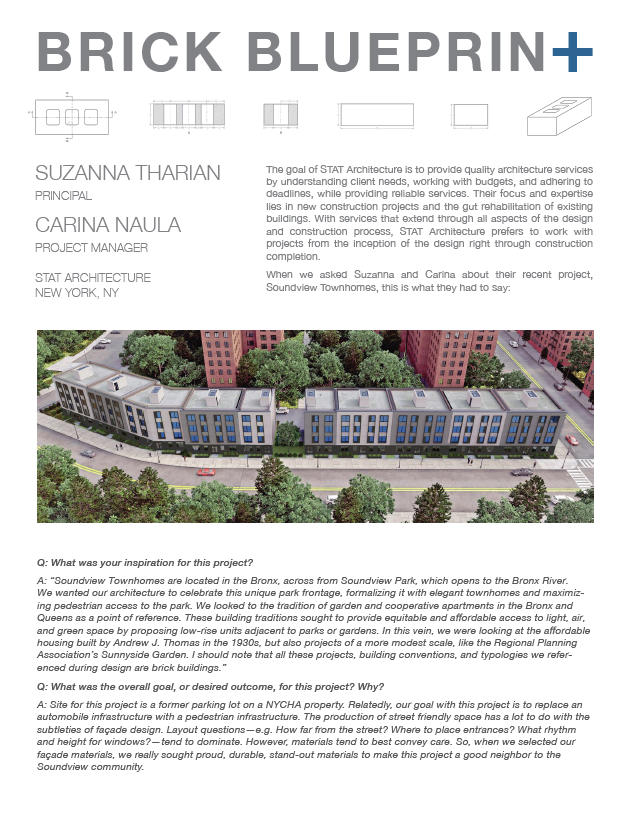
The goal of STAT Architecture is to provide quality architecture services by understanding client needs, working with budgets, and adhering to deadlines, while providing reliable services. Their focus and expertise lies in new construction projects and the gut rehabilitation of existing buildings. With services that extend through all aspects of the design and construction process, STAT Architecture prefers to work with projects from the inception of the design right through construction completion.
When we asked Suzanna and Carina about their recent project, Soundview Townhomes, this is what they had to say:
Q: What was your inspiration for this project?
A: Soundview Townhomes are located in the Bronx, across from Soundview Park, which opens to the Bronx River. We wanted our architecture to celebrate this unique park frontage, formalizing it with elegant townhomes and maximizing pedestrian access to the park. We looked to the tradition of garden and cooperative apartments in the Bronx and Queens as a point of reference. These building traditions sought to provide equitable and affordable access to light, air, and green space by proposing low-rise units adjacent to parks or gardens. In this vein, we were looking at the affordable housing built by Andrew J. Thomas in the 1930s, but also projects of a more modest scale, like the Regional Planning Association’s Sunnyside Garden. I should note that all these projects, building conventions, and typologies we referenced during design are brick buildings.
Q: What was the overall goal, or desired outcome, for this project? Why?
A: Site for this project is a former parking lot on a NYCHA property. Relatedly, our goal with this project is to replace an automobile infrastructure with a pedestrian infrastructure. The production of street friendly space has a lot to do with the subtleties of façade design. Layout questions—e.g. How far from the street? Where to place entrances? What rhythm and height for windows?—tend to dominate. However, materials tend to best convey care. So, when we selected our façade materials, we really sought proud, durable, stand-out materials to make this project a good neighbor to the Soundview community.
Q: Why did you choose brick for this project? How important is material to your approach?
A: Clients, neighbors, preservationists all seem to like brick best. Brick converses easily with New York’s historic fabric and the local authorities in the Bronx were also very keen on brick. Building practices are an evolving set of conventions. Buildings aren’t made the way they used to be, but neither are bricks. Buildings and aesthetics evolve in parallel conversations between builders, producers, designers, and the public. Our office has been working for 20 years with Sal Pate at Consolidated Brick. From Sal, we learn not just the cost of various bricks, but where and how they were made. All these aspects are important to us as designers. The manufacturing processes and location tell us about the embodied carbon cost of the materials we choose, while finish and color communicate contextuality and care.
Q: What features of brick are most important to you? What made you choose Glen-Gery?
A: For any material, our first priority is due diligence regarding its health and carbon cost. When it comes to aesthetics, the biggest differentiator is the finish texture. Some bricks can look clay-like and awkward, but we’ve had a lot of good experiences with Glen-Gery. It’s a reliable and attractive brick. Your team is very skilled at emulating the molded brick look that gives a project that majestic old New York feeling we all look for.
Q: Why did you select Sioux City product?
A: To be honest: color. We pick out bricks in person. We browse the showroom, pull things we like and put them all up on the wall. Ebonite smooth literally sparkled. We needed an attractive base; ebonite was an easy choice. We choose to complement it with glacier gray which is buff brick speckled with blues and creams.
You May Also Be Interested In
We Can Help With Your Next Project
Discover the latest + greatest in design trends, industry news & pro tips from pros.
For all of your project needs, you’ll find everything you need at a Supply Center.
Let Us Know How We Can Help!
Brick Blueprint with OOMBRA ARCHITECTS
Philadelphia, PA
Architecture Firm
OOMBRA ARCHITECTSProducts
Belgian Grey Wirecut, Silver City Wirecut, 90 L Corner [Custom], Exterior 161 Corner [Custom], Exterior 168 Corner [Custom]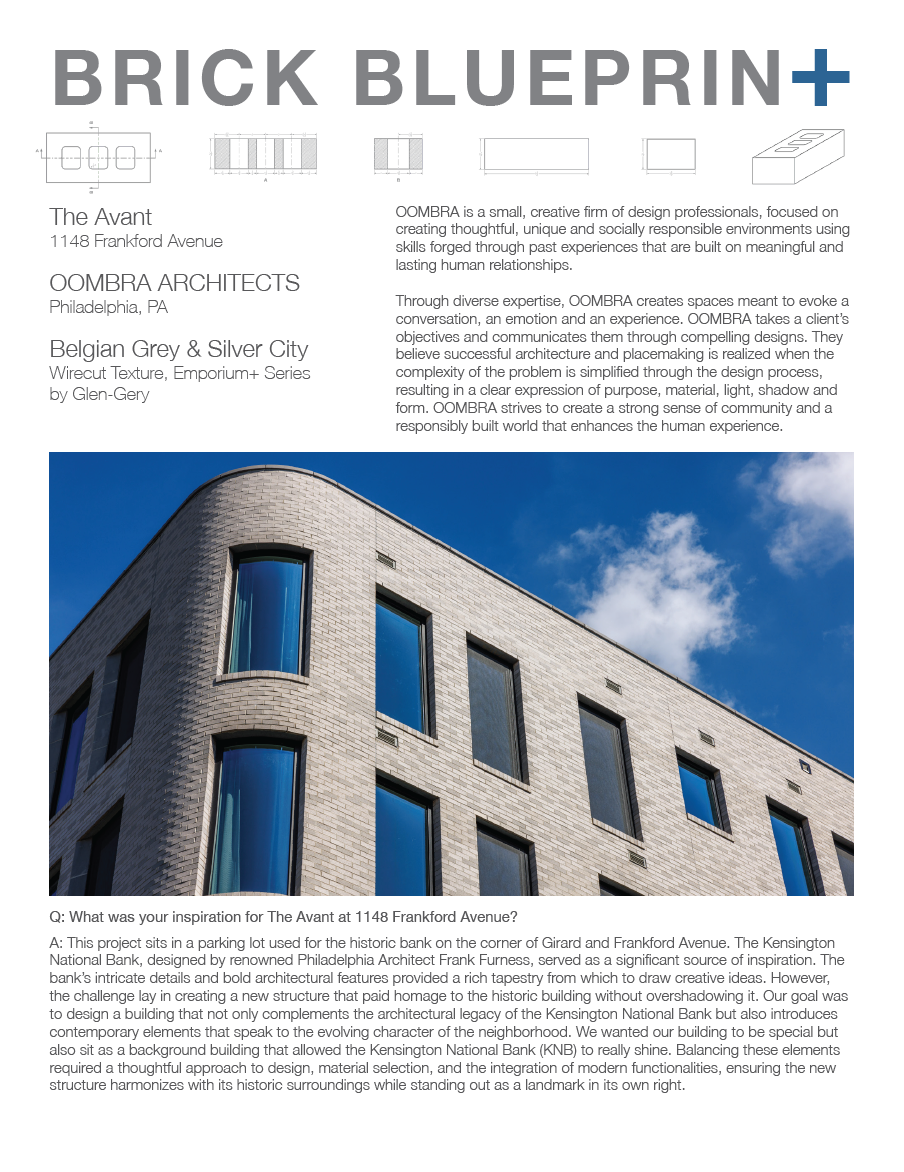
OOMBRA is a small, creative firm of design professionals, focused on creating thoughtful, unique and socially responsible environments using skills forged through past experiences that are built on meaningful and lasting human relationships.
Through diverse expertise, OOMBRA creates spaces meant to evoke a conversation, an emotion and an experience. OOMBRA takes a client’s objectives and communicates them through compelling designs. They believe successful architecture and placemaking is realized when the complexity of the problem is simplified through the design process, resulting in a clear expression of purpose, material, light, shadow and form. OOMBRA strives to create a strong sense of community and a responsibly built world that enhances the human experience.
Q: What was your inspiration for The Avant at 1148 Frankford Avenue?
A: This project sits in a parking lot used for the historic bank on the corner of Girard and Frankford Avenue. The Kensington National Bank, designed by renowned Philadelphia Architect Frank Furness, served as a significant source of inspiration. The bank's intricate details and bold architectural features provided a rich tapestry from which to draw creative ideas. However, the challenge lay in creating a new structure that paid homage to the historic building without overshadowing it. Our goal was to design a building that not only complements the architectural legacy of the Kensington National Bank but also introduces contemporary elements that speak to the evolving character of the neighborhood. We wanted our building to be special but also sit as a background building that allowed the Kensington National Bank (KNB) to really shine. Balancing these elements required a thoughtful approach to design, material selection, and the integration of modern functionalities, ensuring the new structure harmonizes with its historic surroundings while standing out as a landmark in its own right.
Q: What was the overall goal, or desired outcome, for this project?
A: The overall goal for The Avant project was to create a design that both respects and complements the historic architecture of the Kensington National Bank. OOMBRA aimed to integrate modern elements with classic details to create a timeless piece that contributes to the neighborhood's architectural heritage while providing contemporary functionality. Another goal was to keep the project within budget, meet and exceed the client's expectations, and ensure the building ultimately met the needs of the end users.
Q: Why did you choose brick for this project? How important is material to your approach?
A: At OOMBRA, we love using brick for its historical relevance, ease of use, and the knowledge of building by local trades. Additionally, brick has a relatively known cost and experienced less fluctuation during the pandemic. Brick was chosen for its enduring appeal, historical significance, and versatility. In architecture, material selection is crucial as it influences the aesthetic, durability, and contextual relevance of the building. For The Avant, brick helps bridge the gap between the historic bank and the new structure, ensuring a cohesive visual narrative.
Q: What interested you most while designing this project?
A: The most intriguing aspect of designing this project was the challenge of balancing respect for the historic architectural elements with the desire to create a contemporary and functional space. This duality required innovative design solutions and a deep appreciation for the site's historical context. Additionally, at OOMBRA, we have a wealth of experience in designing housing, making this project a particularly good fit for our expertise and interests.
Q: What features of brick are most important to you? What made you choose Glen-Gery?
A: The key features of brick that stand out include its durability, aesthetic flexibility, and low maintenance. Glen-Gery was chosen for their high-quality products, wide range of colors and textures, and their commitment to sustainability, which aligns with OOMBRA's values.
Q: What made this design process different from others you have worked on?
A: This project was unique due to its strong historical context and the need to seamlessly integrate modern design elements without overshadowing the historic bank. Additionally, there were challenges in fitting a residential building on such a tight footprint where a typical 60' double-loaded corridor building would not fit. We had to be creative and used our "OOMBRA LT Studio ©" unit that allowed the building footprint to be reduced by 21' in width. This project was also a bit of a full circle moment for our firm, as we opened our first bank account for OOMBRA in this Wells Fargo Bank. Phase 2 of the project is currently under construction to add another 5 residential units to the second floor of the historic bank and a commercial space on the ground floor.
Q: What is a typical timeline for a project of this scale?
A: A typical project of this scale takes about 8 months to design and a year to construct, but this took a little longer with the supply chain issues and construction cost increases that occurred during the pandemic. The building was completed in the Fall of 2023. It houses 60 apartments and a retail space, including the relocation of the Wells Fargo bank from the KNB building into the new building along the corner of Girard Avenue and Dunton Street. Moreover, the collaboration and commitment from our project team and the clients, Alterra/HK Partners, were instrumental in overcoming these challenges and achieving the project's goals.
Q: Has this project won any awards?
A: The Avant project won an AIA Philadelphia Honor Award in 2022 in the Unbuilt category, recognizing its innovative design and successful integration with the historic bank.
You May Also Be Interested In
We Can Help With Your Next Project
Discover the latest + greatest in design trends, industry news & pro tips from pros.
For all of your project needs, you’ll find everything you need at a Supply Center.
Let Us Know How We Can Help!
Brick Blueprint with Architecture Plus Information
New York, NY
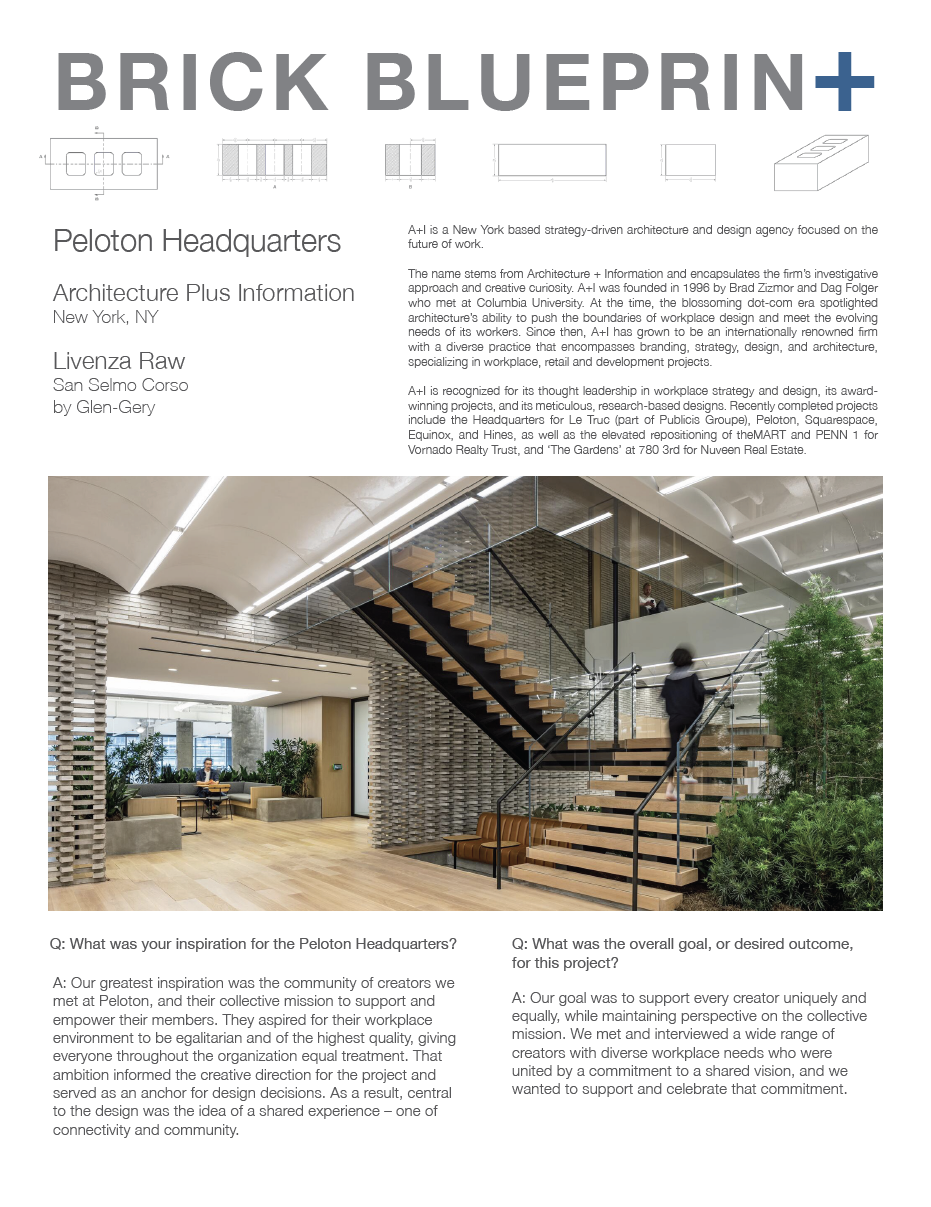
A+I is a New York based strategy-driven architecture and design agency focused on the future of work.
The name stems from Architecture + Information and encapsulates the firm’s investigative approach and creative curiosity. A+I was founded in 1996 by Brad Zizmor and Dag Folger who met at Columbia University. At the time, the blossoming dot-com era spotlighted architecture’s ability to push the boundaries of workplace design and meet the evolving needs of its workers. Since then, A+I has grown to be an internationally renowned firm with a diverse practice that encompasses branding, strategy, design, and architecture, specializing in workplace, retail and development projects.
A+I is recognized for its thought leadership in workplace strategy and design, its award-winning projects, and its meticulous, research-based designs. Recently completed projects include the Headquarters for Le Truc (part of Publicis Groupe), Peloton, Squarespace, Equinox, and Hines, as well as the elevated repositioning of theMART and PENN 1 for Vornado Realty Trust, and ‘The Gardens’ at 780 3rd for Nuveen Real Estate.
Q: What was your inspiration for the Peloton Headquarters?
A: Our greatest inspiration was the community of creators we met at Peloton, and their collective mission to support and empower their members. They aspired for their workplace environment to be egalitarian and of the highest quality, giving everyone throughout the organization equal treatment. That ambition informed the creative direction for the project and served as an anchor for design decisions. As a result, central to the design was the idea of a shared experience – one of connectivity and community.
Q: What was the overall goal, or desired outcome, for this project?
A: Our goal was to support every creator uniquely and equally, while maintaining perspective on the collective mission. We met and interviewed a wide range of creators with diverse workplace needs who were united by a commitment to a shared vision, and we wanted to support and celebrate that commitment.
Q: Why did you choose brick for this project? How important is material to your approach?
A: We chose brick after a thorough material research phase for a central “spine” wall that connects every floor of the project through a shared open space. We needed a material that would be constructed through aggregation, a process in which countless individual elements are combined to create an effect greater than its parts. In this way, the wall became an embodiment of our architectural mission.
Q: What interested you most while designing this project?
A: We spent a lot of time engineering a system for the brick wall that could achieve the complex stacking and rotating pattern we designed. This pattern was developed in response to Peloton’s branding collateral, which uses similar gradient patterns to express dynamic movement, appropriate for this active and stacked space.
Q: What features of brick are most important to you? What made you choose Glen-Gery?
A: In addition to its construction logic, we chose Livenza Raw for its tactile qualities and variation in color and texture. For the desired effect to be achieved, each individual unit in the wall needed to have a distinct and “handmade” quality that set it apart.
Q: What made this design process different from others you have worked on?
A: Because of the complexity inherent in the design, there was a lot of back and forth between the overall design intent of the wall and the details built into each brick. This feedback loop between scales is different from other materials and led to the success of the end result.
Q: What is a typical timeline for a project of this scale?
A: For a project of this scale, the timeline varies greatly depending on a number of factors, from the extent of the strategic interrogation to the complexity of the design. A+I carefully designs the approach and schedule for a project based on our client’s unique needs and desires. On average, a project of this kind takes approx. 18-24 months.
Q: Has this project won any awards?
A: SARA National Design Awards 2022, Fitwel Impact Award 2022 (“Highest Scoring Project of All Time”)
Project Team
Phil Ward, Peter Knutson, Sohee Moon, Chris Shelley, Hannah Lee, Vané Broussard, Nico Martin, Maria Lozano, Anjali Patel, Catalina Rivera, Jara Mira, Josipa Baricevic, Katherine Salamat
You May Also Be Interested In
We Can Help With Your Next Project
Discover the latest + greatest in design trends, industry news & pro tips from pros.
For all of your project needs, you’ll find everything you need at a Supply Center.
Let Us Know How We Can Help!
Brick Blueprint with DS Architecture
Cleveland, OH
Architecture Firm
DS ArchitectureDirector of Design
Eric F. ProsDistributor
The Thomas Brick Company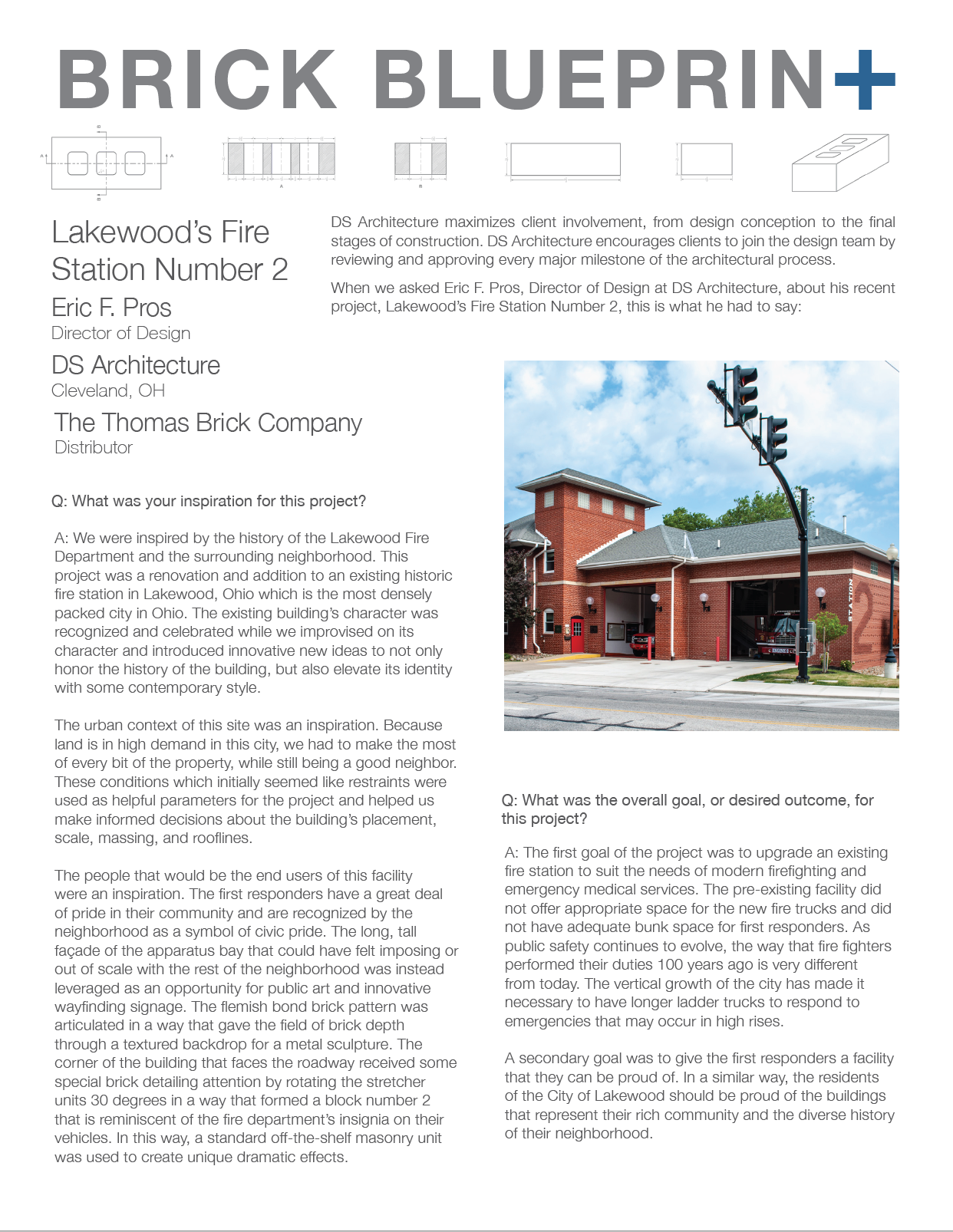
DS Architecture maximizes client involvement, from design conception to the final stages of construction. DS Architecture encourages clients to join the design team by reviewing and approving every major milestone of the architectural process.
When we asked Eric F. Pros, Director of Design at DS Architecture, about his recent project, Lakewood’s Fire Station Number 2, this is what he had to say:
Q: What was your inspiration for this project?
A: We were inspired by the history of the Lakewood Fire Department and the surrounding neighborhood. This project was a renovation and addition to an existing historic fire station in Lakewood, Ohio which is the most densely packed city in Ohio. The existing building’s character was recognized and celebrated while we improvised on its character and introduced innovative new ideas to not only honor the history of the building, but also elevate its identity with some contemporary style.
The urban context of this site was an inspiration. Because land is in high demand in this city, we had to make the most of every bit of the property, while still being a good neighbor. These conditions which initially seemed like restraints were used as helpful parameters for the project and helped us make informed decisions about the building’s placement, scale, massing, and rooflines.
The people that would be the end users of this facility were an inspiration. The first responders have a great deal of pride in their community and are recognized by the neighborhood as a symbol of civic pride. The long, tall façade of the apparatus bay that could have felt imposing or out of scale with the rest of the neighborhood was instead leveraged as an opportunity for public art and innovative wayfinding signage. The flemish bond brick pattern was articulated in a way that gave the field of brick depth through a textured backdrop for a metal sculpture. The corner of the building that faces the roadway received some special brick detailing attention by rotating the stretcher units 30 degrees in a way that formed a block number 2 that is reminiscent of the fire department’s insignia on their vehicles. In this way, a standard off-the-shelf masonry unit was used to create unique dramatic effects.
Q: What was the overall goal, or desired outcome, for this project?
A: The first goal of the project was to upgrade an existing fire station to suit the needs of modern firefighting and emergency medical services. The pre-existing facility did not offer appropriate space for the new fire trucks and did not have adequate bunk space for first responders. As public safety continues to evolve, the way that fire fighters performed their duties 100 years ago is very different from today. The vertical growth of the city has made it necessary to have longer ladder trucks to respond to emergencies that may occur in high rises.
A secondary goal was to give the first responders a facility that they can be proud of. In a similar way, the residents of the City of Lakewood should be proud of the buildings that represent their rich community and the diverse history of their neighborhood.
Q: Why did you choose brick for this project? How important is material to your approach?
A: There are many reasons why brick made sense for this project. There is a sense of symbology for the fire stations to be constructed of brick. Red brick is somewhat synonymous with fire stations and contributes to their iconic presence in communities. “Fireproof” buildings constructed predominantly with masonry became popular and embraced by fire departments.
Because fire stations are public buildings that are occupied 24 hours a day and often maintained by the crew, low maintenance materials, like brick, are preferable. The long-term durability of fired clay masonry products makes them a good investment for such buildings. The longevity of this material ensures that the building will be a building that the City of Lakewood can be proud of for many years to come.
Material choices greatly impact the perception of a building by the public. As a symbol of safety and civic pride, this fire station needs to evoke a sense of stability and permanence. Glen-Gery brick effectively communicates these ideas in a way that not only fits into its historic context but suggests a long-lasting presence.
Q: What interested you most while designing this project?
A: The people that would be using this building 24 hours a day, 7 days a week are really what this project kept coming back to. Providing a sense of dignity for the first responders that keep the City of Lakewood safe are what this project is all about.
The ability to collaborate with local artist Scott Goss on his metal sculpture installation was truly an honor. The building itself is focused on many of the practical considerations for a fire department, but Scott’s “Shielded Together” installation takes the building a step further and truly pays tribute to the men and women who have dedicated their lives to service. The metal sculpture is highly visible and is lit at night so that it can be appreciated around the clock.
Q: What features of brick are most important to you? What made you choose Glen-Gery?
A: Each project is unique, and every masonry application presents opportunities for innovation. In this project, finding a brick that matched the historic color and texture was our first challenge. Thankfully, Glen-Gery’s robust catalog of clay colors and textures allowed us to have several options to consider that were very close to the original brick from 1919, and the later addition. We were fortunate enough to test several sample panels in natural light next to the existing brick to see which option would give us the best match. Our final selection was Wavetex Red Bark. This brick perfectly complements the existing brick from a century ago. Additionally, because we were using brick in some unique ways with multiple faces exposed to the exterior, finding the right texture that would receive light correctly was critical to the success of the project.
The quality that Glen-Gery provides is an additional reason for our selection. The long-term endurance of the material gives the owners of the building a particular level of comfort because masonry is known for its resilience. On the design side of the equation, the brick’s quality is an added benefit.
Q: What made this design process different from others you have worked on?
A: This project presented several challenges, and seemingly limited opportunities for innovative solutions. A collaborative design process with the client and our team helped to streamline the design process and established goals. Where our innovation came into play was in how we treated the material and the installation that made this project truly unique.
Special care was given during the design phase to enable the project to be built while the facility can serve its primary purpose of serving the community. It’s not uncommon for public buildings to remain operational while a capital improvement project is underway, but this project proved to be more challenging since there was minimal extra space on site. The builders worked diligently to keep the construction from interfering with the spaces needed for the firefighters to perform their duties.
Q: How did you utilize the International Masonry Institute (IMI) for this project, and what was your experience like?
A: The IMI is an incredible resource for designers and contractors. They provide technical expertise on proper masonry detailing and installation and advice on unique designs. The Ohio Regional Director is Tom Elliott, and I owe him a great deal of gratitude for his knowledge and dedication to masonry design over the years. The IMI partners with local BAC training centers to provide hands on training for masonry apprentices and continued educational opportunities for skilled craftworkers.
Once we had developed a design, I reached out to Tom to get his feedback on our concept. We reviewed the details together and decided this project could benefit from a full-scale mockup. I generated some drawings of the brick detail that we were working on that not only showed the detail in elevation and isometrics, but also a course-by-course series of plans that allowed the craftworkers the ability to easily understand the design intent at each course. The bricklayers knew exactly which units needed to be solid or cored, and which ones were to be rotated 30 degrees. Although we shrunk the overall scale of the detail down vertically for safety reasons in the training center, the intent of the design was appreciated.
Q: What is a typical timeline for a project of this scale?
A: The scope of this project was well defined from the beginning which allowed us to streamline the process into 2 distinct phases. This scope of work also allowed the contractors to construct the project while keeping the station fully operational during construction with limited interruptions to their service. The design timeline was approximately 8 months with the construction duration taking nearly 12 months due to the unique phasing of the project and sensitivity to keeping the facility operational.
Q: Has this project won any awards?
A: The Lakewood Fire Station Number 2 was recognized in the 2022 JBC Masonry Innovation Competition through the International Masonry Institute (IMI).
You May Also Be Interested In
We Can Help With Your Next Project
Discover the latest + greatest in design trends, industry news & pro tips from pros.
For all of your project needs, you’ll find everything you need at a Supply Center.
Let Us Know How We Can Help!
Ebonite Smooth, Glacier Gray Western