Favorites
SKE+CHED with Design Collective
SKE+CHED ft. Design Collective
Be inspired and dive deeper into the thought process behind Alyse Talbott's work on Solaire 8200 Dixon, in the Ripley 2 district of Baltimore, Maryland.
Solaire 8200 Dixon
Custom Klaycoat Blends
View MoreYou May Also Be Interested In
We Can Help With Your Next Project
Discover the latest + greatest in design trends, industry news & pro tips from pros.
For all of your project needs, you’ll find everything you need at a Supply Center.
Let Us Know How We Can Help!
SKE+CHED with Stantec
SKE+CHED ft. Stantec
Be inspired and dive deeper into the thought process behind Jennifer Grafton's work on the Northeast Community Propel Academy, in the School District of Philadelphia.
Northeast Community Propel Academy
Custom Klaycoat Blend
View MoreYou May Also Be Interested In
We Can Help With Your Next Project
Discover the latest + greatest in design trends, industry news & pro tips from pros.
For all of your project needs, you’ll find everything you need at a Supply Center.
Let Us Know How We Can Help!
SKE+CHED with Richard Wengle Architects
SKE+CHED ft. Richard Wengle Architects
Be inspired and dive deeper into the thought process behind Richard Wengle's custom molded brick residences in the Toronto area.
You May Also Be Interested In
We Can Help With Your Next Project
Discover the latest + greatest in design trends, industry news & pro tips from pros.
For all of your project needs, you’ll find everything you need at a Supply Center.
Let Us Know How We Can Help!
Glazed Brick
To create the unmistakable look of Glazed brick, a glaze is applied to the outer surface of extruded clay and carefully fired, allowing an unlimited long-lasting color range and variation of textures from glass smooth to speckled and rough.
You May Also Be Interested In
We Can Help With Your Next Project
Discover the latest + greatest in design trends, industry news & pro tips from pros.
For all of your project needs, you’ll find everything you need at a Supply Center.
Let Us Know How We Can Help!
Klaycoat Brick
When you build with Glen-Gery Klaycoat®, color is more than just a finishing touch. It’s a focal point that takes any project from “okay” to “outstanding.” That’s inevitable when you have the opportunity to customize the color of your project in an unexpected way to meet any ask and exceed every expectation.
You May Also Be Interested In
We Can Help With Your Next Project
Discover the latest + greatest in design trends, industry news & pro tips from pros.
For all of your project needs, you’ll find everything you need at a Supply Center.
Let Us Know How We Can Help!
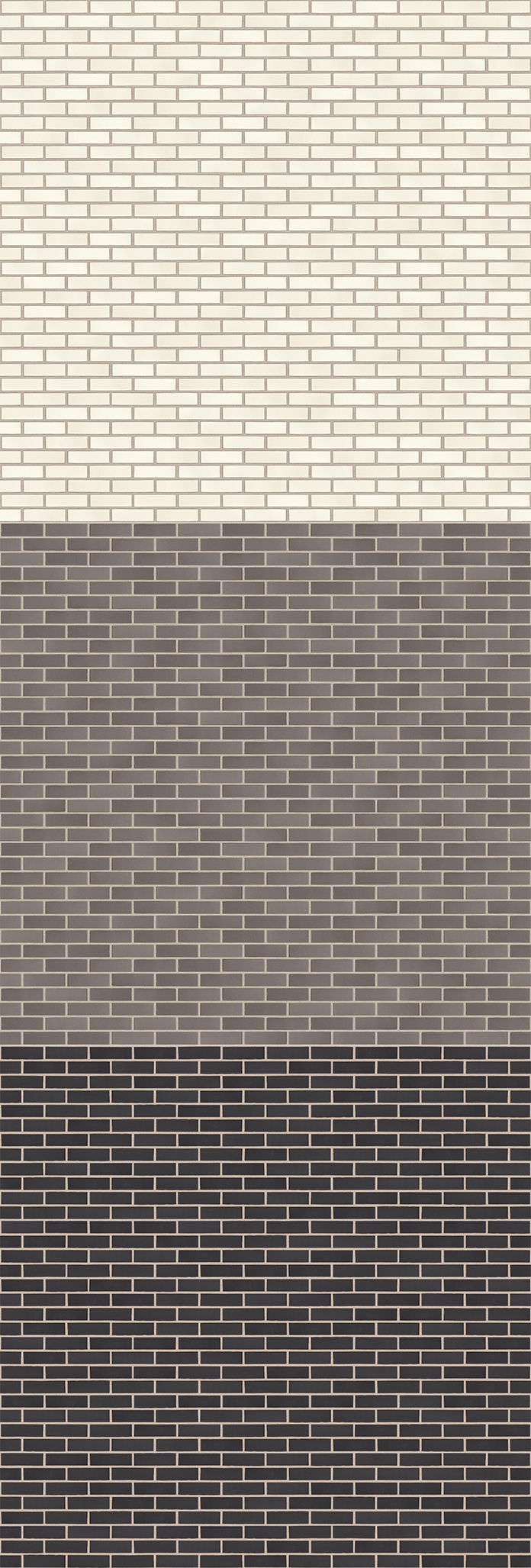
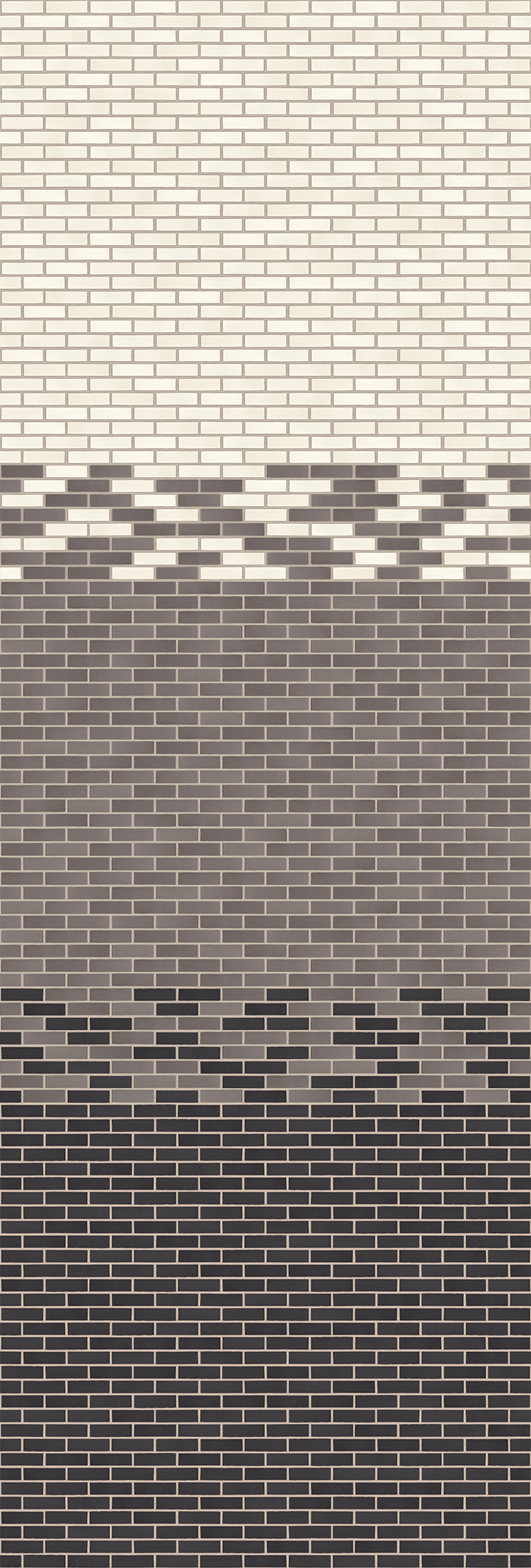
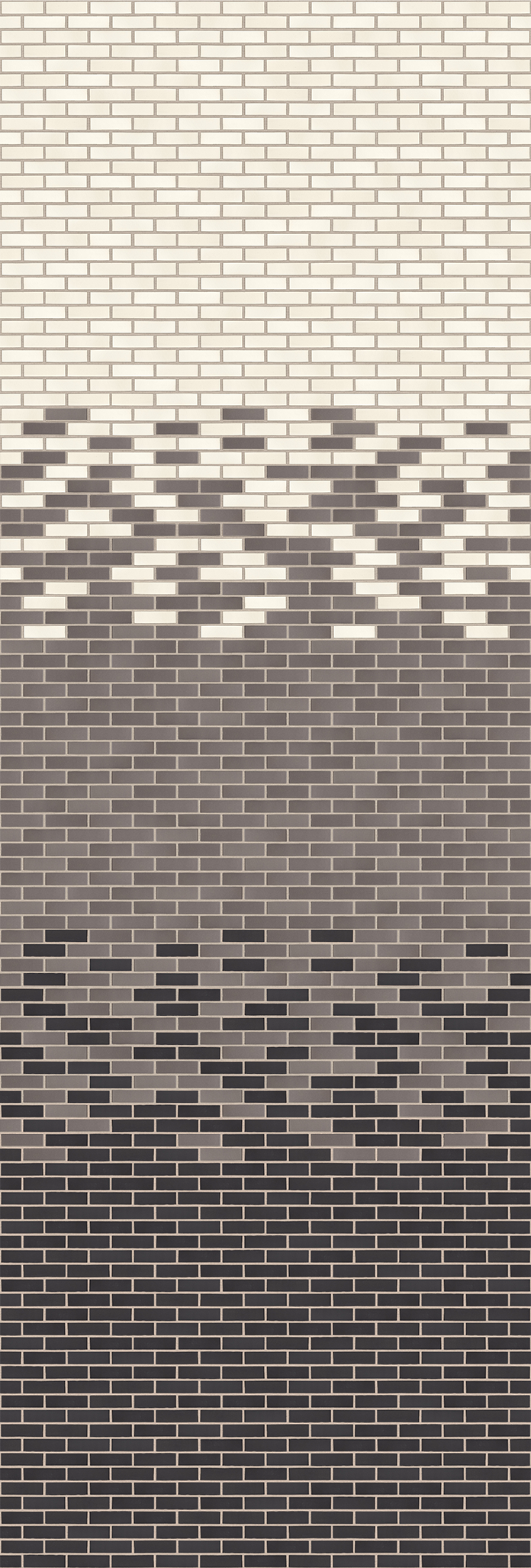
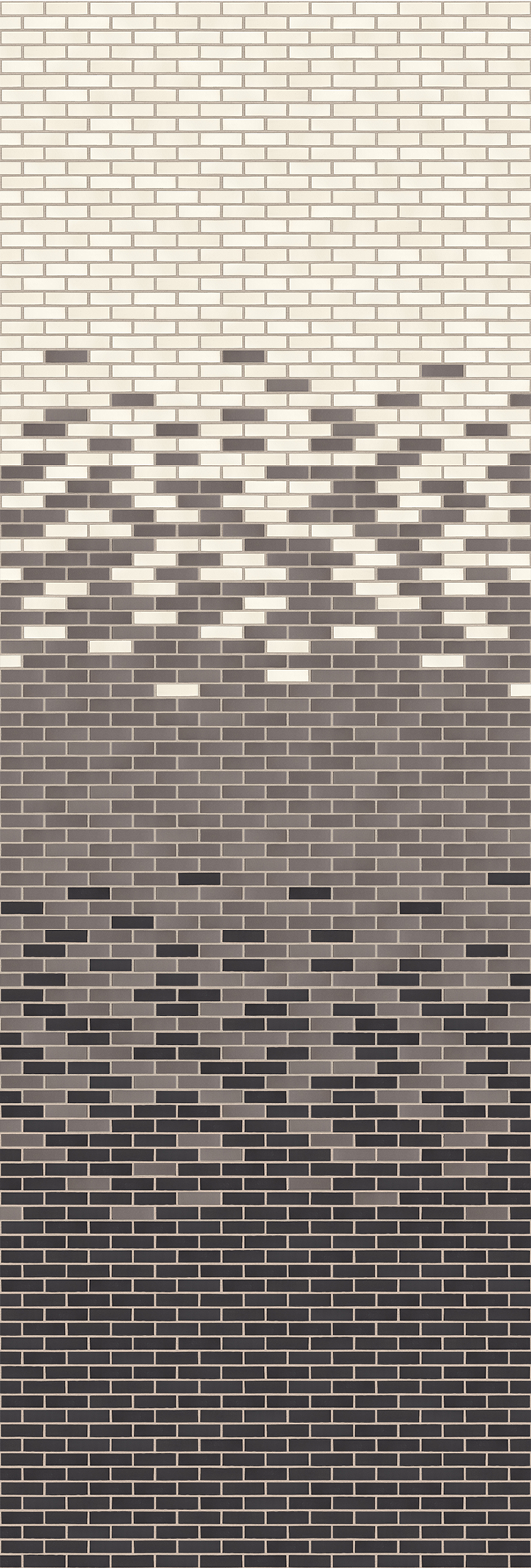
Gradient Brick Blends
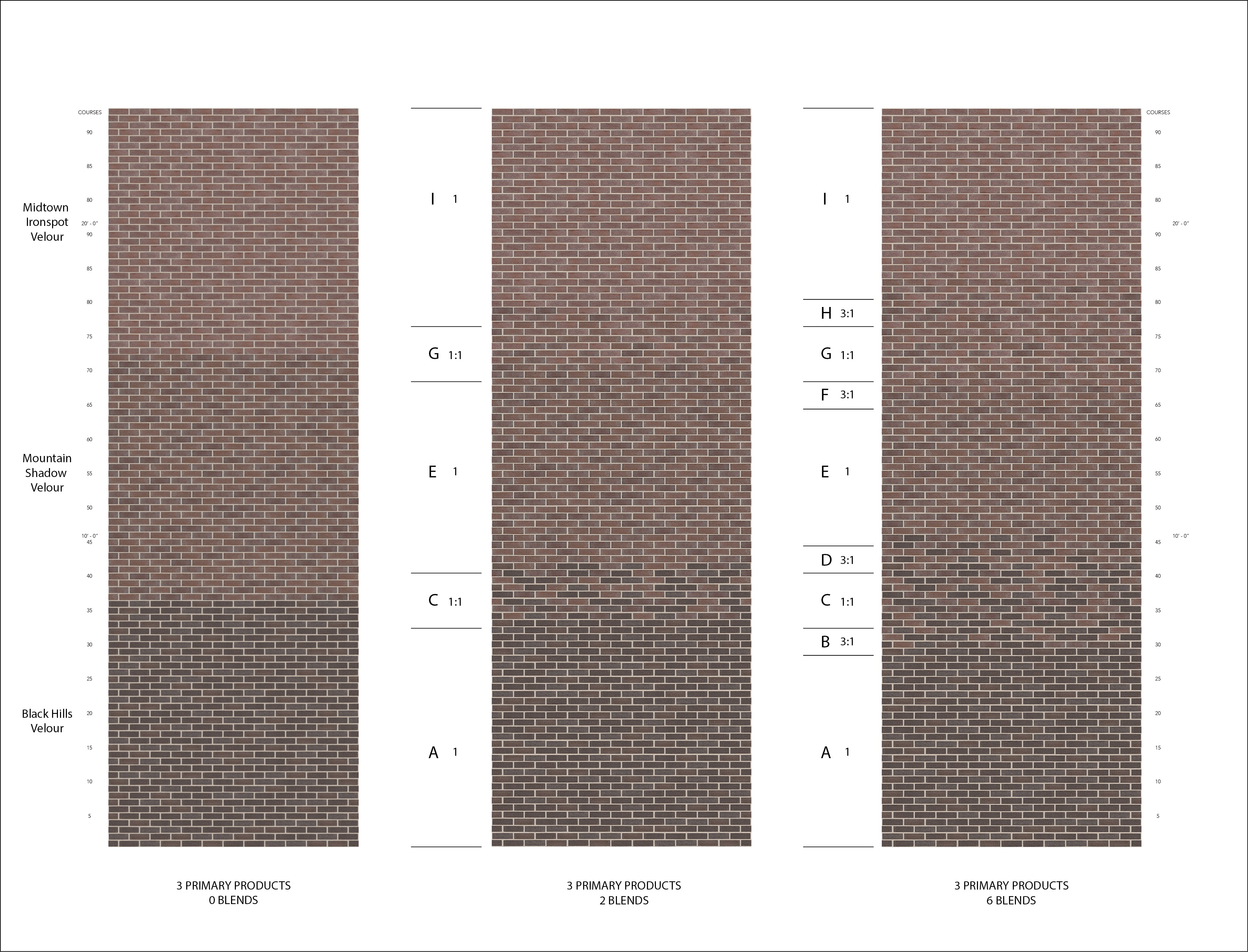
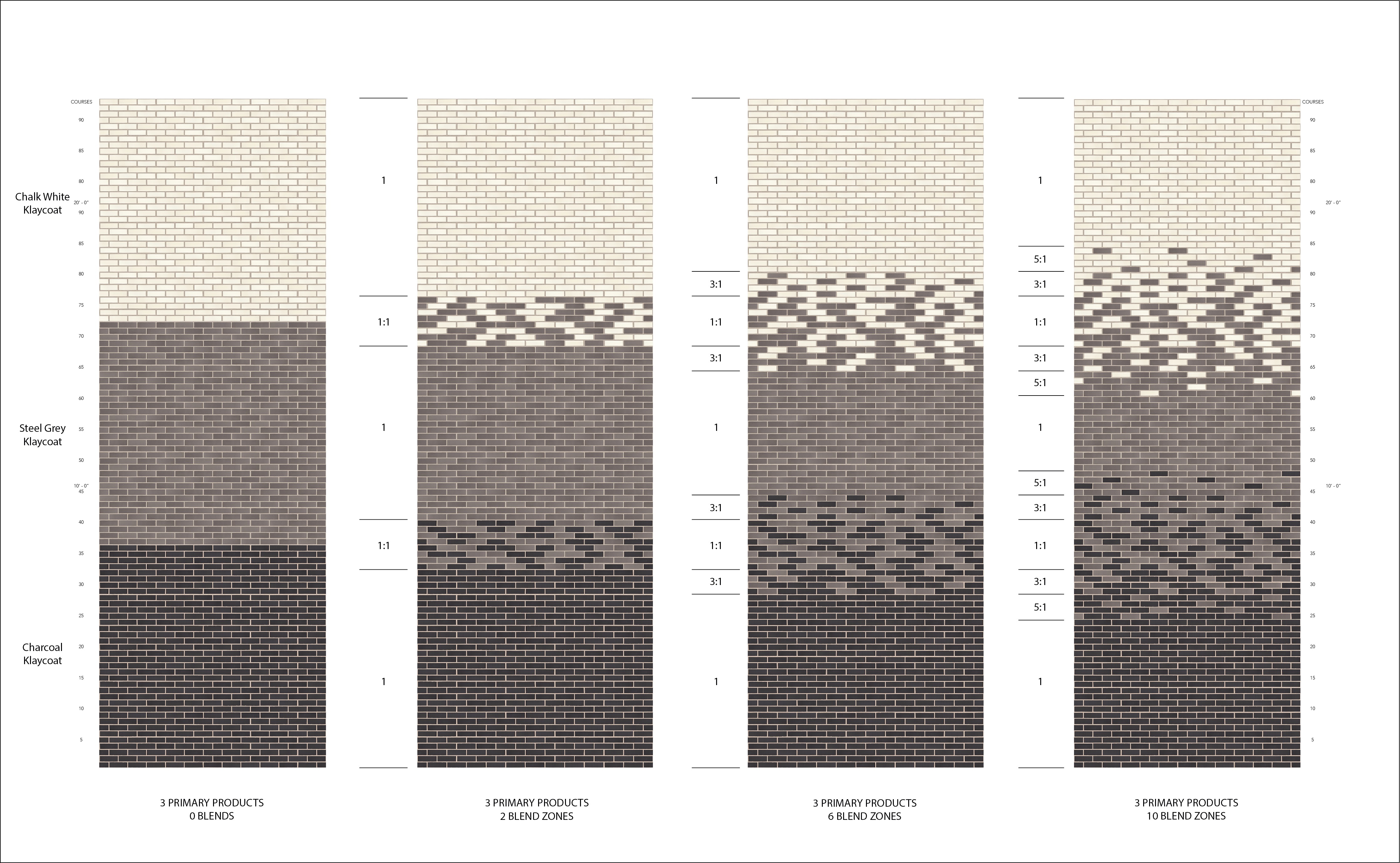
Using Gradient Brick Blends in an Architectural Project
Brickwork is a timeless element in architecture that can create a distinctive character for any building. Incorporating gradient brick blends in an architectural project can add a unique aesthetic element. Gradation can be achieved through blending bricks of different colors, textures, or sizes. This technique can create a striking visual effect, such as a smooth transition from one color to another, or a subtle variation within a single color family.
In addition to aesthetic benefits, gradient brick blends can enhance the functionality of a building. For instance, blending darker bricks near the base of a building can provide better durability, while lighter shades at the top can reflect more sunlight and reduce heat absorption.
When laying the bricks, it's important to follow the manufacturer's instructions for the specific blend. Typically, these bricks are laid in a random pattern to achieve a natural look. The gradual color transition creates a sense of depth and texture, adding dimension to the project.
Using gradient brick blends can elevate any design, creating a unique and cohesive look. Whether you're designing a single story or a multi-level structure, consider incorporating this technique to add a touch of artistry and sophistication to your project.
|
|
|
|
You May Also Be Interested In
We Can Help With Your Next Project
Discover the latest + greatest in design trends, industry news & pro tips from pros.
For all of your project needs, you’ll find everything you need at a Supply Center.
Let Us Know How We Can Help!
Design Vault Ep. 29 29 Huron with Vicente Quiroga
ABOUT THE ARCHITECT:

|
Vicente is a project manager with over 10 years of experience and a diverse portfolio encompassing various building typologies, the restoration of historic structures, complex interior layouts, and both public and private work. He is currently managing the construction administration of 1 Huron—a 266,000-square-foot multifamily building with ground-floor retail and a generous package of high-end amenities located along the East River within Brooklyn’s Greenpoint neighborhood. Based on his involvement in the design of the project, Vicente has an intimate understanding of New York City's building codes and requirements related to waterfront development and building within flood zones. |
|---|
ABOUT THE PROJECT:
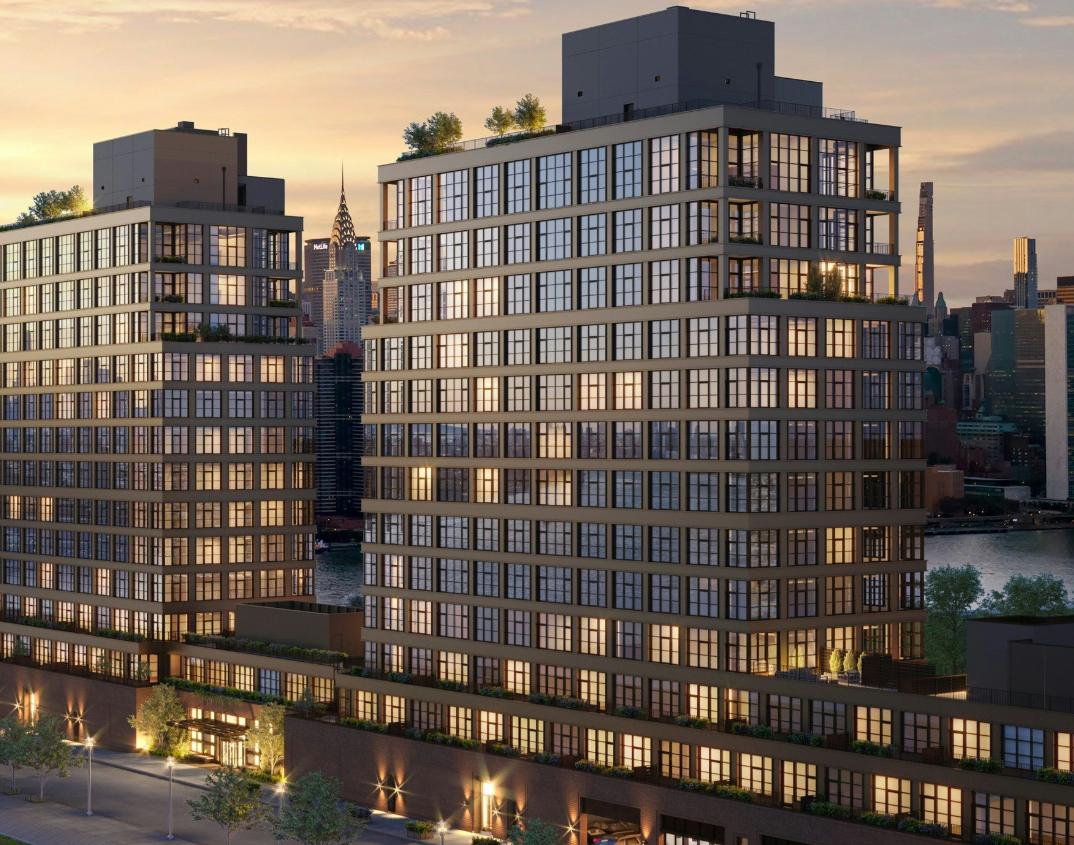
The building is defined by 2 13 story towers connected by a shared lobby whose step forms narrow on the higher floors. The two tower massing maximizes unobstructed views across the East River, taking advantage of its exceptional waterfront location. Due to the building's location in a flood zone, Morris Adjmi coordinated closely with consultants to provide active flood protection solutions such as deployable flood barriers, temporary stairs, flood vents and flood resistant glazing at storefronts. Located within the building's podium, many of the Huron's amenity spaces fall within the design flood elevation, including the indoor pool. Flood resistant glazing within these spaces maintains transparency. The building's glass and steel towers reflect Greenpoint's industrial heritage, while the rough brick podium is inspired by the materials and scale of surrounding warehouses. The heavily gridded facade is comprised of a window wall system featuring I-beam profiles on the pillars.
TRANSCRIPT
00;00;00;02 - 00;00;05;10
Doug Pat (DP)
Let's go inside the vault. The design vault.
00;00;05;12 - 00;00;31;14
Vincente Quiroga (VQ)
We actually decided early on that we would adopt the one story podium and also set back sooner than we actually needed to. It increases the lighting there allows for breezes that blow through. It also allows for multiple outdoor terracing to happen. So those units that aren't particularly high and don't have the same views can step out onto your terrace and see the water.
And so really maximizes the value and effectiveness and the quality of those spaces.
00;00;31;16 - 00;01;05;23
DP
This is my guest, Vicente Quiroga. I'll share more about him shortly. In this episode from the Design Vault we highlight, Vicente’s project 29 Huron in Greenpoint, Brooklyn. The Huron is a mixed use multifamily 13 story 266,000 square foot building with ground floor retail and high end amenities. In order to account for the narrow site geometry and flood zone, multiple massing schemes were studied with an objective to maximize height and floor area distribution and prioritize views.
The building is defined by 2 13 story towers connected by a shared lobby whose step forms narrow on the higher floors. The two tower massing maximizes unobstructed views across the East River, taking advantage of its exceptional waterfront location. Due to the building's location in a flood zone, Morris Adjmi coordinated closely with consultants to provide active flood protection solutions such as deployable flood barriers, temporary stairs, flood vents and flood resistant glazing at storefronts. Located within the building's podium, many of the Huron's amenity spaces fall within the design flood elevation, including the indoor pool. Flood resistant glazing within these spaces maintains transparency. The building's glass and steel towers reflect Greenpoint's industrial heritage, while the rough brick podium is inspired by the materials and scale of surrounding warehouses. The heavily gridded facade is comprised of a window wall system featuring I-beam profiles on the pillars.
Hi, I'm Doug Pat and this is Design Vault. Vicente is a registered architect and project manager at Morris Adjmi Architects in New York City. He holds a Bachelor of Arts in Architecture from New York University and a master of architecture from the City College of New York. He has a diverse portfolio encompassing various building types, such as historic renovations, interiors, hotels, art exhibition spaces, educational facilities and high end residential buildings in the Northeast, the United Kingdom and Spain.
Vicente also has a broad and unique understanding of New York City's building codes and requirements related to waterfront development and building within flood zones. He's currently managing the Construction Administration of 1 Huron on a 266,000 square foot multifamily building along the East River in Brooklyn's Greenpoint neighborhood. Prior to joining Maurice and me, Vicente worked on public restoration projects for the New York City School Construction Authority and the New York City Department of Design and Construction.
So welcome, Vincente. It's nice to have you with us today. Now, for those of you listening who have not heard our interview with Michelle Wagner from Morris Adjmi during the first season. Vicente, could you tell us a little bit about the firm? So where are you guys located? What's the size of the firm? How long has it been around and what kind of work do you do?
00;03;38;11 - 00;04;12;25
VQ
We're based in New York City, near the financial district and Wall Street. We also have a New Orleans office as well, because Morris is originally from there. So we have a broad practice, decades of experience, really working first in New York, and particularly in landmark districts and contexts as well as broadening that to sort of a national practice and also very holistic practice involving urban design, placemaking architecture, interiors, furniture and art services.
The New York office is approximately 70 people, and I think we have about 10 to 20 people in the office as well.
00;04;12;27 - 00;04;18;07
DP
So how long have you been with Morris Adjmi? How long have you been a registered architect and what do you do there?
00;04;18;10 - 00;04;58;00
VQ
So I've worked for about six years there and I've been a registered architect for 12 to 13 years in practice. Prior to that, over 15 years of experience since graduate school. So my role is project manager and flex project architect position, just really responsible for anything and everything to do with the project from client management, coordination, staffing, everything, being accountable for the project throughout the life of it.
And this one in particular has been special because, you know, in a large practice you often inherit projects or people come and go. This project for me has been involved since day zero through completion, so it's very special to me.
00;04;58;07 - 00;04;59;16
DP
And how long has it been?
00;04;59;19 - 00;05;10;24
VQ
Started in 2018, so, you know, approximately five or six years. Some of that was due to the pandemic. There is some slow down pausing during that time where it would have sort of completed a little bit faster.
00;05;10;27 - 00;05;18;03
DP
So most architects at Morris Adjmi are with one project the entire way through and are working on other jobs at the same time.
00;05;18;09 - 00;05;31;02
VQ
Everyone's multitasking. I myself have about six projects actively in different stages of a construction administration or schematic and design development as well. We like to flex our brain.
00;05;31;05 - 00;05;33;02
DP
And how do you like being a project manager?
00;05;33;09 - 00;06;04;25
VQ
It's good. It's a very challenging role because you're juggling practical logistics as schedule and staffing and the finances, but you're also deeply involved with building the client relationship and trust and working with the team to get to the milestones of the project and deliver what you're trying to do, but also take a higher view and really emphasize what are we trying to do here?
What is the objective from a practical standpoint to meet their needs of the project, But also what is the design move? What's the inspiration? What are we trying to do and maintain that throughout the life of the project, which isn't easy?
00;06;04;27 - 00;06;08;14
DP
No, it's not. And how big is the team for the Huron Project?
00;06;08;21 - 00;06;41;06
VQ
It's ebbed and flowed. At some points you have ten people during extensive documentation process. During CA, I think we have about five people. It's particularly because it has extensive interiors. We've staffed sort of an architecture team as well as an interiors team, and then they also have taken on the furnishings and art for the project. So we have over 30,000 square feet of interior amenity with pools and meeting rooms and kids rooms, as well as some outdoor activities where we also collaborated with the landscape architects. So there's a lot of things going on.
00;06;41;09 - 00;06;43;06
DP
And how did your office get the job?
00;06;43;08 - 00;06;59;03
VQ
Well, we were selected from a RFP process with the client. They had tried to develop it into a different solutions in the past and weren't very happy with those studies. So they approached us in a feasibility concept phase to sort of see what they could do as of. Right.
00;06;59;06 - 00;07;00;27
DP
And did you guys know the clients?
00;07;01;00 - 00;07;27;12
VQ
We knew them. It's really our first project with them. We've heard of them before. The client is interesting in that they have a range of experiences of multifamily and hospitality projects in their portfolio and they're also client. That's up for a challenge. You know, the site dimensionally was challenged, the site conditions in terms of remediation of the industrial sites and also its waterfront access, those are all challenges to the design that they were up for.
00;07;27;14 - 00;07;33;25
DP
So tell us a little bit about the history of the location of the site. What was going on there before you guys got there?
00;07;33;28 - 00;08;39;17
VQ
The history of the site, you know, it's a long, narrow site. Our building massing is 100 feet in the north south direction. It's over 500 feet in the east west direction. So it's very distended and lengthened and narrowed. The original site was a one story warehouse, which was kind of the context of the neighborhood. I lived in that neighborhood many years ago, and that was the context.
The context is changing primarily because in a sort of Bloomberg era, there was a zoning plan, but then the 2008 crisis stalled those plans, and it took a while for that increased zoning and development to come to fruition. And so we were part of that increased zoning for the site. In terms of the massing, we wanted to take a sense of the character that was there and honor that.
Not all the projects that we see built really take that into account. And we were thinking, what is the context now and what was the context in the past? So we really thought about selecting a one story podium and selecting Brick as the foundation for that, and also being practical about the openings and where they're located.
00;08;39;20 - 00;08;45;24
DP
Right. So that's a good segue to my next question. So what was the scope and the programmatic requirements for the project?
00;08;45;27 - 00;09;00;14
VQ
For a residential project to build as of right and the emphasis for the target population would be families. So large units, lots of two bedroom and three bedroom units, a lot of outdoor access and the views because of its waterfront proximity.
00;09;00;17 - 00;09;25;13
DP
Yeah, the site is unbelievable. And you guys really take advantage of just about everything out there. It's a great project. So let's talk about the design. So first let's talk about the building stylistically. So to me it looks a lot like a very contemporary warehouse space, right? So there's lots of glass. It almost appears lantern like in the photos that I saw at dusk. It's beautiful.
00;09;25;16 - 00;09;53;28
VQ
The choice of materials was very specific. The neighborhood has a unique grid orientation to the world, and so it captures the light in the sunrise and sunset, in particular. The brick we chose to be a rough, molded brick with a dark mortar and the metal panel has a mica flake to it that captures the light and changes throughout the day.
So sometimes it looks orange and copper. Sometimes it actually looks bronze toned and it has a chocolate sienna undertones to it.
00;09;53;28 - 00;10;05;23
DP
I noticed that in the photographs that the metal definitely takes on a bunch of different colors. So let's back up a little bit. Let's talk about the project restrictions, zoning, any historical requirements for you guys?
00;10;05;26 - 00;10;56;16
VQ
So the site isn't within a landmark district, but as our office really emphasizes context in our practice. So even when there's not those kind of historical restrictions, we like to start there and say, what does it want to be? And so we actually decided early on that we would adopt the one story podium and also set back sooner than we actually needed to.
First, to take a cue from that one story warehouse context, but also how that kind of massing relates to the street and the experience of the street. It increases the light and air and allows for breezes to blow through. It also allows for multiple outdoor terracing to happen. So those units that aren't particularly high and don't have the same views can step out onto your terrace and see the water.
And so really maximizes the value and effectiveness and the quality of those spaces.
00;10;56;19 - 00;11;05;22
DP
So let's talk a little bit about the building and plans. I'm assuming it's along because the lots a long rectangle, the building matches that although it steps back.
00;11;05;24 - 00;11;47;08
VQ
It steps back immediately after the first story. The first story is about 17 feet in height. And so there are some very high ceiling experiences there, ranging from 12 to 14 foot ceilings within the amenities alone. And that also gave us the room to deal with some of the flood constraints as well. Being that the site is adjacent to the East River the predicted flood zones right now are anywhere from 5 to 6 feet above grade. So that was a challenge and a constraint early on where we had to coordinate. We certainly decided we weren't going to excavate because of the high water table. So some of the functions that you would put in the cellar, we put a grade, but we often had to elevate the critical services six feet above where you normally would place them.
00;11;47;10 - 00;11;54;05
DP
So I'm curious, when you're digging that close to the water, do you get a lot of water, a lot of groundwater coming in when you're creating your foundations?
00;11;54;05 - 00;12;22;21
VQ
Yes, you do. Yes. Early on there was a lot of pile driving very deep anywhere from I would say 30 or 40 feet down. And those piles were linked up with large caps, pile caps and then mat foundations at the towers. The slab itself, because of, you know, you have to think more like a boat or a bathtub.
The slab itself was anywhere from 24 inches to 18 inches thick at various points throughout it. And it has to resist uplift.
00;12;22;23 - 00;12;28;07
DP
That's really interesting. So when you're driving piles and there's a lot of bedrock, how do you do that?
00;12;28;10 - 00;12;47;14
VQ
The nature of the historic waterfront is often landfill, so a lot of it is just trash or sediment over 200 years people just dump things in the river and it created a new shoreline, which was often the case, as you see in lower Manhattan as well. So we knew that we were going to have to go deep to hit rock.
00;12;47;20 - 00;12;50;29
DP
So you're driving the piles then 25 or 30 feet.
00;12;50;29 - 00;12;51;18
VQ
Exactly.
00;12;51;18 - 00;12;52;09
DP
I got it.
00;12;52;09 - 00;13;48;10
VQ
Yeah. And another challenge relating to the waterfront edge is we had to deal with actually coordinate with a marine architect because the edge condition was failing and we needed to remediate it. So we coordinated a new driving a new sheet edge along the shore to create that. The site actually is interesting in that it has a natural cove condition that other areas along the waterfront don't.
And so we recreated that in the remediation. But we also worked with the landscape architect to create this. We're obligated by zoning that create a setback for public access on the site. So they really leaned into that curved cove condition that's set back and stepped it down to the water gradually from grade and incorporated eco concrete blocks that have various pockets that allow kind of tide pool action to happen.
And so we thought about breaking down the shoreline a little bit and not just a hard edge.
00;13;48;12 - 00;13;57;21
DP
It sounds really interesting. I mean, when somebody owns a piece of property like that and it's really sitting on debris, in many cases, it's kind of unusual.
00;13;57;24 - 00;14;34;06
VQ
I mean, we tried to find opportunities to maximize the value of the site. With the two tower strategy. We put lots of valuable floor area up high and took advantage of the views. We made double the amount of corner units that you could have by having a two towers. We also separated them over 100 feet apart so that the West Tower really gets out there in front of other buildings that it's alongside.
The East Tower is set back for the east to kind of get around other buildings that could obscure it. And we were actually surprised at how good the views are as it was being built. We knew it was going to be good, but it actually turned out to be better than we anticipated.
00;14;34;09 - 00;14;41;08
DP
It's really beautiful about the design as the corners are opened up then to become porches, right? Terraces, is that correct?
00;14;41;10 - 00;15;04;06
VQ
That's right. This is part of that is a response to some zoning constraints is at a certain height you also had to step back in multiple directions. And one of the things that we like to do is incorporate our balconies into the building facade and not just look like appendages. So we really took advantage of that setback rule and created these covered protected balconies.
Also, it's quite windy, so that coverage helps screen it a little bit.
00;15;04;08 - 00;15;08;14
DP
So an open terrace meets the setback requirements then?
00;15;08;21 - 00;15;09;04
VQ
Yes.
00;15;09;07 - 00;15;13;25
DP
Wow, that's really interesting. So did you guys max out the building height then?
00;15;14;01 - 00;15;36;14
VQ
Yes, we had a R six zoning. We were adjacent to R eight. So there's some taller buildings in the surrounding area. But we did try to sort of maximize it. Part of also with the flood zoning, when you have extreme water table situation, you are allowed to increase up to a certain height. So we were able to utilize the various zoning restrictions to our benefit.
00;15;36;17 - 00;15;39;19
DP
So how long did the building review take with the city?
00;15;39;26 - 00;15;57;14
VQ
Well, certainly just even the public park portion we started in 2008. It probably took a year and a half to two years alone. At the same time, we were overlapping with our design and documentation, so it probably took another two years to really finish all the documentation.
00;15;57;17 - 00;16;09;00
DP
So let's talk a little bit more about the parameters for the building materials and the use of masonry, which from what I can tell from the photos is at the base and then the circulation tower, is that correct?
00;16;09;02 - 00;17;40;06
VQ
The circulation towers are actually stucco with a color to match the metal panel facade. They were really thought of as almost like a concrete massing for the podium. We selected a Glen-Gery Brick that was a molded modular brick. It has orange undertones and some brown tones as well along its finish, and it's a bit city, and we specifically selected it for its character.
It has texture, it catches the light in an interesting way. It's a very practical brick. And so we tried to think about just in the same way that we thought about the rest of the massing and even some of the interior design elements is to marry a practical industrial esthetic that was indigenous to the neighborhood, but also elevated and make it a bit of a luxurious esthetic as well as a hybrid.
So we selected the brick, we selected a dark mortar and did simple moves with the design in terms of let the program and the adjacencies define where those openings wanted to be, because again, 500 feet, we weren't over doing the modulation of that. We really wanted it to say this is where the windows want to be based off of the function of the plan.
And when we knew where those openings would be, we also decided upon simple detailing, corbelling of 1 to 2 inches stack stretcher, bond patterns, soldier brick patterns, which would have been indicative of the kind of twenties, thirties or earlier warehouse context. You know, again, just trying to tie it back to what would have been if it had been built 100 years ago.
00;17;40;08 - 00;17;50;25
DP
Well, I noticed there's a really pretty detail where you're setting the masonry back from the facade to create a reveal for the headers and for some of these openings.
00;17;50;28 - 00;18;03;17
VQ
Yes. And it creates a lot of interplay of light and shadow along the facade. And that was always thought about, you know, how do you deal with such a long facade that would have a lot of opacity to it, but create interest in that opacity.
00;18;03;19 - 00;18;05;17
DP
So did you guys draw the building in BIM?
00;18;05;17 - 00;18;06;17
VQ
Yes.
00;18;06;24 - 00;18;07;29
DP
You guys work in Revit?
00;18;08;04 - 00;18;10;12
VQ
Yeah, we're predominantly a Revit office.
00;18;10;14 - 00;18;19;08
DP
So the studies that you did initially, did you guys draw the whole building in 3D and then show the clients and so they got to see the model? Or did you guys build a physical model too?
00;18;19;10 - 00;18;43;16
VQ
We always start with the Revit process because it has its advantages, sort of quick moves and early viewing studies as well as planning. We did some early models, for the sales we did a full scale model of the whole building as well as the interiors. There's actually a drawer that pulls out of the base of the model and you can see all of the amenities articulated, which is incredible.
00;18;43;18 - 00;18;51;25
DP
Again, I'm curious how large of a set does a project like this create? How many pages just for architecturals?
00;18;51;27 - 00;19;11;26
VQ
That was always a challenge for the documentation was the East West Towers had their own articulations. Between the architectural division and the supporting engineering divisions, we had four volumes of documents just on drawings alone, and I want to say the architectural volume was easily 100 sheets or more unto itself.
00;19;11;28 - 00;19;24;27
DP
Another detail I really like is the exterior facade. So you made the piers and to some extent the floor slabs as they’re exposed on the exterior. It's not really a slab, it looks like steel. It's a really pretty detail.
00;19;24;29 - 00;19;50;24
VQ
Yeah, it's a simple C channel profile that's in ACM, Aluminum Composite Metal panel, and it's an open range screen. We really worked with our facade consultants and structural to simplify the detail as much as possible and maximize the windows. You know, again, this project, by its site positioning and daylighting it wants big windows. So we wanted to coordinate that with slab covers and the column covers.
00;19;50;26 - 00;20;01;15
DP
So could you give me more of an idea of how that open rain screen works? I mean, when I'm looking at the exterior photographs does not look like a rain screen at all. I mean, it looks like an enclosed system.
00;20;01;17 - 00;20;35;18
VQ
The profile clips the slab edge and tacked on to a fin that is part of the window wall extrusion. And that sort of stabilizes the top and bottom relationship and sets the datum for every floor and at every joints we leave it open behind that paneled system is a mineral wall assembly and waterproofing behind that and at the open joints, we coordinated with the shops to return the finish and bend, partly to stiffen the profile, but also finish it off and create a sense of closure.
00;20;35;20 - 00;20;40;20
DP
And what would be the advantage of doing a rain screen versus doing a closed system there?
00;20;40;22 - 00;20;56;05
VQ
It was more practical from an installation and sequencing standpoint and also just maintenance, you know, tall buildings, having to deal with caulking and repairing it later. It's a challenge and you have to think about that for clients’ maintenance. You know, it's a real concern.
00;20;56;07 - 00;21;32;06
DP
Yeah. I'm just getting myself familiar with rain screens. I'm behind residential work and we did a rain screen for my most recent home in New York State and was a real education. It's such an interesting system and I would say I think I tested on it for some CE units that I took maybe a couple of years ago and I thought, Wow, this is a really interesting idea where the facade is actually wide open in some ways and water's allowed just kind of move through it, dry back out again.
You're eliminating a lot of challenges long term by using rain screens.
00;21;32;08 - 00;22;01;14
VQ
I actually have an extensive experience from my school construction authority days of working on rain screens that we often would take existing schools that are 100 year old buildings that were solid wall assemblies, and we found water infiltration. We would take back the finish to the back up and create narrow cavity drainage plains with brick or precast or GFRC elements.
It's definitely in my wheelhouse to work in that context.
00;22;01;17 - 00;22;19;29
DP
It makes perfect sense to allow a wall to dry out rather than capture water behind the facades. All right. But it took us hundreds of years to figure this out. Very interesting. So you guys drew the building in BIM. You have the 3D model. How long have you guys been working in Revit?
00;22;20;01 - 00;22;22;00
VQ
15 to 20 years at least.
00;22;22;03 - 00;22;34;21
DP
Again, I'm kind of curious as an offshoot to this discussion. When you hire people, do you hire people who do not know how to use Revit? Maybe they've used Micro Station or they use ArchiCAD or AutoCAD and then you train them.
00;22;34;28 - 00;23;20;13
VQ
It's ever more common for them to have experiences these days. I actually didn't know Revit when I started, and that was a learning experience for me. You know, it has its pros and cons, you know, if you're an old school CAD person, but I value its ability to, you know, you move a wall, it moves everywhere. You don't have to constantly track that element.
And also when we're doing design options for large complicated projects, thinking about, well, what if the window appears or this dimension or that dimension, we can iterate and quickly deploy changes, you know, especially this day and age where you're dealing with value engineering, they come back with bids, you say, it's got to come out of somewhere. It's an important tool to be able to pivot and retool the design, adapt the design to accommodate these requirements.
00;23;20;15 - 00;24;10;27
DP
It's a really good point for those of you who don't know what BIM is, it's building information modeling, so you're giving lots of information up front to building parts like walls and plan, for example. And initially, at least in my experience, it takes a lot longer to draw something in the beginning, but you've got all that information in there.
So Vicente is explaining that what happens is when you need to make a change, the change is really quick because you're just changing one thing out of a series of pieces of information that you've already kind of filled in. So BIM has really changed the business over the last 15, 20 years. So do you guys learn anything interesting through the design and construction process? Maybe something you'd never dealt with before in terms of details or dealing with the client or the?
00;24;10;27 - 00;25;39;01
VQ
GC Well, certainly that flood design is evolving. We came up with some strategies that even the rules have changed since we started this project. So it's constantly evolving target and some of the forecasted flood elevations have changed across time. So that's something that's an ever evolving discipline of knowledge and thinking about active systems versus passive systems. You know, this building relies on a mixture of passive and active systems, some that the building is set up or either elevated spaces or the wall assemblies set up to resist water, the force of water in other elements, it's relying on staff.
We're trained to deploy solutions that are either barriers or stairs to reduce that access throughout the building. And that's a big challenge with any project that's in a flood zone is egress, space planning services and also mitigating cost. The developer and the clients and the residents ultimately will want to experience these views. But those views are difficult if we're anticipating flooding.
Nobody wants to have windows that are six feet off the ground. We were selective in where we put our efforts and said these areas are going to have the views. We're going to coordinate flood resistant glazing there. The same thought process at the commercial retail and lobby. You know, the places that it mattered. We wanted to maximize the glass. In other areas, we dialed it back down to really use opaque assemblies to articulate the design.
00;25;39;04 - 00;25;42;16
DP
So I mentioned deployable flood barriers. What is that?
00;25;42;18 - 00;26;21;26
VQ
I think of them like Lincoln Logs. Well, there's a range of options out there, but they are often aluminum extrusions that gasket together and stack along channels and they'll go to whatever height that is necessary. They often have back bracing or steel or aluminum sections. Those elements either are built into the facade already or tie back into anchor points that really transfer the loads to the structure.
It's a very complicated interaction and coordination of the design that you want these facade protection elements, the superstructure and waterproofing, you know, it all has to work and it takes a lot of effort.
00;26;21;28 - 00;26;25;28
DP
So what happens to that barrier when there is a flood? Do they break away?
00;26;26;00 - 00;26;27;17
VQ
They resist. They act as a wall.
00;26;27;17 - 00;26;28;21
DP
Resist. Okay. Yeah.
00;26;28;22 - 00;26;39;05
VQ
Normally they're stored in a closet until they're needed. The idea is if you have notice of an impending storm or hurricane, then you would deploy them in advance of the storm.
00;26;39;05 - 00;27;06;01
DP
Thus deployable. Yeah. Interesting. So Vicente, you're a relatively young architect. I say that because at one time I was a young architect and I used to tell my students that you were considered young at 40 or 50. I'm now 55, so please don't be offended by my comment. But based on what you know so far, do you have any words of advice for your younger self or even young architects like yourself just getting started, Not just getting started, but getting started.
00;27;06;08 - 00;27;41;19
VQ
I think curiosity and a willingness to learn a variety of things. Architecture is an interesting creative discipline because there's a lot of rigor and science and technology and law backed up into that knowledge. But it's also trying to solve a problem. You have to really embrace the learning curve of that and learning things that you may not have mastery of, but your organizing, those various constraints and knowledge is into a solution.
And I think that's, if you're enthusiastic and go with it and embrace it, I think you get a lot out of it.
00;27;41;22 - 00;27;57;05
DP
Yeah, I totally agree. I like to tell people architecture is a field where you have to know a lot about a lot. It's as simple as that. So, Vicente, it's been great to speak with you today. Thanks for your time. Where can people go to learn more about Morris Adjmi Architects and yourself?
00;27;57;11 - 00;28;05;26
VQ
You can go to MA.com, our website. You can also check out The Huron Instagram. You can also visit the site. It's a beautiful building.
00;28;06;02 - 00;28;08;18
DP
Yeah, it's a great project. Well, thank you very much, Vicente.
00;28;08;22 - 00;28;12;23
VQ
Thank you.
You May Also Be Interested In
We Can Help With Your Next Project
Discover the latest + greatest in design trends, industry news & pro tips from pros.
For all of your project needs, you’ll find everything you need at a Supply Center.
Let Us Know How We Can Help!
Design Vault Ep. 30 TCS Hall with Kent Suhrbier
ABOUT THE ARCHITECT:
|
Kent Suhrbier is a Principal in Bohlin Cywinski Jackson’s Pittsburgh studio. Kent’s approach to design values evocative environments that maintain a thoughtful sensitivity to the natural environment and the communities they serve. His work ranges from civic facilities and museums to centers for engineering and innovation, corporate headquarters, and university laboratories. The core theme to this diverse experience is his commitment to crafting spaces that define new paradigms, as has been the case on projects like the Frick Environmental Center and Carnegie Mellon University’s ANSYS Hall and TCS Hall. As a designer who cares deeply about promoting a more diverse, talented next generation of designers, he has a continuing role as an Adjunct Professor at Carnegie Mellon University. |
|---|
ABOUT THE PROJECT:
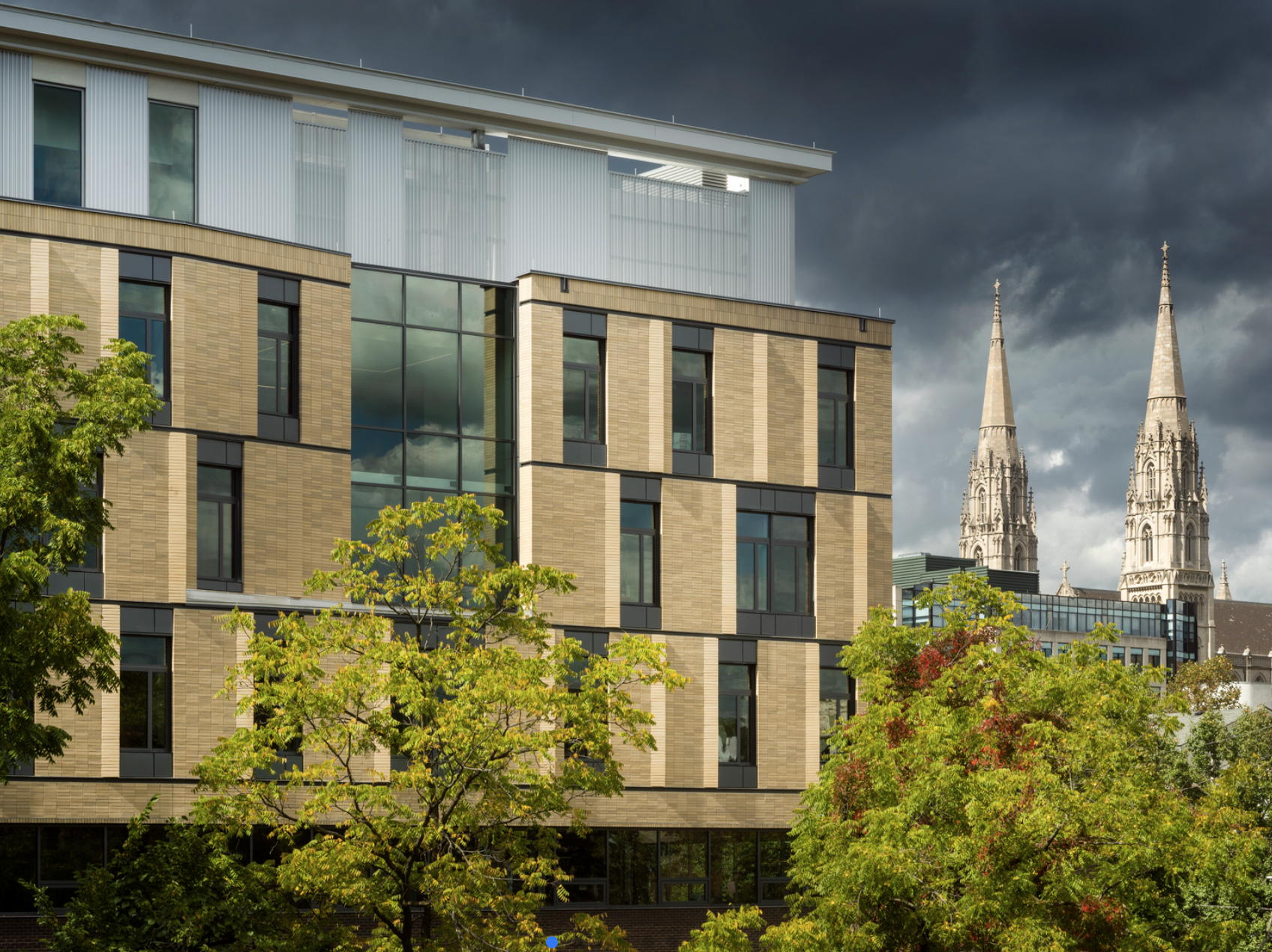
Carnegie Mellon University built TCS Hall, which is a new academic building on Forbes Avenue at the western edge of its campus. The project aimed to allow for future expansion and create connections between the campus and the nearby community.
It was designed to accommodate both private and university users, providing flexible spaces for collaboration while respecting the need for privacy. The finished project, an 88,000 square foot LEED gold certified facility, was done in collaboration with Tata Consultancy Services. The building houses the Institute for Software Research, the Master of Science in Computational Finance Program, the Center for Business Engagement and the TCS Think Tank, all of which promote academic research, innovation and professional development.
The partnered brickwork drew inspiration from the original Horn Postle campus architecture, reflecting the economic significance of brick as a building material in Pittsburgh. This was combined with terracotta and glass to create a balanced, contemporary aesthetic. Various colors and coursing a brick appear across the elevations, such as running bond, stacked and soldier. The brick walls subtly undulate as they mix with flat, dark window bars that dance across the facade.
TRANSCRIPT
00;00;00;03 - 00;00;05;13
Doug Pat (DP)
Let's go inside the vault. The design vault.
00;00;05;16 - 00;00;44;27
Kent Suhrbier (KS)
The one thing that then really influenced the design of the building was meeting a kind of very wide floor plate that could accommodate sort of larger laboratory spaces in addition to lots of perimeter office and workspaces. And so this is an asymmetrical core where we pull everything to one side. We then also cut a big connective series of stairs and interlocking spaces through the center of the building that also gave us some ability to have a relationship between the all the tenants within the building so that they can see each other, experience what's going on with each other, but not be in each other's business.
00;00;44;29 - 00;03;45;00
DP
This is my guest, Kent Suhrbier. I'll share more about him shortly. In this episode from the Design Vault, we highlight Kent's project, TCS Hall at Carnegie Mellon University in Pittsburgh, Pennsylvania. Carnegie Mellon University built TCS Hall, which is a new academic building on Forbes Avenue at the western edge of its campus. The project aimed to allow for future expansion and create connections between the campus and the nearby community.
It was designed to accommodate both private and university users, providing flexible spaces for collaboration while respecting the need for privacy. The finished project, an 88,000 square foot LEED gold certified facility, was done in collaboration with Tata Consultancy Services. The building houses the Institute for Software Research, the Master of Science in Computational Finance Program, the Center for Business Engagement and the TCS Think Tank, all of which promote academic research, innovation and professional development.
The partnered brickwork drew inspiration from the original Horn Postle campus architecture, reflecting the economic significance of brick as a building material in Pittsburgh. This was combined with terracotta and glass to create a balanced, contemporary aesthetic. Various colors and coursing a brick appear across the elevations, such as running bond, stacked and soldier. The brick walls subtly undulate as they mix with flat, dark window bars that dance across the facade.
A cost effective approach was taken to create the rhythmic facade pattern using the logic of binary base code to develop the esthetic modules. Hi, I'm Doug Pat and this is Design Vault. Kent Suhrbier holds a Bachelor of Architecture from Carnegie Mellon University and is a fellow of the AIA. He's also a principal at Bohlin Cywinski Jackson’s Pittsburgh studio.
His work for them includes civic facilities, museums, centers for engineering and innovation, corporate headquarters and university laboratories. The core theme of his diverse experience is his commitment to crafting spaces that define new paradigms, as has been the case on projects like the Frick Environmental Center and Carnegie Mellon Universities ANSYS and TCS halls. His approach to design values, evocative spaces that maintain a thoughtful sensitivity to the natural environment and the communities they serve.
Kent has spent many years teaching the practice of architecture and is deeply committed to mentoring and nurturing the next generation of designers. He's currently an adjunct professor at Carnegie Mellon University. So welcome, Kent. It's nice to have you with us today. So tell us a little bit about balance, a Bohlin Cywinski Jackson studio.
00;03;45;02 - 00;04;30;09
KS
That's a pleasure, Doug. So we're a national practice with studios across the country. Our Pittsburgh studio has been here for little more than 45 years, and it's always been located in the center of downtown Pittsburgh. And similar to kind of all of our groups, works on a blend of typologies in terms of buildings. So we do everything from residential to multifamily.
But at the core of a lot of our work is our university buildings and university projects. And we've been fortunate in the Pittsburgh region to have a very long relationship with Carnegie Mellon that goes back to originally the software engineering Institute and then the Intelligent workplace. And then in more recent years, working on the work with ANSYS Hall and now TCS Hall.
00;04;30;16 - 00;04;36;22
DP
And this is a big firm. So you guys have studios across the United States. Where are they and what's the overall size of the business?
00;04;36;24 - 00;05;04;05
KS
We're not that large. We are about 100 people and we're located in studios in Seattle, San Francisco, Pittsburgh, Philadelphia, and Wilkes-Barre. We started in Pennsylvania. We still have a strong presence in Pennsylvania, but we also, over the years, have created quite a strong studio in Seattle. All the studios develop really about this idea of craft. And so each one kind of has settled in that nature in their place.
00;05;04;07 - 00;05;07;11
DP
So you've been an architect for some time over 30 years, right?
00;05;07;14 - 00;05;09;06
KS
Yes.
00;05;09;08 - 00;05;15;08
DP
Time flies. So tell us a little bit about your experience as an architect. Have you always worked for BCJ?
00;05;15;11 - 00;05;29;06
KS
I worked for BCJ early in my career and then went and had my own practice for a number of years while I was teaching and then had an opportunity to come back to BCJ in the Pittsburgh studio about ten years ago. And we've been at it ever since.
00;05;29;08 - 00;05;32;09
DP
And have you taught anywhere other than Carnegie Mellon?
00;05;32;12 - 00;05;37;18
KS
No. Lots of critiques and reviews, but most of my teaching has been based at CMU.
00;05;37;21 - 00;05;43;01
DP
So let's dig in here and talk about the project. So how did your office get the project?
00;05;43;03 - 00;06;30;02
KS
We were working currently with the university on ANSYS Hall. The university had gone down a path with a slightly different project. It was not working for the combination of the university and the private partner, and so they had decided to actually stop that project and take a different direction. And that's when we were brought in, which was a fantastic opportunity, but also meant that we were in the position of having to work very quickly because this was a project where once you change direction, everybody wants to hold the schedule, hold the original parameters for the work and the project.
And so that put some additional pressures on the work. But at the same time, I think really brought the team together to focus in a way that was actually really advantageous.
00;06;30;04 - 00;06;46;26
DP
That's interesting. One of the most important things we do as architects is manage the client's expectations, right? So you get that project and then you've got to say, Well, we're going to move very quickly as quickly as we can, but we're going to end up spending a little bit more time than you might think getting rolling here.
00;06;46;29 - 00;07;23;09
KS
Yeah, and there was certainly that in the planning and what I think it meant is some of the things happened in parallel. More things were probably run in parallel than you might do on a traditional project and process, which I think actually then allowed us a little bit of freedom to do some experimentation with the materials. We had a very good construction management partner who was on board at the same time we were, which on a project like this where you're moving quickly and you have a fixed budget is essential because every decision has to be made in the context of design, budget and schedule.
00;07;23;11 - 00;07;26;21
DP
So could you give us a little history of the location?
00;07;26;24 - 00;09;03;18
KS
Sure. The location of this, it really drove and I think opened this the opportunity for this project to kind of have the character that it does. As you stated, it draws on the traditional Horn Postle tan & buff brick that defines most of Carnegie Mellon's campus and its original. It's a campus that was developed around 1905 that was a design competition, essentially in a traditional Beaux Arts style.
And then it's evolved with a whole series of much more contemporary buildings throughout the 100 and some years since then. And this specific building is on a brownfield site. Pittsburgh is defined also by these very deep ravines. We have a very deep topography to the city. And so the site for this project is actually on the other edge of the ravine from the main campus.
It's sort of the first building of a new quadrant that is actually at the fringe, kind of between the edge of Carnegie Mellon and the University of Pittsburgh. They share a boundary between each other along this kind of eastern edge of Carnegie Mellon. And so what that meant is we could use the material to tie it to the campus.
But in terms of stylistic, but there was also this drive from both the university and from the private partner with TCS keys to make this something very nontraditional. So this was a task of how to use brick in ways that are not historic or traditional in any way. So leverage the material, but not necessarily alter the details.
00;09;03;20 - 00;09;06;15
DP
So the client knew this was going to be a contemporary building.
00;09;06;22 - 00;09;10;16
KS
They did. I think we were fortunate in that they were insistent.
00;09;10;18 - 00;09;19;01
DP
Well, they chose your firm. It makes perfect sense. So what was the scope and programmatic requirements for the project?
00;09;19;03 - 00;10;45;10
KS
So in your intro, I think you hit most of the stakeholders and there's even a couple more since then because there were some spaces that weren't even fit out when we were doing the building, but it needed to be a very kind of flexible, open floor play. The one thing that then really influenced the design of the building was meeting a kind of very wide floor plate that could accommodate sort of larger laboratory spaces, research spaces in addition to lots of perimeter office and workspaces. And so we did two things to make that happen. We pulled all the core services for the building kind of to the west of the site instead of locating kind of building core in the middle of the floor, played in a traditional developer building. This is an asymmetrical core where we pull everything to one side and free up the floor plate.
We then also cut a big connective series of stairs and interlocking spaces through the center of the building that bring daylight into the center of the building and kind of create a heart between all these various tenants that also gave us some ability to have a relationship between the all the tenants within the building so that they could see each other, experience what's going on with each other, but not be in each other's business.
Because this is a building where you have different research groups, lots of intellectual property that needs to be kept safe between both public and academic groups. And so lots of visual transparency with controlled boundaries.
00;10;45;13 - 00;10;49;09
DP
So the building plan, so the site, is it rectangular?
00;10;49;16 - 00;11;31;13
KS
The site was a much larger quadrant where we master planned for both this building as a sort of phase one that's 88 or 90,000 square foot sort of phase one. And then there's an idea of a connective plaza and paseo that would connect north south through the site. And then there's a Phase two project that was developed kind of through a schematic level that's about 190,000 square feet that's adjacent to it.
You know, it needed to be a very efficient plan. So it starts as a rectangle and then it begins to inflect and kind of reflect some of the views on the site in terms of beginning to bend and open to some of the view corridors and solar orientation that's on site.
00;11;31;16 - 00;11;40;23
DP
Right? So at least in the lower plan, if I recall the plans correctly, there's almost like a diagonal which is cut into that first floor plan. Is that correct?
00;11;40;25 - 00;12;00;14
KS
Correct, yeah. So we started off in with a simple plan. The way we would describe it is we almost want the kind of site forces the views, the kind of the way you move around the site to then begin to push and pull on something that starts very simple, but then can have some more complex geometry to it as it gets pushed and pulled.
00;12;00;16 - 00;12;11;09
DP
So that brings us to project restrictions. So what was the zoning like on this site? Were there any restrictions in terms of the height or the shape of the project? Setbacks?
00;12;11;12 - 00;13;07;01
KS
Yeah. I mean, I don't know any of us have found that magical site where there aren't those we'll all look forward to when we find it.
The site. Had a few issues and that it was a brownfield site. It was a former gas station site. So you can imagine the fun that brings to some of the initial site work. But that also gave us some opportunities to kind of take some parking in underneath the building once we had to kind of over excavate and clear out part of the site.
It's right on the side of the ravine. So from a planning standpoint, we could push the building kind of right up to the tree line and right against the side of a very steep hill that did take some really good coordination with the construction manager. And this is a group, Mascaro, who is regional here but does really a fantastic job and was willing to kind of cooperate on figuring out how then to stage essentially all the facade work while hanging off the side of a hill.
00;13;07;03 - 00;13;10;09
DP
So how long did building review take with the city?
00;13;10;14 - 00;14;12;25
KS
So this one was fairly to finish our zoning question, they're both related. The zoning restrictions on the site are more comprehensive as part of a kind of institutional master plan. This is one of the benefits of working with the university clients is they in some ways create their own zoning within their institutions. So there were some restrictions. The setbacks were predominantly this idea of being adjacent to the hill.
It's along a very busy city corridor. Forbes Avenue and this is an area where we wanted to pull out very closely to the street and kind of hold the urban edge. But we also then had to be very careful in how to do that. And you see, like in the plans, that is reflected by undercutting the lower story so that there's more pedestrian flow, more movement kind of at the lower level, and then pulling the upper levels two through four out towards the street and then again stepping back at the top to create an outdoor green roof and terrace That's part of the think tank at the top floor.
00;14;12;27 - 00;14;23;04
DP
So let's talk a little bit about what I mentioned in the intro. This idea of using binary code to design the exterior elevations. Am I reading that correctly?
00;14;23;06 - 00;15;52;10
KS
Yeah, it was part of it, although my computer science friends would probably tell me that our coding is terrible. But there was an economy to this building that we were also looking to maintain in terms of its budget. And so we were exploring ways where we could create a systematic language of parts for the exterior that could be very expressive but also be very predictable and very manageable in terms of the number of parts.
And so by kind of going back to binary and saying let's just focus on two modules and let's really just break this up over the facade and let's look at how that might then create a facade that's very articulated and very rhythmic, partially because on the inside of the building we needed to accommodate both open workspace, but we also needed to accommodate the potentiality for lots of enclosed offices.
And what we didn't want is a kind of fixed grid necessarily on this facade. This is a space in an edge that I think everyone early on just really wanted to have something that was a little bit more dynamic that would shift with the light. And that's kind of where some of the detailing came in later. So we started basically just saying let's create a, you know, in a and a be a zero and a one, and then let's look at how we can begin to map those over this facade in a way that you can have a very regular plan on the inside, but an exterior that is perhaps a little more articulate.
00;15;52;12 - 00;16;06;20
DP
So you have these modules that you're imagining on the exterior and once you had those parts, you take a look at the plan and the form followed the function of what was going on on the interior in a way.
00;16;06;22 - 00;16;10;05
KS
Yeah, those two in our world push and pull on each other.
00;16;10;07 - 00;16;14;19
DP
Of course. Absolutely. Ever since Louis Sullivan and before him.
00;16;14;19 - 00;16;17;12
KS
Yes.
00;16;17;14 - 00;16;37;18
DP
So let's talk a little bit about the parameters for the building materials. So I read that approximately 30% of construction materials were sourced locally. 30% of the building materials contained recycled content, and 75% of construction waste was recycled or repurposed. Is that all correct?
00;16;37;20 - 00;17;17;04
KS
That is, you know, even though we were, again, trying to work fast and economically, there was still a mandate to make a building that was healthy and that would achieve a LEED Gold certification. And so we targeted many of these things. And then in some ways with the materials, what we would do is target a combination of what are some of the really significant things, and then can we find local sources for some of the really big pieces of the building.
So the terracotta comes from just over the border in Ohio and the brick this building is all brick from the Hanley plant. So 60 miles from here, just northeast of where I'm sitting now.
00;17;17;06 - 00;17;45;21
DP
So the brick facades to describe them. So you've got these flat plains of brick masonry on the facades on various elevations, and then you have these almost triangular protrusions which occur across the facade as well. Did you guys do a series of three dimensional drawings in the office? Did you work in BIM software? Did you model this thing in 3D and then show it to the client and then ultimately mock it up in the field? How did that work?
00;17;45;23 - 00;19;37;22
KS
Yes, yes, and yes, we do work entirely in them and we use that for what it's really good at. We also build a lot of physical models. And so all these projects we will build a series of physical models of varying scales as well. And so whether it's studying the patterning and the kind of decoding of the facade, we would start there.
And then as we develop, it will increase the scale of some of these models. One of the challenges with this building was the area that we had to build was a long, narrow strip that runs north south, which then means we have long east and west facades, which from an environmental strategy is the opposite of what you want.
And so we let that then start to influence the fenestration. And that's a little bit where this folded or triangle other elements came from because we began to think, look, we need something vertical that's going to shade the windows, right? They happened just to the south of every window and this kind of code system that we created. And then how do we make them a shape that can catch the light so that as the sun moves around the building all day, it creates shade.
But it also then can this be a plane that flashes with this kind of brightness at certain times during the day? And so we started with the idea of the just the form, and that came out of, yes, the digital models, the physical models, kind of getting everyone to buy into that as an idea. And then to be honest, the CM and the owner wanted to do those elements out of precast.
They had it in their head that that was the right answer. So, you know, instead of being too bullish about it, we said, well, let's mock up both. So we worked with technical folks on the brick side to get the shape right and get pieces that we can mock up. And then we mocked up some precast and everybody looked at it and said, The precast is terrible, let's do the brick.
00;19;37;24 - 00;19;41;00
DP
And did you use steel lintels then for those parts?
00;19;41;02 - 00;20;25;00
KS
One of the things that was a great challenge, so the building was continuous. We're leaving angles that everything is sitting on and we kind of stack the deck against the precast because the precast had to hang from additional steel, whereas we were able to get the brick shape to stack just on the regular mantle. So it wasn't meant to be manipulative, but it was meant to be economic, and we were able to come up with a way where we could kind of keep the same material and offset some of the cost that comes from doing a custom.
And these are large brick shapes. These are sixteen inches long by about nine inches deep. And so it's one shape, but it's a lot more substantial than a modular brick. But we were able to offset some of that by just how we were holding it up.
00;20;25;02 - 00;20;39;05
DP
Yeah, the brick really alters the scale of the building. I mean, I would imagine precast this massive of panels on the facades versus doing these very pretty finely tuned brick masonry panels.
00;20;39;07 - 00;20;40;18
KS
I'm glad it ended the way it did.
00;20;40;24 - 00;20;46;28
DP
And so I'm curious about software. Just as an aside, you guys are on Revit?
00;20;47;04 - 00;20;48;10
KS
We are Revit based, yeah.
00;20;48;12 - 00;21;04;19
DP
We were talking before we got rolling that you had been on Mac. Now you’re PC. I don't know much about either. I'm on ArchiCAD and have been on ArchiCAD for 25 years. Where you guys on a different software before you switched over to Revit and therefore a different operating system?
00;21;04;22 - 00;21;36;20
KS
We for many years were MicroStation and then we were AutoCAD by fairly early on we drove into Revit for a good portion of our work. Being able to work three dimensionally is just so important. We do use a lot of rhinoceros or rhino where we nest that in our Revit models as well for more complex geometries, things like that.
And so actually when we're modeling whole brick facades, often we'll use some of these other solid modeling tools just because they're a little more flexible in terms of their conceptual work.
00;21;36;22 - 00;21;40;06
DP
So what was the size of the team that worked on the project?
00;21;40;08 - 00;22;07;16
KS
It would vary from a little bit over time. We work in a non departmental way where we pull the team together at the beginning of the project and our intent is that most, if not all of that team stays intact through the construction of the project. So a building of this type, we'd have maybe three or four people kind of fairly dedicated, partially to move very quickly from kickoff to construction was really only about nine months.
And so we had to hustle.
00;22;07;18 - 00;22;10;19
DP
So yeah, that sounds really squeezed.
00;22;10;25 - 00;22;37;07
KS
One of the things that we do plan on is we take a very active role through construction in terms of just staying very engaged in the process. We have a construction manager who's we've already been partnered with for a year. We will make sure that it's a very collaborative process through construction. Well, we do talk about the idea of craft, and craft for us is part design, part how we document but a lot of it is the things that other people are doing, which is putting the whole thing together.
00;22;37;09 - 00;22;38;16
DP
Was the project bid?
00;22;38;19 - 00;22;43;09
KS
It was a GMP, so they would bid packages of it as part of that.
00;22;43;11 - 00;22;45;17
DP
Does the construction manager help with that?
00;22;45;19 - 00;22;47;16
KS
They do, they manage that process?
00;22;47;19 - 00;22;59;11
DP
I'm completely unfamiliar with that process. I do high in residential and I haven't ever worked with a construction manager, although my peers have for certain. That's just not something I've been exposed to.
00;22;59;14 - 00;24;04;07
KS
It depends on the quality of your construction manager, but if you have a good one, you do have some ability then to manage costs kind of all the way through. We would price kind of really almost every 2 to 3 months during design and in some cases make some fairly dramatic shifts in terms of what we were doing, whether it was restacking.
You asked about zoning, the building could have been taller and actually started off a story taller and we kind of restocked it and made it more compact specifically to create some economies. And then that had some opportunities for us to because we were able to create the kind of think tank penthouse on the top, which isn't a full floor.
And then all of our mechanicals are kind of stitched into that from a massing standpoint. So we could get a lot of both economy, but also just this is a building that you see from across the building. We didn't want to leave all the mechanical equipment and all these things kind of fully exposed up on our roof. So it was a way of really stitching it into the building and making it part of the intentional mass of the building instead of an accidental no offense to our engineers piece on top.
00;24;04;10 - 00;24;22;28
DP
Well it's something that happens on most pieces of architecture. I mean, it's just where do the mechanicals go? So did your team learn anything interesting through the design and construction process? Something new for you guys? Something unusual?
00;24;23;01 - 00;25;18;05
KS
I'll start with the positive. We didn't do these large, full scale mockups, and especially when you have a design idea that is so systematic, right, where you're saying, Let's do this one thing and let's do it, we'll make two patterns and we're going to repeat it. The ability to kind of mock that up and debug it and get all the kinks worked out of it before you get up on that, hanging off the side of the ravine, was key, that was just an essential piece because as much as you think it through, as much as you model it as much as you are sure you have it worked out, the sequencing and the constructive ability always has one or two surprises for us. And so, you know, I think that was a really great part of the process. In many ways, it's an owner who's willing to say, Yeah, let's buy a mockup and let's have everyone try this before we get up on the building. That was a really essential one, just because we were able to kind of eliminate so many issues that repeat hundreds of times across its facade.
00;25;18;06 - 00;25;30;00
DP
So that's great. So, Kent, you've been an architect for a while, as we've established, based on what you know today about being an architect, do you have any words of advice for your younger self or even architects just getting started?
00;25;30;02 - 00;26;26;20
KS
There's maybe two things that I share with our group here that I still try to live by, and one is always stay curious, you know, if you can set out each day to learn something new, no matter how long you've done it, if it's a year or two years, 30 years, that's the best thing you can do. One to keep it engaging and to keep it what you believe in.
And then you're constantly improving. One of the things I used to ask of all my students and I still ask of all of our team here is I am good with everybody setting out to make every mistake once and as few as you can twice, because then you're actually learning. If you're trying and you're kind of stretching, you're going to make some mistakes and that's okay.
And that's it's a tricky profession to say that in. I get that right. But it's also, you know, when you have a studio environment, you have peers and you have all these checks and balances. So there's ways to do that. And we still practice that way where we set out to make mistakes, but we're out to learn.
00;26;26;23 - 00;26;36;08
DP
Yeah, I love that. I mean, hey, you can make mistakes. Everybody makes him make that mistake one time. Learn from it and don't do it again and do your best not to do it again, right?
00;26;36;08 - 00;26;41;19
KS
Yeah. Then we're going to have to talk.
00;26;41;21 - 00;26;51;15
DP
Well, Kent, it's been great to speak with you today. Thanks for your time. Where can people go to learn more about Bohlin Cywinski Jackson and yourself.
00;26;51;15 - 00;27;08;25
KS
Probably the best place to start is just at our website with most of our socials and everything else link through there. And we've got some blogs there and all kinds of current things that are going on with the firm where we're hiring some of our new work looks like and that's just. www.BohlinCywinskiJackson.com
00;27;08;27 - 00;27;11;20
DP
Well, thank you very much, Kent. It's been really nice meeting you.
00;27;11;25 - 00;27;16;19
KS
Likewise. So thank you
You May Also Be Interested In
We Can Help With Your Next Project
Discover the latest + greatest in design trends, industry news & pro tips from pros.
For all of your project needs, you’ll find everything you need at a Supply Center.
Let Us Know How We Can Help!
Design Vault Ep. 31 Brendan Iribe Center with Simon Trumble
ABOUT THE ARCHITECT:
|
As a Design Principal at HDR, Simon has curated an extraordinary career spanning over 28 years, propelled by an unwavering commitment to capturing clear, simple, and audacious ideas and metamorphosing them into refined design solutions for intricate and technically demanding building types. He has played a transformative role in propelling the designs to unprecedented heights of excellence. By nurturing a culture of innovation and fostering boundless creativity, Simon has emboldened design teams worldwide to transcend conventional boundaries and achieve extraordinary outcomes. |
|---|
ABOUT THE PROJECT:
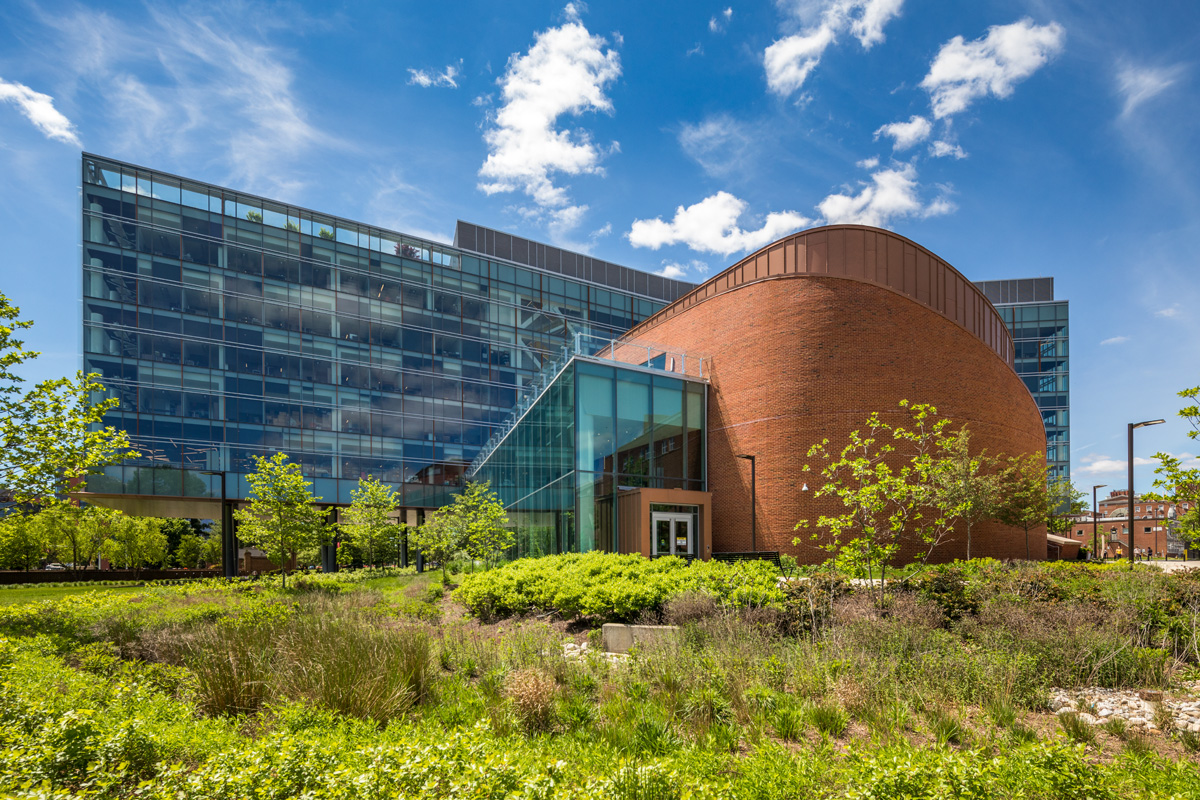
The Brendan Iribe Center, on the campus of the University of Maryland, is a 215,600 square-foot, six-story instructional and research facility with complex, specialized labs that support augmented reality and artificial intelligence, robotics, programming and is also the home of the 300-person Antonov Auditorium.
The building encompasses an image of technological advancement while preserving it’s neo-Georgian heritage on campus with its unique use of brick and bonds patterns.
On the interior wall of the Computer Science and Engineer Center, the brick is conducted in such a divine way that it appears as if it’s moving. The pattern signifies movement and information flow, leading it to achieve forward-thinking and technological innovation.
The material selection of two popular Glen-Gery molded brick colors, Georgian and 53-DD, worked perfectly for the Computer Science and Engineering building to blend in a while standing out on campus. The Brendan Iribe Centers is an excellent exhibit of preserving tradition and history while finding creative ways to be innovative and popular to spectators.
Brendan Iribe Center
University of Maryland
TRANSCRIPT
00;00;00;02 - 00;00;05;12
Doug Pat (DP)
Let's go inside the vault. The design vault.
00;00;05;14 - 00;00;37;06
Simon Trumble (ST)
It was a building that was not fully confined. However, we put on ourselves the fact that we are in a neo Georgian campus. And how do we want to think about it? We've pushed the lines on that. But the handful of elements that come together from that in these neo Georgian buildings are always the white columns, the brick is used, it's on the floor, and then it turns up the walls and places and it becomes the auditorium itself and the campus and the buildings spin around it. The auditorium is the anchor from which everything works.
00;00;37;09 - 00;03;38;27
DP
This is my guest, Simon Trumbull. I'll share more about him shortly in this episode from the Design Vault, which highlights Simon's project, the Brendan Iribe Center for Computer Science and Engineering in College Park, Maryland. The Brendan Iribe Center for Computer Science and Engineering in College Park, Maryland, is designed for work in virtual and augmented reality computer vision, robotics and computing platforms.
The university describes the new building as a reimagined kinetic hub for the campus. The building is both inwardly and outwardly focused, connecting the university with a new innovation district and is easily visible from its prominent location. The dynamic building plan is comprised of two main components: a six story instructional and research space, and a 300 person auditorium joined by a connector.
The main feature of this building is a large glass facade characterized by an inventive curtain wall system that controls solar gain while creating the optical illusion of movement. Interestingly, the campus architecture happens to be deeply rooted in a classical neo Georgian architectural tradition. For this reason, Brick was used in a number of ways as common wall sections and knee walls, parametrically modeled wall patterns and as the main exterior feature of the Antonoff Auditorium.
Hi, I'm Doug Pat and this is Design Vault. Simon was educated in the United States, Mexico and Italy and holds a Bachelor of Design and Master of Architecture from the University of Florida. He's currently a design principal at HDR with a career spanning almost three decades.
His experience extends across an array of large scale technology, intricate projects that span the globe. Among the many buildings Simon has been involved with, he's been the lead project designer on jobs such as the Inova Center for Personalized Health Research Building in Falls Church, Virginia, the USACE’s Baltimore district East Campus Building Four in Fort Meade, Maryland. The USACE’s Baltimore District Defense Intelligence Agency Headquarter Annex Command and Control Facility in Fort Belvoir, Virginia.
And the project we'll discuss today, the Brendan Iribe Center in College Park, Maryland. At the core of his design philosophy lies the art of distilling complexity to its essentials. He's committed to capturing clear, simple and adventurous ideas, developing them into refined design solutions for technologically demanding building types. Simon is a registered architect, LEED accredited professional and a member of the AIAA.
So welcome Simon, it's nice to have you with us today. So tell us a little bit about HDR. Now I know it's a large office. Where is the office that you're located? What's the size of the firm? How long has it been around and what type of work do you do?
00;03;38;29 - 00;05;21;22
ST
HDR has been around since 1917. We're a very old engineering backed company and it started out in Omaha. The office I'm in, we like to call it the Washington DC office, but really we're in Arlington, so pre-Civil War, we would have been DC. At that time, in 1917, the engineering based company Hennessy, H.H. Hennessy was the leader of the office and it started out as a water and electrical service to that area of the country, grew from there to add civil and then architecture services around the thirties and then really bloomed in the fifties to around the time 1700 or so employees. Today we’re in countries around the world.
We're about 200 plus offices and I think about 12 and a half thousand employees with still the largest aspect of it being the engineering company, transportation, aviation, full services architecture is about 15 to 20% of the company. And in general, because of this engineering background, because of this engineering focus, we stick mainly to very technical, sophisticated engineering, heavy buildings, and hence why you see some of the work that we have.
It's a particular focus. Health care isabout 45%, 43% of the work we do in general. And then science and technology picks up about 20%. And then from there it's a plethora of different types of work, again with an engineering bias to that particular work.
00;05;21;24 - 00;05;32;20
DP
And yet these are really beautiful buildings. I drive by the Penn Pavilion once a week down in the city. You guys design that, right, that big red curvilinear building?
00;05;32;22 - 00;05;35;10
ST
Yes, that goes way back. Actually.
00;05;35;10 - 00;05;36;03
DP
It's stunning.
00;05;36;08 - 00;06;15;05
ST
Yeah. The office has really made a push over the last 20 years to bring how we think about buildings, the idea of buildings to the forefront. Because when you start thinking about the engineering aspects of building, it's very straightforward. These are the issues, these are the facts. Here's how we develop it. But when you bring architecture, you bring a bit of poetry to it.
How do we want this to operate? How do we want this to provide for the future? How do we want people to work within it? Iribe’s a great example of that, how that comes together, both for the campus, for the facility, and then, you know, for the client itself.
00;06;15;12 - 00;06;32;16
DP
Yeah, it's a beautiful building. So to back up a second here. So I said you've been practicing as an architect for almost three decades, but 30 years we kind of laughed about that. Tell us how you ended up at HDR and what kind of experience do you have before that? And currently at HDR, if there was a before that.
00;06;32;18 - 00;08;09;14
ST
It's an interesting story. I'd like to call myself a retread because when I came out of school I joined a company called Cooper-Lecky and Cooper-Lecky is fairly famous for having worked with Mylan to do the Vietnam Memorial. Kent Cooper was Saarinen's project architect on the Dulles Airport. So he comes through that lineage of things and they ended up doing the other one that people might know is the Korean Memorial.
They were the project architects doing that, again, coming out of Vietnam. That company got bought out by another company called CUH2A. CUH2A today became the sort of S&T backbone to HDR. So there had been a purchase there in between that time. I spent about five or six years with Smith Group here in DC. So it's interesting because all of that ties together, at Smith Group I was mainly focused on workplace buildings downtown DC, renovation down to the National Cathedral. There was an 18 car underground bus parking terminal. Another thing. So again, almost every engineering background type building for that, it's a beautiful installation. If you go there today, you have no idea that there's about 18 busses parked below ground there and 550 cars or so parked there.
So, you know, I come out of things like that. The Constitution Center, which was the renovation of the largest office building in DC, again with Smith Group. And then I came back to CUH2A which became HDR and have been here ever since.
00;08;09;16 - 00;08;10;28
DP
You're clearly enjoying it.
00;08;11;00 - 00;08;13;06
ST
Yes, but apparently I'm getting old.
00;08;13;09 - 00;08;19;16
DP
You don't think so until you look in the mirror in the morning.
00;08;19;18 - 00;08;21;00
ST
Right. Exactly.
00;08;21;02 - 00;08;25;10
DP
So let's dig in here and talk about the project. How did your office get the project?
00;08;25;13 - 00;11;20;02
ST
Well, so this is even a stranger one. The head of design for HDR Brian Kowalchuk had been called to come to the university. We had done the physics building on the university. I was the lead designer on that one as well. And they had a donor or possible donor in Brendan Iribe, and they wanted to talk through ideas for what's possible.
So Brian met with Brendan on and off for about a year, doing designs and talking through projects and design ideas for how to do a project and to get Brendan excited and focused on helping the university. At the time, this is back in 2016, Brendan then decided to give the university a donation to build this university or build a school.
He gave them a $31 million donation and Michael Antonoff I don't remember the number, but I think it was around $5 or 6 million also donated and it was about the time that interest then passed away from a bicycle accident. So all of this kind of came together. Brendan had been invited back. He had just finished designing Oculus goggles and was fresh off of selling this to Facebook in 2014 for the small sum of $2 billion.
And this is 2014. So the university, of course, very happy to talk with him, invited him back. He, Andrew Reisse came back to the university and took a tour and realized that this was the same computer science facility that they had gone to when they were students years ago. No difference, no changes, no upgrades. And matter of fact, he ended up using a restroom that was broken that they tried to stop him from using, but he needed to use the restroom.
He just couldn't believe the state of the facilities. And here Silicon Valley is drowning in money and in need of high quality students. So he and Andrew Reisse looked at each other and said, Well, how much can it cost to build a school? We should do something about this. And he was thinking $2 million or so, $4 million, but ended up giving $31 million and talking others into it when this all came around, everybody was so excited to do this.
The teachers had gotten together and donated $1,000,000. I'd never heard of this before. The teachers got together and pulled money. Brendon's mom put in a million or so out of her own pocket. He talked other friends into giving a little bit here and there, and when the state saw this, the state was very, if somebody is putting up money, they'll back it.
So they came in and this basically turned the wheels and made it all happen. And then the university found a site and that was really what kicked us off. Brendan wanted to bring Silicon Valley to the east. And how do you do that?
00;11;20;05 - 00;11;41;17
DP
Well, it's pretty impressive. You know, my wife went to school there many years ago and that campus needed a lot of work. This whole neo Georgian thing stylistically, you know, there was a lot to be done there. And recently we've had some friends’ children who are going to school there. And they said the campus is spectacular. When I saw the images your building, I was blown away.
I mean, they're really doing some beautiful architecture there.
00;11;41;19 - 00;12;43;15
ST
The architecture around that campus has really taken leaps forward, not just our building, but some of the other buildings are coming around there. We're sort of in the tech and innovation part of campus. They've designed different zones and they still have their historic core that neo Georgian architecture, fundamentally that underpinnings of neo Georgian still there. And that's affected our building as well.
How we think about it, white columns, brick walls. But what we did was sort of a blended reality. We've pushed and pulled these pieces together and we've created an inside outside that most previous neo Georgian buildings don't really have. You go to classrooms and then, you know, dispel knowledge to each other. But you can turn and look and you go from seeing the blackboard, so to speak, to seeing the outside, this is the old traditional way of teaching, used to sit under a tree and have a discussion.
So we go back to those times, even though today we're in VR headsets and using technology at a different level.
00;12;43;17 - 00;12;50;01
DP
That's a great analogy. So let's back up a little bit. Tell us a little bit about the site. How did they find room on campus for this building?
00;12;50;08 - 00;12;59;21
ST
Well, the university decided on the site at the front of the campus, and when they did, they said what we want to do is design a gateway building.
00;12;59;21 - 00;13;01;28
DP
Is this down on Route one?
00;13;02;00 - 00;16;41;06
ST
This is right off of Route one near the old guard gate. So there's a guard gate that has been moved into position previously. If you see the two in scale, one absolutely just devours the other, One said a person scaled, the other is a six story building with, you know, 16 foot floor to floor. It's in a 25 foot first floor.
So we're talking about a very large space. But they wanted to create a gateway to the campus. That was the charge from the university. The charge from Brendan was how do we unlock the emotion of these students? And then the charge from, so to speak, ourselves is how do we create a knowledge hub, a place where everybody wants to come, they want to stay, but they want to exchange information.
You really learn better one on one that you do sitting with the teacher. It's when you start teaching each other that you really learn. And so we're bringing all these charges together. The campus had given us an old parking lot site, the parking lot for the previous computer science building. It's still there, by the way, but the parking lot for that building.
And when we got the site, started looking at it and started to do designs across US 1 is a new innovation hub that's being built, sort of partnerships with businesses. And then the other side from our site is the old campus, the heart of the campus. So we kind of created a building that essentially was a line that bent from the grid of the campus, looking back into the heart of the innovation campus, looking to the new innovation hubs that are coming.
And that has basically a view to them. We call those the reset zones. These are almost free spaces, but they're knowledge exchange spaces that happen vertically up the building. And those two sides. One of the other things we did was towards that entrance of campus. The building rides us up. It does that for two reasons. It's on columns.
It floats above the landscape, but it's really two reasons for it. Half of that land they gave us is a flood plain, couldn't build on it. So we have a fairly large program and all of a sudden we have half the site, literally half the site. We had to be a little bit inventive about it. And so the core of the building sits over that flood zone and, you know, serendipity to that, that space is also one of the sort of gathering hubs that people come to. Now. It's almost like being under the shade tree. They use it for events that students break out into that space and that breakout space flows into the building where there is also a little bit of a stadium seating zone that just provides these different types of environments where people can decide where they want to go, how they want to focus and use it for different types of events.
The whole ground floor is designed to be explored and used for different scale either university events, private events, and it's used all the time on that floor too. But facing the gatehouse. So facing the entrance of campus, so to speak, are the High Bay labs. And those High Bay labs are in basically open glass areas. They've got robotics.
They're doing, say, unmanned aircraft type things. They've got huge doors. They can bring in vehicles, whatever they might be doing in those, there's about four or five of them and they're 24 hours a day. So at night, there are lanterns and guideposts for the campus itself and for the students to both come and see what's going on. But a reminder, the University of Maryland is doing things and going places. It's alive.
00;16;41;09 - 00;16;58;05
DP
So I'm curious. We'll talk a little bit about the building stylistically. So it's clearly contemporary. Did you have any directives regarding style when you got started? Did they say, Hey, we definitely want a contemporary building with all of these neo Georgian pieces of architecture around.
00;16;58;08 - 00;18;24;22
ST
The campus Master Plan, which is one of the better master plans I have seen and I've worked with. I'm sure there's some others, but it's quite brilliant, you can go download it for yourself. It's a great example of how to do things. Has defined certain areas as historic and historic buildings that you need to stay within context with and other areas as moving beyond that historic into a we'll call it a new historicism, for lack of a better word, because this was the new gateway and because of where it stands, it was a building that was not fully confined.
However, we put on ourselves the fact that we are in a neo Georgian campus and how do we want to think about it? We've pushed the lines on that, but the handful of elements that come together from that in these neo Georgian buildings are always the white columns. We walk through our building, it's all white columns in there, and then places those white columns go from standing very simply straight up to being pulled and leaning as they face the future and the future campus growth.
And that's kind of how we thought about it. The brick is used. It's on the floor, and then it turns up the walls and places and it becomes the auditorium itself. And the auditorium spins. It's almost a rock in the river and the campus and the buildings spin around it. The landscape spins off of that rock. The auditorium is the anchor from which everything works.
00;18;24;25 - 00;18;45;04
DP
And we'll talk about that in just a second. So I'm curious about the project restrictions. So you guys clearly had a flood zone issue. What were the zoning requirements? You talked a little bit about historical requirements and then the university versus the client. How did you guys work within all that and how long did it take to kind of meet all of those directives before you were building?
00;18;45;06 - 00;20;14;02
ST
So this is about a one year design process. So if we say we spend about a year in discussions to think about the building to really work through developing a program that made sense for both the building and the campus, and then to then develop and work with the site, because once we found out actually that it was half the site was gone, there was a lot of discussion of other sites.
And so we actually did some test fits and some design work for sites across the street, for sites in the green space that's there, argued heavily that we should not be touching that site, that green space should be seen as sacred to the campus. Everything should support it and surround it. And we came back to our site and had to think inventively about how to deal with this floodplain.
And I think once we started to anchor onto that, the two computer science buildings really working around a courtyard again, it's a courtyard that's blended into our building and it started to make a lot of sense. There were other issues: the power needs for the building, the water control, for the building. So there's a lot of other things that happen.
Parking areas got cut off, so circulation and access needed to be developed. But we went through all of these different challenges in isolation with the goal of creating the building where it is as a gateway and the building where it is in relationship to the other campus computer science buildings.
00;20;14;04 - 00;20;30;02
DP
So the building plan is really unique. And when I was reading about this building, it mentioned parametric digital modeling. So you clearly use computer modeling for the form of this building and plan. And then ultimately for at least one of the facades on the interior, one of the walls and the interior.
00;20;30;04 - 00;21;33;28
ST
We use it in a couple of ways. The brick itself is actually laid out using parametric tools. I'll explain that a little bit more. The brick on the Antonoff Auditorium, the plan arrangement, it's 22 different curves to make that elliptical shape for the auditorium. The auditorium shape comes out of some of the acoustic design for the room. So it's a visual classroom more than it is a traditional auditorium.
So there are huge screens up there. So the visual access, as well as the stadium kind of seating for that used a little bit. And I say just a little. The majority of that was used for the wall panels to design the wall panels that are inside, and those take cues, The University of Maryland's mascot is the Terrapin turtle.
And so the diamonds on the shape of the back of that turtle were used as a kind of kickoff cue for how we did the wall panels inside. That is a sort of Chevron shape that cascades curves and wraps around that auditorium on the inside.
00;21;34;04 - 00;21;45;18
DP
Wow. That's a really neat idea. So how does a contractor lay out a building plan with all of those ellipses? How does that work?
00;21;45;20 - 00;22;40;13
ST
Really interestingly, there was a lot of discussion early on that we would go from Rhino to construction straight forward. So there are bent and curved steel tubes. There was a lot of discussion with the contractor that they would literally do almost a CAD cam type of situation just using the electronic design drawings to go and construct the building.
However, they did more of a hybrid with that. So we have curved steel studs backing up that brick and those curved steel studs are designed straight from the computer, so then they are shaped and placed, a more regularized steel frame, although it has some curvatures as well, also coming straight from the computer. And so those are brought together in order to then layout the auditorium and then to provide backup for the brick and then to work from there.
00;22;40;16 - 00;22;43;19
DP
Wow, what a great way to do it. The only way to do it.
00;22;43;26 - 00;24;05;20
ST
It's doable otherwise. But the reality is the time to do it today is not the same. And you would shy away from doing certain things because it'll take too long. We have 22 different curves. You might break that down to five or four and you have two different corners and work from there with the gentler bend. It doesn't make sense, but when you see it in plan, the auditorium itself warps in order to allow the courtyards to re match up from the old computer science building to the new computer science, and then to have a staircase that wraps up to a second floor terrace from which you can access the second floor of the main building.
But you also have this garden space. Again, we talk a little bit about nature and the studies looking at the screen and then being able to go outside. In nature, we have three gardens, we have the great gardens, we have the rooftop on the second floor garden, and then we actually have another garden on the very rooftop called the Reisse Park.
00;23;44;14 -
ST
And that was a gift, so to speak, from Brendan Iribe and Andrew Reisse to their buddy who had passed away. And it's got a little gallery up there as well as a garden space, then gives to the campus now, one of the greatest views that they could possibly have, and that gets used all the time for donor meetings, special guests, what have you.
00;24;05;22 - 00;24;09;29
DP
So what was the CAD program that you guys used? Was it Revit?
00;24;10;02 - 00;25;15;12
ST
Our backbone for everything is Revit. On the design side, our backbone has become Rhino and then grasshopper scripting in there to do some of the algorithmic work that we have. So just getting back to the curvature of the brick, because we have a curve in plan, but we also have a curve in section, that brick is skinnier or together it's closer together at the top than it is in the middle.
It's a belly in the middle and so the layout, the curves, what we wanted to do is to not have a bunch of cut brick. And of course we have to have every 30 feet or so an expansion for the brick. And so the expansion is laid up, tied together with the curves, but tied together with the brick module so that the brick module is defined such that we have a half brick or a whole brick throughout those curvatures along the section.
So that's where using grasshopper scripting a little algorithmic work helps to do something that I don't think we could normally do without a tremendous amount of planning work.
00;25;15;14 - 00;25;27;11
DP
Yeah, I would imagine the coordination on the job was really something else. So how many people were on the team and you were clearly leading it? Were there a number of PMs or 1 PM or how did it work?
00;25;27;13 - 00;26;59;06
ST
There was a PM and an Assistant PM. We talked for a while about separating the main building from the auditorium itself. The auditorium was almost a project on its own, I think that got debated about above my pay grade and rejected. I still think it might have been the right way to go with about five designers, I would say working on the building, both interior exterior and the auditorium.
We have some specialty spaces within the building. We have about four project architects and three interior designers working on it. So what would we end up with there? 12 or 15 people or so working on the project fairly consistently and then pulling in some folks to help with a couple of gurus and scripting algorithmic design that really help.
And you know, we have another layer in that brick facade, which is a sort of design element playing up, really showing algorithmic design work in there. It's almost like as if somebody break the bricks and they pull and they fall back into the wall. They almost look like they're falling out, wind blown and in movement. This is in the auditorium and it's a little design feature, really showing off algorithmic design.
You really wouldn't notice the fact that the curvatures had to be figured out that way or the wood paneling had to be figured out that way. Doesn't show that this was a way of really showing and playing with the tool, but using regular brick.
00;26;59;08 - 00;27;01;11
DP
So none of the bricks were custom.
00;27;01;13 - 00;27;03;22
ST
None of the bricks are custom.
00;27;04;00 - 00;27;06;26
DP
Unbelievable. And how many different Glen-Gery bricks did you guys use?
00;27;06;29 - 00;27;59;24
ST
The original is a mix of three different bricks, but it's basically a neo Georgian mix and it's the campus mix that they've had on that campus. The brick was a big debate because when we started to think about this sort of rock in the landscape, we played around with a lot of different materials and we were looking at metal, we were looking at stone, we're looking at precast.
There was other ways to think about it. We started to come back to a precast brick and we came back to regular brick masonry construction done the original way. We have some brick lintels up there that are about 3 to 4 feet big. Those were, if you want, really custom detailing to pull that off. But in general, it's the Georgian mix for the campus and it made sense to anchor the campus in its history, so to speak.
00;27;59;26 - 00;28;07;20
DP
Excellent. So did you guys learn anything interesting or new? Was there something that came up for you that was like, wow, this is something I've never dealt with before?
00;28;07;22 - 00;29;11;25
ST
The curve on the Brick was a lot of debate. When we worked on this early. We looked at the egg sitting in the landscape and we were thinking of that egg. The curvature is both in the bottom as well as the top. And we spoke with a lot of brick experts on doing I'll call it the counter curve, the bottom half of that curve.
And in that discussion, we would have to use seismic anchors to really hold the back. And there was a lot of discussion about whether we really have to invite quibbling into this or if we could follow the curvature of the bell. At the end of the day, I think we chickened out just a little bit. We took it, I'll call it from the belly line straight down and from the belly line above as the curve.
Our thought was within the auditorium. We could light that bottom space, so we'd put a curved light at the base and really have that belly kind of light up. And so the egg would sort of glow from the base. We do have that at the top as well. It solved a lot of other little issues that you say. So it took the detailing down a notch.
00;29;11;27 - 00;29;17;05
DP
I'm sure. As you're talking about all this masonry, Do you guys ever have any challenges finding the right mason?
00;29;17;05 - 00;30;10;16
ST
I would say yes. What's happening today? I'll call it The Art of Work. And this is maybe a product of us as architects, us as a building system. We want less craftsmen and more builders, I’ll use the word we. The old days of craft is really moved to the factory more now than it is in the field.
We don't allow that in the field. We don't have control of it in the field. We're not sure about it in the field. And so I think finding brick masons who can do this in the field is a really difficult job. That's what scares us off from doing it more than anything else. And that's what drives the cost up a little bit more than anything else.
At the end of the day, it's a simple job. It's a job that requires precision. The precision part is what's difficult, not that the job is difficult.
00;30;10;19 - 00;30;32;13
DP
Very interesting. Yeah, I ask that of everyone. I think it's probably 75 / 25%. In my experience, it's really challenging to find a great mason, somebody that can do a good job. They don't need a whole lot of hand-holding. We put together some tests in the field and then we get rolling. It's not always easy. So I understand.
00;30;32;15 - 00;30;41;24
ST
Yeah. I think today that the notion of craft, those that do it are very, very special. Those that are carrying it on are in demand.
00;30;41;26 - 00;30;44;29
DP
Right? So you get the right mason, you got to wait for them and you got to pay for them.
00;30;45;06 - 00;31;31;14
ST
You have to wait for them and you have to pay for them. We tend to do it in smaller places than the whole building or the larger buildings, but I think that's the holdup in a sense. They want to dom they the masons, the mason company, want to do very straightforward buildings. They get in there, knock it out, and they go, But it's not Well, it touches us poetically, so to speak.
It's not what moves people. You know, at the end of the day, when we talk about sustainability, the greatest sustainable work is the work that's loved because people take care of it. The stuff that we toss away is because it's manufactured. It's simple, there's no caring, no love to it. And so we create that garbage by what we do, and that's something we should be very particular about. Think hard about.
00;31;31;17 - 00;31;55;04
DP
What I was just about to ask you for some wisdom, but it was right there. Well, the things that are done really well are taken care of. I love that. That is so beautiful. So you've been an architect for a little while. Based on what you know today about being an architect, do you have any words of advice for your younger self or even young architects just getting started in the business?
00;31;55;07 - 00;32;50;18
ST
Oh good question. When I started out, I wanted to be a car designer and I went to design school. And the design school I went to taught with principles of architecture. And so I fell in love with that aspect of it. I think today a lot of young people, there has to be a bit of a labor of love.
And I think what happens today a little bit is we think we have a degree and we think we've learned it and we haven't. You've just opened the door to possibilities. And so you need to be a consistent learner and go after it. You need some sort of love or some sort of passion to do that. And I think you need to find that and to find that growth.
You said, I've been in this business for 30 years. I have 60 or 70 more years of learning that I need to do. I know that there's so much more to learn and I’ll keep pushing.
00;32;50;20 - 00;33;00;07
DP
Yeah, that humility is really important in any business, but in this specifically, we have to be really good at a lot of things to be a good architect.
00;33;00;11 - 00;33;00;26
ST
100%, yeah.
00;33;00;28 - 00;33;08;11
DP
So Simon, it's been great to speak with you today. Thank you so much for your time. Where can people go to learn more about HDR and yourself?
00;33;08;14 - 00;33;33;25
ST
Well, I would suggest HDR Architecture. You can look up the Arlington studio if you'd like, but better yet, I think just look at the work that's done. There is a plethora of work that the company does, so HDRArchitecture.com would be where I suggest everybody to go can always type in my name Simon Trumble and you'll run into me so happy to talk with you.
00;33;33;27 - 00;33;37;12
DP
Your buildings. The HDR work is really stunning.
00;33;37;19 - 00;33;59;18
ST
I thank you very much. I think it's a big push that HDR has been doing. We're focused on improving what we do. We come at it as the HDR group. It's not so much about me or somebody else. We come here to serve our clients and to do something a little bit more than what they had thought possible.
00;33;59;20 - 00;34;02;12
DP
Well, thank you very much Simon. This has been great.
00;34;02;14 - 00;34;07;11
ST
Thank you, Doug. Appreciate it.
You May Also Be Interested In
We Can Help With Your Next Project
Discover the latest + greatest in design trends, industry news & pro tips from pros.
For all of your project needs, you’ll find everything you need at a Supply Center.
Let Us Know How We Can Help!
Design Vault Ep. 32 Best Of College Campuses
 |
From iconic brick facades to cutting-edge design, discover how campuses blend tradition with innovation. Don't miss the chance to hear from top architects from HDR, BCJ, and David M. Schwarz Architects on what makes these spaces both timeless and inspiring. |
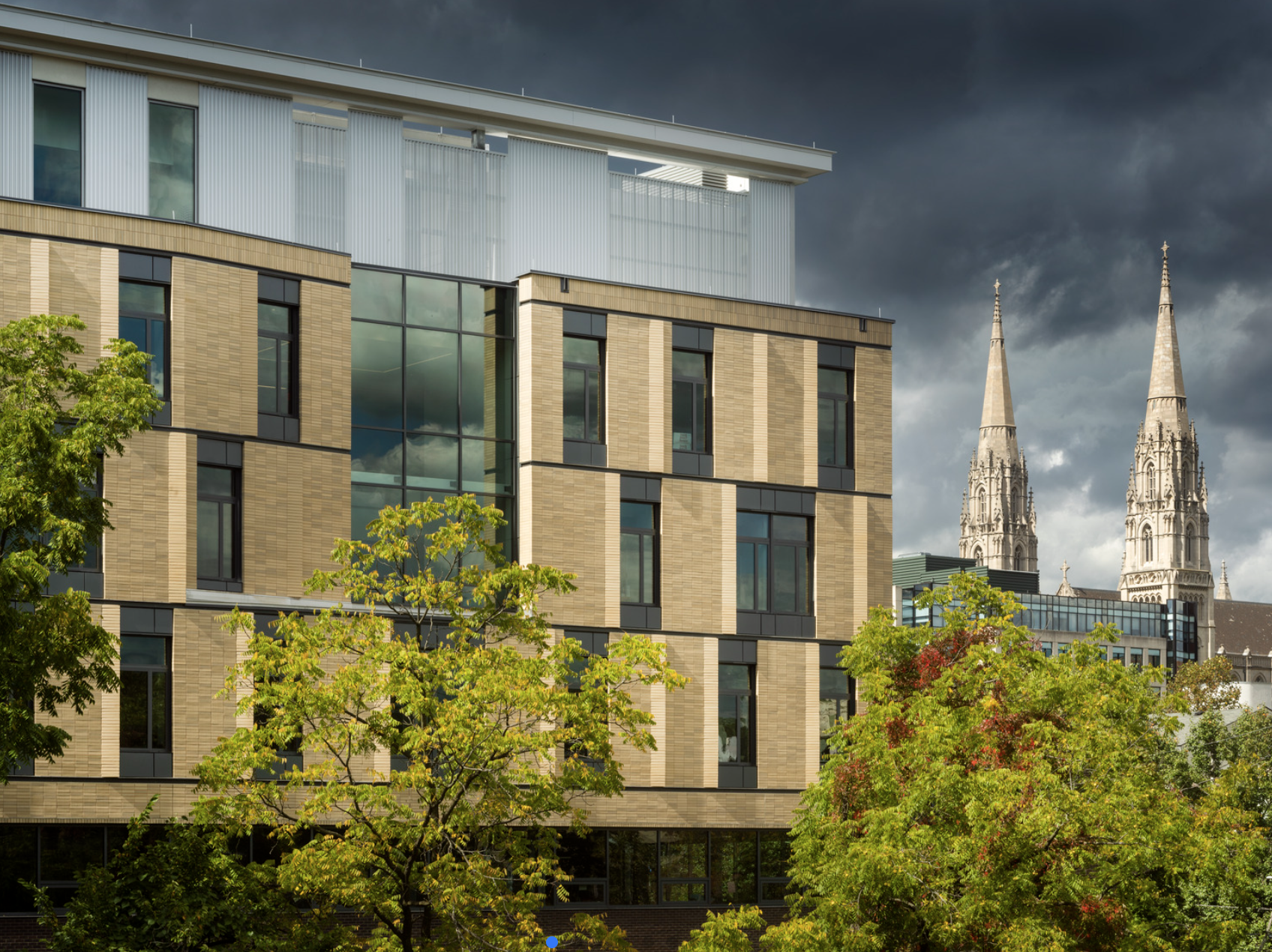
TCS Hall
Carnegie Mellon
Brendan Iribe Center
University of Maryland
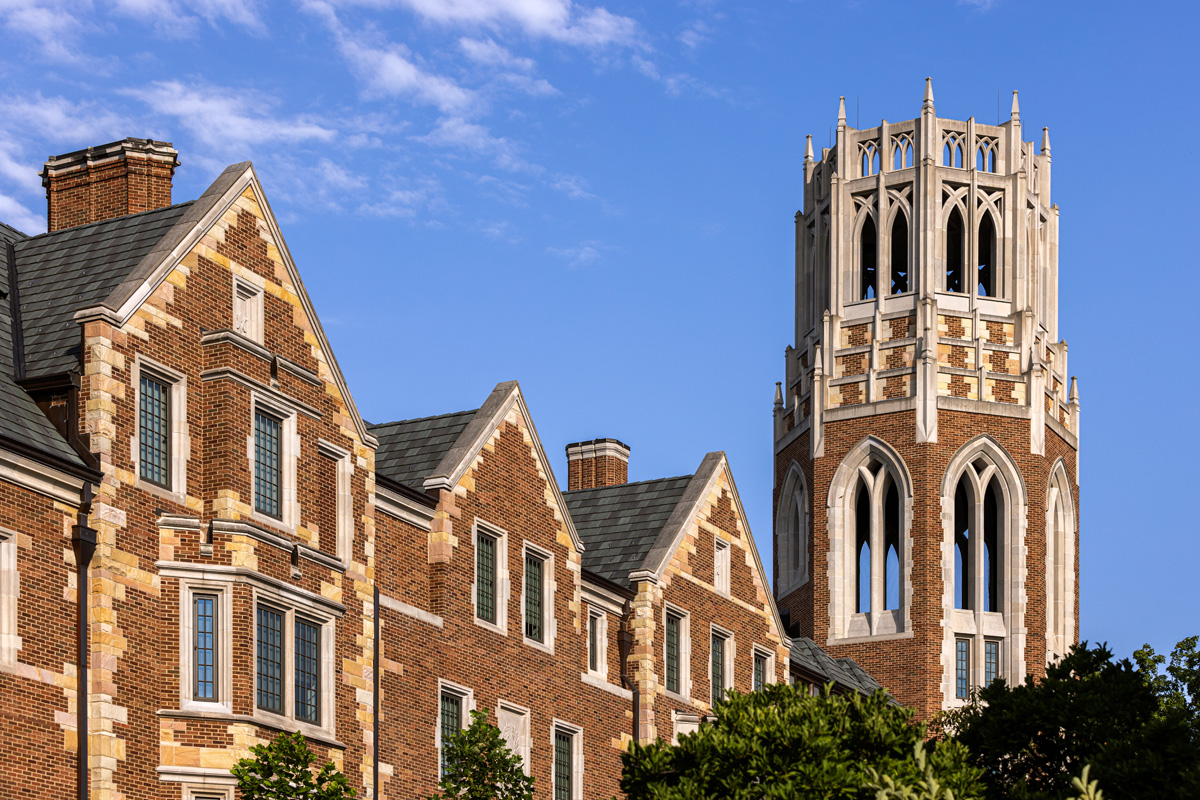
Vanderbilt University
TRANSCRIPT
00;00;00;00 - 00;00;05;12
Doug Pat (DP)
Let's go inside the vault. The design vault.
00;00;05;14 - 00;00;25;16
Steve Knight (SK)
It's a very faithful rendition of what's known as Collegiate Gothic. It is very much in step with this long established tradition of higher education. And that goes back to the church in Europe and then institutions like Oxford and Cambridge. And then it comes over to the states with institutions like Harvard and Yale, who are doing very much the same thing.
00;00;25;16 - 00;00;29;00
SK
They were trying to identify with this established tradition.
00;00;29;03 - 00;01;58;21
DP
In this special series we’re unlocking some of the most powerful conversations we've had so far. We're connecting the dots, revealing hidden gems, and unearthing insights that might have slipped by all to spark your next big idea with brick. Whether you're looking for fresh inspiration or innovative solutions, this series is designed to fuel your creativity. So let's dive in.
Hi, I'm Doug Pat and this is Design Vault. Today, we explore the intricate process of college campus design with insights from Steve Knight of David M. Schwartz Architects, who led the design of Nicholas Zappos College at Vanderbilt University, Kent Suhrbier of Bohlin Cywinski Jackson, who oversaw TCS Hall at Carnegie Mellon University, and Simon Trumble of HDR, the lead designer for the Brendan Iribe Center at the University of Maryland. We’ll highlight various aspects of each project, including the architectural design process, construction challenges and the thoughtful use of brick to blend modern and traditional esthetics.
When working on college campuses, you often have to find balance to respect traditional campus aesthetics while incorporating modern design elements. Steve discussed the eclectic collection of buildings, including a range from Victorian to collegiate Gothic style at Vanderbilt.
00;01;58;27 - 00;02;59;08
SK
The campus itself, it's a really beautiful green garden-like setting. It does have the classification of being an arboretum because of the number of unique specimens of trees one finds there. The architecture is quite eclectic. Like most campuses, there's a kind of a historic heart of Victorian era buildings and some collegiate gothic buildings as well. And then it sort of evolves over time.
I think what's most interesting about the site is kind of a two-sided nature to it. So on one side is West End Avenue, which is a major East-West thoroughfare that connects with downtown Nashville, is sort of the public face of Vanderbilt. So the colleges were a real opportunity, just sort of enhance the university's image to the outward community.
And then on the other side, the opposite side is a very opposite kind of condition. It's a series of very low scale residential structures that house the Greek community. So several houses, each one is a fraternity or sorority. So we had to respond to very different contexts on each side of the building.
00;02;59;10 - 00;03;04;06
DP
Simon reflected on the neo Georgian influences at the University of Maryland.
00;03;04;13 - 00;04;17;19
Simon Trumble (ST)
The campus master plan has defined certain areas as historic and historic buildings that you need to stay within context with and other areas as moving beyond that historic into a we'll call it a new historicism, for lack of a better word, because this was the new gateway and because of where it stands, it was a building that was not fully confined.
However, we put on ourselves the fact that we are in a neo Georgian campus and how do we want to think about it? We've pushed the lines on that. But the handful of elements that come together from that in these neo Georgian buildings are always the white columns. We walk through our building, it's all white columns and there and then places those white columns go from standing very simply straight up to being pulled and leaning as they face the future and the future campus growth and that's kind of how we thought about it.
The brick is used, it's on the floor, and then it turns up the walls in places and it becomes the auditorium itself. And the auditorium spins, it's almost a rock in the river and the campus and the buildings spin around it. The landscape spins off of that rock. The auditorium is the anchor from which everything works.
00;04;17;22 - 00;04;23;24
DP
At Carnegie Mellon, Kent pursued innovative, yet contextually sensitive design.
00;04;23;27 - 00;05;36;12
Kent Suhrbier (KS)
The one thing that then really influenced the design of the building was meeting a kind of very wide floor plate that could accommodate sort of larger laboratory spaces, research spaces, in addition to lots of perimeter office and workspaces. And so we did two things to make that happen. We pulled all the core services for the building kind of to the west of the site instead of locating kind of building core in the middle of the floor plate in a traditional developer building.
This is an asymmetrical core where we pull everything to one side and free up the floor plate. We then cut a big connective series of stairs and interlocking spaces through the center of the building that bring daylight into the center of the building and kind of create a heart between all these various tenants. That also gave us some ability to have a relationship between all the tenants within the building so that they can see each other, experience what's going on with each other, but not be in each other's business.
Because this is a building where you have different research groups, lots of intellectual property that needs to be kept safe between both public and academic groups. And so lots of visual transparency with controlled boundaries.
00;05;36;15 - 00;05;38;25
DP
So the site, is it rectangular?
00;05;39;02 - 00;06;21;05
KS
The site was a much larger quadrant where we master planned for both this building as a sort of phase one, this 88 or 90,000 square foot sort of phase one. And then there's an idea of a connective plaza and paseo that would connect north south through the site. And then there's a phase two project that was developed kind of through a schematic level that's about 190,000 square feet that's adjacent.
It needed to be a very efficient plan. So it starts as a rectangle and then it begins to inflect and kind of reflect some of the views on the site in terms of beginning to bend and open to some of the view corridors and solar orientation that's on site.
00;06;21;07 - 00;06;24;15
DP
Each project sought to blend the old with the new.
00;06;24;17 - 00;07;47;20
KS
One of the challenges with this building was the area that we had to build was a long, narrow strip that runs north south, which then means we have long east and west facades, which from an environmental strategy is the opposite of what you want. And so we let that then start to influence the fenestration. And that's a little bit where this folded or triangular elements came from because we began to think, Look, we need something vertical that's going to shade the windows, right?
They happen just to the south of every window and this kind of code system that we created. And then how do we make them a shape that can catch the light so that as the sun moves around the building all day, it creates shade. But it also then can just be a plane that flashes with this kind of brightness at certain times during the day?
And so we started with the idea of the just the form, and that came out of, yes, the digital models, the physical models, getting everyone to buy into that as an idea. And then to be honest, the CM and the owner wanted to do those elements out of precast. They had it in their head that that was the right answer.
So, you know, instead of being too bullish about it, we said, well, let's mock up both. So we worked with technical folks on the bricks side to get the shape right and get pieces that we can mock up. And then we mock up and precast and everybody looked at it and said, The precast is terrible, let's do the break.
00;07;47;22 - 00;07;50;28
DP
And did you use steel lintels then for those parts?
00;07;51;00 - 00;08;33;19
KS
One of the things that was a great challenge. So the building continuous, we're leaving angles that everything is sitting on and we kind of stacked the deck against the precast because the precast had to hang from additional steel, whereas we were able to get the brick shape to stack just on the regular mantle. So it wasn't meant to be manipulative, but it was meant to be economic.
And we were able to come up with a way where we could keep the same material and offset some of the cost that comes from doing a custom. And these are large brick shapes. These are 16 inches long by about 9 inches deep. And so it's one shape, but it's a lot more substantial than a modular brick. But we were able to offset some of that by just how we were holding it up.
00;08;33;22 - 00;08;47;20
DP
Again, the brick really alters the scale of the building. I mean, I would imagine precast these massive panels on the facades versus doing these very pretty finely tuned brick masonry panels.
00;08;47;22 - 00;08;50;19
KS
I'm glad it ended the way it did.
00;08;50;21 - 00;09;14;02
SK
It's a very faithful rendition of what's known as Collegiate Gothic. It is very much in step with this long established tradition of higher education that goes back to the church in Europe and then institutions like Oxford and Cambridge, and then it comes over to the States with institutions like Harvard and Yale, who were doing very much the same thing.
They were trying to identify with. This established tradition.
00;09;14;08 - 00;09;27;07
DP
Really makes perfect sense. Absolutely. So were there any specific buildings that you can recall that you guys were looking at the tower? Looks like it could have been pulled from the facade from a church in Europe, right? I mean, sure.
00;09;27;07 - 00;10;15;08
SK
We're very eclectic in our approach. We spend a lot of time looking at examples in books. We try to visit places in person, and that was a really important tool at the outset of this project is we actually took members of the client team on a little whirlwind tour of residential college examples around the country. Some examples that we look to for the tower would be the Harkness Tower at Yale.
Slightly more atypical one that we did look at. It would be the Nebraska State Capitol. And I think one feature that we quoted from that one is towards the top of the tower. As it starts to step in, you'll see what we call a little lantern, a little limestone lantern on each of the four corners. That's a common type feature in this style of architecture. When you're creating a tapered tall form like this, We thought it worked very well.
00;10;15;11 - 00;11;09;28
ST
Really. Interestingly, there was a lot of discussion early on that we would go from rhino to construction straight forward. So there are bent and curved steel tubes. There was a lot of discussion with the contractor that they would literally do almost a CAD cam type of situation just using the electronic design drawings to go and construct the building.
However, they did more of a hybrid with that. So we have curved steel studs backing up that brick and those curved steel studs are designed straight from the computer, so then they are shaped and placed a more regularized steel frame, although it has some curvatures as well, also coming straight from the computer. And so those are brought together in order to then layout the auditorium and then to provide backup for the brick and then to work from there.
00;11;10;00 - 00;11;13;04
DP
Wow, what a great way to do it. The only way to do it.
00;11;13;11 - 00;12;34;03
ST
It's doable otherwise, but the reality is the time to do it today is not the same. And you would shy away from doing certain things because it will take too long. We have 22 different curves. You might break that down to five or four and you have two different corners and work from there with the gentler bend. It doesn't make sense, but when you see it in plan, the auditorium itself warps in order to allow the courtyards to re match up from the old computer science building to the new computer science, and then to have a staircase that wraps up to a second floor terrace from which you can access the second floor of the main building.
But you also have this garden space. Again, we talk a little bit about nature and the studies looking at the screen and then being able to go outside. In nature, we have three gardens, we have the great gardens, we have the rooftop on the second floor garden, and then we actually have another garden on the very rooftop called the Reese Park.
And that was a gift, so to speak, from Brendan Irib and Andrew Reece to their buddy who had passed away. And it's got a little gallery up there as well as the garden space then gives to the campus, now, one of the greatest views that they could possibly have, and that gets used all the time for donor meetings, special guests, what have you.
00;12;34;06 - 00;13;09;27
DP
A strong emphasis on craftsmanship and detailed design work was evident across all three projects, whether it was the intricate brickwork, the carefully planned facade systems, or the custom elements within each building. Attention to detail was crucial in achieving the final architectural outcomes. So I read that approximately 30% of construction materials were sourced locally. 30% of the building materials contained recycled content and 75% of construction waste was recycled or repurposed. Is that all correct?
00;13;10;00 - 00;13;48;28
KS
That is, even though we were again trying to work fast and economically there was still a mandate to make a building that was healthy and that would achieve a LEED gold certification. And so we targeted many of these things. And then in some ways with the materials, what we would do is target a combination of what are some of the really significant things, and then can we find local sources for some of the really big pieces of the building.
So the terracotta comes from just over the border in Ohio and the brick in this building is all brick from up at the Hanley plant. So 60 miles from here, just northeast of where I'm sitting now.
00;13;49;00 - 00;14;28;13
ST
And, you know, we have another layer in that brick facade, which is a sort of design element playing up, really showing algorithmic design work in there. It's almost like as if somebody break the bricks and they pull and they fall back into the wall. They almost look like they're falling out, wind blown and in movement. This is in the auditorium and it's a little design feature, really showing off algorithmic design.
You really wouldn't notice the fact that the curvatures has had to be figured out that way or the wood paneling had to be figured out that way. That doesn't show. But that this was a way of really showing and playing with the tool, but using regular brick.
00;14;28;15 - 00;14;30;16
DP
So none of the bricks were custom.
00;14;30;18 - 00;14;32;28
ST
None of the bricks are unbelievable.
00;14;33;05 - 00;14;36;01
DP
And how many different Glen-Gery bricks did you guys use?
00;14;36;04 - 00;15;27;05
ST
The original is a mix of three different bricks, but it's a basically a neo Georgian mix and it's the campus mix that they've had on that campus. The brick was a big debate because when we started to think about this sort of rock in the landscape, we played around with a lot of different materials and we were looking at metal, we were looking at stone, we're looking at precast.
There was other ways to think about it. We started to come back to a precast brick and we came back to regular brick masonry construction. Done the original way. We have some brick lintels up there that are about 3 to 4 feet. Big. Those were if you want really custom detailing to pull that off. But in general, it's the Georgian mix for the campus and it made sense to anchor the campus in its history, so to speak.
00;15;27;07 - 00;15;58;17
SK
Southern Indiana is limestone country, Indiana limestone. It's where the stone was quarried and it's where it is still fabricated. To this day. It is grand tradition. It goes back to the mid 1800s. It had its heyday in the early 20th century with when just imagine the proliferation of limestone buildings one finds in any great city in the U.S. And then it gradually tapered off from there after the war in particular.
But there are still a few very dedicated fabricator firms that do the what they call the cutting.
00;15;58;25 - 00;16;04;27
DP
It had to have been hard to find somebody with so few people doing this kind of this level of detail work.
00;16;05;04 - 00;16;17;24
SK
Well, there's one firm we've worked with on almost all of our projects.They're stil,l this is what they do. They are perfectly set up to do it, Bybee Limestone. We know them very well. We love them and they know us and they love us too.
00;16;17;24 - 00;16;37;26
DP
Yeah, it's stunning. So did brick solve any particular design challenges for the architecture for the client? I mean, you touched a little bit on the color, on the exterior and the feel of the architecture, right? We talked about the fact that you make this building all limestone. You got a problem. I mean, it's just a monolith.
00;16;37;28 - 00;17;42;03
SK
Yeah, well, it's a very warming material. It's a very appropriate in particular, the way it's used here for what is essentially a residential place. It's a very approachable, it's a very durable material. Obviously. And sustainability is very important. We think one of the most important aspects of sustainability is building very consciously using resources very consciously and very wisely, and building something that will hopefully be around for a very long time.
This building will be around for a very long time. We always want our buildings to have a really rich palette of materials, and that's true of the interior and of course, the exterior. So here the palette is a combination of brick, carved Indiana limestone and then an accent stone, which is called Crab Orchard. It's actually a stone that's native to Tennessee.
And we thought that was very appropriate to sort of weave in a local material that one finds in and around Nashville. The brick in particular is really interesting because we knew we didn't want a stark reed of just one color, right?
00;17;42;03 - 00;17;44;09
DP
Like if the building was all limestone?
00;17;44;09 - 00;18;06;02
SK
Was all limestone, right. And even within the brick itself, it's not just one brick. It's actually a blend of three bricks. And we did lots of mock up panels with the help of a very patient Mason in a very patient local brick distributor who gave us about an acre of their brickyard to do all these different experiments.
00;18;06;02 - 00;18;07;06
DP
Wow. That's so cool.
00;18;07;06 - 00;18;41;29
SK
We tried different blends and we ultimately settled on a blend of three bricks for the college, and then we further augmented that with what we call decorative bond detailing. So if you look closely at some of the details, you'll see brick that's fashioned into basket weave patterns, sawtooth patterns. What's known in England is diapering, which is creating a sort of a diamond checkerboard pattern.
And we use different bricks for that as well. They tended to be iron spot bricks that are really beautiful because they catch and reflect light in different ways depending on how the sun is hitting them.
00;18;42;02 - 00;18;58;04
DP
All three projects faced unique challenges during construction to control costs, while ensuring the integrity of the design can explain how significant design adjustments actually benefited both the project's budget and its aesthetic coherence.
00;18;58;06 - 00;19;55;23
KS
We would price kind of really almost every 2 to 3 months during design and in some cases make some fairly dramatic shifts in terms of what we were doing, whether it was restocking, you asked about zoning, the building could have been taller and actually started off a story taller and we kind of restacked it and made it more compact specifically to create some economies.
And then that had some opportunities for us too because we were able to create the kind of think tank penthouse on the top, which isn't a full floor. And then all of our mechanicals are kind of stitched into that from a massing standpoint. So we could get a lot of both economy, but also just this is a building that you see from across the ravine.
We didn't want to weave all the mechanical equipment and all these things kind of fully exposed up on our roof. So it was a way of really stitching it into the building and making it part of the intentional mass of the building instead of an accidental, no offense to our engineers, piece on top.
00;19;55;25 - 00;20;12;04
DP
Well, it's something that happens on most pieces of architecture. I mean, that's just where do the mechanicals go? Simon reflected on the challenges and debates surrounding the unique brick curvature of the Brendan Iribe Center’s auditorium.
00;20;12;06 - 00;21;15;00
ST
The curve on the brick was a lot of debate. When we worked on this early. We looked at an egg sitting in the landscape. We were thinking of that egg. The curvature is both in the bottom as well as the top and we spoke with a lot of brick experts on doing, I'll call it the counter curve, the bottom half of that curve.
And in that discussion we would have to use seismic anchors to really hold the back. And there was a lot of discussion about whether we really have to invite quibbling into this or if we could follow the curvature of the bill. At the end of the day, I think we chickened out just a little bit. We took it, I'll call it from the belly line straight down and from the belly line above as the curve.
Our thought was within the auditorium. We could light that bottom space, so we'd put a curved light at the base and really have that belly kind of light up. And so the egg would sort of glow from the base. We do have that at the top as well. It solved a lot of other little issues, as you say.
So it took the detailing down a notch.
00;21;15;02 - 00;21;27;07
DP
An innovative construction technique was used for the Nicholas Zappos College at Vanderbilt University, where the team found a clever way to streamline the installation of the building's ornamental chimneys.
00;21;27;10 - 00;22;03;14
SK
One of the details that makes the college's really fun and interesting are these ornamental chimneys that you find on the roof. And the contractor hit on a really interesting idea because in particular after the previous college where they did not do this, they elected to construct the chimneys on the ground wall and then hoist them into place with the tower crane that allowed them to advance construction on the roof without tying up a huge amount of roof area with scaffolding and preventing them from drying in the building. It was just a much easier erection process down on the ground.
00;22;03;16 - 00;22;06;19
DP
You just have boiler flues going through these things.
00;22;06;19 - 00;22;10;29
SK
They're vents, they're flues. So they do serve a functional purpose as well.
00;22;11;02 - 00;23;54;20
DP
I think that's a wonderful touch. You wouldn't expect to see these chimney masses on a building like that. They really kind of set it apart. Reflecting on the design and construction of the Nicholas Zappos College at Vanderbilt University, TCS Hall at Carnegie Mellon University, and the Brendan Iribe Center at the University of Maryland, several key themes emerge.
Each project balances tradition and innovation, blending the historical context of the respective campuses with modern design elements. The architects Steve Knight, Kent Suhrbier and Simon Trumble emphasize the importance of collaboration through the process, working closely with clients and construction teams to navigate complex challenges and bring their vision to life. The use of brick as a primary material in various forms, whether to echo collegiate Gothic tradition, create rhythmic facade patterns or blend into a neo Georgian context, showcases how this timeless material can be reimagined to meet contemporary re needs.
The overarching takeaway from these projects is the power of architecture to create meaningful spaces that honor the past while embracing the future, ultimately enhancing the academic environments they serve. If you'd like to hear more about each individual project, you can find links to the full conversations in the show notes. If you haven't done so already, make sure to subscribe so you don't miss the rest of this series where we revisit some of the most powerful conversations and unearth insights that might have slipped by all to spark your next big idea with brick.
You May Also Be Interested In
We Can Help With Your Next Project
Discover the latest + greatest in design trends, industry news & pro tips from pros.
For all of your project needs, you’ll find everything you need at a Supply Center.
Let Us Know How We Can Help!