Favorites
Design Vault Ep. 7 Henhawk House with Sussan Lari
ABOUT THE ARCHITECT:

|
As a graduate of the University of Tehran's School of Architecture in her native Iran, Sussan Lari continued her studies in America by completing two master's degrees in architecture and planning from the University of Pennsylvania. She began her professional career with the Eggers Group P.C., Architects, Planners, Interior Designers, where she was the first woman to be named Vice President and stayed with them for 13 years.
After giving birth to her daughter, Sussan founded her own firm - Sussan Lari Architect PC - in 1992, jumpstarting the new company with corporate interior architecture projects in Manhattan. In time, Sussan's interest evolved and today Sussan Lari Architect is a full-service boutique architectural and design build firm that crafts custom residential and commercial architecture in the greater tri-state area. This change of direction brought about a change of personnel; a new team of well-trained, devoted, and detail-oriented collaborators capable of handling the required creative and technical challenges. Sussan was elected President of the Long Island Chapter of the AIA for the year 2000, and her firm is an ongoing member.
Sussan Lari Architect aims to design and help build functional, comfortable, and beautifully designed spaces for modern living. The firm prides themselves on maintaining a mindful collaboration with all their clients, while also accomplishing their goals within budget and on schedule. By implementing a multidisciplinary approach, every project encompasses the entire spectrum of design and the construction process. Through meticulous attention to detail and passion for creative design solutions, their work is a unique reflection of each client's needs. This year, Sussan is celebration the 30-year anniversary of Sussan Lari Architect PC. |
|---|
ABOUT THE PROJECT:
This project was a gut renovation and major expansion of an existing residence. The existing structure was approximately 4,100 square feet of a Tudor style architecture. Sussan's client purchased the house mostly because of the size of the property and its location. What they ended up keeping was the dining room, as the client liked the architectural, plaster ceiling and its decorative elements. We also kept the living room and its fireplace with the brick chimney that stood tall above the roof. Everything else was eliminated including the cellars.
The new 13,300 square foot construction framed these two existing rooms and expanded in three directions. The revised second floor added height to the first floor, except for the dining room that remained with a lower ceiling height. This design outcome was a L-shaped structure with a multi-level first and second floor which added playfulness and provided much higher ceilings for most rooms in the house.
The gallery was maintained all along the first and second floors overlooking the internal garden where the pool is located. The house enjoys plenty of windows to bring in natural light and connect the inside to the outside. Although the house is a Tudor style design language on the outside with intricate brick design layering, stucco & wood paneling, the inside is completely open, expansive, bright, and modern.
An excellent combination for today's modern residences with a classical exterior and a delightfully modern interior.
Henhawk House
Sussan Lari Architect PC
View MoreTRANSCRIPT
00;00;00;03 - 00;00;05;13
Doug Patt (DP)
Let's go inside the vault. The design vault.
00;00;05;15 - 00;00;36;20
Sussan Lari (SL)
The idea become into doing a L-shape design, and because it was kind of long L-shape, it gave me the opportunity to create the design as there are certain components of structures together with the playfulness of the roof, which is important for Tudor style and also different height and introduction of stucco and introduction of wood paneling, framing, stucco and brick.
00;00;36;23 - 00;02;42;08
DP
This is my guest, Sussan Lari. I'll share more about her shortly. In this episode from the Design Vault we’ll highlight Sussan's project, Henhawk House. This project was a renovation and major expansion of an existing 4,100 square foot residence. The new home is approximately 13,300 square feet.
The home features steeply pitched slate roofs, multiple gables of varying size, light red brick facades and half-timbered elevations with stucco infill and light gray wood. The homemade brick is highly detailed, with soldier, diagonal and herringbone coursing. The design also features tall, narrow windows, elliptical masonry archways and red copper gable finials, all of which reference early English domestic architecture and of course, the Tudor style. Although the exterior of the house is a traditional design language, the inside is completely open, functional, expansive, bright and modern.
Hi, I'm Doug Pat, and this is Design Vault.
Today we're talking to Sussan Lari, AIA. Sussan is a graduate of the University of Tehran School of Architecture in her native Iran. Sussan continued her studies in America with two master's degrees in architecture and planning from the University of Pennsylvania. She began her professional career with the Eggers group, P.C. in New York, where she was the first woman to be named vice president.
Sussan founded her own firm in 1992. Her businesses have full service, boutique, architectural and design build firm that crafts custom residential and commercial architecture in the greater tri state area. Sussan was elected president of the Long Island chapter of the American Institute of Architects for the year 2000, and her firm is an ongoing member. Sussan Lari, Architect, P.C. is celebrating their 30-year anniversary.
So, let's get into the details. Welcome, Sussan.
00;02;42;13 - 00;02;43;12
SL
Thank you.
00;02;43;14 - 00;02;51;15
DP
So, Susan, tell us a little bit about your firm. Where are you located? What's the size of the firm and what type of work do you typically do?
00;02;51;21 - 00;03;43;22
SL
My firm, located in Village of Rosslyn in Long Island. It's about half an hour drive from Manhattan, is on the north shore of Long Island, Nassau County. The space that we occupy is a very old building that was built in 1796. And we actually are the very first tenant of that upper portion of the building. The building was used mostly for offices, for timber construction. And it's a landmark building.
The owner of the building eventually was changed and turned into medical offices on the lower level. And then the upper portion was like an office space and a magnificent space in the attic that has never been used.
00;03;43;25 - 00;03;47;25
DP
And the space worked out in terms of your size and number of people you have.
00;03;48;00 - 00;05;05;05
SL
You know, I always wanted to have a smaller firm. I am a bit of a control freak, a bit OCD with perfectionism. So fortunately, or unfortunately, applies to my projects as well. I need to be intimately involved in the entire process, not only design but also selection of material finishes, you know, detailing selection of the trades. So, I thought that we really wouldn't and shouldn't have many, many projects at once.
So, my intention has never been to have a very large office. So, we all kind of involve on purpose intimately with every single project going on in the office. I believe that if I get my staff involved in the life of the project, then they will be more interested to contribute and perform to their best ability and they’re all involved with the client. So, it's like we all together. The number of people working for me at this point are five. So, we are six of us altogether. And at this point and for a while actually majority of our concentration has been on residential projects.
00;05;05;07 - 00;05;09;03
DP
So, what is your role in the office? What are you involved with?
00;05;09;06 - 00;05;11;01
SL
I put so many different hats.
00;05;11;04 - 00;05;12;13
DP
I kind of thought so.
00;05;12;15 - 00;06;00;03
SL
It's bringing marketing and bring client in. Although I have help. But then interviewing, accepting the project, preparing fee proposals. Design is all mine. That's what I do. Although right now Riccardo from my office, who is actually on paternal leave, has trained to be very good designer as well. As much as possible, I could make it happen, I let him get involved to have his point of view and he's really getting better and better. Majority I would say the concept is mine, detailing is mine, the bricks should be on an angle is mine, the interior architecture is mine, furniture furnishing... So I do a lot.
00;06;00;05 - 00;06;06;01
DP
So, tell me, you do a lot of drawing by hand, a lot of sketching. Is that the way you pass along your information and the ideas?
00;06;06;04 - 00;06;17;20
SL
No. Actually, yes, I do hand sketch. I do hand sketch during schematic and when I would like to explain an idea is all hand sketch, but everything else is CAD.
00;06;17;22 - 00;06;20;03
DP
Okay, so what CAD system are you guys on?
00;06;20;10 - 00;06;57;29
SL
Your basic CAD. Actually, because we are too detailed. I checked all different advancements of CAD, and I kind of thought that what we have, which is really basic CAD, has been incredibly helpful for us to provide us the possibility to go detailed. We detail everything. Like our set of construction drawing is close to maybe 30 drawings, just architecture. And when it gets to interior architecture is another like 30 drawings. We detail like cabinetry and bathroom tiles, that kind of stuff.
00;06;57;29 - 00;07;04;16
DP
Yeah, you get into everything. So, let's talk about the Henhawk house. So, tell me how your office got the project.
00;07;04;18 - 00;07;07;05
SL
Well, as usual, they find us-
00;07;07;07 - 00;07;07;26
DP
Word of mouth?
00;07;08;03 - 00;07;36;26
SL
Word of mouth. And they came to us. And it's a young couple. Very young. And the house was - they fall in love with the land. Location is really a fantastic location. The tree lined boulevard type street in Long Island. The house itself was Tudor style, brick, relatively small. Zoning wise, we were allowed to build close to 8,000 square feet and the existing house was close to 4,400 square feet.
00;07;36;27 - 00;07;38;13
DP
So, there's an FAR there?
00;07;38;15 - 00;08;06;10
SL
Yes. Yes. Everything we do is full force zoning and rules and that kind of I've learned them really well as much as can be played with, we have learned it all. But the house had character. But the house was dim, like typically Tudor style houses from outside are just stunningly gorgeous piece of structure. And when you go in, it’s just sad, dark.
00;08;06;15 - 00;08;11;23
DP
I love the way you describe that. It's so true. So many Tudors really feel that way. Absolutely.
00;08;11;29 - 00;08;47;14
SL
You know, in a way, it gives this kind of fear of people to the Tudor because they think Tudors are supposed to be dark interior and that is not going to happen with my approach to design, because I like the style of Tudor and I don't like the style of sad inside spaces. So, it's bright and happy and is open, is spacious. You know, lots of windows. And in this particular case, the expansion of the house was extensive because I needed to keep a chimney.
00;08;47;21 - 00;08;50;00
DP
Was this a functional chimney or boiler flues?
00;08;50;02 - 00;09;09;17
SL
Yes, functional chimney. And then we wanted to keep a fireplace. We wanted to keep a chimney and they wanted to keep the ceiling - plasterwork ceiling of a dining room - so I said, okay, if we keep all those three, but we get rid of everything else and that's what we-
00;09;09;18 - 00;09;12;10
DP
Wow, Right. I'm sure the contractor loved that.
00;09;12;14 - 00;10;27;23
SL
I work with a contractor. I absolutely love him. I'll get to the stories of my contractors because we are very involved in the construction process. So, my knowledge of construction is very high. And the contractor on this job was incredibly knowledgeable man who loved to do stuff like that but didn't care much to deal with clients and with everything else, paperwork,
So, it worked perfect. The idea become into doing a L-shape design, and because it was kind of long L-shape, it gives me the opportunity to create the design as there are certain components of structures together, section by section with the playfulness of a roof, which is important for Tudor style and also different height and also introduction of stucco and introduction of wood paneling, framing stucco and brick, and also playfulness of a brick. I think we were good in accomplishing that because it has its playfulness, and although it is relatively large, but it is not overwhelmingly massive.
00;10;27;29 - 00;10;29;18
DP
Yeah, I'd say it's well scaled.
00;10;29;21 - 00;11;23;02
SL
It is small scale, right? And then at the end we realized that there's no way we could match the old brick. So, I know Glen-Gery very well, because if I ever have done any brickwork, has been Glen-Gery. And why? Because the quality of the material, and I get service. So, I am fussy enough to worry about the size and also worry about the color of the grout. And I want to have two samples of it made before I even decide what color bricks. So, a rep does that service for us. And due to color, we provide the color to what brick and between those is what I chose. And eventually – and I have awesome mason that are Italian and five brothers and they’re one better than the other. They're local. And they do a magnificent job. And also they built a good size.
00;11;23;05 - 00;11;25;18
DP
They did a mockup for you.
00;11;25;20 - 00;12;06;23
SL
Mockup. Absolutely. And one other thing that I was almost kind of experimenting on this project was that I love the style of Tudor on the outside. I don't like the inside. So that was one issue. Second issue, I like the playfulness of how we could create interesting textures and playfulness of the laying of the brick, but Tudor would allow me to do that because we are compartmentalizing pieces, here and there. Other styles don't do that. And then that herringbone style has to be compartmentalized. Right?
00;12;06;26 - 00;12;08;23
DP
Yeah. And between the boards, I think at one.
00;12;08;23 - 00;12;55;10
SL
And between the board would work. We shouldn't do too much of it because too much of accessory, not good. So it allowed me to experiment and do detailed work and also choosing of the color of the brick and the color of the stucco and the freedom I had in detailing and designing and working also with the roof and with the roofer - I’m friend with the roofer, I'm friend with the Mason man, I’m friend - and to make sure that we get eventually a beautifully detailed house on the outside. And then when it come to the inside, our life is modern. We are living in this time. Our space should be representing our era.
00;12;55;17 - 00;12;57;29
DP
Did you guys use any brick on the interior?
00;12;58;06 - 00;13;00;14
SL
Not on this project.
00;13;00;16 - 00;13;08;06
DP
What were some of the historical precedents we were talking about? Details. Were there any local buildings that were Tudors? Was this the only Tudor locally?
00;13;08;06 - 00;13;27;22
SL
Yes. Actually, no. No, it's not. In this particular street, there are many other brick buildings. Typically, I would drive out on and look at the center and say, ‘Oh, this is so gorgeous.’ And, you know, it's one more beautiful than the other one. But I think mine, right now, it's really complete, in good level.
00;13;27;26 - 00;13;42;27
DP
I love – I love it. It's so great. Were there any significant setback issues? So, we were talking about the size of the existing houses almost three times smaller. Were there a significant number of zoning issues other than FAR, setback things?
00;13;42;29 - 00;13;51;21
SL
Yes. The chimney that I wanted to keep, which was right above the fireplace, was outside of skyline exposure.
00;13;51;22 - 00;13;54;09
DP
Okay. There was a height restriction.
00;13;54;11 - 00;15;41;16
SL
Yes, we always have height restriction. In this case, I said this an existing building. This is not a new house. This is a renovation of an existing house. So, I'm allowed to keep the chimney. And that chimney the end up to really change the inside of the chimney and outside of the chimney and all the bricks and everything.
But we kept the height – now, the zoning, building department going to hear that – fortunately, we had no issue of the setback because we had plenty of space from the front of the house in Kings Point, the setback requirement for front yard is 60 feet and we had way more than 60 feet. It was deep enough that I was able to create a parking courtyard in front of the house and the garage. We have one two car garage on the upper level and then three car garage in the lowest level. The garage is actually coming further out from the front of the house, but I don't think we had any other zoning issues.
But one other feature of the house that I thought it’s kind of important, as I was driving around and see all these Tudor houses, Tudor is not a box. Tudor is never a box. Tudor span, and that is one beautiful feature of when these all expand. We had a lot of width. Plenty of available width. The size of the property was very large, and we had enough room on the site and I thought that if I could add an extra width to the house we’ll be introducing a brick wall extending from the garage and that will be the access from the front of the house to the garden.
00;15;41;18 - 00;15;45;06
DP
And then you did a series of small windows along the garage, correct?
00;15;45;10 - 00;16;03;14
SL
Yes, because a simple wall without any detail in the front elevation was not a good idea. If I can introduce fenestration into the wall and breaking it because this is, again, the style of Tudor.
00;16;03;16 - 00;16;08;21
DP
Did you guys get to do any new details on this project that you hadn't done in the past?
00;16;08;23 - 00;16;23;28
SL
Yes. That brick herringbone is new. The playfulness of the brick above the entrance hall in the front and back. Front and back are identical in what they represent, and we don't repeat ourself. Literally, none of our projects are the same.
00;16;24;00 - 00;16;29;11
DP
I love the red copper finials on the gable ends. Does that double as lightning protection?
00;16;29;17 - 00;17;19;16
SL
Yes. And our roofer is just a master roofer. Unfortunately, he retired after pandemic. We loved him. Just spend a lot of time together coming up with ideas. And he performed beautifully.
And the door - there's also some - another feature we kept many of the existing trees. Trees are valuable. Don't like to cut trees. Doesn't matter if the tree is close to the house or tree is in front of the house. What’s wrong? Tree wants to be where tree wants to be. So, it was a tree that was really beautiful and wouldn't end up to be right in front of that passage to the garden. I couldn't cut the tree, said ‘let it be.’ And actually, in some of the pictures, you could see that the tree is right in front of the passage.
00;17;19;18 - 00;17;28;18
DP
So, this is a traditional home, but this question is kind of top of mind for most people today. Does sustainability come up with your clients at all, and materiality that you guys are using?
00;17;28;18 - 00;18;51;12
SL
Not with the client, but with my – with me, my office. We always do that. I've learned that maybe I've been kind of lucky here and there, having people who really care about sustainability. Sadly enough, majority don't, or they do not necessarily connect building material to sustainability. So, my office does for years. We do it without naming it because then they're concerned about the cost.
There are many different areas that we could really think about building the quality of heating and cooling system, the energy conservation insulation system. Those I do with that saying. My clients often who would not be bothered with that. Selection of the windows, undoubtedly. Using windows with the UL rated that transform the least amount of light, not brightness, but UV into the house we do. When it comes to insulation system, all spray foam. This goes without saying in every project we do. Selection of the material, natural, as much as we can. Selection of materials that are not biodegradable. I fight for that, to not do it.
00;18;51;15 - 00;18;53;27
DP
Did your clients want to use brick from the very beginning?
00;18;53;27 - 00;19;14;28
SL
Yeah, because their house was already brick. So, I thought that they liked the house, they loved the ceiling of the dining room. So fine, that was. And then I said, what else do you like? “We like the fireplace.” Okay, I like the chimney, but they like the fireplace. Fine. What else? “Brick.” And I said, okay, because Tudor style is brick.
00;19;15;04 - 00;19;23;24
DP
Well, I'm thinking it's solved so many design challenges for you guys. I mean, you got to be really playful with brick, but it also solved a lot of problems.
00;19;23;26 - 00;19;39;20
SL
Well, with brick, needless to say, is an amazing material. And it has been used for centuries and centuries and centuries, and still doing well. So, I don't quarrel when it comes to selection of brick.
00;19;39;23 - 00;19;44;00
DP
Did your team learn anything interesting through the process of building this building?
00;19;44;07 - 00;19;46;08
SL
We do on every building, actually.
00;19;46;10 - 00;19;53;22
DP
Isn't that interesting? It doesn’t matter how long you've been practicing, every one of us seems to learn something new every - every job. More than one thing.
00;19;53;28 - 00;19;57;26
SL
Undoubtedly. Information constantly changing.
00;19;57;27 - 00;20;00;09
DP
Yeah, that's a good point. It really does. Yeah.
00;20;00;11 - 00;20;30;09
SL
And what is available in the market constantly change. I think we become obsolete if we do not pay attention to what's happened. If we become comfortable in doing the same thing on and on, then our curiosity also lacks. And then we become so proud in what we do because we are successful and we are, you know, making money and we made it and we repeat the same thing. That is kind of the end of creativity.
00;20;30;11 - 00;20;35;18
DP
Off subject, have you thought at all about A.I. and what it means for our profession?
00;20;35;20 - 00;20;59;05
SL
Yes. I kind of love the idea. Yes. And I know that so much of worries there is there of AI to replace human beings. At the end, we are using the AI either to our benefit or not, but I think the benefits that AI could do are so amazingly high.
00;20;59;07 - 00;21;00;18
DP
So, using it as a tool.
00;21;00;22 - 00;21;01;27
SL
Like everything else.
00;21;02;04 - 00;21;20;23
DP
Well, I just wonder at what point, how much control are we going to have over how we're using AI, how our clients who aren't coming to architects are using AI, whether or not architects will ultimately use it as part of their services? It's a huge can of worms, but it's definitely something I've been thinking about.
00;21;21;00 - 00;21;24;01
SL
Let me tell you something. When I was graduating from UPenn-
00;21;24;02 - 00;21;25;11
DP
I went to Penn, by the way, too.
00;21;25;12 - 00;21;26;15
SL
Did you?
00;21;26;19 - 00;21;27;21
DP
I did. For graduate school, yeah.
00;21;27;26 - 00;22;02;19
SL
Okay. So same with me, graduate school. When I was graduating, they had a lecture, a farewell lecture. And the lecture was kind of gloomy because now you're done, graduated. We're sending you off to practice architecture, but we want to let you know the number of percentage of American buildings being designed by architects – I don’t remember exact number, but it was between nine and 11 – and then they said, compared to European – that I remember very well – 45%.
00;22;02;19 - 00;22;03;14
DP
Wow.
00;22;03;16 - 00;23;39;10
SL
So, I left school knowing that. Then I was thinking that that is not the problem necessarily with architect, but the problem of American not know what we do and the importance of our presence for every project. And that is again and again and again, we need to somehow change that level of knowledge of public work, which I think AIA is trying to do the best of their ability to inform public as the importance of architect, because we are not a set of drawings.
If anybody thinks that our work is a blueprint, then they have no clue of the importance of architect in any project. And we should also never try to compare ourself or believe that builders have taken our spot because typically, especially for residential architecture, people go to a contractor sometime before coming to the architect, and that is because contractor has been available and present for years and architects have not been available and present.
And the majority of quality architects, they don't want to even go to residential architecture because to them is just not good enough. And they have left this vast possibilities. We have – our builders build these buildings, by not the fault of themselves, because they don't know better of whatever is left of the world of residential architecture in America is sad.
00;23;39;12 - 00;24;14;07
DP
Wow. What I like about your position is that it's very positive, right? You could sit there and say, you know what, we're done designing, AI is going to be able to do it. It's going to have access to every design in the world and it's going to take over the world. And I love your explanation of being in school and hearing that architects – and I think I heard the same thing, that they were only responsible for a very small percentage of what was actually being done out there – and the reality is you still have a job and I still have a job, and although our jobs may change, I think we're going to be busy for a long time.
00;24;14;08 - 00;24;59;13
SL
We're going to be fine. We're going to be fine. And I think is gradually shifting. If people are shifting toward being concerned about their well-being, if shifting about being concerned about their health, their eating habit, small percentage, but we are small percentage when it comes to using our services. So, I think architecture and our part of the work, which is the importance of aesthetic, this is something I cannot put more emphasis on than anything else. Even if you don't need my knowledge, fine. But then the contractor’s knowledge – yes, he has knowledge of construction and maybe knowledge of material, but doesn't have knowledge of-
00;24;59;13 - 00;25;00;23
DP
Doesn't have the aesthetic training.
00;25;00;26 - 00;25;01;22
SL
No.
00;25;01;24 - 00;25;04;10
DP
Well, Sussan, it's been really nice to meet you.
00;25;04;15 - 00;25;05;28
SL
Thank you so much.
00;25;06;00 - 00;25;09;21
DP
So where do people go to find out more about Sussan Lari Architect, PC.
00;25;09;21 - 00;25;14;24
SL
I have a website, sussanlariarchitect and Instagram.
00;25;15;00 - 00;25;18;04
DP
Very good. Well, thank you very much for being here. It was really nice to meet you.
00;25;18;05 - 00;25;19;13
SL
Thank you very much for inviting me.
00;25;19;15 - 00;25;20;28
DP
I love your house. It's beautiful.
00;25;21;03 - 00;25;24;10
SL
Thank you.
You May Also Be Interested In
We Can Help With Your Next Project
Discover the latest + greatest in design trends, industry news & pro tips from pros.
For all of your project needs, you’ll find everything you need at a Supply Center.
Let Us Know How We Can Help!
Design Vault Ep. 6 Guildford Court with Peter VanderPoel
ABOUT THE ARCHITECT:

|
Peter VanderPoel is a practicing architect licensed in Maryland, Washington DC and Virginia. His practice focuses on residential and small commercial projects in and around Washington DC. He received a Bachelor of Architecture from the University of Kansas and a Master of Architecture from Virginia Tech and is a Certified Passive House Consultant. He has taught architecture at the university level for over 10 years and is current an Adjunct Professor at Virginia Tech's Washington Alexandria Architecture Center (WAAC) in Alexandria, Virginia. |
|---|
ABOUT THE PROJECT:
The Guildford Court project was an opportunity to build a luxury home in a suburban area of McLean, Virginia. The demands of the site were the driver of the design. The lost is similar to the state of Georgia, both in shape and orientation, and is located on a cul-de-sac with a very narrow street frontage. The property lines that extended back from the street describe an angle of approximately 60 degrees. The lot if very steep, rising 20' as it extends back from the street to the northwest. "I find the best architectural solutions as ones that respond and accommodate external forces, rather than ignoring or fighting them" - Peter VanderPoel.
The 60 degree angle drawn by the property lines suggested three axes might be used, as a hexagon is defined by three axes to enclose its shape. The program called for three major components: automobile access and garage, semi-public (formal and casual entertaining) and private. Moving cars across the site and garaging them is naturally limited by a cars ability; climbing steep hills and parking on steeply sloped surfaces is undesirable. The south side of the site is the lowest area with a minimal slope running from east to west. This proved most desirable for moving cars on and off the site. Placing the garage block here would also provide some privacy for the interior portion of the lot. These axes allowed for programmatic elements to respond to one of the three axes, depending on needs and relationships. The street frontage is similar to Georgia's Atlantic coast; relatively narrow and near the south side of the property. The semi-public portion of the program is located here with an area for an office near the front entrance, beneath the private block and the family functions in the main, brick clad block. The private portion of the program was placed on the east side of the property raised up to meet the high end of the site, resting on the semi-private block. Stairs provided the hinge on which to turn these three block through their 120 degrees rotate with the semi-public and private stairs expressed as a grand, sculptural stair with a large skylight about. The splayed organization allowed for a natural courtyard scheme with the south and east side screened by the house itself and the trees and slope at the north and west to screen those views. The privacy afforded by this arrangement was leveraged by inclusion of a pool in this area. A series of terraced retaining walls, reliant on the same 3 axis grid, sculpted the steep portion of the site and carved out the level area for placement of the pool.
Guildford Court
Peter VanderPoel Architects
Read Case StudyTRANSCRIPT
00;00;00;00 - 00;00;05;13
Doug Patt (DP)
Let's go inside the vault. The design vault.
00;00;05;15 - 00;00;30;15
Peter Vanderpoel (PV)
Even though it wasn't important at the moment, but with COVID, the idea of having a prominent place or office in the house also came to the fore during the design process, three car garage, the expectation of a pool, some sort of flattened area for a deck around that pool, and then we've got the very steep hill in the back that turned into this terrace for someone could lay out there and get sun. It's fairly private there in the center of that spot.
00;00;30;17 - 00;02;15;21
DP
This is my guest, Peter Vanderpoel. I'll share more about him shortly. In this episode from The Design Vault, we’ll highlight Peter's project, Guilford Court. Guilford Court is a luxury home in a suburban area of McLean, Virginia. The lot is angular and located on a cul-de-sac with narrow street frontage. It's also quite steep, rising 20 feet as it extends back from the street.
Peter uses three separate virtual axes to inform the floor plan and programmatic organization of the house. The garage, located on the south side of the property, is clad in wood, while the private portion of the house, which resembles a kind of modern Tudor facade, is enclosed in fiber cement siding. The middle semipublic spaces are enclosed in a dark brick veneer.
The landscape also reflects the same three axis grid with sculpted geometry that level out the site.
Hi, I'm Doug Pat and this is Design Vault.
Today we're talking to Peter Vanderpoel, registered architect of Vanderpoel Architecture. Peter is a practicing architect, licensed in Maryland, Washington, D.C., and Virginia. His practice focuses on residential and small commercial projects in and around Washington, D.C. He received a Bachelor of Architecture from the University of Kansas and a Master of Architecture from Virginia Tech.
He's a certified Passive House consultant and has taught architecture at the university level for over ten years. He's currently an adjunct professor at Virginia Tech's Washington Alexandria Architecture Center, located in Alexandria, Virginia. So, let's get into the details. Welcome, Peter.
00;02;15;26 - 00;02;16;14
PV
Thank you.
00;02;16;16 - 00;02;27;21
DP
Thank you very much for being here. So first, tell us a little bit about Peter Vanderpoel architecture. Where you guys located? What type of projects do you take? And what have you been working on lately?
00;02;27;23 - 00;02;55;18
PV
The practice is located in Arlington, Virginia. If you're from the area, it's not far from the courthouse metro. Arlington used to be part of DC before receded back to Virginia a few hundred years ago. So we're right near downtown D.C. The practice is mostly residential and some small commercial projects. I'm trying to expand some of the commercial portfolio just to have a better balance in the marketplace. But I've been practicing - I've been on my own now for about 20 years now.
00;02;55;20 - 00;03;02;01
DP
Wow. So, tell me a little bit about the office. So how many people do you have working with you? Is that pretty consistent?
00;03;02;08 - 00;03;27;04
PV
So, the studio is in the backyard of my house, but it is off grid, so I have solar panels to run it and huge battery and a room in the back. It's not a passive house quality in terms of the exterior envelope, but it sort of leans those ways in response to the site. But it's very small. It's not much bigger than a garage. And I have two employees there, one full time, one part time. We can spend most of our day in there in a pretty comfortable fashion.
00;03;27;06 - 00;03;34;18
DP
That's pretty cool. Let's dig into that a little bit. So when did you decide to have an office or a building on your property that was off grid?
00;03;34;20 - 00;04;16;26
PV
Well, we used to have a garage. It was doing self-demolition over time. It used to be – it was not a Sears and Roebuck house, but it was a kit house from the 1980s. Yeah. And I forget the name of the company that made it. And it was one story. So, when my wife originally bought the house and then when our first child came, we decided to add the second floor.
And then I was working in the basement for a long time. But as the practice progressed, decided that I needed extra space. So, we finished off the demolition where the garage was essentially put it in the same location. But it's a story and a half. There's one floor and then there's a mezzanine above. Both my wife and I paint and so we have a couple easels up there on that second level. But the lower floor is all architecture.
00;04;17;03 - 00;04;19;19
DP
That's so cool. How long has your office been there then?
00;04;19;21 - 00;04;28;19
PV
Physically, for about five years. I started doing my own residential work in about 2001 when I was in graduate school, evenings and weekends.
00;04;28;22 - 00;04;31;16
DP
So, your first client, was that somebody you knew?
00;04;31;18 - 00;04;52;05
PV
No. It's a woman and I – she had a house not too far away, and she wanted to make it more energy efficient. So, we worked on that together. It went very well. And she decided that she wanted to do a more robust project. She bought the house across the street from her. Kind of a long, interesting story that goes with that. But then we built a new house for her and that was sort of my first big project.
00;04;52;12 - 00;04;57;02
DP
So, have you always been interested in energy efficiency in architecture and building?
00;04;57;08 - 00;05;29;16
PV
No, to be honest, it doesn't come up as often as you'd think and conversations with clients. But it's something that I'm trying to push now. As a passive house consultant, I can see the value of it, and it's not that difficult to get to. That's kind of fussy when it comes to construction, but in terms of the cost, it's making a much better envelope.
The tail on idea is that the mechanical systems, they don't need to be that special because you're not using them that much. The idea is not to be clever about producing energy, it’s to avoid using it in the first place. So, keep what you have.
00;05;29;18 - 00;05;34;26
DP
So, is it gotten less expensive over the last five or ten years to do energy efficient homes?
00;05;35;02 - 00;05;38;16
PV
I don't think so, because all of the construction costs have gone up after COVID.
00;05;38;22 - 00;05;39;10
DP
Oh wow, interesting.
00;05;39;10 - 00;05;54;11
PV
Everything associated with construction is – most of its up. Some things are starting to come down now. There are some materials that sort of lend towards that or lean towards the passive house and they're expensive like everything else. So, I don't think so.
00;05;54;18 - 00;06;02;28
DP
Interesting. Well, I’d love to talk more about that, but we're here to talk about Guilford Court. So, let's dig in here. How did you guys get the project? How did you get Guilford Court?
00;06;03;05 - 00;06;25;10
PV
I used to belong to a business networking group, and it was there that a friend of mine who was an insurance agent had met somebody who did construction. He wanted to do some projects and I went and had coffee with him one time, and then he had some backers who wanted to do a luxury home, and they found a lot in McLean. So he gave me the call and then we got started on the project from there. So, it was through business networking.
00;06;25;13 - 00;06;40;08
DP
Okay, so you didn't know the clients initially. Interesting. So, let's talk a little bit about the site. Tell me a little bit about the architecture around the site and I guess I should ask, was there a house on the site before you guys got there?
00;06;40;14 - 00;07;13;14
PV
Yes, there was. So, most of the houses there on that cul-de-sac were built, I would think in the seventies, the split-level brick. And over time – so when I first saw the site, all the houses on the cul-de-sac were like that. And during the design and construction process, I think at least two of them now have been torn down and rebuilt. There are a lot of tear downs in Washington D.C. because a lot of people come into the neighborhood – Amazon and whatnot – so it's not too hard to sell a house in that area at this moment. The houses that were on the lots were McMansion. I mean, I want to say-
00;07;13;17 - 00;07;17;05
DP
Sure. So stylistically, colonial stuff?
00;07;17;07 - 00;07;37;24
PV
Yes, colonial, stucco, no modern leanings at that time. That was sort of just before things were starting to get modern in the general building industry in D.C. So, it was typical suburban, large suburban houses. McLean's a wealthy community, so they're large and very nice but kind of standard stuff.
00;07;38;00 - 00;07;44;19
DP
Sure. So, it was kind of goofy when your client was like, hey, I want to do something modern. You're thinking, oh boy-
00;07;44;21 - 00;07;47;09
PV
Oh no. That's what I want to hear! I mean, the nice thing is I-
00;07;47;09 - 00;07;58;01
DP
No, I meant for all the neighbors – potentially for the neighbors. Sure. Right in the back of their mind. Did they ever talk about that? Hey, do you think, you know, we're going to put something modern here? We're excited about that. We don't really care.
00;07;58;05 - 00;08;09;10
PV
I think there's enough new things in that market, and new neighbors and so on that it's not as tight as it might be in terms of styles. And I think that's okay.
00;08;09;13 - 00;08;11;00
DP
How long has the house been finished now?
00;08;11;06 - 00;08;12;18
PV
It's been a couple – three years.
00;08;12;19 - 00;08;15;08
DP
Okay. So, you would have heard by now through the clients?
00;08;15;15 - 00;08;17;20
PV
Yes.
00;08;17;22 - 00;08;26;01
DP
So, let's see, programmatic requirements. So, you guys had your first meeting and they said, this is what we want. What was that?
00;08;26;03 - 00;09;25;17
PV
Well, the program was fairly standard, in that, the expectation to be a family, a number of bedrooms, a studio – if there was an artist, that would be sort of back on the site, but even though it wasn't important at the moment, but with COVID, the idea of having a prominent place or an office in the house also came to the fore during the design process – three car garage, the expectation of a pool, some sort of flattened area for a deck around that pool, and then we've got this very steep hill in the back that turned into this terrace for someone could lay out there and get sun. It's fairly private there in the center of that spot. So, in terms of the programmatic elements, they were more luxurious than some, but nothing out of the ordinary.
And then it was mostly dealing with the site that I think the interest started to come into the project because the first time I saw it, there was a house on there. We went out the back door and I went, ‘Oh my.’ In school you always go, ‘Oh, this will be challenging,’ but then in real life it's like, ‘oh, how are we going to do this?’
00;09;25;19 - 00;09;36;00
DP
So, did they talk about square footage in the beginning too? We want a house that's going to be 5,400 square feet, 3,000 square feet, 8,000. They have an idea because of square foot costs. Did they think about the house-
00;09;36;00 - 00;09;45;23
PV
No. As it was built – so, the contractor made some changes as the project was built. So, there was square footage added between permit and occupancy.
00;09;46;01 - 00;09;47;28
DP
You can do that? Don't you have to re permit?
00;09;48;03 - 00;09;56;08
PV
Different jurisdictions. Like they don't have an FAR in McLean. That's Fairfax County. Alexandria does and it's a-
00;09;56;09 - 00;09;59;09
DP
Yeah, I know. I deal with FAR like, it never ends.
00;09;59;09 - 00;09;59;19
PV
Yeah.
00;09;59;23 - 00;10;05;28
DP
And then you start thinking about renovating the basement and then FAR comes back in and you're working on the house and it's crazy.
00;10;06;01 - 00;10;08;29
PV
Yeah, it's just lot coverage there, and that's never a problem.
00;10;08;29 - 00;10;10;27
DP
Okay. What size is the house?
00;10;11;01 - 00;10;13;03
PV
I think it's 7,000.
00;10;13;03 - 00;10;29;18
DP
Okay, so let's talk a little bit about the building design. So, we already discussed the fact that you've got a site with some challenging topography. Talk a little bit about the unique geometry or the geometries that were generated based on what's physically out there.
00;10;29;18 - 00;12;18;03
PV
So, the lot as it looks in plan, in the site plan, it kind of looks like the state of Georgia and the Atlantic coast of Georgia, which just a little bit to the northeast of Florida is what's on the cul-de-sac. So, there's a very small entrance circle for the cul-de-sac, very small entrance onto the site, and then very steep as it goes up in the back.
And then these two angles that almost describe 60 degrees from the two property lines that go away from the cul-de-sac. And so, my first inclination was, well, that's almost 60 degrees. And so, a hexagonal plan would work on a plot like that. So, then I started looking at precedents for that. I know Frank Lloyd Wright had done the Hanna house in California that was based on the hexagon. He had done a whole series of projects based on geometry. So, I had looked at those, but it was through that less hexagonal forms and more towards three axes rather than we normally think of two axes that X and Y. But this now has these 120-degree rotation that with a hexagon you have three axes that are involved in describing that geometry and that was essentially the same geometry we had on that site. So that became the basis for the design.
And there were three geometries. We've got three programmatic elements of getting the cars on and off the semipublic and then the private. And then we also have this dramatic rise in height. So, we could also do the same thing vertically. We had the garage at the lowest level so the cars can get on easily. The semipublic now faces the street on this very narrow frontage and then the private is up highest and essentially resting on top of the semipublic block and runs back. But because the site is so steep, it touches ground. It's a grade at the back of the property, even though it's sitting on top of the lower level at the front.
00;12;18;06 - 00;12;35;05
DP
So, you did a lot of thinking about this project. The clients must really love that. I mean, you sit down with them, and you start talking about these three axes and three levels, three buildings, three heights, you know, the whole thing up there must have been like, “wow, man, this is really cool. This guy knows what he's doing.”
00;12;35;07 - 00;13;15;20
PV
You had mentioned that I teach, and one of the things that I find the easiest way to engage with clients is to talk about ideas rather than just areas and square footage costs, because everybody wants to be on board with that because thinking is the fun part of the design. The best compliment I get is somebody says, I never thought of that. I feel like, well, so I'm bringing value to this.
I have proposed several different designs. I think I had three different options. I had pinned them all up in the office and had wine and cheese for some people come in and just talk about it, and the design that is there right now was not my first choice. But then someone had said, “well, you know, this has all these things going on with these three axes.” And then it was like, ‘yeah, I think that is the best one.’
00;13;15;26 - 00;13;18;12
DP
When you're talking about people, is that the clients or other people?
00;13;18;12 - 00;13;20;18
PV
No, no. Other people in the office.
00;13;20;21 - 00;13;27;19
DP
Oh, that’s so great. So, you had a kind of design charrette in the office. Everybody's looking at it. You stand back and you kind of go through all the design options.
00;13;27;26 - 00;13;36;09
PV
And then the same thing will happen with the client. This was a speculative house, so it wasn't dealing with the final client, with the person who's going to move into the house.
00;13;36;11 - 00;13;42;15
DP
Oh, it was a spec house. Interesting.
So, local zoning codes and issues there.
00;13;42;18 - 00;14;08;29
PV
Fairfax County isn't that onerous. The usual, there's lot coverage. There's no aesthetic review. They do have those in Georgetown, in D.C., and in Old Town, in Alexandria, Virginia. But most of the other jurisdictions don't have an aesthetic review. And so, we didn't have to worry about that. The FAR, which happens in Alexandria, but not in Fairfax, we didn't have that. It's just lot coverage. It's rarely a problem.
00;14;09;02 - 00;14;10;25
DP
There wasn't anything too challenging.
00;14;10;28 - 00;14;11;17
PV
No.
00;14;11;19 - 00;14;12;15
DP
And building codes, IRC?
00;14;13;11 - 00;14;19;18
PV
Yeah, well, it's - Virginia has a uniform state building code, which is based on the IRC, and they have a couple of tweaks in there. But yeah.
00;14;19;24 - 00;14;26;27
DP
Right. Of course, they do. So, describe the building plan for us. What did you end up with?
00;14;27;00 - 00;16;50;09
PV
Well, one is getting the cars on and off the lot. They can't – just the nature of cars – they can't be going up and down hill. So, we need to get them on the shortest route and the lowest route so that if you think about the site as a state of Georgia, the Florida borderline was where the cars came in. The semipublic faced the cul-de-sac. It addressed through there and then we had stairs going up this series of stones, because one of the concerns was that's a long way up to get to that first floor just because it's so steep. So, we have these stones on the site that are shifted. So, you're sort of walking across these lily pads and then a diagonal that goes up and then a set of stairs. So, there's a variety of experiences moving towards the front of the house.
We also had the office portion and that was right inside the front door. So, if someone in the house decides to set up office there, they have a client come by. They don't have to go into the main house just in and out the front door, take care of business.
And then from there, a few more steps go into the main house. So that opens up in a very large open space. There's the fireplace, dining, living, kitchen are all in that area. And then behind the kitchen is sort of the pool deck area for showers and changing and so on. And then there's a large circular stair that's the pin.
So, if you think about the semipublic and the private, they splay out at 120 degrees and the stairway is the pin that holds us together to do that rotation. So, there's a very large grand sculptural stair up to the second level, and it comes up between the master bedroom and the additional bedrooms so that when you move towards the cul-de-sac, you're now in the master bedroom suite that is like this big diving board looking over. It's a tremendous site of this that was very challenging. But being in that master bedroom and looking out over the trees, away from the site, it's a dramatic view. Going the other direction, there are the other bedrooms, as I said, eventually gets back to grade because it gets so steep in the back. And then there's also the stair continues down.
So, there's a family room in the basement, a large television there as well. And then on the other end, we have that same rotation with the garage, and that's a much more modest stair coming from the garage into that living space. But it's based on those three axes and those two hinges to turn it on to the site, both in plan and in section.
00;16;50;15 - 00;17;00;28
DP
Yeah, that's really cool. So, tell us a little bit about the building materials. We’ve already discussed the house is modern and you use a series of different materials for the house.
00;17;01;01 - 00;17;31;29
PV
Right. There's fiber cement boards for the bedroom space and then the semipublic was a brick, and then the garage was - I think there's a wood on there. So, we have a couple of different faces. There's a brick facade for the semipublic. I think there's some brick as well on the garage. And we also brought some of the brick inside in the living spaces. We wanted to have a variety of materials to represent because everything's now being divided into threes with the garage, semipublic, private spaces.
00;17;32;01 - 00;17;38;19
DP
So, tell me a little bit about why you guys chose to use brick and in particular the dark brick.
00;17;38;22 - 00;17;55;25
PV
The dark brick. That was not my selection. I did not select the colors on that element, but it would also be contrasting. You could see the dramatic change in color because as I said, it's about these three elements and so they read differently everywhere you cut it.
00;17;56;00 - 00;18;02;21
DP
And it would seem to me that you chose to use brick as a differentiated design element, right?
00;18;02;23 - 00;18;13;08
PV
Right. It's also very common in this part of the country. In Old Town, Virginia, and just all up and down the East Coast, brick was the way to do durable construction and still is.
00;18;13;10 - 00;18;17;13
DP
Are there any houses around this one – are masonry as well?
00;18;17;17 - 00;18;36;11
PV
Yes. So, the houses that were there in the neighboring lots, most of them were split level with a lower with brick on the first floor and siding on the second floor. The houses that have come in their place, the two I can think of are stucco, but there's a lot of brick in the neighborhood.
00;18;36;14 - 00;18;53;12
DP
So, this is, as we discussed, it's contemporary. I wanted to talk a little bit about the unique construction details. I'm looking at these two facades that come together at the corner, and we've got two completely different building materials. That must have been a challenging detail. And you got a window, you got a corner window there. So how did you guys do that?
00;18;53;20 - 00;19;59;16
PV
There's steel in there to handle that opening on the corner. The reason why that angle is the way it is – something else that we hadn't discussed is that I used to play the drums, and still do. And for a long time, I used to play actually, in a bagpipe band. More sophisticated than you think – but, so, rhythms is something that I've been dealing with since I was ten years old.
And one thing that came up is what called polyrhythms, where you have overlaying rhythms. You take two rhythms that may not be so interesting on their own, but when they're overlaid with each other, then it creates something more interesting than either of them were to begin with. And that's how I view this project that this overlay, the reason why that window angle is there on the corner is because the geometry of the private portion has been thrust through the semipublic and so there's an angle that goes through. The chimney was rotated along that as well, and the contractor turned that back. But it was that slot that pushed through that mirrors the same access that the private portion is on.
00;19;59;19 - 00;20;05;03
DP
Is the chimney also masonry? And that's supported by steel. Doesn't run straight through the building.
00;20;05;06 - 00;20;07;19
PV
Right. There are portions of it that are supported with steel.
00;20;07;19 - 00;20;11;06
DP
Did you guys end up using any brick on the interior?
00;20;11;08 - 00;20;29;24
PV
Well, there is you can see it on the lower portion there. There's brick for the fireplace surround, which is in the lower left photograph there.
And there were also two trees on the site where we ended up pulling those up, but the contractor had those milled and use them for the trim. The wood that's above the fireplace there is from those trees.
00;20;30;00 - 00;20;31;13
DP
Do you remember the species?
00;20;31;15 - 00;20;34;16
PV
My recollection will be black locus, but I'm not sure.
00;20;34;18 - 00;20;47;06
DP
I was going to ask you what some of the historical precedents were for the for the architecture, but clearly were into much more modern architecture here. However, as you said, we see brick in the area.
00;20;47;08 - 00;20;52;08
PV
Yeah, there's brick. The material is common in Northern Virginia. The building forms.
00;20;52;15 - 00;20;54;02
DP
Yeah. I was going to say we've got gables here.
00;20;54;02 - 00;21;01;21
PV
Yeah, that's pretty common as well. So, the basis of it is traditional, but the implementation has become modern.
00;21;01;24 - 00;21;12;26
DP
And tell me a little bit, what I call this modern Tudor aesthetic. Where did that come from? And I know it's not modern Tudor but describe that for our listeners.
00;21;12;28 - 00;21;22;15
PV
So, from this view, the division of the fiber cement is accomplished with these vertical elements that come proud of the exterior finish.
00;21;22;18 - 00;21;28;16
DP
Okay, so they're not set back into the fiber cement. They're actually proud. So, it's applied.
00;21;28;18 - 00;21;44;00
PV
Yeah. And so that could be considered a reference. It was not the intention, but the half timbers that was common with timber houses would use expressed wood materials and then with stucco in between those and then the angles for the roofs are fairly standard.
00;21;44;05 - 00;21;44;24
DP
Are those 12:12’s?
00;21;45;07 - 00;21;51;25
PV
Tudor style, yes, they are. The contractor ended up putting living space up there as well. So, you made good use of that space.
00;21;51;25 - 00;21;59;28
DP
Oh, of course, that's great. And you had no issues with having a third or fourth story there, right? So, were there any height restrictions on the site?
00;22;00;04 - 00;22;06;12
PV
There are, but Fairfax County, you add up, it's an average the way it was in the back. We were okay on the front.
00;22;06;13 - 00;22;10;19
DP
Right. You said the third story, which was the basement was set down into the site.
00;22;10;22 - 00;22;18;04
PV
Yeah. You can see it on the left, the lower right image there you can see the window for the basement below that large corner window.
00;22;18;08 - 00;22;23;25
DP
So, did you learn anything new about brick dealing with these details, even with this cantilever?
00;22;23;27 - 00;22;37;29
PV
Well, no, it's just with steel implemented in there, it's fairly common. If you go through D.C., the urban renewal period of Georgetown in the seventies and eighties, there’s brick everywhere. And so, everybody knows how to work with brick in D.C.
00;22;38;03 - 00;22;55;19
DP
Well, it's clear it solved a design issue for you guys because you were looking for a series of materials that all went together, and I love the color. It goes so well with everything else. It really just works. I think it looks great. Now, who did the drawings for the job and did you do them in 2D and 3D, 3D, BIM?
00;22;56;11 - 00;23;14;28
PV
No. Well, we did a sketch up model. I was renting some space with the firm down, and Alexander at the time had a woman helping me out to do most of the construction documents in AutoCAD. And then we had the sketch up models for presentation just to talk about the design. There was originally, that's when I used to draw with my hands. I used to do it on sketch paper.
00;23;15;04 - 00;23;33;05
DP
You and me both. It's so great. I got so lucky, I worked in an office in Baltimore, and they got so slow that they trained me on CAD. This was 97, 98. Thank God. I would have been completely unemployable for the rest of my life had I not learned how to draw and, you know, how to use sketch up, which is great.
00;23;33;05 - 00;23;39;09
PV
Well, yes, I do. When I started though, we had a product called GDS, and it was McDonnell Douglas.
00;23;39;11 - 00;23;42;03
DP
Okay, So airplane software. You’ve gotta be kidding me. That’s great.
00;23;42;03 - 00;23;49;24
PV
It was their software. And there was a manual that was about two inches thick. And yeah, once you read it, you were fine, but it wasn't that friendly.
00;23;50;01 - 00;23;54;10
DP
Oh my gosh. So, sustainability and this house.
00;23;54;12 - 00;23;55;07
PV
Not a concern.
00;23;55;12 - 00;24;01;03
DP
Not an issue with the GC? Just wasn't something that you were going to push as part of the design build aspect of the house.
00;24;01;16 - 00;24;03;15
PV
No, that wasn't a concern for this project.
00;24;03;16 - 00;24;08;03
DP
No, I get it. I always ask all our guests; did you have any trouble finding a good mason?
00;24;08;05 - 00;24;11;22
PV
They're easy to find in Alexandria. If you see – I tell you what-
00;24;11;22 - 00;24;12;25
DP
Right. There’s so much brick in Washington.
00;24;12;27 - 00;24;26;16
PV
There's one project I can think of where they didn't get a good mason. I was down in Key West one time and they said, “you know, Hemingway did this wall.” And I said, ‘it looks like a drunk author did it.’
00;24;26;19 - 00;24;33;03
DP
That’s great. Oh, my gosh. So, before you go, I'd like to ask people, what's your favorite part about being an architect?
00;24;33;06 - 00;25;18;21
PV
It's in two phases right now. So, I used to teach full time. When I was teaching full time, I would say, I'm not making anything and I'm - that's what I'm trained to do. When I'm making things, often times I'll say, but this isn't about ideas. And so right now, the balance between those two is very gratifying. And being able to talk about ideas, which I like to think, is one of the benefits that I have in the office, because we'll talk about this stuff. I think everybody's more energized when that happens.
So, it's the camaraderie of the office. I know a lot of people are doing the remote work. We're in place and the studio. It's a fun place to be. The schematic design is my favorite part. You know, when I get close to retirement, everything else is going to go to somebody else.
00;25;18;21 - 00;25;19;02
DP
Oh, that's great.
00;25;19;10 - 00;25;21;19
PV
But I continue doing the schematic design.
00;25;21;21 - 00;25;27;13
DP
Yeah. So, I was going to ask you, what's the one thing you like least about being an architect? And it's probably all the other stuff.
00;25;27;13 - 00;25;32;03
PV
Site surveys. Yeah.
00;25;32;05 - 00;25;34;29
DP
You don't mean like existing condition stuff.
00;25;35;05 - 00;25;36;25
PV
Yeah, I haven't done that. We’re small enough, I’m not still doing that.
00;25;36;25 - 00;25;52;05
DP
It’d drive you nuts. Yeah, I get it, man. I've done many at home. Peter, you talked a little bit about Frank Lloyd Wright. Are there any architects that are usually in the back of your mind when you're designing that you really admire their work?
00;25;52;08 -00;26;35;17
PV
It more has to do with admiring the ideas because that's an inexhaustible font of information, whereas the projects they've done, they're done it does these certain things, but they're ideas that live inside of there that can apply to whatever project. So, depending on materials, depending on geometry, depending on what the site is telling me, that will determine then who I'll look to for references.
Like, for instance, as I mentioned, Frank Lloyd Wright did a series of houses based on a simple geometry that grew from one element that expanded. Corbusier, there was a lot of ideas in how he dealt with space, sort of the modern aesthetic, but it wasn't so much just this look. It had to do with accomplishing something he wanted to do intellectually.
00;26;35;20 - 00;26;41;29
DP
Yeah. Interestingly, Wright used brick in some of his work. Pretty effectively.
00;26;42;07 - 00;26;43;13
PV
Indian red.
00;26;43;15 - 00;26;52;26
DP
Yeah. Indian red. Well, Peter Vanderpoel, it was very nice to meet you today. Could you tell me how we can find out more about you and your architectural firm?
00;26;53;02 - 00;27;04;12
PV
Well, I have a website pvanderpoel.com P-V-A-N-D-E-R-P-O-E-L dot com. That has some samples of my work. And other than that, I'm pretty quiet.
00;27;04;14 - 00;27;07;00
DP
Well, great. The house is beautiful. Congratulations.
00;27;07;00 - 00;27;07;09
PV
Thank you.
00;27;07;16 - 00;27;09;13
DP
I'm sure it's been a big success.
00;27;09;15 - 00;27;13;22
PV
It's very gratifying to see that - to see ideas that happen.
00;27;13;24 - 00;27;15;18
DP
Yeah, I think it's the best part about being an architect.
00;27;15;18 - 00;27;18;14
PV
Marriage of the two things – having an idea that actually gets built.
00;27;18;21 - 00;27;45;25
DP
Yeah, that's great. Congratulations.
You May Also Be Interested In
We Can Help With Your Next Project
Discover the latest + greatest in design trends, industry news & pro tips from pros.
For all of your project needs, you’ll find everything you need at a Supply Center.
Let Us Know How We Can Help!
Design Vault Ep. 5 Park + Elton with David Gross
ABOUT THE ARCHITECT:

|
David E. Gross, AIA is the Co-Founder and Executive Partner of GF55 Architects, a national firm with offices in New York City and Miami. GF55 has a specific expertise in Multi Family, Retail, Educational, Hospitality, and Industrial Architecture. Since 1984, GF55 has designed and built over 12 million square feet of housing nationally. David’s projects have received two Urban Land Institute Models of Excellence Awards and was the recipient of the Andrew J. Thomas “Pioneer in Housing” Award in 2010 from the NYC AIA Chapter. David received an AIA Award of Merit for the renovation and addition of a historic and significant Mid Century Modern house in Rye NY. His work has also been featured in Architectural Digest and The New York Times. David has established the David E. Gross Fellowship at the University of Pennsylvania Weitzman School of Design for the study of Housing. David is a board member at the University of Pennsylvania Weitzman School of Design advisory board to the School of Architecture, the New York State Association for Affordable Housing (NYSAFAH); Citizens Housing and Planning Council (CHPC) as well as the NY Housing Conference. He has been a visiting design juror at Yale College, New Jersey Institute of Technology, and Pratt Institute. From 2004 to 2016 he taught an annual session on the relationship of the Architect to the Development Process at the NYU Graduate School of Real Estate MBA Program. The continued progress and intelligent development of Architecture through future generations was fundamental to David’s decision in establishing this fellowship. David graduated Cum Laude with Distinction from the University of Pennsylvania. He also earned his Master of Architecture from the University of Pennsylvania where he was a Thesis Prize Finalist and a Stewardson Memorial Competition Representative. |
|---|
ABOUT THE PROJECT:
Park and Elton, a development with 38 residential units consisting of two 5-story buildings, correspond to the Melrose Commons Urban Renewal Plan providing a range of affordable housing choices to support diversity. The sister buildings exemplify the goal of New York City’s affordable housing mission; providing quality housing through high design input and cost effective measures. The use of simple materials in a creative way resulted in these modest buildings. The subtle volume and height of Park and Elton maintain the human-scale of the public realm. The simple modern cornice and the differentiation of the window header detail with the application of the soldier brick pattern references the historical brick clad buildings found throughout the district.
Construction of the buildings included sustainable design elements and incorporated NYC Green Building Standards. Features include Energy Star appliances and lighting, high efficiency plumbing fixtures and high‐quality durable concrete plank and masonry bearing wall construction. Park and Elton are considered equivalent to LEED certified buildings.
Park + Elton
David E. Gross / GF55 Architects
See MoreTRANSCRIPT
00;00;00;00 - 00;00;05;11
Doug Patt (DP)
Let's go inside the vault. The design vault.
00;00;05;13 - 00;00;22;00
David Gross (DG)
Most of our buildings are taller and bigger. And this was a little bit of a throwback. A five-story building, not too many square feet, but it was a challenge for us and an opportunity to look at our housing work on a smaller scale and very proud of it.
00;00;22;02 - 00;02;59;25
DP
This is my guest, David Gross. I'll share more about him shortly. In this episode from the Design Vault, we’ll highlight David's project Park and Elton.
Park and Elton is a development with 38 residential units in the Bronx, consisting of two distinct five story buildings. These buildings correspond to the Melrose Commons Urban Renewal Plan. The plan provides a range of affordable housing choices for the Bronx.
The use of simple building materials, including brick in various patterns, colors and facade wall depths, makes these modest buildings appear quite unique. The simple modern masonry cornice and the differentiation of the window header detail with soldier course patterns reference the historical brick clad buildings found throughout the district. The subtle volume and height of Park and Elton also maintain a satisfying human scale.
Construction of the buildings included sustainable design elements and incorporated New York City Green building standards. Park and Elton are considered equivalent to LEED certified buildings.
Hi, I'm Doug Pat and this is Design Vault. Today we're talking to David E. Gross, AIA. David earned his Master of Architecture from the University of Pennsylvania and graduated cum laude with distinction.
David is the co-founder and executive partner of GF55 Architects, a national firm with offices in New York City and Miami. GF55, has expertise in multifamily, retail, educational, hospitality and industrial architecture. Since 1984, GF55 has designed and built over 12 million square feet of housing nationally. David's projects have received two Urban Land Institute Models of Excellence awards and was the recipient of the Andrew J. Thomas Pioneer and Housing Award in 2010 from the New York City AIA chapter.
David received an award of merit for the renovation and addition of a historic and significant mid-century modern house in Rye, New York. His work has also been featured in Architectural Digest and The New York Times. Today, we're going to talk to David about GF55’s Park and Elton Project.
Welcome, David. So, before we get started, tell us a little bit about GF55 Architects. I understand your firm is in both New York City and Miami. What's the size of the firm and do the offices take the same kind of work?
00;03;00;04 - 00;03;17;11
DG
We're very much a New York firm with a satellite office in Miami and the Miami offices in support of the New York workload. The needs of staffing vary, and sometimes we have the ability to staff the projects through the Miami workforce as opposed to the New York workforce.
00;03;17;13 - 00;03;24;03
DP
So, tell us a little bit about GF55 architects, who you're the co-founding partner. How did you guys get your start?
00;03;24;09 - 00;03;52;06
DG
My partner, Len, he's the “F” and I - Len Fusca - we met in grad school, and we were partners right away in both architectural terms and friendship terms. Down the road, 15 years later, we met Shy, also, who's our third partner and the three of us are close professionally and friendship wise. We're all friends. We have about 50 people right now and we have a varied practice. But really a specialty in housing.
00;03;52;08 - 00;03;54;18
DP
How long have you had the Miami location then?
00;03;54;25 - 00;03;57;23
DG
I would say since 2012.
00;03;57;27 - 00;03;58;27
DP
Has that been helpful?
00;03;59;01 - 00;03;59;27
DG
Very helpful.
00;04;00;03 - 00;04;04;25
DP
Do you have people that you work with locally and then you also work with them in Miami?
00;04;04;29 - 00;04;41;01
DG
Yes. The Miami office specializes in retail. We do a large amount of retail buildout work across the country, but our main office, I would say, is New York. In New York, we do a lot of projects that are versions of Park and Elton, but much larger. We also do charter schools and medical facilities, and we're working on a large storage facility near the JFK Airport, which came to us right before COVID and then the entire process of COVID with Amazon, it was all of a sudden that's a building type that was very much in demand.
00;04;41;06 - 00;04;46;21
DP
Ironically, it's a good segue way to what is your role in the office. Right. Everybody's doing something different. What are you doing now?
00;04;46;23 - 00;05;53;26
DG
I like being an architect. You know, sometimes I find that I maybe I'm focusing on the buildings too much. I would say that my role is focusing on the long-term growth of the company and the direction of the company.
We have an outside consultant on how to manage the office because at 50 people, all of a sudden, it's way too big for any of the three partners to direct themselves. And we value the expertise that we give, and we are mature enough now to value the expertise that outside consultants give us. So, we try to run the office very professionally. And I would say that a lot of our energy about running the office is motivating the workforce and we motivate the workforce through a carrot rather than a stick.
It's not the old school where you better be here or else. We have to market – intra-office marketing is almost as important as outside marketing. We have to make sure that everyone's gratified and satisfied because anybody under 40 demands that of us. It's challenging and it's interesting and it's – I like it. It's heartwarming.
00;05;54;02 - 00;06;01;06
DP
It's a neat paradigm, though. I mean, thinking deeply about your employees and their well-being and wanting to keep them, I think that's wonderful.
00;06;01;10 - 00;06;04;13
DG
We should sign you up for the volleyball team.
00;06;04;16 - 00;06;05;21
DP
I need about another foot!
00;06;05;24 - 00;06;10;00
DG
It's not just volleyball. It's après-volleyball that they like. You know, like apres-ski.
00;06;10;07 - 00;06;20;00
DP
That's great. All right, so let's dig in here and talk about Park and Elton. So, Park is at 3120 Park Avenue in the Bronx. Elton is East 159th Street in the Bronx, correct?
00;06;20;03 - 00;06;20;17
DG
Yes.
00;06;20;24 - 00;06;30;14
DP
So, you're a board member of the New York State Association for Affordable Housing, the Citizens Housing and Planning Council, as well as the New York Housing Conference, correct?
00;06;30;20 - 00;06;30;14
DG
Yes.
00;06;31;09 - 00;06;41;23
DP
You're intimately familiar with affordable housing. This project, did you know it was coming up? What was the process by which you interviewed or took the job or how did that work out for you?
00;06;41;26 - 00;07;31;26
DG
It was actually part two of a project. That part one was maybe ten years before that. And unfortunately, the original developer passed away. One of his employees took over the job and it's a unique project for us because most of our buildings are taller and bigger. And this was a little bit of a throwback, a five-story building, not too many square feet, but it was a challenge for us and an opportunity to look at our housing work on a smaller scale and very proud of it.
As you mentioned, I'm a member of housing organizations. I grew up, my father and grandfather were builder developers and while their work wasn't affordable with a capital A, it was affordable with a small A because they built stuff that was a modest price points. And I really have a lot of familiarity with that building type.
00;07;32;02 - 00;07;34;13
DP
Well, it sounds like something that can be pretty gratifying.
00;07;34;18 - 00;08;02;16
DG
Yeah, I would say that's my main professional focus. And Parker and Elton were challenging because even though they're small in scale, they're important. One of them is on the corner and it forms a strong impact on that street. And it's a part of the South Bronx, that is, the buildings are modest. These buildings are very much a breath of fresh air to the neighborhoods. They're small, but they punch above their weight class visually.
00;08;02;18 - 00;08;08;10
DP
So, did the architecture in the neighborhood affect the architecture that you ultimately made?
00;08;08;13 - 00;09;44;13
DG
I would say the architecture in the neighborhood affected it in scale, but not in aesthetics. I think that our point was to be not oppositional, but in contrast to the older buildings and, you know, one of our mottos is creative responses with humble materials. If you look at the classic modern architects, the housing was really an issue in the 1920s and it was never about luxury materials. Despite the Barcelona Pavilion and all the history of obviously building these amazing villas in a modernist style for very wealthy people. But the focus, on paper at least, was housing for people.
And what's so great about Park and Elton is because they're a small size, we really had to focus on the details. I would say that I had a great team in the office to work with. The original designer, Dimitri Papageorgiou and I worked on the basic idea. We had a third person on the team, Emily Koustae, who was sort of sitting next to Dimitri offering her opinion, said it so smartly that we listened. And then the woman who ran the job during construction, Ingrid Aguilar, she was also very important because during the construction we started to see some opportunities with the way the brick was laid that we tested it, she looked at it, she photographed it, she brought it back to the office, we changed it. There is a detail of white brick that goes up the building as if it's like bubbles floating into the air. They become fewer as they go vertical.
00;09;44;13 - 00;09;45;18
DP
It's denser below.
00;09;45;19 - 00;09;48;19
DG
Yeah, and that was all done during the construction.
00;09;48;24 - 00;09;52;17
DP
So, let's start with the client's programmatic requirements. What did they want?
00;09;48;24 - 00;10;52;28
DG
HPD is the housing preservation development arm of the New York City government. And they have strict guidelines about what size units and what mix you can build. And they have different programs that the developer wants to qualify for to get tax credits.
So, we had to satisfy the specific program for affordability that the city and the developer had worked out. So, we satisfy that the one bedrooms are 650 square feet, studios are 475, etc., etc. There's a million requirements on how big the windows can be and what kind of air conditioning and what the energy rating is. Even though they're affordable, they're built in a very, very quality manner.
So that was the first requirement. Then there's a zoning requirement for a maximum building height and a maximum lot coverage. And there's a lot of metrics and matrices that you have to satisfy in order to finally get to the way it looks.
00;10;53;05 - 00;10;56;02
DP
So, there weren't any breaks given to the fact that this is affordable house.
00;10;56;04 - 00;11;03;22
DG
No, no special breaks. It's built into the code that you get a certain benefit from building affordable units.
00;11;03;24 - 00;11;07;20
DP
So, tell us about the two sites. How were they the same? How were they different?
00;11;07;23 - 00;12;10;19
DG
The Park is on the corner, and it has a corner window that wraps the facade, and you see it from a distance. And then Elton is an infill building on a street that is at a diagonal to the building itself. And we knew that in order to come out of this alive, both mentally and architecturally and constructability wise, we had to make the buildings the same.
So, we made them the same. The choice to use brick was an easy one because brick is so flexible, because brick is a unit that's made so that you can change it as you lay the brick which is laid by a person. So, there's a way to get richness and detail in the facade through the brick. It's super durable and the way we did it where we have the window panels are shiny black brick as opposed to the, I think, two color blend on the rest of the building gives it the texture as if it were a different material.
00;12;10;22 - 00;12;25;10
DP
When I was reading about the project, you said that the building plans are super simple and yet, you know, you stand back, and you look at these things and there's – you got something going on. So, tell us a little bit about the building plans. How did you make them a little less like a box?
00;12;25;12 - 00;14;10;09
DG
There's a little tower on the end, and on each end to give the building a little more shape, you know, lack of a better term. But that's a right out of the zoning code that allows you to do that. New York is actually very conservative because quality housing, which is the current zoning for housing encourage you to make boxes so that when you go down the street, whether it's Park Avenue or 135th Street in the Bronx, all the buildings are the same height. They're looking to create that urban scale that's consistent. And along the avenues, it's taller and along the side streets it's lower. But it's consistent. And you can see from these photographs that our building is within a few feet of the adjacent buildings. So that's how we ended up with the massing.
In terms of the windows, it's very budget constrained. So, it's not just simple materials and creative ways. The whole process, you have to find the design and there's a discipline to using the materials to change the scale. For example, if we had just drawn the elevation with the windows, it would seem like a barracks. It would just be a box and it would seem very closed. But by doing visual tricks, like adding the side panels and a different color that matches the window frame, it expands the visual impact of the window opening and it makes the scale of the implied grid larger. So, it seems airier, but in fact it's not airier. It’s a visual trick. Architects are doing that all over the world to try to bring their buildings into scale.
00;14;10;13 - 00;14;17;05
DP
And you change the direction of the brick, right? The way the brick is laid, and the facade undulates somewhat, right?
00;14;17;09 - 00;15;22;22
DG
I mean, if you zoom in on the photographs that we're looking at, the horizontal bands, they're vertical and they're a stack bond. They line up as a grid. And the regular brick in between the horizontal bands is a running bond that stagger each joint the half a dimension of the brick. So, you get a different way the sunlight hits the brick. It adds visual nuance and detail, which I think there's a criticism of buildings when they're too stark, unless they're completely stark. And then the starkness is a design feature.
But I think you need to find the details to make the building visually interesting. I think you owe that, as the architect, to the world. It’s beauty, commodity and delight since Vitruvius said it, and he probably wishes he had copyrighted that phrase because that would be a great brand in 1642. But commodity is the function, and the structure is firmness, and delight is it has to look good. I mean, that's fundamental to being an architect. It has to look good.
00;15;22;29 - 00;15;27;10
DP
What about the color? How did you guys choose the brown? The variations of brown.
00;15;27;12 - 00;16;14;15
DG
The brick has sort of a brown, gray feel, and we wanted it to seem contemporary and not traditional in any way. I think that that brick that we used, because it's such a small quantity and it's a small relatively a small building, it's a more expensive brick than the cheapest. The developer, the builder, is often looking for the least expensive.
But in this case, the difference in the cost between a better brick and a simple brick was minimal. So, we went with a more fashionable, more stylish brick that you see in other buildings around town on a taller and more higher end buildings. In fact, we use this brick in other buildings, we like this building. There's sort of a little laboratory for us to explore other ideas.
00;16;14;18 - 00;16;18;15
DP
How was it working with the mason in the field? Did you guys do mockups?
00;16;18;17 - 00;16;46;21
DG
We did mockups. I think that Ingrid, she got the guys to do what she wanted. You know, so much of the world is about how do you get the other person to hear you and how do you get the other person to do what you want? And certainly, the architect has no literal power. They have the power of persuasion. And I think we worked closely with the developer and the contractors to persuade them to help us achieve our visual goals.
00;16;46;23 - 00;17;03;03
DP
Yeah, clearly. We're talking a little bit about design challenges here and we're talking about how you manipulated the bricks in various ways to create a facade that looks more appealing. Did brick solve any design challenges for you guys?
00;17;03;05 - 00;18;18;19
DG
I mean, brick has been a success since, you know, the Egyptians. Brick has been a success since the Neanderthals almost. But brick gives you a tremendously good thermal rating in New York. Any building that is built with public money or public support has to achieve a very high green rating. It's basically a LEED rating. 20 years ago, 15 years ago, everything was LEED. It had to be rated.
Well, the New York City green enterprise standards are fundamentally a LEED goal. So, we had to achieve that. We have to do an energy certification at the end and brick is just a tremendously flexible material for that. If you use a metal panel, which is much more expensive or a terracotta panel, it isn't necessarily any more energy efficient than brick.
So, brick helps with that because it's a small unit, it's flexible. So, if you run into a funky dimension in the space between your building and the property line in the adjacent building, it's easy to manipulate. And you can work with it on the site and the guy who's laying it can work with it for you.
00;18;08;22 - 00;18;24;20
DP
I don't know a whole lot about building in New York City. Talk a little bit about how long was the planning process for the building. How long did the review, the City Review take? How long was the design process? Construction process start to finish?
00;18;24;22 - 00;19;14;29
DG
That's a good question. It takes about 9 to 10 months to design a building from start to finish. In the middle of that process, you file the drawings about five months in with the city of New York. It takes four months plus to get the drawings approved. As they are reviewing the plans and asking for more information, you're working on the plans and filling in the information. So, the filing process and the production process, the design process are running in tandem. They're running concurrently.
Then there's another 2 to 3 months for the project to have the site prepared, demolition to take place, SOE which is a Support of Excavation process, you have to support the site as it's being excavated. And then I would say a building like this takes about 18 months to build.
00;19;15;06 - 00;19;16;10
DP
Park or Elton?
00;19;16;17 - 00;19;40;10
DG
They were both built simultaneously. They weren't built one and then the other built at the same time. So, when they did the foundation on one, they were doing the foundation on the other. The concrete sub was at both sides at the same time. The brick was done at the same time. These are simple load bearing buildings where it's a block backup to a brick facade and concrete floors and load bearing concrete walls.
00;19;40;15 - 00;19;41;14
DP
No steel?
00;19;41;15 - 00;19;44;14
DG
A miscellaneous steel over the windows. Miscellaneous steel at the corners.
00;19;44;20 - 00;19;45;24
DP
Just steel lintels and-
00;19;45;27 - 00;19;59;28
DG
Yeah, not too much steel. The spans are that long. And if you look at the building without the details, the masonry is about 35% of the width of the windows. So that's a very short span.
00;20;00;03 - 00;20;01;24
DP
What about ARB?
00;20;01;26 - 00;20;50;22
DG
There is no ARB in New York City. You can build a 100-storey building and – city planning, if you need any kind of variance, or you have a zoning issue, city planning acts as the architectural arbiter of the project. But if it's a simple project like this, an as-of-right project, you would be smart to show it to a community board because the community boards, you know, that's the smallest governmental association in the city and it's really the local people who are on a community board. Obviously, it's the people that really care. And you want the community board to be a part of your process. So, the developer will meet with the community board quietly, keep it friendly. And a project like this, I don't think there was any opposition whatsoever.
00;20;50;22 - 00;20;55;23
DP
And you do that - you wrap up schematic design, then you meet with people that are local.
00;20;56;00 - 00;21;20;03
DG
Exactly. To gain support because the last thing you want is opposition. I've worked in other cities and the great thing about New York is there are hurdles in front of you, many hurdles, but they're above ground. It's not like a game, you know, a video game where the hurdles come at you as you're running. You see them in front of you. The rules are transparent, and you can work the system.
00;21;20;06 - 00;21;26;14
DP
And when you guys present, do you present three dimensional images that you put together, Revit or-
00;21;26;14 - 00;21;47;22
DG
Revit. We do all of our work on three-dimensional building information modeling. Now, we don't use any CAD. Our staff is really talented and expert at BIM, and that means that when they're drawing, the very first line is a wall, not a line. And this three dimensionals are right there. And we have some very talented renderers.
00;21;47;25 - 00;21;53;12
DP
I’m sure. So, did you guys learn anything through the process of designing and getting these buildings built?
00;21;53;14 - 00;22;21;04
DG
The architecture is a very slow-paced world. If there's a crisis, you're not doing it right. There really shouldn't be any crises. Maybe when you're young and you forgot the most fundamental thing, there’s a crisis. But at this point, I would say that these buildings were inspirational for me because the four of us, the team, we were engaged all the way through, and we kept looking at it. It was a small project, and it was exciting in that way.
00;22;21;07 - 00;22;24;20
DP
I'll wrap it up with an easier question – maybe a harder question.
00;22;24;24 - 00;22;25;29
DG
Throw them at me. Come on.
00;22;26;05 - 00;22;29;05
DP
You clearly have a lot of experience being an architect-
00;22;29;29 - 00;22;32;13
DG
I didn't start out with gray hair. I've earned-
00;22;32;20 - 00;22;35;11
DP
I had hair.
00;22;32;20 - 00;22;37;12
DG
Exactly. Sure, you have hair.
00;22;37;15 - 00;22;45;25
DP
So, if you had to look back and give your younger self advice that you didn't know back then. What would it be, about being an architect.
00;22;45;27 - 00;23;24;22
DG
That's a great question. It reminds me of something I was thinking about on the way over here in preparation for today's chat. I think in any profession - medical, legal - your user group, your client is turned off to jargon. You can't speak with technical terms or only terms that another architect would recognize. So, I try very hard to be plainspoken and put things in terms of the benefit of the client and I think that that is something that I'm good at and people respond to that because the goal is to have a dialog with your client. And I think that's the best way.
00;23;24;29 - 00;23;44;05
DP
You know, interestingly, growing up, you must have seen how important that was with your father and his business. Having a good relationship, being a good communicator, being positive, never telling somebody no. Yeah, we can look at that. Let's give it a shot. So, it would seem to me that you learned an awful lot from your folks.
00;23;44;13 - 00;23;44;27
DG
I did.
00;23;45;04 - 00;23;49;24
DP
Well, David, it's been great to have you here. Thank you very much for your time. Where can people go to learn more about GF55?
00;23;49;26 - 00;24;00;02
DG
www.gf55.com or check out our Instagram page or our Twitter feed for all the stuff about us.
00;24;00;03 - 00;24;03;12
DP
All right, pretty straightforward. Well, thank you very much for your time. It's great to meet you.
00;24;03;19 - 00;24;05;11
DG
You too. I'm sure I'll see you soon.
00;24;05;12 - 00;24;09;01
DP
Right on.
You May Also Be Interested In
We Can Help With Your Next Project
Discover the latest + greatest in design trends, industry news & pro tips from pros.
For all of your project needs, you’ll find everything you need at a Supply Center.
Let Us Know How We Can Help!
Design Vault Ep. 4 Morgan Parc with Gavri Slasky
ABOUT THE ARCHITECT:

|
Mr. Slasky started his career at SBJGroup as the project manager for an eleven story, 311 unit residential building in Long Island. Since then, together with Mr. Stephen Jacobs, he has designed and managed over 3 million square feet of residential new construction projects throughout New York and developed an expertise in the Building Codes of New York City and New York State.
A major focus of Mr. Slasky’s work is in Transit Oriented Development, where he seeks to strengthen historic town centers in the greater New York region with mid and high-rise multifamily and mixed-use buildings adjacent to commuter train stations. Mr. Slasky has piloted these projects from conception to completion, testifying at local municipality Zoning Boards, producing documentation for Building Department approval, overseeing construction administration and working together with the general contractor and owner in achieving building occupancy. As a testament to their success, two of these projects received the Long Island Smart Growth Award.
In New York City, Mr. Slasky has designed and managed high-rise hotel projects, and performs peer reviews on many SBJGroup projects for compliance with Building and Energy Code.
Mr. Slasky received his Masters in Architecture from Princeton University and his B.A. from Columbia University, majoring in architecture. Prior to joining SBJGroup, Gavri worked at Kohn Pedersen Fox on supertowers in Korea, megablocks in China and urban planning for the Boston Seaport and New York City’s Hudson Yards. |
|---|
ABOUT THE PROJECT:
The design of Morgan Parc is inspired by the best traditions of late-nineteenth and early-twentieth century mercantile buildings that were widespread throughout the northeast. Their major architectural features responded directly to the needs and functional requirements of the new industrial age and thus were a precursor to the modern movement which developed in subsequent decades. Their most distinguishing features included a repetitive, structural system that was often expressed on the exterior with brick piers that permitted the introduction of large windows that would maximize the amount of daylight required for the manufacturing process. Typically the exterior walls were built of brick, which at the time was the most utilitarian and economic material available. Very often the exuberance of the builders was expressed by intricate brick detailing that helped to humanize buildings that often have a scale to them. Morgan Parc is a U-shaped building opening up the site to Second Street. The building center is a courtyard and event space in the heart of Mineola. The building is composed of a central tower at the far side of the square, flanked by two symmetrical wings, gradually stepping down from Front Street to the more pedestrian Second Street.
The approach to the building is from Second Street through the paver drive in the courtyard. Arriving at the corrugated glass and steel porte cochere, one enters the double heighted residential lobby at the center of the building. The tall first floor is occupied by retail tenants that fronts onto the arcaded courtyard and retail valet parking. The parking garage entrance and exit are on Front Street.
The masonry facades draw upon turn-of-the-century mill buildings whose architecture is expressed in their strong deep structural piers and intricate brick detailing. The building façade is composed of deep articulated masonry piers that extend the full height of the building, opening up at the ground floor to create a retail arcade that wraps the courtyard. Large industrial size window units span between the deep piers, flooding the apartments with natural light. The building is capped by glass-enclosed rooftop amenity spaces, an outdoor pool and terracing roofs overlooking Long Island’s expansive landscape below. The cascading roofs will also offer a landscaped public area for the residents, as well as private terraces adjacent to the apartments. The building’s three cellars contain parking for the building’s residents as well as attended parking for the retail valet.
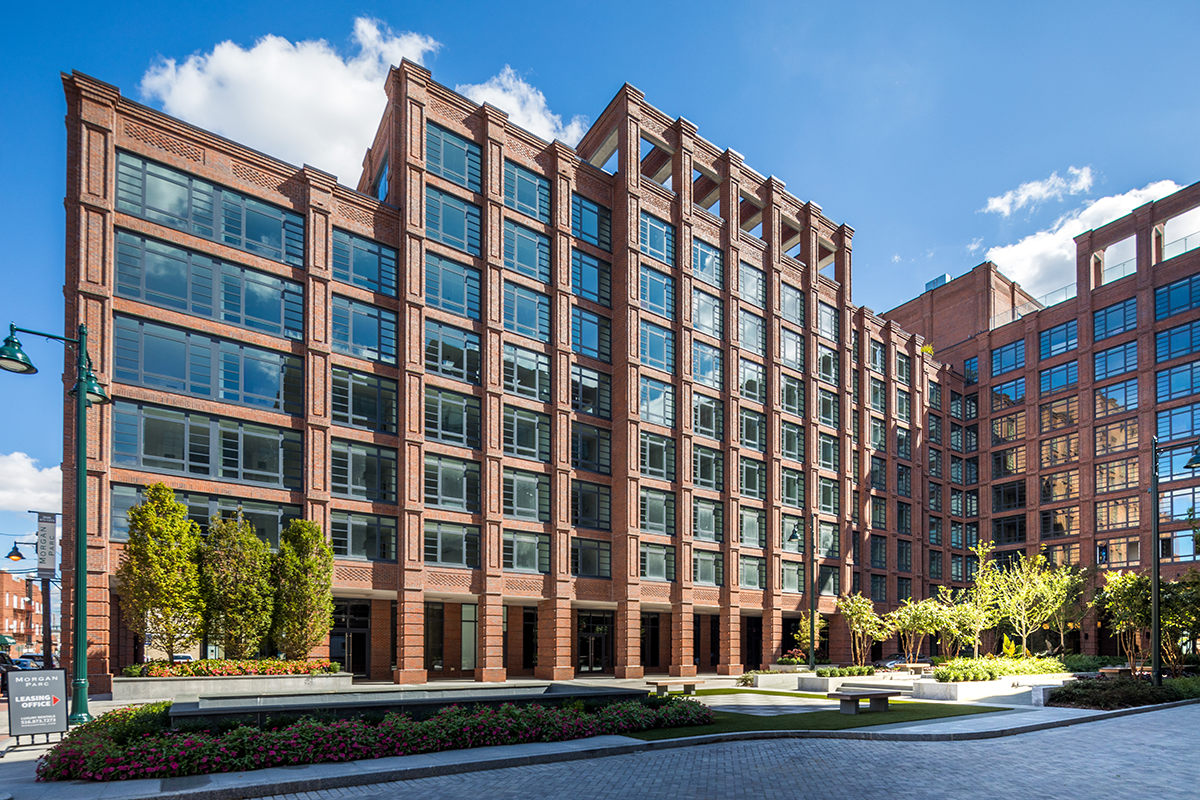
Morgan Parc
Gavri Slasky, SBJ Group
See MoreTRANSCRIPT
00;00;00;00 - 00;00;05;19
Doug Patt (DP)
Let's go inside the vault. The design vault.
00;00;05;21 - 00;00;28;06
Gavri Slasky (GS)
We were given the site. Needed to build as many units as we could, but to keep the center open and accessible to the public. This courtyard, this Village Green, was intended to be used by the Village for tree lighting ceremonies or other public events. The idea was to try to incorporate the public into the building as much as possible.
00;00;28;14 - 00;02;31;27
DP
This is my guest, Gavri Slasky. I'll share more about him shortly. In this episode from the Design Vault will highlight Gavri’s project Morgan Parc. The Morgan Parc Project is comprised of 267 residential units situated above retail space. The nine story building is composed of a central tower at the far side of the square, flanked by two symmetrical wings, the masonry facades draw upon turn of the century mill buildings whose architecture is expressed in their strong, deep structural piers and intricate brick details.
The building facade is composed of masonry piers that extend the full height of the building, opening up a ground floor to create a retail arcade that wraps a courtyard. Large industrial sized window units span between the deep piers. The building is capped by glass, enclosed rooftop amenity spaces, an outdoor pool and terracing roofs, which overlook Long Island.
Hi, I'm Doug Pat and this is Design Vault.
Today we're talking to Gavri Slasky, AIA, LEED AP. Gavri received his master’s in architecture from Princeton University and his B.A. from Columbia University in Architecture. Gavri started his career at Stephen B. Jacobs Group as the project manager for an 11 story 311-unit residential building in Long Island. Since then, together with Mr. Stephen Jacobs, he has designed and managed over 3 million square feet of residential new construction throughout New York and developed an expertise in building codes of the city and state.
Gavri specializes in piloting projects from conception to completion, testifying at local zoning boards, producing documentation for building department approval, overseeing construction administration and working together with the general contractor and owner in achieving building occupancy. Today, we're going to talk to Gavri about SBJ's Morgan Parc project. So welcome, Gavri.
00;02;32;00 - 00;02;34;00
GS
Thank you, Doug. Good to see you.
00;02;34;02 - 00;02;47;26
DP
And it's great to see you. It's nice to have you with us today. So, before we get started, tell us a little bit about Stephen B. Jacobs Group. Where are they located in New York? What's the size of the firm? And what type of work too they do?
00;02;47;28 - 00;03;38;20
GS
So, we are a mid-sized firm, about 30 architects and interior designers in Manhattan, where we're on Park Avenue South and 27th Street. So just north of the side iron building there. Our firm has been around for quite a long time. The founder of the firm, Stephen Jacobs, created the firm in 1967. So, it's been over 50 years. And the amount of work that he's done in New York is uncountable. So, over this time, you go to any street in New York and there's a building by SBJ Group.
For the most part, we specialize in multifamily housing. We've done quite a number of hotels and we've diversified recently into school buildings, commercial buildings, and we do quite a range of work.
00;03;38;23 - 00;03;46;15
DP
That's pretty impressive walking around New York City. Do you ever count on how many buildings they've done? Is it like a hundred? Like 200?
00;03;46;17 - 00;03;49;09
GS
No, there's definitely thousands, for sure.
00;03;49;10 - 00;03;50;04
DP
Oh, my goodness.
00;03;50;11 - 00;04;05;00
GS
We have this old Sanborn book, and every time that we got a project, I remember one of the former principals of the firm, Herb Weber, would just shade the lot in and so he would be able to flip through and keep track of it that way.
00;04;05;06 - 00;04;30;07
DP
Those Sanborn maps are pretty incredible. When I was at Penn State. My thesis was Housing for the Homeless in Times Square, if you can believe it. But I sent away for the specific Sanborn maps for that location, and I believe they were used by firemen. Yeah, they had to have been 75, 80 years old. They were updating at one point. I don't even know what they do today. Can you even get Sanborn maps?
00;04;30;14 - 00;04;48;05
GS
You can. Now, everything is digitally available. You have digital tax maps. They're super precise and updated. You can rewind history and go back to see what this looked like a decade ago or a hundred years ago and see how the site has evolved. Just a fun site analysis.
00;04;48;07 - 00;05;11;22
DP
Yeah. The maps have a footprint of the building at that particular location at the particular time, and then they have the heights of the buildings of various heights as you move around the building so you can literally build a model from them. So, tell us a little bit about yourself. So, this interview's pretty unique because you're in Israel and we oddly enough, know one another. Why don't you tell us a little bit about that?
00;05;11;25 - 00;05;15;22
GS
Yeah. It's great to see you. It's been almost 20 years.
00;05;15;23 - 00;05;17;15
DP
Oh, my goodness gracious.
00;05;17;17 - 00;05;35;14
GS
That's hard to say. The summer of 2004, I had just graduated Columbia. My teacher, Joeb Moore, offered me a summer internship at his firm in Greenwich. My seat was actually right next to your seat. I was wondering if you would remember me. It's been a long time.
00;05;35;16 - 00;05;45;20
DP
I do. I was like Gavry Slasky. Yes! I remember the name! It was a long time ago.
00;05;45;24 - 00;05;49;10
GS
It was. And to be fair, I was only there for a summer.
00;05;49;11 - 00;06;04;04
DP
So yeah. I joined Joeb in 1999, I believe, and I worked with him for about 20 years, 15 of those as a consultant. So, it was a great experience. He's an amazing architect, one of the most talented men I've ever met in my life.
00;06;04;07 - 00;06;09;26
GS
He's an amazing architect and such a kind person. Does such beautiful work.
00;06;09;28 - 00;06;21;15
DP
He does. If you're interested, Joeb Moore, joebmoore.com. Check it out. So how long have you been with Stephen B Jacobs group? Tell us more about your role in the Office.
00;06;21;17 - 00;06;22;13
GS
So I've been.
00;06;22;13 - 00;08;06;24
GS
At group for about a decade, and the first project I worked on, which he mentioned actually was in Mineola. It's not this Morgan Parc project. It was sort of the predecessor to this. We were working on a 300 plus unit apartment building, around the corner from this Morgan Parc project, called One Third Avenue, and that was my first project working with Stephen, and with this same client, Kevin Lalezarian.
That was a new experience for me. I had previously worked on single family homes. I worked for a year at KPF, so that was completely different, working on Super Towers in Asia. This was New York. This was something that was extremely practical. It's going to get built. It was going to get built, and fast. And the people in the office, they knew what they were doing. They done that type of work for a long time. So, it was quite a learning curve for me. That was a great project.
And during construction of that project, One Third Avenue, the client decided to go ahead with the second project around the corner from that. He had faith that he wouldn't be competing with himself. He'd be able to fill up all of his units.
We started designing Morgan Parc. That was such a rewarding project for me because I was on that from day zero, going with the client and Stephen to the Planning Board meetings and really seeing how a project starts from its conception, being in every single meeting, hearing how the building gets massed out, all the different considerations of it through the years of approvals and construction. And it opened about three years ago, during the pandemic, actually.
00;08;06;26 - 00;08;39;17
DP
So, let's talk a little bit about the building. Just as an aside, so I met Isaac Daniel Astrachan a couple of weeks back. He also works for SBJ. I was a host for a panel discussion here at the Brickworks Design Studio on 5th Avenue, and Isaac was on the panel talking about the Morgan Parc project. So, I know a little bit about it, but let's get into the details. So, you just explained how your office got the project. Your client wanted to do another building with you guys. Had SBJ worked with those clients for a number of years, even before the project you came in on?
00;08;39;20 - 00;09;13;28
GS
Yes. The Lalezarians are a family of real estate developers and property owners, second generation and repeat clients for us, as are many of our clients. That's what they do. They build buildings, they hold on to the buildings, they manage them, and we try to give them the best service that we can, be as efficient as possible and make the most beautiful building that we can with the budget. And they come back to us. That is basically the goal. So, most of our clients are repeat clients like that.
00;09;14;00 - 00;09;36;04
DP
Well, it's really impressive. It's the most important thing for an architect, right, to get word of mouth business. You're not marketing your company all the time. You've got a steady stream of people that are coming back to you after they get to work with you, you know, the first time. So that's wonderful to hear. So, tell us a little bit about the history of the location of Morgan Parc and what impact that might have had on the design.
00;09;36;08 - 00;10;24;05
GS
So, Morgan Parc is on a piece of property right in the center of Mineola, which is the seat of Nassau County. The property is right across the street from the train station, so it is uniquely located for a transit-oriented development. It is right in the center of their downtown.
Prior to our client owning the property, all that existed on that property was a single Citibank building and a sea of parking. Actually, during the construction of One Third Avenue that I mentioned before, our client, when he purchased the Morgan Parc property, moved the Citibank tenants into One Third Avenue building and making way for this second development.
00;10;24;08 - 00;10;25;12
DP
That's really interesting.
00;10;25;15 - 00;11;00;26
GS
It's located at the heart of their downtown right next to the train station. NYU Langone is right across the street there as well. So, it's a busy area. And on Mineola’s master plan from a few decades ago, this site was labeled as the village green. It was their sort of center, their downtown. But that was a sort of future hope that somebody would make that a reality. Village Green was actually a working name of our project until marketing came along and made it into Morgan Parc. But that was always in the forefront of the design.
00;11;00;28 - 00;11;05;24
DP
So, that's a good segway. So, tell us a little bit about the programmatic requirements from the client.
00;11;05;27 - 00;12;00;08
GS
We were given the site. Needed to build as many units as we could, but to keep the center open and accessible to the public. This courtyard, this Village Green, was intended to be used by the Village for tree lighting ceremonies or other public events. The idea was to try to incorporate the public into the building as much as possible – or when I say the building, the site. It's a large square shaped property. While it was a parking lot for Citibank, people would use it as a cut through, as a shortcut to get to the train station. And so that also became part of the program. The client wanted to maintain access, crisscrossing through the site so people can still get to the train station without having to walk all the way around the block. So, we created these openings between the different wings of the building so people can get from one side to the other.
00;12;00;11 - 00;12;02;21
DP
Describe the building plan to us then.
00;12;02;24 - 00;12;44;18
GS
It's a U-shaped building which has its tallest portion on the tracks, which is that front street. So it’s the back of the building. So that's a nine story structure at that point. It has the two wings of the “U” that gradually step down to six stories at Second Street, which is the downtown street.
The scale of the building respectfully interacts with the existing context there. The larger buildings that I mentioned at NYU and some other buildings are situated at the train tracks in that zone. And then the historic downtown is lower scale, three- or four-story buildings.
00;12;44;20 - 00;12;47;29
DP
So, you're a little bit of an expert on zoning codes.
00;12;48;01 - 00;12;50;29
GS
I've had my share of reading-
00;12;51;01 - 00;13;04;22
DP
Right! So, it sounds to me like a project like this, you really got pretty good at what's going on with the city – what the requirements are. So, tell us a little bit about the project restrictions for this particular job, maybe a little bit about the zoning codes.
00;13;04;25 - 00;13;39;19
GS
They don't quite have a zone sort of set up for this. So, what we had to do is go in and propose what it is that we wanted to build there – look around at other developments in that area and see what would be appropriate and then open that up to discussion to the public. And that project was in front of the planning board maybe four times. These meetings, which started about 7 p.m. or so, they would go till 11 p.m. they would have standing room only of people giving comments pro and against.
00;13;39;25 - 00;13;47;25
DP
Their local people come to the meeting, and they want to say what they think of the architecture. So, this is like an architectural review board, right?
00;13;47;29 - 00;15;02;11
GS
Sorta. You know, it's interesting because the comments were less about the architecture, more about planning, traffic, and heights of buildings and schoolchildren. So those were the major concerns that they had, but it was the democratic process. So, watching it play out, seeing everybody given the opportunity to have a voice, and through that process, the building changed as well. In reaction to that, the building got smaller.
And we were given the opportunity also to present the benefits of the building and what the building would be offering the city, because as we were designing this, this wasn't a building that we were designing in isolation from far away and imposing it onto the local town, but rather with the village of Mineola in mind constantly. And so, so much of the building was being built and designed not just for the residents but for the people of the town. And I used to go out there during construction every week or two and go to the coffee shop across the street and really got to see this downtown come together where there used to be, essentially, a hole in the middle of it with this enormous parking lot. The building has so many different facets to it, but the public side of it was really rewarding.
00;15;02;13 - 00;15;10;09
DP
Well, again, a good segway. Why don't you talk a little bit about the style choice and how it reflects or relates to the buildings that are around and in the neighborhood?
00;15;10;12 - 00;16;11;05
GS
So, when Stephen conceived of the design of this building, he was thinking of historic mill buildings, turn of the century factory buildings that were made of brick, that had large openings, had repeated structural piers. They were built in an efficient way, allowing for large openings to light up the factories where the work would be taking place in. And they were often clad in brick by masons who were extremely talented. And it's hard to find people of that talent today, but that was their craft.
So that was in the back of Stephen's head and a lot of the work that he did in the early period of his career in the late sixties, early seventies was adaptive reuse. He had taken these types of buildings and turned them into lofts, but at this point he was creating this new building that based off of its old historic model.
00;16;11;08 - 00;16;28;14
DP
So, when the clients came to you guys and you talked a little bit about aesthetics, did they give you any historical precedents or did they say, hey, this building has got to match the aesthetic of what's around it? And then maybe talk a little bit about your use of brick and why you guys chose that particular brick and that color.
00;16;28;17 - 00;17;47;13
GS
I had mentioned that these were repeat clients, so we knew them very well. We knew their tastes. We knew their preferences. They came to us, and they said that they wanted a timeless building, a building that wasn't a fad that would be dated in a decade or so. They wanted something timeless. They don't build buildings and then sell them. They build them, and then they keep them and maintain them as part of their portfolio. So, they were looking to create something for the long run.
So, I think at that point, Stephen started to think about these historic buildings that are so beautiful that they become historic landmarks and get adapted for one use, changing to another, use. I brought people to see this building after it was completed and they asked me, what was this building before? It's funny to think that this is a brand-new building, but I thought that that was actually quite a compliment. We are trying to emulate historic buildings. We never thought that we would be able to fool people that this was historic. That wasn't the intent, but it just fits. And when the client asked for timeless, I feel like that type of reaction from people that visit the building didn't know the site before. I feel like that accomplished the goal that the client was looking for.
00;17;47;20 - 00;18;28;19
DP
Yeah, Issac said the same thing when he was here that people had asked how long the building had been there, you know, after the building had been constructed. So interestingly, when you go to school, when you go to architecture school, one of the first things I learned was that the architect is striving for timelessness in their work, right?
Not all architects choose to do that, but at Penn State they talked about that a lot. I found it pretty interesting. I like to ask people that come in whether or not brick solved any design challenges or design problems for you guys. And clearly it did in this aesthetic realm. But can you think of any other way that you were able to use Masonry and it solved some design challenges?
00;18;28;22 - 00;19;51;00
GS
There's a lot of different facets of this building, but I think the brick is one of the key factors that brought this whole building together. It's a large building. There could have been other approaches to take using different materials to break up the mass, and you see that quite a lot around the suburbs. What Stephen wanted to do was to embrace that this was a large building and take one material, being brick, and use it as many ways as possible and unify the building, make one unified building out of it.
We worked on a few details. We worked on them and reworked them and got feedback from masons, reworked them again. We created a couple of unique shaped bricks. We were playing with all sorts of articulation, ins and outs and we ended up with a detail for the pier and detail for the cornice, a detail for a second-floor band – it was really about three or four typical details that we worked out. And then repeated it in a rhythm and executed it. And it was wonderful working with the masons on site as well, because as architects we can draw what we want, but at the end of the day it's all about the execution of the craftsperson. We were fortunate to have a great mason on the project.
00;19;51;07 - 00;19;55;05
DP
So, did you guys build actual physical mock ups that were out there?
00;19;55;07 - 00;20;18;10
GS
Yes, we did. We built a couple of mockups and made a couple of adjustments during that period. And then they started and they were able to start low down on the building, did a few portions, and then once they got those couple of details down, they're able to run with it. And it was a long process and a lot of brick, and the client had faith in it. I was very fortunate about that and it came out great.
00;20;18;12 - 00;20;38;12
DP
So, two quick questions about how long everything took. I'd like to think about how large is the set of drawings when you're going to build a building like Morgan Parc? Did you guys draw the thing in 2D and 3D? And how long did this whole process take? Through Planning, city review, design, and then construction.
00;20;38;14 - 00;21;42;03
GS
Great question. The way that we work, we work in 3D and 2D. At the same time, we usually model the building in Revit. We’ll work out the massing, the elevations, study different details in three dimensions and color, testing out different color combinations. We had gone back and forth on whether the windowsills should be metal or cast stone or brick. And we tested out these options in three dimensions and 3D models.
The working drawings at the end of the day were all done two dimension CAD, and they were, you know, as precise as we could get. It's actually interesting. The building is a U-shaped plan, but it's two Ls that are joined at the center to make this U-shaped. So, the building is actually mirrored down that center. So, we were able to draw it, one L, and mirror it. That was part of my struggle over the years, was to try to keep it as symmetrical as possible so that we can keep on using that for efficiency.
00;21;42;06 - 00;21;45;16
DP
That's pretty cool. So, you really only had to draw half the building, right?
00;21;45;19 - 00;21;47;11
GS
For the most part.
00;21;47;13 - 00;22;13;14
DP
I'm sure there's way more that goes into it, but when you first say that, you say, Oh wow, that's pretty cool. So, the thing is simply mirrored. I'm sure there's a lot of differentiation that goes from one L to the other, but it's pretty interesting.
So, what's, kind of, top of mind for a lot of people today is sustainability. Did you guys talk about that at all in terms of using masonry, or was that a request that the client had that you guys had to keep in mind?
00;22;13;19 - 00;24;17;16
GS
Sustainability is something that's viewed in every project that we do in one sense or another. Brick buildings allowed for a cavity wall and continuous insulation on the exterior of the backup wall. And so, it allows for a beautiful finish, but a very sustainable envelope. And the amount of insulation that you put in that cavity wall is really dependent on how large of a relieving angle you can get for the brick because the more insulation you have, the further the brick has to be on the backup wall. That's sort of the only limitation.
00;22;52;09 - 00;22;54;03
DP
And what did you guys end up doing?
00;22;54;04 - 00;24;17;16
GS
Yeah, it's been a couple of years. I don't remember exactly. We put as much as we could. We put insulation on the inside as well.
This is not exactly related to brick, but one of the most interesting, sustainable anecdotes from this building that I remember is in the excavation of the building. Long Island is built on sand primarily, and it's a great site for foundations to build shallow foundations. The sand takes the load, but another advantage of it was the contractor who excavated out the sand, and I don't know how many hundreds or thousands of truckloads of sand have to go out of this building – I didn't even mention that the building has three cellars for parking – so they went down 30, 40 feet into the ground for the entire site. So maybe a million and a half cubic feet.
The contractor who was excavating that, taking that sand away, sold that sand to a construction company for concrete. So concrete is a very carbon heavy building material. But what I like to think about was that the sand in the foundations in the site for this building, actually went back into the building process. I'm sure it didn't go to our building. It probably went to someone else's, but it wasn't just shipped off to someplace and dumped somewhere.
00;24;17;24 - 00;24;39;16
DP
We always have interesting experiences, right? So, was there anything as you went through this process of building Morgan Parc, designing it and ultimately going through the various stages with the town, with the city, then getting the thing built? Was her anything that you or your team learned that was really interesting for you? It was kind of a first.
00;24;39;19 - 00;25;48;27
GS
There's so many firsts. Every building process is a learning experience. There's this one lesson learned that was interesting. It was during the brick installation, actually. I noticed that there was this one detail at the corner of the building that wasn’t correct, and I was wondering how could they make that mistake?
It doesn't have the usual frame around it. The brick checker pattern just died into the side and I looked at our drawings and then I realized that the elevation was taken with a pier, hiding a portion of the elevation behind it. And so, it looked like that was the end of the building, but it actually continued another foot or so. And the mason was looking at the elevation and they didn't see that.
So, they just continued the same pattern until the end that maybe they thought there was a dimensional mistake or something. So, every week I would go to them and say, are you going to fix that detail? And he was like, at the end. And I was thinking to myself, oh, you better fix that at the end before Stephen comes to take a look at that. But he did. And that was an interesting lesson learned – to make sure that every elevation is drawn, nothing is being hidden by any portion of the building in and of itself.
00;25;49;00 - 00;26;36;13
DP
Well, I think about that a lot, I go out on to the job site and I see something and it's not exactly the way I had drawn it. And sometimes you're just not paying attention, sometimes I didn't cover it well enough in the drawings and unless you're out there on a weekly basis, these things just completely get away from you.
So, one last question before you go. This is very interesting to me. So, you're an expert on zoning and building codes. So, this is an incredibly valuable asset for any office. I would imagine at some point you could probably become an attorney with all the knowledge that you have. Was that something that you always gravitated toward that side of the business over time, or is that just you were kind of thrown into it? It was interesting to you. You were good at it, and that's how it evolved.
00;26;36;16 - 00;28;25;23
GS
It's funny, it's not the part of architecture that people are usually interested in, and it definitely wasn't so in the beginning for me. But the more I read through these things, the zoning – New York City, or every different town has their own zoning ordinances - there are so many nuances there, and these words that are written down there were written very carefully, and they create what you're building is going to be. And so, careful reading through these documents are critical, whether it's zoning or building code. And I came to really enjoy creating it. And it is probably the dorkiest thing, but I enjoy it and I enjoy getting emails or calls from colleagues saying, “Gavri, can you check what are we allowed to do here?” I love being able to look it up and learn. Each time I look at it, I learn more and then the codes change from 2008 to 2014, New York City now 2022, and New York State has their own codes. And then to compare in New York City versus New York State and to see what's allowed in one versus the other. They don't tell you why in these things, they just tell you what's allowed or what's not allowed.
You try to think about what is a consideration, what's the difference between New York and New York City in New York State. So, New York State has larger sites. So, their stair cores are allowed to be further away from the center. They try to direct people to have their egress stairs at the edges of the building. The dead end distances are shorter than they are in New York City. In New York City, they allow you to have scissor stairs in residential buildings because you have a small footprint and you don't really have much of a choice. These rules, they end up shaping the plan. They end up shaping every aspect of the building.
00;28;26;00 - 00;28;39;28
DP
Well, Gavri, I can tell you really love this stuff. And I'm sure Stephen B. Jacobs Group is very happy to have you. So, thank you very much for spending some time with us today. Where can people go to learn more about SBJ architects?
00;28;40;01 - 00;28;49;00
GS
Yeah, you can go to our website sbjgroup.com.
We are on 27th and Park Avenue South. Looking forward to hearing from everybody.
00;28;49;07 - 00;28;51;08
DP
It's a small world, man. It’s great to see you.
00;28;51;10 - 00;28;53;12
GS
It's great to see you, Doug. Thank you so much.
00;28;53;18 - 00;29;21;00
DP
Thanks, Gavri.
You May Also Be Interested In
We Can Help With Your Next Project
Discover the latest + greatest in design trends, industry news & pro tips from pros.
For all of your project needs, you’ll find everything you need at a Supply Center.
Let Us Know How We Can Help!
Design Vault Ep. 3 Front + York with Michelle Wagner
ABOUT THE ARCHITECT:
|
Michelle Wagner is a Project Director at MA | MorrisAdjmiArchitects. Withmore than 25 years of experience as an architect, she excels in themanagement of large-scale projects and has played a vital role in leading thedesign and delivery of some of the firm’s most ambitious assignments. Mostrecently, this includes the delivery of Front & York, a 1.2 million-square-footmixed-use multifamily complex in Brooklyn, NY. The large-scale, two-towerdevelopment occupies an entire city block and encompasses a unique blendof apartments, condos, and luxury penthouses, as well as an unparalleledpackage of indoor and outdoor amenities and more than 140,000 squarefeet of retail. Before joining MA, Michelle worked on the World Trade CenterMaster Plan and Design Guidelines with Studio Daniel Libeskind. Michellereceived a Bachelor of Environmental Design from the University of Coloradoand is a Registered Architect, licensed in New York and Colorado. |
|---|
ABOUT THE PROJECT:
Informed by the past but designed for the future, Front & York adapts Dumbo's historic warehouse aesthetic at agrand scale with a contemporary residential reinterpretation.The Manhattan Bridge is the spine of the Dumbo Historic District. Its monumental stone anchor is as essential tolocalcharacter as brick warehouses and Belgian-block streets. Front & York is a new multifamily developmentinspired by the evolution of this post-industrial context. Like the bridge’s stone anchor, it is a bold contribution to theurban fabric that is emblematic of the neighborhood.The new1,200,000-square-foot building occupies a full city block, but thoughtful massing reduces its perceived size.All four facades are pulled back 15 feet from the property line to create a generous new pedestrian zone lined withmore than 140,000 square feet of retail.Continuing to recall the Manhattan Bridge, storefronts are framed with a highly customized system ofblue steelarches and industrial-inspired entry canopies featuring corrugated glass. Above, theresidential levels of the buildingare clad in acustom gray engobebrick, hand-laid and organizedinto a grid by a glass-fiber reinforced concrete“Superframe” that helps the facade read from afar.More than 2,500factory-style divided light windows providepanoramic views of Lower Manhattan, DowntownBrooklyn, and the multi-tiered courtyard at the building’s core—the largest private park in Dumbo.Within, every detail was considered. The building’s condos and apartments feature 10-foot ceilings,chevron-patterned white oak flooring, and custom millwork, fixtures, and finishes throughout.Offering one of New York City's largest and most comprehensive amenity collections, Front & York providesresidents with access to nearly 100,000 square feet of leisure and lifestyle spaces. To create a club-likeexperience for residents, most amenities are co-located on “Level Eight” within two wings linked by alandscaped wrap-around terrace featuring two outdoor pools, cabanas and outdoor kitchen space, anoutdoor screening area, and an outdoor fireplace.
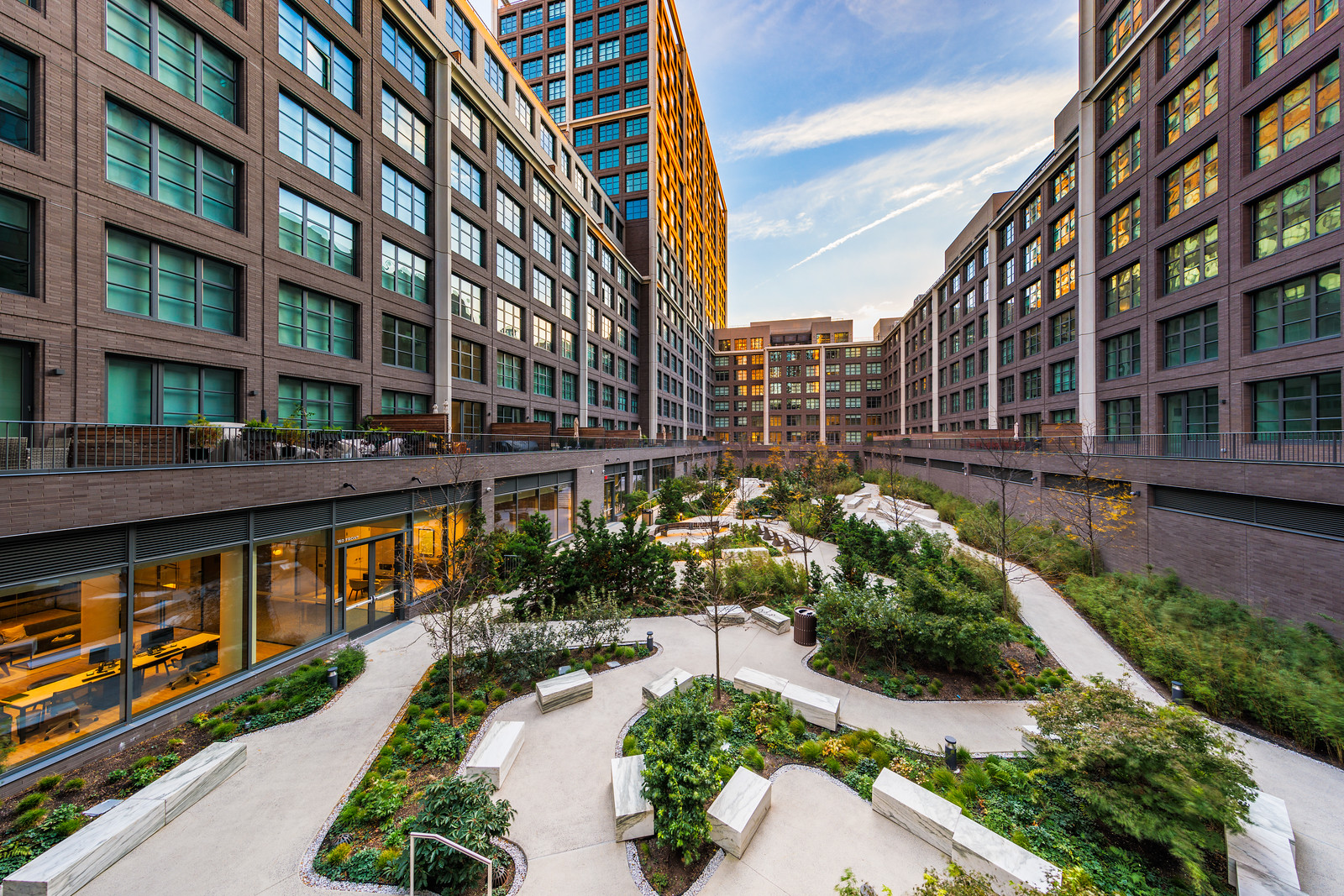
Front + York
Michelle Wagner, Morris Adjmi Architects
See MoreTRANSCRIPT
00;00;00;00 - 00;00;05;22
Doug Patt
Let's go inside the vault. The Design Vault.
00;00;05;25 - 00;00;20;17
Michelle Wagner
One of the nice things about the site is it's next to the landmark districts. So the heights to the north are low and set, and they won't go any higher. So we knew we wanted to be tall and get as many apartments above that height for views to Manhattan.
00;00;20;20 - 00;02;15;29
DP
This is my guest, Michelle Wagner. I'll share more about her shortly. In this episode from the Design Vault we’ll highlight Michelle's project Front and York. Front and York is a 1.2 million square foot mixed use and multi-family complex in Brooklyn, New York. The large scale two tower development occupies an entire city block and encompasses a unique blend of apartments, condos, and luxury penthouses, as well as an unparalleled package of indoor and outdoor amenities, and more than 140,000 square feet of retail.
The project features a blend of more than 750 condo and rental units, as well as an interior courtyard that spans nearly one acre. Not to mention a challenging 25-foot grade change across the site. The building resembles that of a late 19th or early 20th century warehouse or factory, but significantly more luxuriant. With a glass fiber reinforced concrete frame and light gray brick infill, the building is quite beautiful and absolutely massive.
Hi, I'm Doug Pat and this is Design Vault. Today we're talking to Michelle Wagner, registered architect, LEED AP. Michelle has her Bachelor of Environmental Design from the University of Colorado and is a registered architect licensed in New York and Colorado. Michelle is a project director at Morris Adjmi Architects. Before joining Morris Adjmi, Michelle worked on the World Trade Center Master Plan and design guidelines with studio Daniel Libeskind.
With more than 25 years of experience, she excels in the management of large-scale projects and has played a vital role in leading the design and delivery of some of the firm's most ambitious assignments. So, let's get into the details. Welcome, Michelle.
00;02;16;03 - 00;02;18;08
MW
Thank you, Doug. Thanks for that introduction.
00;02;18;12 - 00;02;26;08
DP
So first, tell us a little bit about Morris Adjmi Architects. Where are they located in New York. What's the size of the firm and what type of work do you do?
00;02;26;16 - 00;02;49;29
MW
Sure. We are in lower Manhattan, downtown, really. Right near the stock exchange. It's about a 100 person firm in New York. We also have a small office in New Orleans, about maybe a dozen people now. And that's where Morris grew up, actually. So he still has a home there and family there. And that office covers a lot of our work that's in the South now as we really branched out.
00;02;49;29 - 00;02;57;23
MW
We started as a very New York based firm in 1997. Do you want me to go ahead and tell the story of Morris's origin story?
00;02;57;24 - 00;02;59;13
DP
Yeah, sure. I'd love to hear it. Absolutely.
00;02;59;15 - 00;03;25;27
MW
OK. He was working with Aldo Rossi in Italy. He speaks Italian and he became kind of Aldo Rossi's right hand man in New York when he got the commission of the Scholastic Building in Soho, which you probably know. It's kind of a very modern, but fitting into that historical context very well, right next to the Little Singer building, which is a very famous piece of architecture we all probably learned about an architectural history class.
00;03;25;27 - 00;03;36;29
MW
So Aldo was tragically killed in a car accident in the nineties, and Morris finished that project for him and kept the office going and started his office from there.
00;03;37;06 - 00;03;39;23
DP
Wow. So what kind of work do you guys do today?
00;03;40;00 - 00;04;00;04
MW
We really focused on multifamily, office, hospitality work, our core. We also have art services and interior design, so we really try to deliver all of those services whenever we can. We also have a guy that focuses on urban design, so we've got some multi parcel experience in master planning as well.
00;04;00;07 - 00;04;03;21
DP
Wow. So, a comprehensive list of services that you guys offer.
00;04;03;24 - 00;04;04;26
MW
Absolutely.
00;04;04;29 - 00;04;11;08
DP
So, tell us a little bit about yourself. How did you end up at Morris Adjmi? How long have you been there and what's your role in the office?
00;04;11;10 - 00;04;49;02
MW
I came to New York originally to work on the World Trade Center Master Plan with Daniel Libeskind, which - with my husband - which was really supposed to be a six-month contract. And we've been in New York for 20 years now. So that's the way things go. After that, I really enjoyed the experience of working on large scale master planning projects.
So, I went to another firm for a while that focused on master planning and architecture. And then through a friend that I met at that firm, I just heard about this great architect, Morris, and I started to look at the work and I got invited for an interview and that was seven years ago, and I haven't looked back.
00;04;49;04 - 00;04;51;06
DP
Oh, that's so great. So, you're clearly enjoying it.
00;04;51;06 - 00;04;52;16
MW
Very happy there. Yeah.
00;04;52;18 - 00;05;00;12
DP
So, let's dig in here and talk a little bit about our building. Tell us about the Front and York project. So how did your office get the project?
00;05;00;14 - 00;05;14;08
MW
It was an invited competition. It was LIVWRK and CIM. There were three or four architects, I think. Bjarke Ingels was one of them... ODA. So, we all had a charrette. It was paid, but you know, not a lot.
00;05;14;10 - 00;05;15;13
DP
Sure. Of course.
00;05;15;15 - 00;05;28;02
MW
It was a lot of excitement around this competition because it was a big, big block. And you just don't get projects this big in the city very often. So, a lot of effort went in, and we won. So that was great.
00;05;28;05 - 00;05;35;20
DP
So just as an aside, are there a lot of competitions like that in New York that firms like yours or firms that are your size try to get?
00;05;35;25 - 00;05;51;04
MW
We're often invited to competitions where they've already kind of pre-selected architects and asked to participate. And of course, it's optional if you want to do that, because you know when you're going in for a competition that you're going to put a lot of effort in really to win that project.
00;05;51;12 - 00;05;53;16
DP
And how many firms do you usually compete against?
00;05;53;22 - 00;06;11;09
MW
We don't always know, honestly. At the time, sometimes it's a blind, so we don't really know. And then we try to find out, with some difficulty. But, you know, three or four small group, I think if it was a large number, we'd be less interested. Yeah, because you got to feel like there's a good chance.
00;06;11;11 - 00;06;14;07
DP
That's great. And how long does that process take?
00;06;14;13 - 00;06;15;13
MW
Usually, six weeks.
00;06;15;22 - 00;06;18;27
DP
So, you have six weeks to complete the project. And then...
00;06;18;27 - 00;06;20;00
MW
A concept design.
00;06;20;00 - 00;06;29;00
DP
The concept design. Okay. And then they pick somebody. Well, that's going to be challenging to like scheduling projects in the office. Are we going to get this one or are we going to get that one?
00;06;29;02 - 00;06;42;16
MW
Oh, yeah. Well, that's a lot of what I do now as a director. A lot of the scheduling. When I worked on Front and York, I was the project manager, so it was really about the project but have been elevated to director. So, it really is more about scheduling and staffing.
00;06;42;17 - 00;06;44;17
DP
I bet, with all those people.
00;06;44;17 - 00;06;45;05
MW
Yeah.
00;06;45;07 - 00;06;54;03
DP
So, tell us a little bit about Front and York. So, tell us some of the history of the location of Front and York and then how did that impact the design?
00;06;54;05 - 00;07;03;07
MW
So, the location is a full city block in Dumbo and it was formerly a lead factory and so there was contamination on site.
00;07;03;07 - 00;07;04;09
DP
I can only imagine.
00;07;04;09 - 00;07;23;12
MW
Yeah. And I think maybe that's why it sat vacant since the eighties. I think maybe it was a private parking lot and fenced for decades. So, you know, it really needed a big development like this to afford to clean off the site because really, we remediated like 50 feet of soils in some areas.
00;07;23;12 - 00;07;24;07
DP
50 feet?!
00;07;24;09 - 00;07;38;14
MW
Yeah. So, all of the contaminated soils were dealt with, some carted away somewhere, cleaned on the site under supervision of AKRF, our environmental engineer. So, it really took a big project like this to kind of utilize that site.
00;07;38;16 - 00;07;41;08
DP
Was the area around the site already well developed or...
00;07;41;10 - 00;07;49;01
MW
It was. There were already towers around the site. 100 J Next door was a tall tower. I don't know. It's probably 20 years old at least.
00;07;49;04 - 00;07;59;09
DP
So, what were the client's programmatic requirements? You guys won the competition and they said, okay, this is what we need. Or you already knew that because you had entered the earlier competition and won it.
00;07;59;11 - 00;08;14;27
MW
Yeah, they came with a residential program, mixed use. They already knew what they wanted the program to be, of course. We weren't sure how we were going to handle the middle of the block because it is an extra-large block. So, some of our early options had a road in the middle.
00;08;14;28 - 00;08;15;16
DP
Oh, wow.
00;08;15;20 - 00;08;54;17
MW
One thing they really wanted; they wanted cars to be thought of as part of the site. Whether we drove up with a big turnaround in the middle, like the Antwerp, I think it's got a big turnaround in the middle. So, we looked at that. At the end of the day, we decided that the center of the block really should be a park and it would bring the value up for all the interior apartments as well as the street side.
One of the nice things about the site is it's next to the landmark district. So, the heights to the north are low and set and they won't go any higher. So, we knew we wanted to be tall and get as many apartments above that height for views to Manhattan.
00;08;54;19 - 00;09;03;02
DP
For those of you who are listening, should take a look at the site plan and the floor plan because it really is quite beautiful with almost like a park-like feature right in the middle.
00;09;03;06 - 00;09;22;21
MW
Yeah. As you mentioned, in the beginning, there's a massive park. It's like almost the size of a football field. It's for all the residents. We have a mixture of apartments and condos, front York, but everybody can access the park and even there's a lifetime fitness there as well. And they have some access to that park.
00;09;22;26 - 00;09;35;03
DP
Oh wow, that's so great. So, I know there's something unique about the site, right? There's a change in topography. So, when you guys first went out there and looked at that, am I correct, it was 25 feet approximately.
00;09;35;08 - 00;09;35;27
MW
About 20.
00;09;35;28 - 00;09;47;23
DP
So that's a big deal for a lot. That is as big as this one. You have to start to think about this going to be a really big building. Where do we enter? What floor we entering? How did you guys deal with that?
00;09;47;25 - 00;10;09;24
MW
It was a real challenge and of course we had to look at many iterations on how to deal with that. One thing we did know is that we wanted the condo lobbies really to see through to the park, and the condos are sited on opposite corners of the site. So, there's a big grade change from the lobby floors on each corner, like 20 feet.
00;10;09;29 - 00;10;24;04
MW
But we wanted to see that park. So, you know, eventually what we came up with was really like rolling hills in the park. I think when you go there, you'll notice it's very kind of hilly and there's a lot of winding path and it feels very organic and natural.
00;10;24;08 - 00;10;33;20
DP
Not like a city. So, tell me a little bit about the zoning ordinances there. You said you guys could be taller than buildings that were nearby. How is that even possible? And what were your restrictions.
00;10;33;23 - 00;10;57;02
MW
Actually, we are an as of right project. We did not apply for any variances. That was part of the directive from the beginning. We didn't want to wait for that. It can take months to get a ULURP or a zoning amendment here. So, we were as of right. So, we just maximized the floor area and the height limit and really didn't have to get special approvals.
00;10;57;04 - 00;10;58;24
DP
Interesting. So that's kind of nice.
00;10;59;02 - 00;10;59;22
MW
Yeah.
00;10;59;29 - 00;11;05;07
DP
Right? Walk into a project like that. So, tell us a little bit about the building plan. So, it's like a big donut.
00;11;05;12 - 00;11;31;16
MW
It's a big donut, yeah. With a large park in the middle, there's sort of a lower podium level that's about eight stories and then on opposite corners there's the towers, which are the condo apartments that are 22 stories tall, and those were sited on diagonal corners and also diagonally from another existing tower in the neighborhood, just to maximize view corridors and make sure that we weren't blocking any view corridor.
00;11;31;18 - 00;11;37;06
DP
Did you guys go through a lot of design iterations in terms of where those towers were and how tall the building was?
00;11;37;06 - 00;11;38;01
MW
Absolutely.
00;11;38;02 - 00;11;38;29
DP
A dumb question!
00;11;39;01 - 00;12;07;24
MW
Well, an interesting thing is, though, in our competition, it was similar massing with the two tall towers on the corner, but they told us, okay, that was the competition. Now we're starting over. So, we looked at every possible massing scenario again. And then of course, we ended up back with the towers on the corner. But the big changes, they were more massive. They were bigger towers, more like bars, because they really wanted to have great views in these apartments.
00;12;08;01 - 00;12;25;03
DP
So, style, I said in the intro, it looks a little bit like a factory warehouse building. I mean, it does, but it doesn't, right? I mean, it's incredibly stylistic. Talk a little bit about how you chose the particular style because it's a little traditional and it's still contemporary.
00;12;25;05 - 00;13;03;23
MW
You know, I think we were inspired by all the factory buildings in Dumbo. I mean, that is the period of significance, that early American factory building, which were very large, and they had big factory windows and were usually brick or masonry.
The storefront, you might notice we have a very tall sort of metal, blue metal storefront, and it looks very muscular, almost like structural steel. It's aluminum, but it looks like structural steel that was really inspired by the Manhattan Bridge, which you can see just down the block from both Front and York. You see the structural steel of the bridge.
00;13;03;25 - 00;13;09;05
DP
So, you guys decided from the get go that you were going to make a brick building, right?
00;13;09;07 - 00;13;48;22
MW
We did. We always wanted the brick. We actually looked at this building as precast donuts initially, just really a client directive thinking that was going to be the most economical solution. But even as precast, we wanted that gray brick. I mean, we were really trying to kind of fit into the neighborhood. There's a lot of granite, gray cobblestone in Dumbo and it was a big building, so we wanted something a little recessive and quiet, I think, in the brick color. So, we were looking for that dark gray brick, even when it was a precast building, which ultimately, it's not precast. It’s hand-laid Glen-Gery brick.
00;13;48;25 - 00;13;53;04
DP
So, what are some of the unique construction details that you guys employed here using brick?
00;13;53;25 - 00;14;37;23
MW
Well, the first thing is the brick itself. I mean, we had actually gone pretty far down the road with the precast and had a gray color in mind. But, you know, of course, economics are always a factor. And we couldn't find an economical gray brick that suited us.
So thankfully, we had a great salesperson that told us about, new at the time, custom color Glen-Gery on go clay coating, which is not like a clay coat that's very opaque and solid. It's actually more translucent and we could pick any color that we wanted and it was pretty economical. So that's what we did. We found a beautiful kind of dark, medium gray, very muted, and then a little lighter gray at the penthouse. On the kind of additions on top.
00;14;37;26 - 00;14;48;01
DP
And I'm looking at some really beautiful details here, particularly the recess in between that kind of frames out every one of those windows. Was that a detail that you guys spent a lot of time working on?
00;14;48;01 - 00;15;04;08
MW
Yes, that was actually a detail that we developed when it was precast donuts. And funny enough, we really liked it because it just gave that little bit of detail to the facade that without it, it felt a little bit flat. So that was originally there to hide the precast joint.
00;15;04;08 - 00;15;05;20
DP
Oh my gosh. So, it's a remnant of an earlier design.
00;15;05;20 - 00;15;14;01
MW
It's a remnant of an earlier design. I think at one point the client suggested maybe we should take it off. And we all said that we really like it.
00;15;14;08 - 00;15;16;15
DP
Yeah, it does an awful lot for the facades.
00;15;16;15 - 00;15;23;14
MW
We're going to use it to hide the brick control joint instead. So, that's tucked in there. And that's why you don't see them at the windows.
00;15;23;16 - 00;15;25;01
DP
So the control joints are inside.
00;15;25;03 - 00;15;26;17
MW
There in that reveal to one side.
00;15;26;26 - 00;15;32;05
DP
Oh, I'd love to see a blow-up detail on that. Tell me a little bit about the concrete structural frame.
00;15;32;07 - 00;15;34;18
MW
That's the GFRC. The white frame.
00;15;34;18 - 00;15;35;19
DP
Yes. Is that structural?
00;15;36;08 - 00;15;53;18
MW
Really beautiful. It's not structural, it's trim. This is a concrete building. So yeah, that is a device really to help modulate the scale of the building and also to help it read from a distance. I mean, you can see, actually, you can see that from a plane. I've seen it flying overhead.
00;15;53;19 - 00;15;54;22
DP
Are you serious?
00;15;54;24 - 00;16;12;15
MW
Yeah, it really does help bring down the scale because, you know, could you imagine if you didn't have that trim? I think the white color, it's really kind of neat standing on Front and York and seeing the blue and white bridge just right there and just kind of the colors just feel good. They fit into the neighborhood. There's white on the bridge.
00;16;12;22 - 00;16;17;28
DP
Had you guys looked at doing that in any other color, like gray, having it melt back into the facade?
00;16;18;05 - 00;16;34;02
MW
We study everything. We're very iterative, I think in our process. And you - we always internally look at three options. You know, we really push it and then we narrow down the options for the client usually, but lots of options.
00;16;34;04 - 00;16;38;08
DP
So, did brick solve any particular design challenges for you guys or for the client?
00;16;38;14 - 00;17;10;07
MW
I think the choice to go to brick was just feeling competitively at the time it was cost, but also just the control of knowing that you could go to different masons if you needed to. I think a lot of times there were more than one trade for - I don't know about the brick. I think that was just one mason in the end, but because it was such a big building, they wanted to make sure that there was some duplicity, I guess, of trades being able to work on things. And I think they got nervous about getting all the precast from one place.
00;17;10;14 - 00;17;20;17
DP
Did you guys have any challenges finding a good mason? I mean, I would imagine in New York it's not a big deal, but even in a Westchester County where I do a lot of work, we always have a challenge finding good masons.
00;17;20;17 - 00;17;35;25
MW
The masons were great. Everybody was great. New Line was the CM, New Line Structures. And we worked on this three years in construction. After three years, it was really hard ending construction because we were kind of a big happy family at that point. It was great.
00;17;35;27 - 00;17;44;18
DP
So, into the office I often think about how many people work on a project. How many people were on this team, and how many people did the drawing for the job?
00;17;44;25 - 00;17;50;01
MW
I'd say at least 20 at its peak, when we were in construction documents.
00;17;50;11 - 00;17;53;07
DP
Yeah. Now, did you guys do this in 3D?
00;17;53;10 - 00;18;35;11
MW
Oh, yeah. We did this in Revit. We usually start with Rhino, something very, you know, design-y and flexible and fast. But once you get into Revit, it becomes you're building a building, right. And a computer. So, becomes more cumbersome. But we absolutely did it in Revit. And actually that ended up being tremendously helpful because we use BIM in construction all the way through. That is, New Line did. That's something they like to do and always do. So, they have specialists that can really run Revit and they model in great detail all of the MEP plumbing and electrical systems throughout the building. So, we find clashes in construction on the computer before they ever happen in the field.
00;18;35;14 - 00;18;38;01
DP
How long have you guys been on Revit? Just curious.
00;18;38;03 - 00;19;04;14
MW
I think we transitioned, probably fully by 2018. When I started in 2016, I think we had one or two projects in Revit. Now we're all Revit. I think we're starting to lose people that know how to work in CAD, but we still have a few. Well, because everybody does Revit. So, we really, we can export to CAD and everything, but we just don't have many people drawing in CAD anymore - and doing the layers.
00;19;04;18 - 00;19;13;07
DP
Oh my goodness. Right. That that's how I operate right now. Well, I do both, but I'm on ArchiCAD. Are most of the people in the city on Revit?
00;19;13;14 - 00;19;21;15
MW
I think so. I'm sure there are still people working in CAD, but I think more and more people are going to Revit, especially for big projects.
00;19;21;18 - 00;19;29;18
DP
So, did sustainability ever come up as a factor in choosing brick, for example, color, texture, thermal, code compliance?
00;19;29;21 - 00;20;03;03
MW
This isn't a LEED project, so we didn't consider it for its sustainability, per se. But we did do something at Front and York, which was we qualified for Zone Green, which is a New York City zoning rule, that if you make your exterior wall thicker and heavily insulate it up to 16 inches thick, you actually get a zoning bonus for that. So, we did that. So, these are 16-inch-thick walls with lots of insulation, CMU back up. That's how this is a sustainable project in terms of the brick wall.
00;20;03;08 - 00;20;05;20
DP
So, it's an efficient veneer - it's an efficient facade.
00;20;05;21 - 00;20;22;21
MW
It's a very, yes, efficient façade. Helps with heating and cooling loads. We also won the Big Apple Brownfield Award for environmental protection for the clean-up effort I mentioned. Yeah, 2020. So, cleaning up that site was a very good move for Dumbo.
00;20;22;28 - 00;20;26;20
DP
Just curious, where does all that go? Where does all the land that they've removed...
00;20;26;26 - 00;20;38;12
MW
Sometimes they can actually treat it on site. It depends on - they test certain segments like it's a very involved process. If it's very, very bad then there are places out west that will accept it.
00;20;38;12 - 00;20;38;28
DP
Okay.
00;20;39;01 - 00;20;54;09
MW
If it's not, that can be landfill like for other projects that can be cleaned and kept local. So, the good fill was - actually like people would come, they put a call out and people would come if they needed fill for their construction projects and they'd cart it away.
00;20;54;14 - 00;20;59;09
DP
Yeah. Interesting. So, I'm thinking here, do we see any masonry on the interior?
00;20;59;13 - 00;21;08;27
MW
We do a little bit up on the eighth floor and amenities. We have some sort of indoor-outdoor fireplaces that have brick. So yeah, there's a little bit.
00;21;09;04 - 00;21;18;10
DP
That’s great. So did your team learn anything interesting through the design and construction process, something maybe that you guys hadn't been through in the past?
00;21;18;13 - 00;22;15;18
MW
I would say that one thing that we found very difficult at first was the redlining process in architecture, where the more senior architects will redline drawings and then give them to the junior staff to pick up the changes. That was very difficult with a 20-person team. So that kind of prompted us to find a tool which we eventually found Blue Beam Studio, which now we use on every project in the office where you can go in and do group markups together and highlight together. So, it's one document and you refresh the document periodically. So, we had a lot of logistical challenges like that.
We had to set certain meeting pulses internally to make sure we were communicating. So, we weren't overlapping or ignoring a corner of the building, which you can sometimes do, and it's 1.2 million square feet. I think there were a lot of things we learned internally through this process that actually help us now on some of our larger projects.
00;22;15;26 - 00;22;18;10
DP
How long was it until you guys implemented Blue Beam?
00;22;18;12 - 00;22;25;03
MW
It really like started, I think with Front and York and now the whole office is on it and we really do all of our markups that way.
00;22;25;11 - 00;22;26;08
DP
That's really cool.
00;22;26;10 - 00;22;34;23
MW
QAQC reviews and Blue Beam’s, probably the new CAD, I would say for a lot of us, because it is a very good markup and measuring tool.
00;22;34;29 - 00;22;35;24
DP
Yes.
00;22;35;26 - 00;22;39;02
MW
And it's cloud based or it can be. So, you can work in a big group.
00;22;39;03 - 00;22;40;26
DP
So, you can go in and draw in 2D.
00;22;41;02 - 00;22;41;20
MW
Yep.
00;22;41;22 - 00;22;44;21
DP
Wow, that's pretty cool. We've been using Procore.
00;22;44;28 - 00;22;50;07
MW
Yeah. We also use Procore. New Line Structures did and that was tremendously helpful.
00;22;50;07 - 00;22;53;05
DP
Yeah, for project management, it's been great. Super helpful.
00;22;53;09 - 00;23;20;08
MW
Yeah. And just the process of using Navisworks and Revit is basically - Navisworks is the software that helps you look at Revit and really find those clashes in the field. This was the easiest CA project, maybe not easy for all of the staff, but in terms of the leadership, we weren't running into big problems. It was very smooth. We were finding the problems in the model in the field. So that was great.
00;23;20;11 - 00;23;25;19
DP
How many drawings does a job like this have? Like what does a construction document set look like?
00;23;25;19 - 00;23;27;09
MW
Yeah, I think about 500 drawings.
00;23;27;09 - 00;23;28;00
DP
Oh, my goodness gracious.
00;23;28;03 - 00;23;31;27
MW
Yeah, something like that. Three or four volumes, you know. Lots of trades.
00;23;32;01 - 00;23;34;22
DP
Wow. And construction was three years.
00;23;34;25 - 00;23;35;15
MW
That’s about right.
00;23;35;20 - 00;23;37;19
DP
Wow. So how long has it been complete?
00;23;37;26 - 00;23;44;22
MW
I think it's been complete release since the summer. Last summer? I could be off by a month or two.
00;23;44;29 - 00;23;46;26
DP
Are they happy? Is it full?
00;23;46;29 - 00;23;53;06
MW
I don't know if it's full, but it's very well occupied. I do know that there's 16 penthouses are all sold.
00;23;53;09 - 00;23;54;08
DP
Wow.
00;23;54;13 - 00;24;12;23
MW
The views are spectacular all around. So, I think maybe they wish they built more larger apartments because really when this was landing, I mean, seems like the trend started to go to larger apartments. With COVID and everything. A lot of one-bedrooms, but they're really nice sized one-bedrooms, you know.
00;24;13;00 - 00;24;13;26
DP
Yeah. The photographs are beautiful.
00;24;13;29 - 00;24;28;00
MW
Yeah. And the amenities are - we've had so many developers and other people touring the amenities on the eighth floor. There's 15,000 square feet of amenities up there and they're spectacular. And a couple of swimming pools.
00;24;28;03 - 00;24;28;25
DP
Oh, my gosh.
00;24;28;26 - 00;24;31;13
MW
On the roof. I think that's a real selling point.
00;24;31;15 - 00;24;39;12
DP
So, one last question before you go. Personal question, What's your favorite part of the job and what's your least favorite part of the job as an architect?
00;24;39;14 - 00;25;01;17
MW
Well, I like to solve problems with teams. I really like large projects because you get to work with large teams and it's just really fun. We have a lot of people that we have a lunchroom at, at MA and we have people that sit around and do the New York Times crossword puzzle together every day, and we just like solving problems together. So that's my favorite part.
00;25;01;24 - 00;25;05;05
DP
Yeah, that's great. You don't have to tell me what you don't like.
00;25;05;07 - 00;25;10;04
MW
What I don't like, I think would be obvious, which is the stress and the headaches. And, you know...
00;25;10;04 - 00;25;13;09
DP
Yes. I can only imagine on projects that are this big.
00;25;13;09 - 00;25;18;24
MW
Right. Running into things that you didn't expect in the field. Those are the things that I like the least.
00;25;18;24 - 00;25;23;10
DP
Yeah. My boss used to say, “it's always the thing you don't see coming that gets you.”
00;25;23;11 - 00;25;24;03
MW
That's right.
00;25;24;03 - 00;25;37;09
DP
It really is. It's not the stuff you worry about all the time. It's the one thing you just never saw coming. Well, Michelle Wagner, thank you very much for your time today. Where can people go to find out more about you and Morris Adjmi Architects?
00;25;37;12 - 00;25;40;14
MW
I’d suggest our website, which is ma.com
00;25;40;16 - 00;25;50;01
DP
All right. You got it. Well, super simple. And thank you very much. It's been great. Front and York’s gorgeous. Thank you very much.
You May Also Be Interested In
We Can Help With Your Next Project
Discover the latest + greatest in design trends, industry news & pro tips from pros.
For all of your project needs, you’ll find everything you need at a Supply Center.
Let Us Know How We Can Help!
Design Vault Ep. 2 Vanderbilt University with Steve Knight
ABOUT THE ARCHITECT:

|
Steve Knight, AIA is a Principal with David M. Schwarz Architects, Inc. he studied at North Carolina State University where he received his Master of Architecture, that same year he joined David M. Schwarz Architects. Steve primarily focuses on his firm’s performing arts venue projects. He served as Project Architect for the design of Schermerhorn Symphony Center, The Palladium at the Center for the Performing Arts, the Gaillard Center, and most recently an 8,000-seat amphitheater in Huntsville, Alabama. He is currently leading the office’s team on the design of a neighborhood center for Chevy Chase Lake in Maryland and the multi-phase Residential College project at Vanderbilt University. Steve is active in preservation advocacy, serving as President of the Art Deco Society of Washington and on the board of the International Coalition of Art Deco Societies. |
|---|
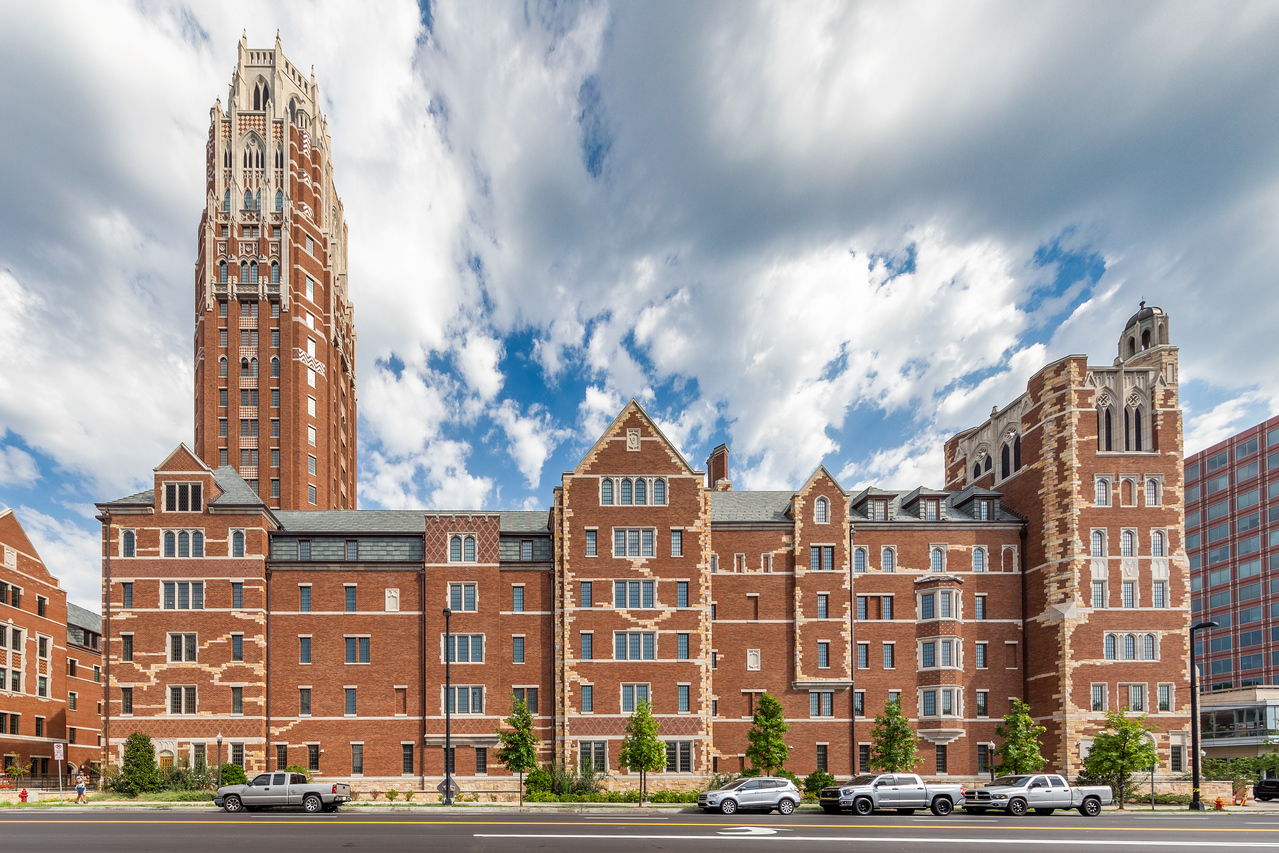
Vanderbilt University
Nicholas S. Zeppos College, Bronson Ingram Building
See MoreTRANSCRIPT
00;00;05;27 - 00;00;29;07
SN
It's a very faithful rendition of what's known as Collegiate Gothic. It is very much in step with this long-established tradition of higher education that goes back to the church in Europe and then institutions like Oxford and Cambridge. And then it comes over to the states with institutions like Harvard and Yale, who are doing very much the same thing. They were trying to identify with this established tradition.
00;00;29;14 - 00;02;24;07
DP
This is my guest, Steve Knight. I'll share more about him shortly. In this episode from the Design Vault we’ll highlight Steve's project, the Nicholas S. Zeppos College Building at Vanderbilt University.
The Nicholas S. Zeppos College Building is several thousand square feet, five stories with a large tower at one end. The building is red brick and limestone, designed in the collegiate Gothic style. The building has a slate roof, slate dormers, large brick chimney masses, limestone window frames and quoins, multi-story window bays, gable forms across the facade, and limestone gothic arches, a tall square picturesque tower with chamfered corners, polychromatic brickwork and limestone cap rounds out the building at one end.
Hi, I'm Doug Pat and this is Design Vault. Today we're talking to Steve Knight, who led the team designing the Nicholas S. Zeppos College at Vanderbilt University in Nashville, Tennessee. Steve is a member of the American Institute of Architects and he's a principal with David M. Schwarz Architects. He studied at North Carolina State University, where he received his Master of Architecture. That same year, he joined David M. Schwarz Architects. Steve primarily focuses on his firm's performing arts venue projects. He served as project architect for the design of the Schermerhorn Symphony Center, the Palladium at the Center for Performing Arts, the Gilliard center, and most recently, an 8000-seat amphitheater in Huntsville, Alabama.
Among other projects, he's currently leading the offices team on the design of the multiphase residential college project at Vanderbilt University. The Nicholas S. Zeppos College Building is one of four residential buildings for DMS at Vanderbilt University. So let's get into the details. Welcome, Steve.
00;02;24;14 - 00;02;25;28
SN
Greetings, Doug. Good to be here.
00;02;26;08 - 00;02;30;09
DP
So, tell us a little bit about your firm, David M. Schwarz Architects.
00;02;30;20 - 00;03;04;27
SN
Sure. We're a mid-sized design architect and planning firm. We're based in Washington, D.C. We have about 35 design architects on staff. We were started in the mid-seventies by our founder, David M. Schwarz.
It was a really interesting time to start an architecture firm in Washington and in the U.S., really. And there are two pivotal things that happened in the late seventies. The first was the district passed one of the most stringent historic preservation ordinances in the country. And on the heels of that, the federal government enacted tax credits for historic preservation.
00;03;04;27 - 00;03;06;22
DP
Really? How fortuitous.
00;03;07;00 - 00;03;43;12
SN
So, we found ourselves, the firm at the time - this is before my time there, obviously - but we found ourselves working in newly established historic districts on landmark designated buildings, and it really informed how we think about architecture that architecture is - it's very important that it responds very carefully to the context around it. Each building is part of a larger ecosystem that creates meaningful places, beautiful places to walk, live, places that are memorable. That really is a kind of a train of thought that I think we've carried through all of our work to this day.
00;03;43;20 - 00;03;54;16
DP
So, the greater majority of the work that you guys do is traditional. Has that been challenging in any era over the course of the last 50 years when people were doing more modern architecture and...
00;03;54;26 - 00;04;42;08
SN
Well, it certainly is today. We never sought out to be traditional architects in that sense. One project begets another, and like many architects, we sort of get known for our buildings and what we do. And I think in terms of that stylistic leaning, if you will, it's a bit controversial these days, I think, particularly within the architecture design community, where I think there is a tendency amongst the majority to want to look forward in sort of the past is the past, let's look to the present and let's look to the future.
I think for us, architecture is primarily about communication. And what we mean by that is that buildings in their edifices say something to people and it's really important that they engage with the communities that they serve.
00;04;42;20 - 00;04;58;02
DP
Yeah, it's interesting talking about classicism, traditional architecture, having a kind of language and speaking to the community in a certain way. Right. It's kind of understandable language for many people. You see, especially in Washington.
00;04;58;10 - 00;05;02;25
SN
It is, it's a very legible language of building and design. Absolutely.
00;05;03;03 - 00;05;05;14
DP
So, tell us about your role in the office.
00;05;05;27 - 00;05;33;12
SN
I'm a principal in the firm. I've been with the firm since I finished graduate school back in the late nineties. I started out as an intern and then, as you could imagine, sort of worked my way up through architect staff and project architect and then project manager. I spend most of my time communicating and working with teams of people in the office. Design, for us, is a very collaborative sport. The office is a very collaborative environment.
00;05;33;12 - 00;05;33;28
DP
That's great.
00;05;34;05 - 00;05;59;17
SN
I think one of the most interesting things to me is the founder, David Schwarz. I have rarely ever seen David pick up a pencil and draw something, but he commands a great deal of influence and quality oversight of the firm's body of work, largely through talking to people, getting to know each of us. And I in turn try to do the same.
00;05;59;25 - 00;06;02;08
DP
Well, you've been there a long time. It sounds like you've got a great boss.
00;06;02;14 - 00;06;07;06
SN
He is a great boss. We got a great group of people around me. I consider myself very lucky.
00;06;07;12 - 00;06;20;27
DP
Oh, that's really cool, because, I mean, architecture is challenging enough, right? It's a challenging profession. Very difficult business. We're all architects, right? So, we're all a little self-absorbed. To find somebody you enjoy working with and for is wonderful.
00;06;21;02 - 00;06;22;01
SN
Yeah, it's very important.
00;06;22;04 - 00;06;34;02
DP
Yeah, that's great. So, let's dig in here. Let's talk about the residential college project at Vanderbilt and specifically the Nicholas S. Zeppos College building. How did your office get this project?
00;06;34;15 - 00;07;25;15
SN
Well, it goes back to a master plan study that we did. Oh, at least 15 years ago, we conducted a study. The university was interested in reorganizing student life on campus, and they struck on the idea of the residential college model, which grows out of a very well-established tradition that starts on the other side of the pond by places like Oxford and Cambridge.
And then it comes to the States in the early 20th century with the Ivy League institutions like Yale and Harvard and Princeton. And what they really liked about it was this notion of breaking down the larger student community into smaller communities of a few hundred people. So, we developed this master plan that sort of provided strategic opportunity areas on where these colleges could be located.
00;07;25;21 - 00;07;28;28
DP
So, they came to you with this idea. There would be four colleges.
00;07;29;06 - 00;07;38;02
SN
They came to us with a very broad idea of, “we want to rethink student life on campus,” and through conversation, the residential college model came out of that.
00;07;38;02 - 00;07;38;21
DP
Wonderful.
00;07;38;23 - 00;08;00;27
SN
And then opportunity areas across campus. We identified sites. They then constructed what they called the freshman campus, the freshman college, if you will. That's where all first-year students go to live and there was a bit of a lull. And then we sort of came back with this more defined project of the four colleges, of which Nicholas S. Zeppos is number two.
00;08;01;08 - 00;08;07;11
DP
So, had you been hired at that point or were you working against other architects to try to get the project?
00;08;07;16 - 00;08;17;01
SN
No, we had been hired at that point. We had done other work in Nashville, most notably the Schermerhorn Symphony Center, the Nashville Symphony's concert hall.
00;08;17;01 - 00;08;18;02
DP
So, they knew of you.
00;08;18;03 - 00;08;22;19
SN
So, they knew of us. And we just developed good, strong relationships in the community.
00;08;22;20 - 00;08;31;27
DP
That's great. It's a great way to get jobs. So, can you tell me a little bit about the history of the place, the town, the neighborhood, the buildings around the site?
00;08;32;04 - 00;08;52;00
SN
Sure. In Nashville, it's a fascinating city with great heritage and history. One of its monikers is the Athens of the South. They have a full-scale replica of the Parthenon on Centennial Park campus, which is actually just across the West End Boulevard from Vanderbilt.
00;08;52;02 - 00;08;55;07
DP
I'm sure I've seen photos of this and have forgotten. That's incredible.
00;08;55;17 - 00;08;59;15
SN
It. It really is. Every detail is fully, faithfully executed.
00;08;59;16 - 00;09;02;07
DP
I'd love to talk about that some time but go ahead.
00;09;02;17 - 00;10;17;15
SN
But that's not why it's called the Athens of the South. It's called the Athens of the south because of the number of institutions of higher learning that one finds there. So, you have Fisk, you have Vanderbilt, many institutions. And it just at a sort of a per capita level. It developed this sort of bookish, erudite culture. Another thing that helped reinforced it was there's a great deal of publishing that happens there, mostly religious, and musical publications.
So anyway, so it's the Athens of the South, so that's really neat. The Vanderbilt history is really interesting because it's basically it's founded as an outgrowth of the Civil War. The institution, it was basically viewed by its namesake who endowed the starting of the university as a kind of a healing moment between the North and the South.
Cornelius Vanderbilt. And he has a statue, obviously, in the heart of campus. The campus itself is - it's a really beautiful green garden-like setting. It does have the classification of being an arboretum because of the number of unique specimens of trees one finds there. The architecture is quite eclectic. Like most campuses, there's a kind of a historic heart of Victorian era buildings and some collegiate gothic buildings as well. And then it sort of evolves over time.
00;10;17;24 - 00;10;31;07
DP
So, you touched a little bit on what these college buildings are composed of. Could you give me a little bit more information about the programmatic requirements of each of the four buildings - or let's just stick to the Zeppos College building?
00;10;31;12 - 00;12;03;17
SN
Yes. So Zeppos houses 340 students. We typically say beds. It has 340 beds. So that's the lingo in that business, if you will. And it's viewed as a really holistic living environment for students. Not only are there places to sleep, but there are also places to study, places to gather. There are places to eat. There are even accommodations for some resident faculty. Each of the colleges, or at Zeppos, has a family - faculty member and their family has an apartment within the facility. And they help provide leadership and mentorship to the student community.
So, and all of those things are fully realized programmatically with dining facilities. There's a really great dining hall in Zeppos. There's a great room, as we call it, a large living room with wood paneling, courtyards. So there's nice quality, secure, defensible outdoor space for the students to use.
On each of the floors, it was a really interesting challenge because we're dealing with a lot, even within that reduced footprint of only 300 odd beds, it's still a lot of program, a lot of footprint to have to manage. So, to create a sense of place that's navigable and somewhat homelike and approachable and familiar, we did some interesting things within the student floors. There's a lot of articulation in the building massing, and we offset the double loaded corridors to create nodes and they tend to coincide with elevators and stairs so that we create places for students to naturally bump into each other.
00;12;04;00 - 00;12;16;08
DP
Well, I'm going to actually ask you about that in just a minute. So first, let's back up and talk a little bit about the site and the topographic features, if there are any. Or are they just completely flat?
00;12;16;19 - 00;13;04;06
SN
No, there is a bit of grade change from - I have to get my compass directions right - from east to west. I think what's most interesting about the site is it has kind of a two-sided nature to it. So, on one side is West End Avenue, which is a major east west thoroughfare that connects with downtown Nashville. It's sort of the public face of Vanderbilt. So, the colleges were a real opportunity to sort of enhance the university's image to the outward community.
And then on the other side, the opposite side is a very opposite kind of condition. It's a series of very low scale residential structures that house the Greek community. So, several houses, each one is a fraternity or a sorority. So, we had to respond to two very different contexts on each side of the building.
00;13;04;17 - 00;13;08;22
DP
So, tell us a little bit more about the building plan. You started getting into that.
00;13;08;29 - 00;13;29;25
SN
Sure. So Zeppos is a figure eight with two courtyards. What makes the figure eight is what we call a double loaded bar, if you will, on the upper student room floors. You have rooms on both sides of a corridor. And again, there's interesting offsets in those corridors and bars to help break down the massing.
00;13;30;04 - 00;13;32;25
DP
Does that create these large gables?
00;13;33;00 - 00;13;48;03
SN
Yes. And then and then some of the bars, we actually punch through to create Gables to help break down and articulate the massing of the building. It's basically a city block. So, all of those moves are really important to help make the building very approachable and friendly.
00;13;48;11 - 00;13;51;14
DP
Are all four college buildings a city block.
00;13;51;26 - 00;14;14;09
SN
About. They each layout a little differently from one another. The one immediately to the east of this one, Rothschild College. That one has three courtyards. Due to the particulars of that particular site and obviously what makes the Zeppos college most special amongst the four of them is this 300-foot tower at one end of it.
00;14;14;17 - 00;14;20;03
DP
So that's a great segway. Tell us about the style of this building because it's stunning.
00;14;20;12 - 00;15;02;06
SN
It's a very faithful rendition of what's known as Collegiate Gothic. It was really very much a communication and really a marketing decision by the university in terms of we looked at lots of different vernaculars. What should these things look like? And the entire team ultimately arrived at Collegiate Gothic is the appropriate response. It is very much in step with this long-established tradition of higher education that goes back to the church in Europe and then institutions like Oxford and Cambridge, and then it comes over to the States with institutions like Harvard and Yale who are doing very much the same thing. They were trying to identify with this established tradition.
00;15;02;13 - 00;15;04;13
DP
Really? I mean, it makes perfect sense.
00;15;04;14 - 00;15;05;02
SN
Absolutely.
00;15;05;13 - 00;15;14;25
DP
So, were there any specific buildings that you can recall that you guys were looking at? The tower looks like it could have been pulled from the facade from a church in Europe. Right? I mean.
00;15;15;02 - 00;16;04;01
SN
Sure, we're very eclectic in our approach. We spend a lot of time looking at examples in books. We try to visit places in person, and that was a really important tool at the outset of this project is we actually took members of the client team on a little whirlwind tour of residential college examples around the country. Some examples that we looked to for the tower would be the Harkness Tower at Yale.
A slightly more atypical one that we did look at. It would be the Nebraska state Capitol and I think one feature that we quoted from that one is towards the top of the tower. As it starts to step in, you'll see what we call a little lantern, a little limestone lantern on each of the four corners. That's a common type feature in this style of architecture. When you're creating a tapered tall form like this, we thought it worked very well.
00;16;04;09 - 00;16;11;29
DP
And you chose brick for the majority of the material for these exterior facades? Tell me a little bit about that.
00;16;12;07 - 00;16;45;17
SN
Well, we always want our buildings to have a really rich palette of materials. And that's true of the interior and, of course, the exterior. So here the palette is a combination of brick, carved Indiana limestone, and then an accent stone, which is called Crab Orchard. It's actually a stone that's native to Tennessee. And we thought that was very appropriate to sort of weave in a local material that one finds in and around Nashville. The brick in particular is really interesting because we knew we didn't want a stark read of just one color.
00;16;45;19 - 00;16;48;08
DP
Right. Like if the building was all limestone.
00;16;48;08 - 00;17;09;26
SN
Like it was all limestone. And even within the brick itself, it's not just one brick, it's actually a blend of three bricks. And we did lots of mockup panels with the help of a very patient Mason, and a very patient local brick distributor who gave us about an acre of their brickyard to do all these different experiments.
00;17;09;27 - 00;17;10;16
DP
That's so cool.
00;17;10;16 - 00;17;46;22
SN
We tried different blends and we ultimately settled on a blend of three bricks for the college, and then we further augmented that with what we call decorative bond detailing. So, if you look closely at some of the details, you'll see brick that's fashioned into basket weave patterns, sawtooth patterns, what's known in England as diapering, which is creating a sort of a diamond checkerboard pattern. And we use different bricks for that as well. They tended to be iron spot bricks that are really beautiful because they catch and reflect light in different ways depending on how the sun is hitting them.
00;17;47;06 - 00;18;26;25
DP
Yeah, so it's interesting. We've got this polychrome going on, so you guys have the red brick and then I see these diamonds which are made from a different color brick, and then you're taking that one step further. You're backing off the changes in color perhaps, and you're changing the direction of these bricks and the patterns on the interiors.
I mean, it just takes so much time and thought to do everything you guys are doing on these facades. How much time did it take? Just doing like the design work? And who was doing that design work in the office? How were you doing these drawings and how are they being reviewed? I mean, there's a lot going on here.
00;18;27;02 - 00;19;17;26
SN
There's a lot there. I mean, the process is really key and it's a very layered process. You don't start out drawing detail. You start out with a parti and then you look at the plan and then you study the massing and then you get to a point and that's schematic design and that was probably about five months. And then we launch into design development.
We are refining the details and that was probably another six months of design development. And within both of those design phases, it's hand sketching, physical study models - we still love doing old fashioned models, just cutting out of cardboard and matte board - as well as two-dimensional drafting. And then, of course, actually three-dimensional modeling and digital modeling in the computer. That was a really key tool.
00;19;18;06 - 00;19;22;26
DP
With all these bricks and all those patterns. Must have been an unbelievable process.
00;19;22;26 - 00;19;45;28
SN
Yeah. And then it all has to be documented. It's a beautiful project. The standards were very high at the same time we did have a budget and doing cost take-offs at each of the milestone levels of completion - at schematic design and design development - were very important and they caused us to have to do some recalibrating and some adjusting to keep the thing on budget and on track.
00;19;46;09 - 00;19;52;23
DP
Yeah, I mean, you sit down with the clients and show them some of this stuff and I'm sure the first words out of their mouths is how much is this going to cost, right?
00;19;52;25 - 00;20;12;01
SN
Sure. It's interesting. In the earliest design packages, schematic design, you just can't draw all the detail. So, we actually put photos of collegiate gothic buildings in the drawings to help the contractors really get their head around, okay, this is really complex here. This is not your typical...
00;20;12;14 - 00;20;19;14
DP
And there had to have been a lot of handholding in the field too. I mean, a lot of the detail, like the variegated quoins, the quoining on the corners.
00;20;19;14 - 00;20;23;19
SN
Yeah. Every one of those stones is actually laid out in the design.
00;20;23;27 - 00;20;30;16
DP
All the dimensions, the materiality, the color. Like everything. Wow. So, there's a lot of details.
00;20;30;27 - 00;20;39;27
SN
Yes. I mean, it's a phone book level – for anybody who remembers what a phone book is – a phone book thickness level of drawing and documentation.
00;20;40;04 - 00;20;51;19
DP
Tell me a little bit about the limestone work, because, again, the level, the detail and the wonderful intricate detailing, I mean, you've got to draw and then you got to find somebody to make that.
00;20;51;28 - 00;21;24;16
SN
It's southern Indiana is limestone country. Indiana limestone. It's where the stone is quarried and it's where it is still fabricated. To this day, it is grand tradition. It goes back to the mid-1800s. It had its heyday in the early 20th century with, one just imagines, the proliferation of limestone buildings one finds in any great city in the U.S. and then it gradually tapered off from there after the war in particular. But there are still a few very dedicated fabricator firms that do the what they call the cutting.
00;21;24;23 - 00;21;30;24
DP
It had to have been hard to find somebody with so few people doing this kind of - this level of detail work.
00;21;31;07 - 00;21;44;12
SN
Well, there's one firm we've worked with on almost all of our projects. And they’re still - this is what they do. They are perfectly set up to do it, Bybee Limestone. We know them very well. We love them and they know us. And they love us too.
00;21;44;12 - 00;22;05;24
DP
Yeah, it's stunning. So back to Brick for a second. Did Brick solve any particular design challenges for the architecture for the client? I mean, you touched a little bit on the color, on the exterior and the feel of the architecture, right? We talked about the fact that you make this building all limestone. You got a problem. I mean, it's just a monolith.
00;22;06;06 - 00;22;38;17
SN
Yeah, well, it's a very warming material. It's very appropriate, in particular, the way it's used here for what is essentially a residential place. It's a very approachable, it's a very durable material, obviously. And sustainability is very important. We think one of the most important aspects of sustainability is building very consciously, using resources very consciously and very wisely. And in building something that will hopefully be around for a very long time. This building will be around for a very long time.
00;22;39;05 - 00;22;45;02
DP
That's for sure. Were there any unique construction details that you guys developed as you were working on this?
00;22;45;12 - 00;23;50;11
SN
Yeah, as I mentioned earlier, architecture is a very collaborative sport, and we didn't do this all ourselves. We had a very dedicated architect of record Hastings Architects out of Nashville. They were very faithful in working with us to realize all of the technical detailing, achieve what we're trying to achieve aesthetically, and then a really good contractor late in construction. They were very on top of things the whole way.
I'd say a couple of specifics: one of the things, the details that makes the colleges really fun and interesting are these ornamental chimneys that you find on the roof. And the contractor hit on a really interesting idea because in particular after the previous college where they did not do this, they elected to construct the chimneys on the ground, and then hoist them into place with the tower crane. That allowed them to advance construction on the roof without tying up a huge amount of roof area with scaffolding and preventing them from drying in the building. It was just a much easier erection process down on the ground.
00;23;50;21 - 00;23;53;09
DP
You just have boiler flues going through these things. I mean.
00;23;53;16 - 00;23;58;06
SN
They're vents, They're flues. Yeah. So, they do they do serve a functional purpose as well.
00;23;58;07 - 00;24;05;00
DP
I think that's a wonderful touch. You wouldn't expect to see these chimney masses on a building like that. They really kind of set it apart.
00;24;05;07 - 00;24;46;07
SN
One other quick detail is it sort of goes back to the documentation. After we get even through CDs and in construction, there's then what's known as the submittal process where shop drawings are submitted and the contractor hired one firm, an engineering firm that was sort of the central documentation point for all of the masonry. Typically, you would have separate drawings for brick and limestone, and in this case, the Crab Orchard. So, we had one firm that was weaving all of that together. It really helped the coordination and adjustments that had to be made to some of the technical details because it was all in one place. You know, it's also this is modern cavity wall construction.
00;24;47;13 - 00;24;49;03
DP
That’s a good point. Okay. So how does that work?
00;24;49;11 - 00;25;23;18
SN
So, there's a concrete superstructure between the slabs. We span metal studs. And then much like any building, we pack insulation between the studs. There's exterior rated gyp. board and then a barrier coating that goes over that and then some additional installation in some cases to get the proper R-values. And then the brick is hung off the building. It's built the way modern brick buildings are built today. Cause it really had to be, because that's just how we build - that's how people know how to build. Yet, we're trying to achieve something quite different in the aesthetics.
00;25;23;25 - 00;25;26;07
DP
Did you guys use any brick on the interior?
00;25;26;18 - 00;26;01;09
SN
So far, no. But there's one last college that's under construction and we were using brick in the dining hall of that one. It'll be a thin brick that's applied to the inside wall surface, but it's been a fun opportunity and a challenge at the same time across four colleges, because we want them all to fit within this collegiate gothic vernacular.
But yet, we want each one to be slightly different, so it's identifiable and to the community that lives there in a larger community as well. So, finding subtle, fun, different things we could do from one to the next was always one of the most interesting and challenging parts of this.
00;26;01;21 - 00;26;10;17
DP
I was thinking about while we were talking about the general contractor that you worked with. Was it a bid job or did you guys go immediately to the GC?
00;26;10;27 - 00;26;31;26
SN
They were a construction manager. So, they were brought on board early in the process during design. We like working that way because we like getting the technical expertise and input during design. We can constantly be moving forward as opposed to taking three steps back if a contractor comes on much later and says, “I wouldn't have done it that way.”
00;26;32;01 - 00;26;37;09
DP
What I was getting at was whether or not you had any challenges finding a really good mason.
00;26;37;19 - 00;26;48;06
SN
You know, it's interesting. It's lots of masons. There was a mason subcontractor, but they in turn subcontracted. It would be interesting to ask them. I know it was a challenge.
00;26;48;08 - 00;26;50;21
DP
Finding the right people to do the work.
00;26;50;21 - 00;26;51;17
SN
The right skill set.
00;26;51;23 - 00;26;57;11
DP
It's always a challenge for every architect. So, Steve, what was your favorite part of the project?
00;26;57;22 - 00;27;36;01
SN
I really enjoy the design development phase. We're really getting in and figuring out details. It's a level of problem solving that I find really interesting because in the earlier design phase, we sort of setting up the game board and making the major moves, but then to go in and make each one actually work and really figure stuff out and all the tools that we used to do that and it's a really interesting variety of tools, whether it's a half inch scale model of a corbel that's sitting on my desk or a sketch or the digital model, I just find problem solving at that level to be really, really fully engaging and satisfying.
00;27;36;10 - 00;28;02;24
DP
It's great. It takes a long time for most people to find what they really love about the profession, right? I mean, some people end up doing everything they've small offices, some people end up doing one thing one or two things inside of an office. It's a challenging business. It's a challenging profession. I think it's really nice that you're as happy as you are doing what you're doing and as good as you are at it. That's wonderful.
00;28;03;02 - 00;28;24;05
SN
I think one of the other interesting things, I use the word ownership a lot with the teams in the office and in design development. It's a really great opportunity to give individual young designers pieces of the building to figure out and design. When it's all done, they can come with me to the site and they can look at that point and yeah, I did that. That's really cool.
00;28;24;05 - 00;28;30;16
DP
Oh, that's great. So, Steve Knight, it was great to have you here. Where do people go to find you and your firm?
00;28;30;20 - 00;28;41;29
SN
Go to our web site www.dmsas.com. And if you're in Washington DC, come by and pay us a visit. 1707 L Street
00;28;43;00 - 00;28;47;09
DP
You get to meet some of our listeners. That's wonderful. Well, thank you very much, Steve Knight.
00;28;48;00 - 00;28;49;12
SN
Thank you, Doug. It's been a pleasure.
You May Also Be Interested In
We Can Help With Your Next Project
Discover the latest + greatest in design trends, industry news & pro tips from pros.
For all of your project needs, you’ll find everything you need at a Supply Center.
Let Us Know How We Can Help!
Design Vault Ep. 1 H-House with Mateusz Nowacki
ABOUT THE ARCHITECT:

|
Mateusz Nowacki is an architect and founder of Everyday Studio. Masteusz received his Bachelor of Architecture from Carleton University and the University of Toronto where he received his Master of Architecture. Everyday Studio is a collaborative design space dedicated to the research of domestic living prototypes and housing design. Predicated on the belief that architecture of all scales holds the potential to turn the everyday mundane into something wonderful and unpredictable, the studio devotes its efforts to creating spaces that are thoughtful, engaging, and timeless. Its work has been recognized in various architectural media including Dezeen, Dwell, Ottawa Magazine, and GOHBA Housing Design. Mateusz also has professional experience from several prominent Canadian offices, with current work ranging from multi-unit housing, multi-use recreational facilities, and post-secondary institutional buildings. |
|---|
ABOUT THE PROJECT:
Located within a forested community known for its maple tree forest, tranquil properties, and traditional homes, the residence was designed to reference the neighbourhood typology of a ‘house with two wings’ into a form that established more intimately scaled spaces. Simultaneously, the design sought to reinterpret traditional building materials and architectural language through minimal detailing and interior spaces more directly linked to the landscape. The resulting design is organized into two volumes, with a third elevated volume stacked perpendicularly to form a central, double-height nucleus connected to exterior courtyard spaces on either side. Grounding the design within a familiar architectural language, these minimal volumes use traditional gabled forms clad in natural, tactile materials that provide a timeless character and evoke the surrounding landscape. Wood siding and brick are commonplace for the neighbourhood, yet here the textured clay brick grounds the house to the site and references the vivid maple tree foliage in the fall, while dark walnut wood battens recall traditional window shutters. The h-shape configuration allows the home to fit comfortably within the neighbouring context while offering each wing a unique relationship to the site via a sheltered lanai at grade and an upper-level cantilevered terrace facing south.
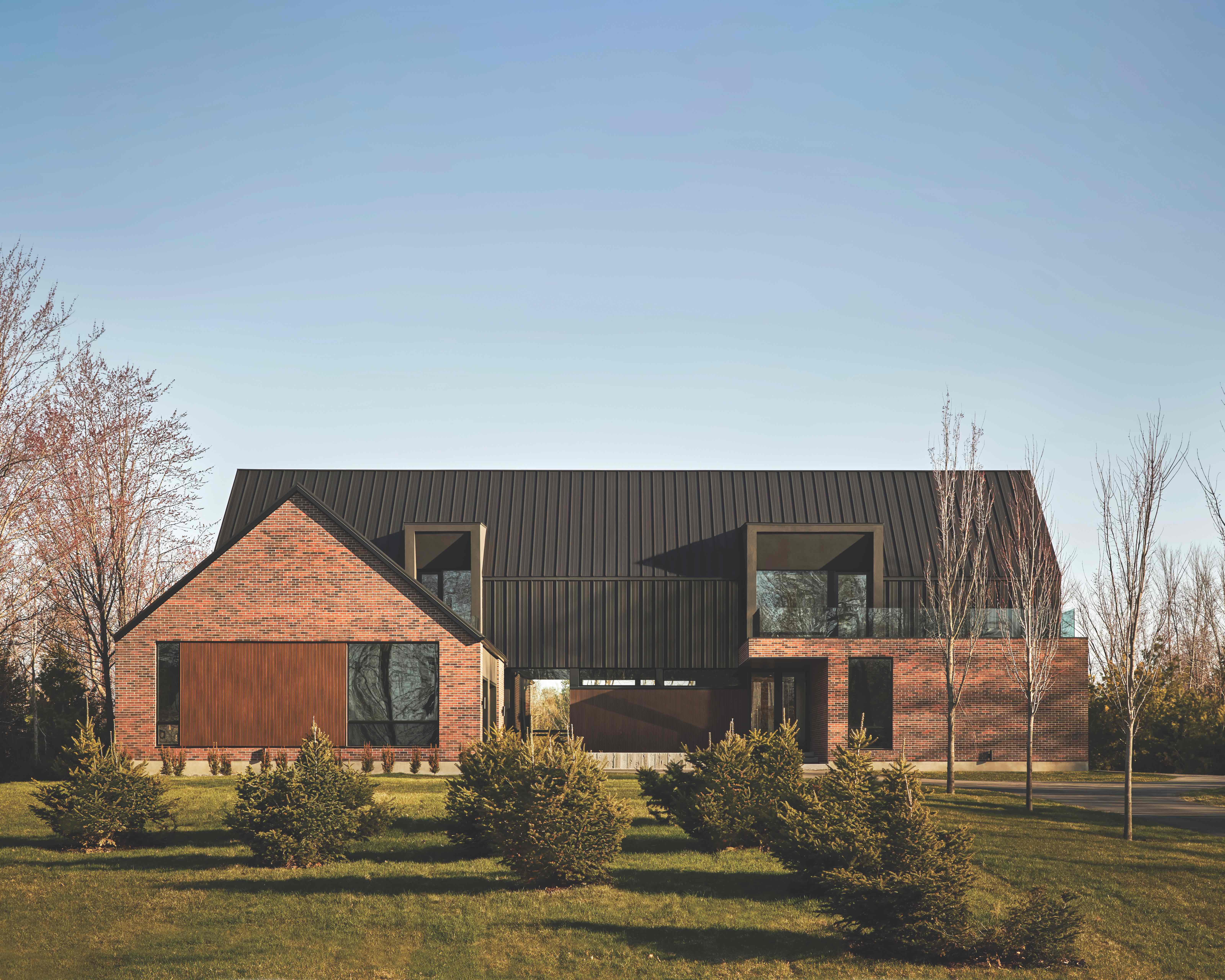
TRANSCRIPT
00;00;02;24 - 00;00;32;01
MN
We looked at references of Eastern European architecture that felt familiar to them in terms of their context. Right? So, they grew up in small villages in southern Poland, where a lot of the typical houses there are just built out of clay brick, and the clay brick is exposed. All the mortar is exposed. So, it's all load bearing. One could look at that and say, well, that's really utilitarian and reflective of the structure of the house and, you know, where's the cladding? But to me I find that really interesting. I'm like, Oh, that is the cladding. And how do we kind of represent that in a new way?
00;00;33;00 - 00;01;01;25
DP
This is my guest, Mateusz Nowacki. I'll share more about him shortly. In this episode from the Design Vault, we’ll highlight his project, The H-House. The H-House is a residential home. The name is derived from the shape of the home, in plan, with the two story central spine and flanking single story legs clad in brick. The building uses standing seam metal, a variegated red brick and large modern black windows.
00;01;02;17 - 00;01;51;10
DP
Hi, I'm Doug Pat and this is Design Vault. Today we're talking to Mateusz Nowacki, architect of the H-House in Manotick, Ontario. Mateusz is the founder of Everyday Studio. He received his Bachelor of Architecture from Carlton University and is Master of Architecture from the University of Toronto. He's been practicing architecture in Toronto for over eight years and is a licensed OAA member.
Everyday Studio’s work has been recognized in various architectural media, including Dezeen, Dwell, Ottawa Magazine and GOHB Housing Design. So, Mateusz, tell us a little bit about your firm, Everyday Studio. Where are you located? What's the size? What kind of work do you do?
00;01;51;17 - 00;03;02;00
MN
Yeah, so I founded Everyday Studio in 2019 after doing a few years of freelance work, small projects here and there. I got a kind of first larger residential project of around 3500 square feet. It felt like a good time to kind of describe the notion of a studio that looks at the practice of researching and thinking about different housing prototypes and using that first project as a case study for that.
And it was sort of a kind of deviation of the thesis that I worked on in 2015 that looked at housing prototypes as well. And so, the purpose of the studio was really to be a kind of collaborative space to work with clients or contractors or trades or researchers to kind of understand the possibilities that housing can take in alternative forms than the typical vernacular.
And those studies can be polemical or literal. So, in some cases they might just be research based or text based. In some cases, they might be full houses. So, the kind of idea being that this collaborative space is meant to bridge that gap between what's on paper and what's actually built. So, we're located in Toronto, my studio right now. So, it's usually just me, but sometimes I take on some seasonal stuff and we can kind of range from a 1 to 3-person office.
00;03;02;08 - 00;03;08;21
DP
Okay. So, tell me a little bit about how you got this current project. The H-House, and how you get work in general.
00;03;08;29 - 00;03;55;29
MN
Yeah. So as any startup office does, work comes from just networking and passing on of a name. So, one project turns into another project and into another project. So, this one came from a client that was interested in the property in Manotick, and started off as a conversation with that client. And I think he had seen some of the past projects that I had done in that area as well.
Interestingly enough, like in that rural area of Manotick outside of Ottawa, I did I think two other kind of full houses which started to breathe a little bit of attention and got this client’s attention. So, it started off as a conversation, which turned into a kind of concept design for the project and the initial sort of idea was to create a house that's better connected with the site and with nature than some of its neighbors. And I can kind of touch upon that in a little bit. But it started off from there.
00;03;56;05 - 00;04;05;00
DP
I mean, I think that's a great place to start. So, give me a little bit about the history of the place, the location, the town, the neighborhood, the buildings.
00;04;05;09 - 00;05;17;11
MN
Yeah, to that point, I think that's such an incredible and important part of the story of this project. So much of where we drive inspiration from is context. You know, where is this thing located and why is that important. In the case of this area, so, the town is called Manotick. It used to be flagged with a number of agricultural fields.
It was a really kind of agrarian farming village some 75 to 100 years ago. And it hasn't developed much since that. Manotick itself is a small little town, you know, with single family homes surrounded by kind of two rivers and the kind of external area of that, the sort of periphery is surrounded by still some farming fields and some kind of larger sort of developments for larger scale homes.
So, where this property is located, it's in a neighborhood that was developed called Rideau Forest. So, it's filled with these two-acre wooded lots. So, it's quite a heavily forested area. But interestingly enough, like there are still traces of the agrarian history of the site. So, when you kind of meander through some of the still available properties there, you can see some of the old kind of stone walls which divvied up different fields for different species of crop and things like that. So, it has this really inherent tied to farming and to that kind of nature of the site, even though it's evolved now to be this neighborhood of two acre properties in really large houses.
00;05;17;17 - 00;05;21;28
DP
Is it typical to have an architect in that neighborhood?
00;05;21;28 - 00;06;17;09
MN
I would say no. Most of the houses that are built in that neighborhood – they come from two kind of forms. They come from either the client looking to have a sort of full-fledged design build project where they contact their custom home builder, per se, or they come ready with a plan that they've found or purchased or something like that. So, although the houses are quite custom in nature, they follow a kind of similar and typical pattern. Whether these large houses with these kind of large wings and adaptations. And what happens is they get quite visually noisy, they have quite deep floor plates, and the amount of carving that has to sculpt the roof geometry becomes very intangible from a visual perspective. And the way that we wanted to approach this project was sort of an antithesis to that was how do we marry the former context in kind of a gray and sort of idea of this site and its history with the understanding of what the site is today and the kind of neighborhood context.
00;06;17;18 - 00;06;41;06
DP
It sounds to me like – I mean it's pretty challenging to get sophisticated clients and then in a neighborhood like that, to end up with a client that's really interested in making great architecture, right? And listening to an architect and working through these challenges. So that must have been a nice experience because it doesn't sound like you knew them per se, right? They found you through relationships that you had with other people.
00;06;41;06 - 00;08;00;24
MN
Well, well, wait Doug, there's more.
So, we definitely started the conversation, the cons design with this client and to kind of emphasize the story a bit further, he also contacted my father, who has a construction company in Manotick in Ottawa. So, he has basically a custom home building company. He's one of these custom home builders in this area. So, he wanted to kind of work with us together at one point or another in the project, the client kind of backed away, you know, had alternative plans and sort of wanted to go in a different direction, I think ended up moving to a different country.
And so, we had this relatively well-developed design that was at a good point, a good conceptual point, and we had already invested a lot in how to create this marriage between site history and current context of neighborhood and things like that. And so, because my father was attached to the project, he kind of inherited its journey and was like, you know, I still want to move forward with this project, whether it becomes the project that we just build as a sort of passion project and sell, or whether it becomes something that is tied to our living, then he’s game.
So, he inherited the journey of the project. And so, from then on, we started to really look at incorporating nuances of my father, my mother's kind of Eastern European history into the project and see how the context of Eastern Europe and the area that they had lived in could start to influence materiality and tectonics of the project as well. So, it had this kind of new layer that was thrust upon it afterwards.
00;08;01;04 - 00;08;04;01
DP
So, am I getting this right? This was ultimately for your mom and dad?
00;08;04;06 - 00;08;05;10
MN
Yeah. So, they live there now.
00;08;05;12 - 00;08;06;12
DP
Oh, that's so cool.
00;08;06;12 - 00;08;07;12
MN
Yeah, they live there now.
00;08;07;12 - 00;08;08;11
DP
Unbelievable.
00;08;08;11 - 00;08;23;02
MN
It was an interesting kind of story of starting off with someone else, you know, and then kind of transferring it over, but not wanting to abandon it because so much was invested in in the first place. And then, you know, starting to layer on this new level of thinking to the project as it became more about them and less about the previous clients.
00;08;23;02 - 00;08;25;05
DP
So, you get along with your mom and dad?
00;08;25;05 - 00;08;29;06
MN
I do. I mean, yeah, Eastern European stubbornness aside, you know, I do for sure. Yeah.
00;08;30;14 - 00;08;31;19
DP
Do you have brothers and sisters?
00;08;31;28 - 00;08;34;29
MN
I have one brother. He works for the company as well. He's like, Yeah.
00;08;35;02 - 00;08;38;29
DP
So, your interest in architecture was early on, right? Your dad was a builder?
00;08;39;04 - 00;09;42;03
MN
Yeah, for as long as I can remember, since I was ye tall – for the listener, I’m pointing very low to the ground. Yeah. I've been on construction sites with my dad. I fully attribute my interest in architecture to him and to kind of him putting me in a context of watching things materialize and happen. And so, I think as a child, I was just inherently interested in – what are we actually building? You know? Like, it's great that we're building it, but what does it look like? What does it form? What kind of space does it create afterwards? And so, I married that with another interest of mine, which was really kind of urban thinking. Though this project is in a rural context, I think my suburban upbringing really planted the seed in me to want to think about a kind of different way of thinking about architecture and living and urban qualities of sites and things like that.
And so, when you look at it through that scope, this project was sort of the evolution of those things of me being kind of surrounded in this type of, you know, suburban, rural kind of context as a child, being able to come back and work on a project with my dad was a sort of full circle moment.
00;09;42;06 - 00;09;51;23
DP
Yeah, it's an amazing experience. That's wonderful. You seem like a very intuitive, very curious guy. So, let's go through quickly what were the client's programmatic requirements?
00;09;52;02 - 00;11;14;12
MN
So, a kind of synthesis of space, really trying to tighten the space a lot so that there was no wasted space in terms of program. So, I mean, at its core of programs, there's a living room and a kitchen in the dining. There's no accessory spaces, there's not a secondary living or sitting room or a secondary nook for eating.
It's just a simple kitchen, dining, living space associated with that typical mudroom powder room, a small home office, a main bedroom, and then a series of bedrooms with individual on-suites upstairs, as well as a library kind of gallery space. But the idea was to kind of be able to synthesize all these into a very tight knit floorplan.
So, when you look at the plan of the project, it's actually only a bar, the kind of adaptations that come off of the ends, house a garage, kind of veranda, lanai space off of the back, another garage on the other side. We kind of broke them into two. And then the main bedroom is actually the only programed interior floor space that comes off.
So, the house is quite tight. It's all housed into kind of one bar, and that tightness allows for the program to kind of work its way around each other. So, there's this constant sort of voyeurism as people move through the house. They're seeing each other from multiple levels and multiple rooms, and it invites cross ventilation, which is really important to the way I approach projects. There's a certain depth to the floor plate, which allows you to cross ventilate the space and creates really good environments for living, quality of light wise and ventilation wise.
00;11;14;19 - 00;11;27;19
DP
Yeah, there's a lot to unpack there. I mean, I’m going to keep going and maybe we’ll come back to it. So, tell me a little bit about the site, the topographic features. Is it flat? Is there any change in elevation and how did that affect your plan?
00;11;27;25 - 00;12;03;29
MN
It's a relatively flat site. It's not a site that has really strong topography to it. It does drop off a little bit at the back. But we didn't see the design from the get go as something that could start to play with elevation because it would feel forced if we would do that, you know, if we were starting to carve out spaces out of the topography to create walkouts or things like that, we really looked at the site as something that we said, okay, this is a planar condition. It's quite nicely treed around. So really, let's emphasize the connection to the sort of natural vegetation on the site and create the sense of living within this forest condition, which is, you know, why the house is heavily glazed towards the kind of more rare private conditions.
00;12;03;29 - 00;12;11;01
DP
Yep. Not everybody is that lucky. Sometimes it's a little easier when you don't have a ton of topographic issues to deal with.
00;12;11;09 - 00;12;16;07
MN
It's certainly easier. You tend to seek out the challenges in other places… At least, I do.
00;12;16;07 - 00;12;29;28
DP
It's almost nicer, I find as an architect, to have a challenge because then it makes you really work at design, right? What about project restrictions? So, like zoning, building codes…was there anything that was challenged in regard to that?
00;12;30;09 - 00;13;58;13
MN
So, from a zoning perspective, not really, because in this area like that, the zoning is quite lenient for a neighborhood like this. Within the frame that we were building, the size that we were building, we didn't have to deal largely with zoning issues or setback issues or anything like that. From a challenge perspective, I think the biggest one is one that surrounds the way in which I approach all my projects, which is buildability.
With that I mean, I try to find a way to create really interesting and engaging architecture using really conventional methodologies. So, this is a stick frame house that limits its use of steel, and yet we see cantilevers and floor protrusions and things like that. It's like, how do we get there if you're not building a full house out of steel?
And largely like my kind of interest in that was trying to make engaging and good architecture available to both clients and contractors at a better price in a way that feels more approachable from a building standpoint. And because with this house – my father being the contractor working on it – I knew inherently how he likes to build things and what his limitations are as a builder.
I use that as a framework within which to start thinking about the design, thinking about the tectonics, thinking about really strategically, where we're using more costly steel, where we were using larger expanses of glass, but also where we were tightening them up. And so, though the house looks like it's tectonically a lot more maybe complex than it looks, if you peel all of it back to the bones, it's no different than all the neighbors, which are just typical conventional stick-built houses with wood trusses.
00;13;58;21 - 00;14;03;00
DP
Right. So, a lot of thought went into, I would imagine, how much this thing was going to cost.
00;14;03;11 - 00;14;50;19
MN
Certainly how much it was going to cost, and just the approach to how it was going to be built. So, I remember, you know, when we were working through the construction documents on the project, having weekly conversations with the contractor and with trades that were involved from the early onset of how do we want to actually make this thing materialize, how do we want to build this thing? Like, you know, how is this beam going to sit? What kind of posts is it going to sit on? And almost working through it with a really solid understanding of structural engineering without going right to the consultant and asking him what to do. Like, we had this really intimate relationship with how this thing was going to be built and in a way that sort of harkened back to the agrarian structures that it's influenced by was the individual who owns that property is going to come in and look at the timber he has and build it himself. And we're sort of creating a modern interpretation of that approach in some degree.
00;14;51;01 - 00;15;02;15
DP
So, a big question would be, in particular, if I was working with my folks, the style choice. So how did you guys end up doing a modern building? Was that something they wanted right away?
00;15;02;23 - 00;16;37;27
MN
Yeah, it started off as a contemporary project with the first client that we were working with, and they were interested in a sort of a contemporary expression of a sort of farmhouse condition, right, using sort of materials that were natural and kind of warm tone to work with the site really well. And so, we kind of kept in that vein, but certainly started to work more specifically once my father was on board with kind of continuing the journey of the project.
So, from a style perspective, the houses certainly a deviation from them like they used to kind of live in a house that was quite ornamented and detailed and things like that was a beautiful house. Right? But I think them seeing me continue to work on projects and the kind of projects I was working on, it really started to kind of have an effect on them and me coming on home at Christmas and talking about how important natural light is and that kind of stuff.
It really had an impact. So, they saw that as something that they could kind of work with themselves in terms of how to approach the house. And then on top of that, we looked at references of Eastern European architecture that felt familiar to them in terms of their context, right? So, they grew up in small villages in southern Poland where a lot of the typical houses there are just built out of like clay brick, and the clay brick is exposed, all the mortar is exposed.
So it's all load bearing. One could look at that and say, well, that's really utilitarian and reflective of the structure of the house and, you know, where's the cladding? But to me, I find that really interesting. I'm like, Oh, that is the cladding. And how do we kind of represent that in a new way? Hence where we landed with the materiality of this project, which is a kind of smoked darker tone sort of clay brick that ages really well and it has this kind of grace and it's a timeless quality. So, we looked at those precedents as a reference in terms of where the style of the house itself lands.
00;16;37;27 - 00;16;47;06
DP
So, your choice of brick masonry, really, you knew from the beginning that you were going to be using masonry there at some point, right?
00;16;47;16 - 00;17;53;28
MN
It was set out at a conceptual level, yes. Though the tone or the color or things like that were sort of up in the air. Then when my father and mother had, during the project, they kind of seemed interested in carrying on that idea. Specifically, I remember for my mother when I said, you know, we're thinking about this kind of clay colored brick and something that looks really natural.
She loved that idea. She really never understood why more houses in a kind of contemporary context didn't do that, at least in the context where they live. And to some degree because the house, you know, in its design, in its formal and massing quality, it can appear really stark compared to its neighbors. The materiality choices of it are meant to sensitize that approach.
So, this notion of really conventional brick is meant to appear familiar to kind of an onlooker or to the person that lives at that home. It has this really timeless quality to it. It's like I can understand that house because it's made of brick. It's made of a conventional thing that I know that's been around for ages and has its conventional color. That's the color that brick usually looks like. When you ask a child to draw a brick, they're going to draw a red brick, maybe with three cores, if the child is advanced enough. Right? There's this familiarity which helps make the architecture more digestible.
00;17;54;08 - 00;17;59;22
DP
So, set up the building materials in general for us because the palette isn't just brick.
00;17;59;22 - 00;18;09;04
MN
Yeah. So, the kind of two wings that ground the house at the base are a Smoked Tudor Velour modular brick. So, it has this kind of rusty sort of clay color.
00;18;09;10 - 00;18;15;10
DP
And those colors, I would use the word variegated. Right? So, we see a series of different colors in that red clay.
00;18;15;11 - 00;18;40;01
MN
Yeah. The specification of the brick itself has a variation in it. It's up to a good bricklayer to make sure they patronize it quite well. But a lot of that is just coming from like the brick looks like it's been smoked at its edges and some are more smoked than others, which is where you start to get that kind of differentiation. And we like that a lot because the house has these really monolithic large brick volumes. And so, the kind of variation, the slight variation in the tone really help to kind of break that monotony apart a little bit.
00;18;40;08 - 00;18;43;07
DP
Was it hard to find a mason?
00;18;43;07 - 00;18;44;05
MN
A good mason? Yes. It’s always hard to find a good mason.
00;18;44;06 - 00;18;45;25
DP
It is! It's crazy!
00;18;45;25 - 00;19;18;20
MN
Yeah. And so this is why, you know, as a studio, we think it's important to kind of collaborate with trades early on because they can help kind of understand or they can help kind of propose ideas about how to get the masonry right at these angles or at the cantilevers that we’re proposing, things like that. And then the other materials were using a black standing seam metal above. So conceptually the volume that hovers above these two things floats. So, metal felt more appropriate. And then we're using a composite wood system in between the windows. So that's meant to kind of be a homage to sort of old wooden shutters that kind of peel away from the window itself.
00;19;18;24 - 00;19;20;15
DP
Where did you find that?
00;19;20;15 - 00;19;35;08
MN
It’s a product – I think it's based in the States. I can't recall. It's meant to be a veneer, but it's made out of wood fibers that are infused with like fiberglass and resin. So from a durability perspective. There's no maintenance. And it retains its color over time really well.
00;19;35;12 - 00;19;41;03
DP
And you're using steel lintels over these large openings that you're then using this wood infill between the windows.
00;19;41;09 - 00;19;45;05
MN
Correct. With the main one being the cantilever at the front entry of the home.
00;19;45;14 - 00;19;47;25
DP
So how did you pull that off?
00;19;47;25 - 00;20;06;05
MN
So, you know, we're looking at brick as a simple material and it's execution that appears very traditional in the way that we're applying it. But we found moments where we could start to kind of give it a more contemporary execution, and the main one being the cantilever at the front entry, which is just upheld by steel beams that are cantilevering out and transferring their way back to kind of point loads in the house.
00;20;06;05 - 00;20;07;23
DP
So they're tied back into the walls.
00;20;08;00 - 00;20;20;19
MN
Yeah, correct. And that cantilever holds a terrace on the upper floor, so a dormer above the entry that opens out onto a south facing terrace that you can use. And even in the kind of cooler spring months, because the sun engages that terrace quite nicely.
00;20;20;25 - 00;20;23;23
DP
Right. And that's a clear glass guardrail up there.
00;20;23;23 - 00;20;24;08
MN
Just a butt joint across.
00;20;24;08 - 00;20;25;07
DP
No frames.
00;20;25;07 - 00;21;03;01
MN
No frames. Yeah. So that it just kind of appears really minimal and visually to kind of carry on the notion of this house being an antithesis, that's exemplified in this entry now. You know, just talking about it, so many of the houses in the context, you know, the entries are these large columnar conditions, you know, with very ornamented roofs and things like that meant to kind of evoke this kind of grandiosity.
And here I think we're trying to evoke a grandeur, but we're doing so in a more nuanced way, layered elements, a kind of a structural acrobatic of this cantilever, the brick kind of enveloping you, your eye moving vertically towards that dormer. It's creating that grandeur, but doing so in using kind of tectonic architectural elements.
00;21;03;11 - 00;21;08;20
DP
So, did using bricks of any particular design challenges for you or for your clients?
00;21;09;01 - 00;21;42;17
MN
From a design challenge perspective, I think you sort of touched on it before, but it was how to allow the house to bridge the gap between the history of the site, the approachability of this kind of architecture in this kind of neighborhood and this sort of nostalgia of materiality for the client's past. Right? When we looked at those three conditions, Brick felt like a very natural material to kind of start to solidify that.
So that was the challenge of how do you build something like this in this kind of neighborhood? And brick really started to provide an answer for that in terms of how to bridge those gaps and how to create an architecture that feels timeless.
00;21;42;25 - 00;21;50;11
DP
You've got these traditional gable forms and yet you have these modern flat roof forms. What are the neighbors think? Have you heard from any of them?
00;21;50;21 - 00;21;52;20
MN
From when I'm around the house and I've been there.
00;21;52;20 - 00;21;53;10
DP
Yeah.
00;21;53;10 - 00;21;59;23
MN
A lot of cars roll by very slowly, I suppose. Although, I haven't heard many words being spoken, right?
00;21;59;29 - 00;22;00;21
DP
Do your folks hear anything?
00;22;00;21 - 00;22;18;25
MN
You know, I'm sure they only hear the good things. No one's going to say their real opinions. But to me, architecture is not about pleasing everyone. It's a subjective, you know, discourse, right? So it's about creating something that feels specific to the client, but also feels like it's mindful of its context and of where it came from in a really intelligent way.
00;22;19;04 - 00;22;27;21
DP
That's well put. Besides the cantilevers with the masonry, with the brick, were there any other unique construction details that you came across as you were building this thing?
00;22;28;02 - 00;24;22;01
MN
Yeah. So I mean, you can see in one of the photos we're looking at here in the studio, the interior, we use the bricks in the interior as well on the main kind of fireplace wall. So, the interior planning is kind of regimented by these volumes. So, as I mentioned before, the kitchen dining and living spaces are sort of one holistic space and they're separated by these equal 16 foot wide, almost like objects, one being the kind of back bar of the kitchen clad in a kind of white oak, one being the sort of kitchen island, 16 foot long cloud, and of course the main one being the fireplace clad in the brick, and then the third one being a kind of double height staircase, which has these sort of steel slatted risers that link the two levels together.
So, the main rooting element was the brick on the interior. And so, from a kind of challenge perspective, we had to just understand how to reinforce that brick on a conventional concrete foundation system with two steel beams trying to look at how to do that in the most conventional and cheapest way that we can make it work from a size of a beam perspective. But in execution, we found when you lay brick inside, you have to sequence that really specifically with all the other materials that are going in the house of the all the other trades that are coming in the house. You know, when is the right time to install the brick?
And we had to perform a few acrobatics with there because there's a kind of linear expression of the fireplace that's clad in a kind of thin steel plate reveal. So, we had to kind of cantilever the brick around that as well and kind of find a meaningful way to transfer it down. And then to express the tectonics of the build – and thankfully, the good work of the trades – we have uplighting that shines up on the brick in the kind of evening moments which really help to kind of show its tactility and it's rough surfacing. This brick specifically has a really natural finish to it. It's not polished or anything like that. We really like to use materials that look like they're supposed to look what they are. Bricks should look like brick. It should feel natural, it should feel rough, it shouldn't feel metallic or shiny or things like that. And so updating it felt like a celebration of selection of the brick, too.
00;24;22;01 - 00;24;32;15
DP
So, who did all the drawing? I love to ask that question because I love to draw, and this must have been really a wonderful experience for you because you're working with people that you really know well.
00;24;32;26 - 00;25;13;12
MN
It was primarily me. Like, I was doing the drawing from kind of early concept design to the CD's – construction documents – and to the landscape design as well. We didn't touch upon that one either, but because of the H form of the house, it forms two courtyards, one at the front and one of the back of the house. You know, conventional front and back.
And then the orientation of the pool is actually perpendicular to the orientation of the house, which kind of pulls the eye out towards the backyard and then towards a kind of pool house which is not pictured on these images we're looking at. So that sort of tertiary structure, that pool house there, kind of completes the series of objects that encapsulate that rear design of the site. We looked at an execution of that as well when I was drawing this thing up.
00;25;13;21 - 00;25;20;04
DP
Did you create three dimensional renderings for your folks? So, this is 3D modeled and then what software did you use?
00;25;20;15 - 00;25;22;00
MN
A number of different software.
00;25;22;04 - 00;25;24;12
DP
Like Revit, ArchiCAD?
00;25;24;12 - 00;25;31;19
MN
Sketch paper to start. You know, trace. A lot of rolls of trace paper. And then software wise, yeah, I mean, it starts in CAD and then it moves to Revit and then--
00;25;32;00 - 00;25;33;13
DP
Revit was the main software?
00;25;33;13 - 00;25;36;24
MN
Yeah. And then some studies in Rhino and SketchUp, and some rendering--.
00;25;36;24 - 00;25;40;13
DP
So, you know your way around that whole suite of products.
00;25;40;13 - 00;25;45;04
MN
Like most things, architects know a little bit about a lot of stuff. So, I know a little bit about every program.
00;25;45;04 - 00;25;47;08
DP
That’s so well-put. It’s so true. I'm not an.
00;25;47;08 - 00;25;48;03
MN
But I’m not an expert at any of them.
00;25;48;03 - 00;26;02;19
DP
So, tell me, sustainability is something we talk a lot about and you talked a little bit about that. Could you expand on this notion, the idea that you used Brick because I guess partially because it is a sustainable material.
00;26;03;02 - 00;27;37;14
MN
Sustainability from the perspective of the material choice? Yes. That's exactly why. Like, we like that on this project, brick is long-lasting. It is a material that requires zero to no maintenance and only improves over time. The patina that it develops over time is a likable factor of the project. Thinking about, let's say in Toronto, downtown Toronto, a lot of the older buildings that were built in the late 1800s or early 1900s were built from brick that was made at Toronto factories. And it usually is just the clay brick, right? And the exterior walls are all masonry load bearing walls and the interior structure is usually heavy timber. A lot of those went down in a large fire like most projects in the Chicago, right? But the ones that are still there, which there are quite a bit of them, they're looked at as precedents of really good, timeless architecture.
And you think about why that is a big influence. That is the long lasting quality of brick. You lay it and it feels organically and naturally sustainable without having to look at other projects as a precedent, given that the manufacturing process of the brick and also have a pretty low carbon footprint. And if you're sourcing it from a plant that's close to the site itself, that all kind of engages in that sort of sustainable approach of the brick.
And then outside of that, as a piece of architecture, we talked about the tightness of the project, the tightness of the envelope, all to create forced air ventilation that feels really well rounded because the air doesn't have to move all through the house. The HVAC design of the project is really, really tight in terms of how, you know, air movement gets kind of forced into all these spaces.
And of course, in the summer months you can all but turn off all of your heating and cooling systems because the house is so naturally ventilated. So, it creates really cool environments in the hotter summer months as well.
00;27;37;27 - 00;27;51;08
DP
So, give me one thing that you guys learned. It doesn't have to be about brick, but something that you learned through this process of designing a house, having two different clients, and then getting to the finish line.
00;27;51;19 - 00;28;28;21
MN
Working with a family member can be challenging, but can also be very rewarding. It can be challenging in the sense that a family member like my father, who has years and years of experience of building houses already, right? So they're really ingrained in how they've been doing things and here comes this young’in that's trying to look at a new way of thinking about this.
So that butting of heads and that friction can be very challenging. So, it's important to kind of keep your eye on the ultimate goal that you're trying to achieve together from the outset and not lose sight of that and let cool heads prevail, essentially. Right? I think that was a big lesson learned and so much so that, you know, my father and I are still continuing to work on some projects together.
00;28;28;21 - 00;28;29;16
DP
You're still talking?
00;28;29;16 - 00;29;24;28
MN
Yeah, still talking and still doing this stuff together, which is fantastic. At the end of the day, we love and I particularly am really thankful that I get to leave this kind of legacy behind with him, you know, of doing a project together with him. It's really a great kind of thing to leave behind, you know, a physical thing.
And outside of that, we talked about it before, but getting trades involved early. You know, we had some hiccups, of course, on site, as every project does. But we did learn on this project that getting trades involved early in the process was helpful in terms of how we were able to execute exactly what we wanted because we could have those conversations and planting the seed in whoever is, you know, working on whatever the product may be that they're installing or are working on. They also feel like the project is partly theirs.
Getting good trades is a challenge from any project’s perspective, but I find when you get them excited about it, they feel like they can bring their best work, you know, in terms of trying to suffice. The challenge of presenting them and make them feel proud that they're part of the process. And I think that's a really important one.
00;29;24;28 - 00;29;49;12
DP
Yeah, it's interesting to personalize that. I always ask the clients to bring in our contractors in schematic design, right at the end of schematic design, so we can get a preliminary price on the job. But I like how you describe this as more of a kind of relationship with these people that then grows and they get excited about the job. They're in early, they get to look at the drawings and then they have something to say about the project.
00;29;49;18 - 00;30;59;03
MN
Yeah, it's a kind of evolution of the typical kind of architecture delivery methods. So, you've got your design bid build, which really can create a divide between the architect and the contractor and the client to some degree. Then you've got the design build model which tries to integrate the contractor or an architect to some degree and create a more holistic approach.
And so, this is kind of an evolution of that. It's a design build with integrated input from trades and from the clients so that everyone feels like the project belongs to each and every individual that's working on it. There's forms of that called integrated process delivery that can be really timely right? But because we're just looking at house design and house construction, we can still be really intimate and fast tracked about the process as well.
So, this project, from initial design to final conception and kind of move in was two and a half years. I've worked at offices on custom bespoke residential architecture where projects of a similar scale, but with much more rigor and structural acrobatics and things like that were 5 to 6 year process. Right? That's part of what I think is interesting to us as a studio is how do we deliver these projects in a timely manner as well and not abuse the sort of amount of time that these things take.
00;30;59;14 - 00;31;07;05
DP
Yeah, particularly important with your parents.
MN
Yeah, indeed, indeed.
DP
Well, Mateusz, thank you very much for being here.
00;31;07;05 - 00;31;08;10
MN
Yeah, thanks so much for having me.
00;31;08;10 - 00;31;10;14
DP
And tell everybody how they can find you.
00;31;10;17 - 00;31;24;22
MN
We're somewhat engaged on social media. So, our website is www.everyday-studio.ca. At Instagram where everydaystudio_ that would probably cover most of the social media, but yeah, we try to keep up to date as much as we can.
00;31;24;23 - 00;31;27;12
DP
Okay, well, Mateusz Nowacki, thank you very much.
00;31;27;12 - 00;31;28;05
MN
Yeah, thanks, Doug.
You May Also Be Interested In
We Can Help With Your Next Project
Discover the latest + greatest in design trends, industry news & pro tips from pros.
For all of your project needs, you’ll find everything you need at a Supply Center.
Let Us Know How We Can Help!
Design Vault Ep. 15 650 Park Avenue with Christa Waring
ABOUT THE ARCHITECT:

|
Christa is a Principal at CTA Architects P.C. whose journey with the firm began in 1994 when she joined as a member of the technical staff. With a deep-rooted passion for sustainable design and a keen understanding of Building Code and Zoning issues, Christa plays a pivotal role in driving the office's environmental research and implementation of green technologies, including adherence to LEED and Certified Passive House design standards.
Christa has worked on some of the firm's largest projects, and she brings a consistent focus on sustainability to all of her work. The 90,000-square-foot, mixed-use Lower Eastside Girls Club/Arabella 101 was designed to LEED standards, and the Grand Street Guild moderate rehabilitation featured a 3,500-square-foot maintenance building with a seasonally blooming extensive green roof. Her recent projects include the award-winning exterior preservation of the cast iron façade at 54 Bond Street, and she recently oversaw the completion of the conversion of an illegal SRO into low-income housing for formerly homeless elderly residents on the Upper West Side. Her current workload includes the start of construction on a building rehabilitation project that is part of the New York State Energy Research and Development Authority's RetrofitNY pilot program.
In addition to her work as a Principal at CTA, Christa taught at Pratt Institute for a number of years and lectured for the New York City Urban Green Council and the Northeast Sustainable Energy Association. She is also a member of the New York City Department of Buildings Construction Requirement & Materials Committee and the New York City Energy Conservation Code Commercial Advisory Committee.
|
|---|
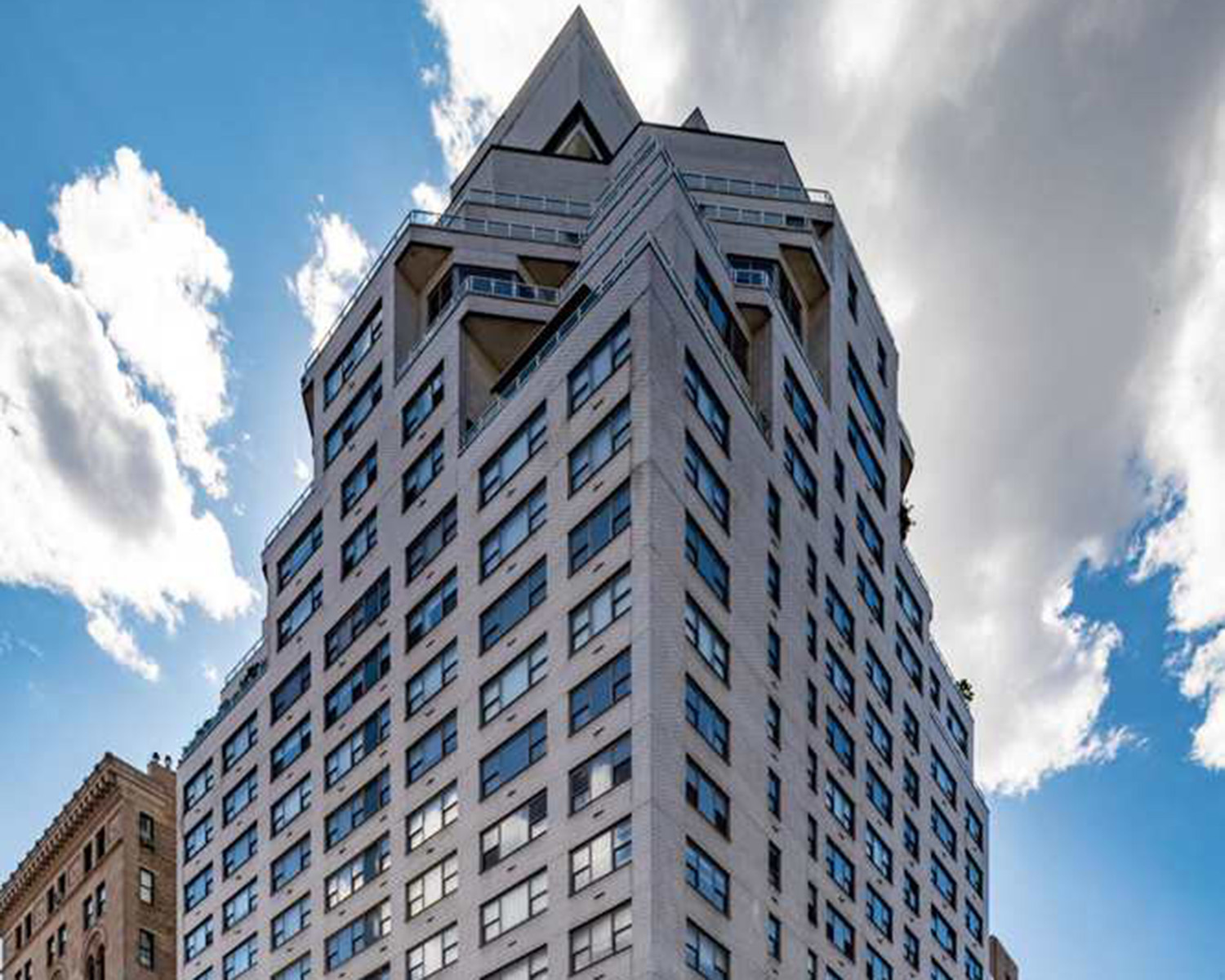
650 Park Avenue
designed by CTA Architects
TRANSCRIPT
00;00;00;00 - 00;00;05;13
Doug Patt (DP)
Let's go inside the vault. The design vault.
00;00;05;15 - 00;00;28;26
Christa Waring (CW)
It's only exterior work. Right now, we've just mobilized to start the brick restoration. We had great assistants getting a perfect match to the original white glazed brick that they have there. You want to make sure when you're doing this much brickwork that your spackle is right, and it doesn't stand out in the end. And Landmarks approves the work very easily.
00;00;29;03 - 00;03;30;29
DP
This is my guest, Christa Waring. I'll share more about her shortly in this episode from The Design Vault. We highlight Christa's project in New York City, 650 Park Avenue. 650 Park Avenue is located in the Upper East Side Historic District, built in 1963 and designed by Emery Roth and Sons Architects. It's a 21-story apartment building with a white glazed brick facade and setbacks above the 16th floor.
The base of the building maintains the building line of Park Avenue. Recent façade examinations revealed a deficiency in the wall tie system that connects the face masonry to the backup concrete block masonry. CTA designed a program of facade repairs that include face masonry pinning in addition to the restoration of all shelf angles across the façades. The original construction features have finished glazed edge over all the window lintels, which has an impressive impact on the esthetic of the building. Thus, the project entails an extensive masonry rebuild where matching the existing brick is of paramount importance.
Hi, I'm Doug Pat, and this is Design Vault.
Christa Waring is a principal at CTA Architects, P.C. in New York City. She's been with the firm since 1994. She received her Bachelor of Architecture from Pratt Institute. She's passionate about sustainable design and has a keen understanding of building code and zoning issues.
Christa drives her office's environmental research and implementation of green technologies, which includes adherence to lead and certified passive House design standards. She's worked on some of CTA's largest projects, including the 90,000 square foot mixed use Lower East Side Girls Club, Arabella 101, and the Grand Street Guild. Her recent projects include the award-winning exterior Preservation of the Cast Iron Facade at 54 Bond Street.
She also recently oversaw the completion of the conversion of an illegal SRO into low-income housing on the Upper West Side. One of her current projects includes a building rehabilitation project that's part of the New York State Energy Research and Development Authority's Retrofit New York pilot program. Christa taught at Pratt Institute and lectured for the New York City Urban Green Council and the Northeast Sustainable Energy Association.
She's also a member of the New York City Department of Buildings Construction Requirement and Materials Committee, and the New York City Energy Conservation Code, Commercial Advisory Committee. So welcome, Christin. It's nice to have you with us today. So, tell us a little bit about CTA architects, P.C. in New York City. So where are you guys located in New York. What's the size of the firm? How long have you been around and what type of work do you do?
00;03;31;02 - 00;04;46;14
CW
Well, thank you for having me today. CTA Architects. We're located down in the Flatiron District, just a couple of blocks from the Flatiron. We have 60 plus employees at this point, including support staff. We do a variety of work in New York City. All of our work is focused in the five boroughs, frankly, mostly Manhattan. We do have Brooklyn and Queens, some in Staten Island, a couple in the Bronx.
But we originally started out in 1987 or so. We came into being around the time that the first facade laws came into effect. And so, it was something that we naturally fell into. And we have been doing that work ever since I've been there since 1994. Our founding partner, Doug Cutsogeorge was my professor at Pratt and hired me as an intern in my second year there, and I have been there ever since.
So, I was an intern. I typed envelopes that when we had typewriters, I fax things and then went out and did field measurements and climbed around on ladders and hung on scaffolds. And 29 years later, still there. And I've been a partner since 2014.
00;04;46;17 - 00;04;49;16
DP
Real quickly, tell me about these façade laws. What is that?
00;04;49;23 - 00;05;55;20
CW
You know, my business partner Dan, could give you, like, every single date and iteration, but I'll give you the gist, which is that terracotta fell off a building at Columbia University and that initiated a city response, which was at that time called Local Law ten, which mandated that all buildings over six stories have to be inspected every five years by a registered professional and a report submitted to the Department of Buildings.
So, at that point, all of the buildings submitted on the same day, February 21st, every five years, and as the law developed, it keeps developing based on things that have happened in the city. At that point, it was just the street elevation and you just had to look at it with binoculars. Now it's the entire building and you have to look at it from a hanging scaffold or a bucket truck. And depending on the construction type, you have to open probes through the face masonry to expose what's in the cavity.
00;05;55;25 - 00;05;59;20
DP
Wow. So, the incident at Columbia was that in the early eighties?
00;05;59;21 - 00;06;09;27
CW
That was in the early to mid-eighties. So first it was Local ten and then it was local Law 11. And now it's called the Façade Inspection Safety Program.
00;06;10;05 - 00;06;14;05
DP
So, it sounds like a good thing. They're now inspecting buildings for this very issue.
00;06;14;12 - 00;06;25;23
CW
Right. And now they broke up the buildings. There are three sub cycles, so not every report for every building in the city is due on the same day. So now it's broken up. So that makes it a little easier.
00;06;25;26 - 00;06;32;12
DP
So, tell us a little bit about yourself. So how long have you been a practicing architect and what's your role in the office as principal?
00;06;32;19 - 00;06;53;26
CW
I got my license in 2003, But, you know, obviously I was working for the nine years before that. Currently, as principal, I do a lot of things. I wear a lot of hats. I yell at contractors, I hold clients’ hands and bring in work and put out fires where I need to.
00;06;53;28 - 00;06;55;02
DP
Do you like your job?
00;06;55;04 - 00;07;08;05
CW
I do. It is challenging. It's a lot. You have to really want to buy into it and invest. My partners, I've been with them almost 30 years. They're family and it's a good place to be. They're good partners.
00;07;08;12 - 00;07;11;15
DP
That sounds like a really interesting niche market.
00;07;11;17 - 00;07;33;01
CW
It is. And it's funny because, you know, there are a few firms in the city that do this, and we all know each other, and then we all get offshoots from employees have left and hung their own shingle and proceeded to sell focus and exterior restoration work. I would say it's about 70% of our work is exterior restoration.
00;07;33;06 - 00;07;38;04
DP
Gotcha. Let's talk about 650 Park Avenue. So how did you guys get the project?
00;07;38;06 -00;08;21;11
CW
So, I think, like everything in my history at CTA, it was word of mouth. It's kind of a tangled web. So, we use a consulting engineer who was working on a project out and Garden City, Long Island, and they needed an architect. So, he referred me to the owner, and the owner liked us and then brought us on to some of the more buildings that he owns in Brooklyn.
And then they were going around and around with their facade issues at the building that he lives in. And so, then he brought me in over there. So, it was all this chain. I always say, you never know who you're talking to when you're going to run into them again, who they are, who they end up being. To you and professionally. So that's how we got brought into the building.
00;08;21;18 - 00;08;29;07
DP
That's really interesting. So, could you give us a little history of the location? So, what was there prior to 1963, if you know?
00;08;29;13 - 00;08;43;23
CW
I do not know what was there prior to 1963, but it is a typical white glazed brick building of that era with the wedding cake setbacks. Also, during that construction period, the kind of problems that you find typically in that construction.
00;08;43;26 - 00;08;50;06
DP
So, the scope of the project then was only exterior work. Do you guys too any renovation work on the interior?
00;08;50;13 - 00;09;05;21
CW
It's only exterior work right now. We've just mobilized to start the brick restoration and we are going to visit with landmarks, redoing the ground floor, the base of the building as well.
00;09;05;23 - 00;09;07;20
DP
So, the project is currently underway.
00;09;07;26 - 00;09;08;24
CW
It's just started.
00;09;08;24 - 00;09;09;06
DP
Just getting rolling.
00;09;09;06 - 00;09;11;04
CW
Just getting rolling. It's exciting.
00;09;11;11 - 00;09;18;05
DP
So stylistically, the setbacks on those building that's due to the new laws in New York City at the time.
00;09;18;09 - 00;09;21;25
CW
Yes, those were due to zoning.
00;09;21;28 - 00;09;35;22
DP
Project restrictions - so when you guys are working on an exterior facade, what are the rules of the road? How do you guys end up doing a project like that? I would imagine that the exterior is all scaffolding at some point. What does the city make the contractor do?
00;09;35;24 - 00;11;06;28
CW
Okay, so first we started this project with, I would say, upwards of a hundred probes through the face masonry to really define what the issues were, because there was some debate over the extent of the repairs that were necessary. So, I spent a lot of time on the scaffold in the summer of 2022 looking at all the probes and really identifying the same repetitive problem over and over again.
We're just getting mobilized with hanging the rigs and part of all that entails is we had to file drawings at the Department of Buildings to get our permits and landmarks. Landmarks has to approve first, and we had great assistance getting a perfect match to the original white glazed brick that they have there. You would be surprised at how many iterations of white glazed brick there can be, but you want to make sure when you're doing this much brickwork that your speckle is right and it doesn't stand out in the end.
And Landmarks approves the work very easily. We didn't have any issues. I submitted to them the chip that we had custom made for the building. So that was great. To mobilize, the contractor has to pull scaffold permits, so he has to file with the city to install hanging scaffolds. There was already a sidewalk shed in front of the building to protect the pedestrians on the street. It's a corner building, so a lot of sidewalk shed that's been there for a while.
00;11;07;06 - 00;11;11;19
DP
So, let's back up. How did they know they had a problem? There were bricks falling off the building.
00;11;11;26 - 00;11;24;06
CW
It originally came up in a small exterior restoration project before our time that someone identified that they had a problem, and then it just kept developing from there.
00;11;24;10 - 00;11;29;05
DP
And how many sides were that exposed? Two or three. I understand it's a corner. Does it have a back side?
00;11;29;10 - 00;11;35;18
CW
Actually, it's L-shaped in the back. It has a number of large façades. It has the two large corner facades.
00;11;35;20 - 00;11;39;26
DP
So, the building's L-shaped and plan to then open up to a courtyard and-
00;11;39;26 - 00;11;40;05
CW
It does.
00;11;40;06 - 00;11;44;26
DP
Okay. How long does the project then take? Start to finish on a building this size?
00;11;44;28 - 00;12;12;26
CW
So, we're looking at completion in February of 2025. So, it's going to be about a year and a half on the ground. We have to install all of the pins. We have to pin the face masonry back to the backup block, which is a retrofit wall tie and first they pin and then we're going to strip all the shelf angles above and below the shelf angle and address the flashing and repaint the shelf angles.
00;12;12;26 - 00;12;22;12
CW
And sometimes we'll have to replace some of the angles and rebuild the masonry. And we have some parapet work to do, parapets that are not in good shape.
00;12;22;14 - 00;12;35;16
DP
So just so I understand that. So, they put up the scaffolding. Then you end up spending a bunch of time out there. I would imagine your partners are also out there. What I'm getting at is who identifies the structural issue? Who's the expert? Is it the architect?
00;12;35;24 - 00;12;36;27
CW
Oh yes, I did that. Yep.
00;12;37;03 - 00;12;45;06
DP
Interesting. You then document those issues in drawing form, like two dimensional drawings or 3D drawings and present them to somebody.
00;12;45;11 - 00;13;13;02
CW
Yes. Two dimensional drawings and photographs. I think the photos really speak a thousand words on this one. I presented it to the board. It's a condominium, so they have a board of directors and we met with them. I went over what I saw and the resident manager there was also very helpful, and he understands the situation and saw some of the probes that were open, that were closer to the ground and could confirm what we were telling them.
00;13;13;05 - 00;13;25;13
DP
So, you put together a set of drawings and is that priced like a typical architectural set of drawings by a GC? Is it then bid out and the lowest bidder is chosen? What's that process look like?
00;13;25;19 - 00;14;52;03
CW
So, we put together a set of drawings and construction details because we had opened so many probes, there were no questions. A lot of times when you work on a building and there are no existing drawings, which is probably 90% of the time for us, you're making assumptions about how things were built in the period of the building, right?
So inevitably you open it up and there's a surprise, sometimes a minor surprise, sometimes not so minor surprise. But this one, because we had had so many probes opened, we were able to really pin down what was behind the wall. So, we put together elevations, construction details and written specifications. We put them out to bid like the architects having a niche market in exterior restoration in New York City, there are also contractors who are a niche market for exterior restoration in New York City.
So, we bid to five or six or seven of those guys, the majority of whom I've known for many, many years. You know, we all work on the same stuff, and they select the bidder. Because it's private, it doesn't have to go to the lowest bidder. You know, we usually have an interview process so that the board can meet the contractor and get their feel for if they're a good match, that they're going to be a good match with building staff. So we go through the bidding process and then the contract is awarded and they do all that legal stuff on the side that I don't have to worry about.
00;14;52;08 - 00;14;58;04
DP
So, you guys do two dimensional drawings, details, any 3-D stuff? Not really necessary.
00;14;58;04 - 00;15;00;03
CW
Not really necessary for this type.
00;15;00;03 - 00;15;03;21
DP
And how many people end up working on one of your projects like this one?
00;15;03;24 - 00;15;11;00
CW
So, on this project, it was myself, our project manager, Freddy, and his staff member Arefa.
00;15;11;06 - 00;15;24;25
DP
So, let's get into the details. How does this work? Like, how do you do what you're doing? Are you just replacing bricks in specific areas? Are you replacing entire facades? And what does that detail look like?
00;15;24;28 - 00;15;33;29
CW
So, in the scope that we settled on, we are replacing the bricks along every shelf, angled the building, and this building has shelf angles that every floor.
00;15;34;02 - 00;15;36;11
DP
Explained to us what that is, a shelf angle.
00;15;36;13 - 00;16;11;02
CW
This is a concrete framed building. So, it has a concrete structure, and a shelf angle is a continuous steel lintel basically that holds up the masonry at every floor and it's bolted back to the concrete slab at regular intervals. There are shims and bolts, and it holds the slab in there. It holds the brick at every floor, provides the gravity support, and the wall ties provide lateral support. So, the shelf angles that this building were in very good condition. There are a few issues here and there, but nothing terrible.
00;16;11;02 - 00;16;11;20
DP
They’re all steel?
00;16;11;25 - 00;16;18;08
CW
They are steel like three by three, 4x4 angles. Some of them were shallow. So, we're making them a little deeper.
00;16;18;14 - 00;16;20;04
DP
Were they galvanized or painted?
00;16;20;09 - 00;16;46;03
CW
The original ones were not. They were painted. But when we go back, we go back with galvanized and stainless-steel bolts, and then we replace the shims and the bolts, obviously. And where we find a length of deteriorated shelf angle, we will replace that. We have an allowance for that in the contract to deal with that because there were some areas higher up on the building where they get, you know, more weather exposure that we're in worse condition.
00;16;46;05 - 00;16;49;10
DP
Tell us a little bit about the brick. How did you get the matches?
00;16;49;17 - 00;18;25;21
CW
Fortunately, this building hasn't had any huge projects on it, so it was fairly easy to identify which white glazed brick was the original brick, which was good because there were maybe three different bricks on it, different color, white base. You know, one was a little pink, one was a little white, or some had a brown speckle, some had a fine speckle, some had a varied speckle.
So, because there are so many setbacks, we were able to go to somebody's terrace where there hadn't been any work high up on the building because at the base at stone. So, I'm not comparing it at the base of the building. We also walked along the sidewalk shed because that gets you up higher. And we selected - we were like, okay, this is the original brick.
And then I reached out to King's. They are brick distributors in New York City, and the folks there were super helpful and made me all sorts of custom samples and they have little brick chips and brought the brick chips up to site and went through everything with the resident manager and decided on our brick. And then you mentioned in your intro the finished underside of the brick at all of the window lintels.
So, when you have a shelf angle you don't see in the field of the masonry, you don't see the underside, the clay body of the brick. But over the lentils you can see like the little yellow clay body of the brick. And I really got into the fact that it was finished on the underside. I think it's just a little bit like a perfect little thing that I really liked. So, we asked for that as well.
00;18;25;23 - 00;18;29;11
DP
Is that like a space that's about a half hedge, three quarters of an inch wide?
00;18;29;14 - 00;18;43;10
CW
Yeah, it's about a half an inch. If you have the right amount of bearing. And so, they put the glaze on the underside. So, the Masons have to be aware, obviously, when they're rebuilding to look for that. I'm sure I'll catch some in the beginning before they get used to it.
00;18;43;18 - 00;18;45;13
DP
Is it going to be hard to find a good mason?
00;18;45;19 - 00;18;51;10
CW
We have the contractor on board, and he has good masons on hand, so I'm not very worried about that.
00;18;51;16 - 00;19;01;08
DP
So, did you guys learn anything interesting through the construction process, through the inquiry process, anything unusual, Anything you'd never seen before?
00;19;01;14 - 00;20;11;10
CW
Not anything I've never seen before, thank goodness. Because those are never good surprises. I was happy, given the lack of wall ties, that I was happy to find that the backup masonry was still in good condition. We didn't have to worry about the backup masonry because that can also be an issue. We decided to pin the columns, which I was surprised actually worked because I had never pinned columns before because you're pinning into the concrete.
So, when you do the retrofit wall tie, you can call the manufacturers rep and he'll come out and do a test. He'll drill in the wall tie, and then he has like a crank to see what the force is, to see if the tie actually holds. And I had originally planned to strip all of the column locations in the building and rebuild that as well.
But on another project of mine, we had had pull tests done for retrofit pins on that building and they went into the columns, and I was like, wait, what? I didn't think that could happen. So, we called them out. We had had him do the tests in the field, in the masonry before, but we had him come back and do the pull tests and the columns and the pins drilled right in. So, it was great news.
00;20;11;17 - 00;20;15;13
DP
So, these are columns on the exterior facade behind the brick masonry.
00;20;15;16 - 00;20;31;04
CW
Right there, directly behind one wythe of brick behind the masonry. So, the backup concrete block goes right to the column. And then if you were to take all the face masonry off the building, you would see a grid of the columns with the backup block in between.
00;20;31;06 - 00;20;38;00
DP
And all the residents there. Do they get to live through the construction process?
00;20;38;02 - 00;21;04;06
CW
They do...Yeah. It's never pretty. It's just not. I feel bad, but there is going to be a lot of saw cutting, which is dusty. There is going to be a lot of drilling, which is loud. So, I hope that people at 650 Park, if you're listening, maybe you go back to working in the office for a while. What we do is loud and not anything that anyone wants to have to hear all day long if they're home.
00;21;04;08 - 00;21;08;02
DP
Back to the building for a second. I'm really surprised there were no drawings.
00;21;08;03 - 00;21;13;06
CW
We did have some the building super. The resident manager had some drawings.
00;21;13;08 - 00;21;21;10
DP
Yeah. What's always amazing. I mean, to go back further than that, people-built buildings from so little information, right? I mean, it's crazy.
00;21;21;14 - 00;22;05;26
CW
Yeah. So, we didn't really find any wall details. We had elevation drawings and then there's always elevation drawings, probably some plans and lots of plumbing drawings and mechanical drawings, which I don't need and are never accurate because they never built it that way anyway. And it was sixty years ago. So, lots of things have changed. So, we did go through the resident manager's giant bin of drawings in the beginning and got what we could use and it was helpful.
I mean, it helped us locate all of the columns along the facade, right? We wouldn't have had that if we didn't have the original drawings. It would have been more of a guess. But like in this project I said was knock wood a lot of guesswork so far.
00;22;05;29 - 00;22;16;02
DP
Yeah. And you talked a little bit about existing conditions and drawings. Is that something that you still do, do some existing condition sketches when you're out there and then somebody'll draw it up for you or.
00;22;16;09 - 00;22;56;00
CW
Oh absolutely. That's part of the process. You know, I went to site one day with my notebook and my pen and the contractor said, well, the girl who came last time had an iPad. And I said, I don't have an iPad. I have a notebook and a pen. They tried to give me an iPad, but I'm just more comfortable sketching it.
I feel like there is a connection between pencil and paper that makes you understand what you're looking at and what you're drawing. I don't know. When you go to architecture school, you don't really know anything when you start. And I started to understand through drawing, and I went to school in the era where there was no computer drafting.
00;22;56;00 - 00;22;56;16
DP
Yeah, I experienced the same thing.
00;22;56;21 - 00;23;13;25
CW
Yeah, I feel like there's a real connection and I think, you know, a lot of times there's an assumption that the computer program is the be all, end all. Not that just a tool and people don't really sometimes don't understand what it is that they're drawing because the computer's creating the detail.
00;23;13;28 - 00;23;15;14
DP
They miss it in the learning process.
00;23;15;19 - 00;23;35;24
CW
Yeah. And because we do what we do, that's not something that they teach. They don't teach that at school. I actually didn't have to take construction documents in school because I got credit for my job because I was doing actual construction documents. I worked full time. I went to school part time. So, it took me a very, very long time to graduate.
00;23;35;26 - 00;23;37;09
DP
Wow, that's impressive.
00;23;37;11 - 00;23;37;22
CW
Yeah.
00;23;37;29 - 00;23;42;20
DP
Christa, was sustainability an issue for you guys when you took on the project?
00;23;42;27 - 00;24;46;20
CW
Unfortunately, with this project, given the parameters of the scope, we could not really accomplish the integration of additional insulation in the cavity or something to that effect, moving forward, but in our office, we really focus on the concept of maintaining existing buildings and doing rehabilitations as sustainable practice. We have a sustainability coordinator that we brought on about two years ago.
She's fantastic. She keeps us honest. She's always regulating things, making sure we're composting, taking things out of the garbage can and putting them in the compost. We did a full led switch over on our lighting in the office pushed by her. She's changed our specs, you know, she'll give me and my partner Dan markups on the specifications with suggestions and we integrate that into our specifications. We do have a sustainable component in every job and some jobs, we can take it to a whole other level.
00;24;46;27 - 00;25;03;03
DP
Yeah, it would seem to me that have to go to the interior, right, and rip out all of the plasterwork and drywall and then reinsulate. So, I'm curious, a building like that, it gets a new facade, but it's not going to really change the R-value of the walls and it's still probably going to be a cold building.
00;25;03;06 - 00;25;28;21
CW
Right, there is that. And then a lot of times people say, well, I can put in these super-duper windows. And I'm like, Yeah, but your walls are not insulated at all. And you have a PTAC unit, which is basically a hole in the wall. So, you have to look at the balance of how to accomplish what it is you need to accomplish. But we look at the materials and the VOCs, and the location where things are made as well plays into sustainability.
00;25;28;21 - 00;25;29;29
DP
Yeah, it is what it is.
00;25;30;00 -00;26;06;06
CW
Yeah. I was on the Energy Code review Committee, as you mentioned, the advisory committee, but one of the reasons I signed up for that is because it does not answer existing buildings to the extent that I think it should, given that it's the New York City Energy Code and there's still some gaps in there. But, you know, we're conserving these buildings, we’re restoring them, we're not tearing down and building new ones.
And so that's good for the environment. But then how can we make a realistic energy code that you can apply to all of these existing conditions that we can't just change?
00;26;06;09 - 00;26;09;13
DP
I think it's wonderful. It's something most people don't think about.
00;26;09;20 - 00;26;38;04
CW
They don't know. And I lectured for Urban Green on the Energy Code. I gave a scintillating seven-hour long lecture. I ran out of words, though, during COVID, I couldn't do it on a screen. So, I tell my kids I ran out of words because there are a lot of words, but I think even sometimes the people that I was lecturing to depending on, you know, like you said, a normal architecture firm isn't thinking about this stuff because they're not dealing with existing building. They're dealing with a plot of land.
00;26;38;06 - 00;26;59;27
DP
So, Christa, you've been an architect for some time. Based on what you know today about being an architect, do you have any words of advice for either your younger self or young architects coming up? Because what you do is a little different - the 70% of the work that you guys do - is really very different from what many architects end up doing when they get out of school.
00;27;00;05 - 00;27;33;04
CW
One word of advice is not to be too married to the thought of what you think you want to do and to try different things, and you might really find something that surprises you, that you do. I've found along the way I've done some projects I would never imagine when I was in school that I would do something like that, and I really enjoyed it.
When you go to school, you have a vision, I'm going to do this. I want to do this. And if you just open yourself up to different projects and you might find something that really makes an impression on you.
00;27;33;11 - 00;27;35;23
DP
Yeah. What clearly worked for you?
00;27;35;25 - 00;28;13;05
CW
Yeah. And to my younger self, I don't know that I have advised my younger self because I don't know how much I've changed, but I always felt like if you're doing what you enjoy and you're with people that you enjoy doing it with, then little things that might be irksome to contemporary youth don't really register. They're not important in the long run, and you have to see the big picture.
I mean, did I think when I was hired, did I think when I was 23, someday I’ll own the company? No, I didn't think that, but it happened. So you never know. Hard work and a lot of luck is what gets you where you want to be.
00;28;13;10 - 00;28;19;29
DP
Christa, it's been great to have you here. Thanks for your time. Where can people go to learn more about CTA architects and yourself?
00;28;20;02 - 00;28;44;21
CW
We have a website. It's www.ctaarchitects, all one-word dotcom where we showcase all of our finest work. Sometimes people look at our website and get a little, oh that's very fancy, but I always say it's your portfolio, it's your best, but there's everything in there. There's all this stuff that we do that doesn't make it to the portfolio level that's necessary.
00;28;44;24 - 00;28;46;15
DP
Well, thank you very much. Been great to have you.
00;28;46;19 - 00;28;51;09
CW
Thank you for having me. It was nice talking.
You May Also Be Interested In
We Can Help With Your Next Project
Discover the latest + greatest in design trends, industry news & pro tips from pros.
For all of your project needs, you’ll find everything you need at a Supply Center.
Let Us Know How We Can Help!
Design Vault Ep. 16 Z House with Shane Neufeld
ABOUT THE ARCHITECT:
|
Shane Neufeld, RA is an American architect and artist born in Brooklyn, New York, in 1982. He received his BA in Fine Arts in 2004 from Amherst College, where he studied painting and literature, and his masters degree in 2009 from the Yale School of Architecture. He is the founder of Light and Air Architecture, (www.landa-arch.com) a architecture and design firm based in Brooklyn NY. The firm’s work has been widely published, and completed projects include the Z House, Switchback House, Sterling Place, Skylit House and Nassau Street Loft. The office also focuses on issues concerning social justice, such as L/AND/A’s competition winning entry for the Trans-Atlantic Slave Trade Memorial in Richmond, Virgina.
After graduate school, Shane spent three years with Rogers Marvel Architects in New York, working on a variety of projects that focused on urban, residential, commercial as well as institutional architecture. Such designs include Pierhouse, a large-scale residential building to be completed on Brooklyn’s waterfront, SandRidge Energy’s amenities campus in downtown Oklahoma City, and RAMPed Up, a USGBC National Competition Winner for an affordable house in New Orleans. Additionally, he was a Project Architect at Christoff : Finio Architecture where he oversaw the design and construction of the Kentucky Museum of Arts in Craft in Louisville. Shane has also served as a faculty member at the New Jersey Institute of Technology School of Architecture. He is a Registered Architect in New York.
|
|---|
ABOUT THE PROJECT:
The Z House (named for the shape of its stair) is a transformative renovation providing a different model for the urban, domestic experience. At the project’s center is a new “switchback” stair that integrates the house vertically and horizontally, carving out the existing structure in order to shape dynamic sightlines that connect inhabitants in new and exciting ways. The stair’s drama is heightened by the placement of large windows punctuating the rear façade, allowing the vertical space to open to the exterior - directing views from the stair, through the house, and to the yard beyond.
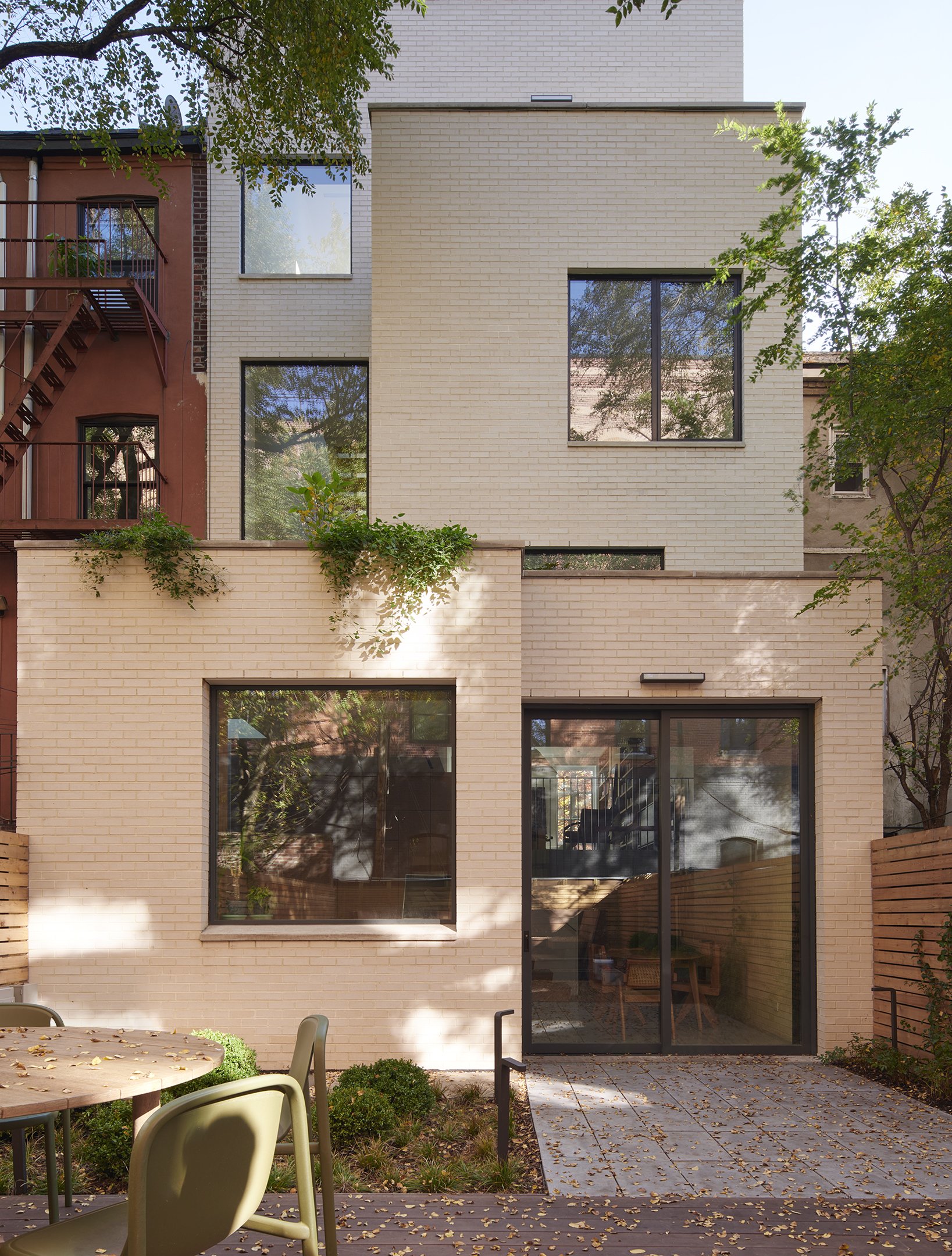
TRANSCRIPT
00;00;00;02 - 00;00;05;13
Doug Pat (DP)
Let's go inside the vault. The design vault.
00;00;05;16 - 00;00;20;14
Shane Neufeld (SN)
I think what was special about this project was that the clients were able to generate a lot of input that forced me out of my comfort zone, think about things in new ways, and take some of the systems and strategies I had in place, but to create something completely different than had been done before.
00;00;20;20 - 00;02;47;11
DP
This is my guest, Shane Neufeld. I'll share more about him shortly. In this episode from the Design Vault, we highlight Shane's project in Brooklyn, New York, called The Z House. The Z house, named for the shape of its stair is a renovation, providing a unique model for the urban domestic experience. At the Project Center is a new switchback stair that integrates the house vertically and horizontally, carving out the existing structure in order to shape dynamic sightlines that connect inhabitants in new ways.
The stairs drama is heightened by the placement of large windows punctuating the rear facade. These allow the vertical space to open to the exterior directing views from the stair through the house and to the yard beyond. Descending from the rear of the parlor floor is a smaller stair slotted between a steel guardrail and oak millwork. This connects the living room to the new horizontal additions below.
Here, the added square footage accommodates the kitchen and dining room in a single dramatic double height space that visually unites the rear yard and the parlor floor above. A green roof located above the garden level helps to buffer sightlines and cultivates a natural intimacy for the residents inside.
Hi, I'm Doug Pat and this is Design Vault. Shane Neufeld is an architect and artist born in Brooklyn, New York.
He received his B.A. in Fine Arts from Amherst College, where he studied painting and literature and his master's degree from the Yale School of Architecture. He is a registered architect and the founder of Light and Air Architecture and Design in Brooklyn. The firm's work has been widely published and completed projects include the Z House, Switchback House, Sterling Place, Skylight House and Nassau Street Loft.
After graduate school, Shane spent three years with Rogers Marvel Architects in New York, working on a variety of projects that focused on urban, residential, commercial as well as institutional architecture. Additionally, he was a project architect at Christopher Fernyhough Architecture. Shane is also served as a faculty member at the New Jersey Institute of Technology's School of Architecture. So welcome, Shane.
Nice to have you with us today. So tell us a little bit about Light and Air Architecture in Brooklyn, New York. So obviously you're located in Brooklyn. What's the size of your firm and what type of work do you do?
00;02;47;13 - 00;03;42;19
SN
It's great to be here. Thanks for having me. Our office is 2 to 3 people. It varies from project to project. We do mainly residential work in Brooklyn, although we have done apartments as well in the city. We're trying to get beyond residential for institutional projects, so we're very open minded about the kind of work we want to do.
But we see a lot of potential spatially, in particular with residential work and in townhouses here in New York. For us, the townhouse is rich with opportunities to explore, and in a city that tends to maximize every square foot, we kind of take a more artful approach where we want places that people want to spend time in rather than maximize.
And so we pursue clients and tell clients this off the bat so they know what they're getting into. And it's a different type of work in our mind than what new people normally see and people are used to.
00;03;42;21 - 00;03;44;11
DP
So how long has a firm been around?
00;03;44;17 - 00;03;55;15
SN
We were founded in 2017. I founded the office on my own house, the Switchback House, which was a derelict brownstone in Bed-Stuy, Brooklyn, and I used that as a starting point.
00;03;55;20 - 00;03;59;01
DP
So that's your home? Yes. Oh, that's so great. It's beautiful.
00;03;59;05 - 00;03;59;19
SN
Thanks.
00;03;59;25 - 00;04;01;28
DP
It must have been a great project for you.
00;04;02;04 - 00;04;28;12
SN
It was intense. I was working still at an office, so I was drawing the plans at night and eventually left my job to work on it full time during construction. It was an incredible learning experience. I hadn't really worked with Townhouse in New York before. I'd work on the Louisville Museum of Arts and Craft, which was a masonry building that would use steel. So I was familiar with the kind of means and methods are getting into, but not in Brooklyn itself.
00;04;28;14 - 00;04;32;13
DP
So you have a family and you all lived through construction.
00;04;32;16 - 00;04;45;05
SN
I actually had a loft in Bed-Stuy, what I call Home Depot Heights, which wasn't so nice at the time. It's loud, but we lived there at the time. My son wasn't born yet, so it worked for us.
00;04;45;07 - 00;04;54;03
DP
So tell us a little bit about the history of the location, the building. How long has it been there? Was it always three stories?
00;04;54;06 - 00;05;33;01
SN
Yeah. So with the Switchback House, my work got out there pretty fast and a young couple came up to me interested in exploring ideas of a new house for themselves that wasn't traditional, that had aspects and qualities that they saw in the Switchback House. And so they had purchased a derelict brownstone in Clinton Hill. It was two stories and a basement, so I guess that's three.
But it can be confusing, but parlor with one above. Basically it had a kind of 1960s faux concrete facade at the time. It was split up into multiple units. They had a big vision for transforming this house entirely from the get-go.
00;05;33;03 - 00;05;39;14
DP
So let's back up a little bit. So you explained how your office got the project. Did you know the clients?
00;05;39;16 - 00;06;31;22
SN
I did not. And so that's something that I've tried to be, you know, getting clients in architecture is very, very difficult. It's very much word of mouth. Obviously, people are spending lots of money. They want to work with someone they're comfortable with, someone they know will provide a product that they're happy with and that works. But it's a catch 22 at the very beginning.
Those connections don't exist. And so what I've really tried to do, and I think this originates from my background as a painter, is that I try to make work that's evocative and I want people to see the images. I want them to say, Hey, that's what I like, that's what I want, and kind of bypass a lot of the other stuff.
That's the hope at least. And so I think thus far I've been able to do that. And so they saw my projects online and had that reaction. And through a series of interviews and get togethers and walkthroughs, eventually they felt comfortable with me through other recommendations, obviously, as well.
00;06;31;26 - 00;06;36;06
DP
So what was the scope of the project? What were the clients’ programmatic requirements?
00;06;36;09 - 00;07;54;17
SN
That's pretty interesting as well. So I mean, there was this idea early on that we sketched of a kind of grand public floor on the stoop level. Basically, they knew they wanted to add to the building horizontally. We weren't yet sure about vertically, but the original building, it was wider than most townhouses, 22 and a half feet, but it was only 32 feet deep.
So the addition was necessary in order to function, basically. Then the idea of the living space on the parlor floor and with bedrooms above and originally, as I've done in other projects, I thought of the adult level on the second floor with the kids above. They pushed me to invert this, which created a very interesting programmatic and spatial result.
Basically with the vertical addition on the rear, you end up having a terrace on the top floor off the master bedroom. I think what was special about this project was that the clients were able to generate a lot of input that forced me out of my comfort zone, think about things in new ways and take some of the systems and strategies I had in place, but to create something completely different than had been done before.
So in that respect, when I first started this project, I thought about it as, you know, Switchback House 2.0. I like this idea of the Switchback as a typology that offers a multitude of spatial outcomes depending on the family's needs.
00;07;54;19 - 00;08;04;07
DP
So it can't be easy getting a new addition done in Brooklyn, right? I mean, what do you go through in terms of project restrictions, zoning codes, etc.?
00;08;04;10 - 00;08;27;29
SN
That's a very good question. I mean, luckily this building wasn't landmarked, so we didn't have to go through landmarks review. We were given kind of free range to do what we wanted. But a horizontal and vertical submission is significant. It requires an old one change of use. We went from a two family or three family to a single family.
It was significant time for approvals. We did not do SOE. We we didn't dig out the cellar in the rear.
00;08;28;02 - 00;08;30;18
DP
So the building plan, straight rectangle?
00;08;30;20 - 00;08;47;05
SN
It's actually staggered slightly in plan and the addition and that has to do with the lot line itself. So you can see that in the kitchen, the area where the sink and window are that that actually pushes out slightly beyond where the sliding doors are that defined the end of the dining room space.
00;08;47;11 - 00;08;48;12
DP
Do they have a backyard?
00;08;48;13 - 00;08;49;15
SN
They do.
00;08;50;39 - 00;08;52;12
DP
So they were encroaching on it when you put the addition on?
00;08;53;29 - 00;08;54;03
SN
Slightly but 30 feet to the rear is the code.
00;08;54;09 - 00;08;56;11
DP
So they still have a backyard. They've got room.
00;08;56;18 - 00;08;57;25
SN
Oh, yes, significant room.
00;08;58;02 - 00;09;04;27
DP
So how long did the planning process take? City Review design to construction? Like start to finish? How long were you on the job?
00;09;05;03 - 00;09;17;15
SN
Well, I started the project. I started designing think it was the end of 2018. It took about a year to get started and the project itself took another two years to finish. Year and a half. Two years.
00;09;17;15 - 00;09;18;07
DP
And pandemic.
00;09;18;11 - 00;09;34;10
SN
Yes, through that as well, through price increases on plywood and windows that took over a year to arrive, miserable at times. But a truly wonderful client who trusted us trusted the process, communicated well, and we really got through it together.
00;09;34;15 - 00;09;41;02
DP
Yeah, a common story for we architects. I mean, everything took longer, cost more. It was insanity.
00;09;41;09 - 00;10;38;09
SN
Yeah. I mean, I think what's really interesting for me about this project was that this addition that we had, we wanted it to feel completely different than the front of the building. We actually restored the front of the building to its original state, which was a cementitious or brownstone facade. Despite adding a floor, we made it look, appear as if that's the way it had always been.
So we were playing up this Jekyll and Hyde inside, outside contrasting relationship. And so the rear is this monolithic kind of earthy force in a way that appears entirely different from the front of the house. And there was a real desire with the large windows to bring light and air into the space, to feel continuous ness of the space between the inside of the building and the rear.
And I think that's really where the search also for the right brick came into play because we knew that whatever we did, which we wanted to be masonry on the rear also had to be that same masonry on the inside of the addition as well.
00;10;38;17 - 00;10;52;02
DP
So tell us a little bit about style choice. So the owners, did they just say right away, hey, we want to do something contemporary? They're looking at your project, the Switchback House, and they're thinking, this is what we want to do. That's why we came to you.
00;10;52;04 - 00;11;14;22
SN
To be honest, I always tried to actually sidestep away from conversations about style, but there was an idea from the get-go that they had seen our work. They wanted something in that vein. There was no conversations about whether something should be stylistically historical or modern or contemporary. There was just questions about where things should be, how they should function, and what material should be the outcome.
00;11;14;29 - 00;11;20;07
DP
Did the city dictate that the third story on that front elevation had to be a traditional aesthetic?
00;11;20;09 - 00;11;22;25
SN
Absolutely not. That that was a client driven.
00;11;22;25 - 00;11;23;16
DP
Client driven.
00;11;23;19 - 00;12;04;00
SN
Yes. And you know what? At first I thought, you know what? If the vertical edition was something modern, stepped back and those were ideas that I was really interested in to play as a counterpoint to the historical facade. But the client and I think to their credit, in the end, this idea of really disguising the kind of dynamism that was going on inside that the front played a more subtle, subdued role.
I really like that. In the end, the front door is a reference to their heritage. Actually, it's a mahogany lattice that references Geoffrey Bauer's work and some of the screens that he developed in his work. So there's suggestions of a kind of different world within, but it's very subtle.
00;12;04;02 - 00;12;10;15
DP
So tell us a little bit about the building restrictions. Was there an FAR? Zoning codes?
00;12;10;17 - 00;12;28;14
SN
Yeah, sure. So it's a 20 to by, I think a little under a hundred foot deep lot. So obviously you have to do your calculations. But no, we are not maximizing FAR, we're close, but not maximizing the envelope is, I believe, 50 feet on the street side. But we're not engaging any of those limits.
00;12;28;20 - 00;12;31;12
DP
You guys used masonry on the interior as well.
00;12;31;16 - 00;12;34;11
SN
We did. And those are full masonry bricks on the inside.
00;12;34;18 - 00;12;35;17
DP
So it's load bearing.
00;12;35;24 - 00;13;13;10
SN
Well, we're not using the bricks for load bearing purposes. It is a CMU all in the addition, but the bricks take up the three and five eighths inch width, which is I think really interesting. I think this is again speaks to the kind of work that we do is that we looked at tile products. I think Glen-Gery very makes tile products too of some of those bricks but we wanted it to turn corners.
We wanted it to move, we wanted it to appear fully authentic. And in the end, I think once we had reflected on all the products available, that using the same brick, the same finish was the right move. And with the 22 and a half foot wide lot, it really afforded us that opportunity.
00;13;13;12 - 00;13;18;29
DP
So tell us about some of the unique construction details that you guys ended up using on the project.
00;13;19;01 - 00;14;20;08
SN
This whole project, this whole house was bespoke. I mean, it kind of drove us mad how difficult it was. We were there almost every other day figuring things out. You know, my office is near Clinton Hill, so it's a five minute bike ride. And there were lots of things to consider constantly as the construction progress went on. But I think that one quality that we like to achieve in all of our projects is this notion of materials and volumes, kissing or abutting in very sensitive ways.
So knowing that if you want two finish materials to have a tolerance of, let's say an eighth of an inch or a 16th of an inch next to each other, one has to constantly move back from those materials and think about what's on the inside. So we worked with Henrybuilt on this kitchen. Henrybuilt produces very beautiful high end kitchens.
But I the architect am the verifying field for that if you can believe it we actually designed and dimension this kitchen before the masonry was built so the masonry that you see in the kitchen was actually designed to the specs of the kitchen.
00;14;20;13 - 00;14;22;16
DP
Wow, that is backwards.
00;14;22;21 - 00;14;38;26
SN
But I had to know where everything was. So we have the CMU in place. I had to understand the depth of all the materials where they would end up. And using that information we decided what the kitchen was, where it would be. And then I'm on the field supervising, making sure that the masonry is indeed where I think it will be.
00;14;39;03 - 00;14;50;06
DP
Yeah, I think it's pretty cool. It's pretty rare to see masonry on the interior of a building. You just referenced, there were other materials you guys talked about using for both the interior and maybe even the rear facade.
00;14;50;08 - 00;16;19;11
SN
The client, they had this dream of a masonry rear facade. I did too. I mean, it's what made sense. I mean, masonry is a East Coast material. It is something we see a lot here. The beautiful old buildings, you know, of the Northeast are made of brick, many of them red brick. And so that was a theme that came up as well.
The client did have a bit of a dream of this red brick facade, but knowing that this brick would live on the inside as well, esthetically, I felt that a red brick spoke too much of exterior use and would be a kind of too much of a contrast to the type of mood and space we were trying to create on the inside.
A lighter brick reflects light. It bounces light around. It doesn't present itself as a color so much as an opportunity for variations in tone throughout a space. There's so much light in this house that we kind of, after some time and looking at many, many different products in many Glen-Gery products, we decided that a white light cream colored brick was the right choice.
And then it came to question, Well, how do we get a white brick that has the texture that works both on the outside and on the inside, and doesn't force someone to see that as an issue in one way or the other. And so we went with, in the end, white velour, which we felt was this perfect middle ground of cream colored was not too white, was not too beige, not too reflective, not too matte, and had a wonderful kind of authentic handed texture to it that I think really helped the house out a lot.
00;16;19;13 - 00;16;23;21
DP
And used a slightly darker mortar. Right? So we didn't know it's brick.
00;16;23;21 - 00;16;39;26
SN
Correct. We tested it out. So that was a sense of do we want the lines to go away? That's always a question you know, architects deal with. I think we found something that wasn't too much of a contrast, but very clearly spoke to the manual craft that goes into putting brick walls together.
00;16;39;29 - 00;16;41;29
DP
So you guys have a green roof on this?
00;16;42;04 - 00;16;42;23
SN
We do.
00;16;42;26 - 00;16;46;11
DP
So sustainability was something you guys talked about?
00;16;46;12 - 00;17;13;21
SN
For sure. We have solar panels on the roof and a green roof, 100 square feet of green roof is required now of new construction in New York on residential projects. If you don't have solar panels, we kind of decided to do both. The solar panels actually came a little later on in the project, but the green roof is integrated into the addition, so that actually when one descends down the stair from the second to the first floor, they look out of a window that views out upon the green roof.
00;17;13;24 - 00;17;30;24
SN
And that green roof also, the intention is over time it grows, it's exotic, it falls down the facade. And so the idea of the brick as a kind of monumental monolithic material that as a counterpoint to the organic quality of the roof itself, our hope is that they really begin to work together in a lovely way.
00;17;31;01 - 00;17;34;05
DP
How much energy can they generate with the solar panels?
00;17;34;08 - 00;17;40;23
SN
Probably anywhere between 40 to 50%. You know, I think obviously in the winter, not so much, but in the summer a lot.
00;17;40;26 - 00;17;49;03
DP
Yeah, that's pretty cool. Let's talk a little bit about the architectural process, 2D 3D. Do you work in both? What are the programs you're using?
00;17;49;08 - 00;19;06;00
SN
Yeah, well, I'm an artist in the truest sense of the word. You know, I'm a draftsman and I was a painter in college. I still paint, I think, with a pencil and paper. I think through watercolors and painting. And that's how ideas begin to formulate in my mind. And so everything begins in a kind of old school way for me, it's kind of funny.
I like digital tools, but I think that I'm most creative on working directly with my hands. So I also think that's very exciting for clients. People forget that you're sitting at a table with paper and you're with a client, and to be able to communicate ideas through drawing is a privilege and it's fun.
And so that's how I begin the process. And then very quickly, we're moving to we use Rhino for all of our 3D design and a lot of model making. So our office, we have a 3D printer, we've created a hybrid process where, you know, as you can see in the photograph, our models have 3D printed components, wood components that are done by hand, concrete.
In a funny way, the models are a kind of precursor to the actuality of the house itself in that image. That's a quarter inch model there. It's a significantly large model and I think we use that with clients. They enjoy it. The model really offers a quality of light and experience that the renderings don't.
00;19;06;02 - 00;19;08;06
DP
Yeah, I was going to say clients love models.
00;19;08;09 - 00;19;12;26
SN
Yeah, they do. We don't charge for them, but we should.
00;19;12;28 - 00;19;17;04
DP
So you said you had two other people in the office working with you on this project?
00;19;17;11 - 00;19;35;07
SN
On this project, it was just me and one employee. You know, we worked together. Hands and hands, both of us. All hands on deck, figuring this out. I did most of the CA, Construction Administration, on this project, and I'm very hands on on site as well, drawing, sketching with builders, working directly with the foremen. And, you know, those are all things I really enjoy.
00;19;35;10 - 00;19;39;08
DP
So you're out on site every two or three days, which is wonderful?
00;19;39;15 - 00;19;43;11
SN
Or terrible, depending how you think about it. But in this case it was wonderful.
00;19;43;11 - 00;20;01;24
DP
Of course, I was just wondering, you know, you spend so much time with the GC and the subs. There's something you learn like every day. I mean, I feel like I learn an awful lot. I'm 54. I've been an architect for close to 30 years, and I feel like I'm learning something new, whenever I'm in the field that happened with his job or any other jobs?
00;20;02;02 - 00;20;44;15
SN
Yeah, I mean, I really enjoy it because it's really humbling. I mean, I'm not the type of architect who thinks they know the right answer all the time. I really approach my projects from a kind of artful spatial perspective, and I rely on the different trades and the experts that I surround myself with to help me through the process to get the project realized.
And so that means I have a trusting relationship with GCs as best as I can, that, you know, we work together. I take their advice. You know, I follow their lead at times to help resolve certain things that I might not know how to do. That's not frustrating for me. That's the best. And I like architecture because of that. Every project offers me a chance to learn something new and I find that challenge exciting.
00;20;44;17 - 00;20;53;05
DP
It's a great attitude. It's a humble one, and it's one most architects should have, right? We go out there and we can learn an awful lot from the people that are doing their job.
00;20;53;12 - 00;21;17;29
SN
Yeah, I mean, at some point I want to be in a position to maybe have a bit more knowledge. But I also think you can't be too trusting. I mean, there are moments when things aren't done right or mistakes are made that will realize in making the project not what it should be. It's hard to speak up at those moments and take agency, But yeah, it's a fine line. But all in all, I approach it through teamwork and being humble and listening to those around me.
00;21;18;01 - 00;21;21;07
DP
Did you guys end up using the Mason that you found right away?
00;21;21;09 - 00;21;30;20
SN
This project is pretty amazing in that the crew that we worked with did everything so the Mason was not someone subbed out. It was a crew of guys that did everything on this project.
00;21;30;22 - 00;21;31;29
DP
That's pretty unusual.
00;21;32;04 - 00;21;34;12
SN
Yes, maybe not as much in Brooklyn, but yes.
00;21;34;17 - 00;22;02;27
DP
So Shane, you're a young architect with a presumably long runway in front of you. Do you have any advice to young architects out there that are looking for projects and they're wondering, like, how does this work? You had said early in our discussion that in the very beginning it's really hard to find work. I mean, you've got to kind of wait for somebody to find you.
And how do you get your work in a magazine and then somebody finds it and then, you know, you're recognizable. It's a long it takes a long time.
00;22;03;00 - 00;23;29;16
SN
I have a lot of varied interest in my life. You know, I have a family, I paint, I do other things. Architecture, obviously is my career and it's what I want to do. But I think, one, it's helpful not to have all your eggs in one basket so that there are many things in life that make you happy.
And I think that helps and affords one with the patience that's needed to be an architect because a project from its beginning to its end to its publishing is five years even on a house, right? So that kind of patients you need, that can be really frustrating I think if you take a step back and think about it that way.
But it's just the reality. Working hard to get the images out there. I do believe I hate to say it, but the photographs are the medium by which our work is understood. It's very important to photograph your work with someone you trust in the way that you imagine it to be understood. I don't think people do that enough.
I work with my best friend is someone I grew up with who's my photographer, and it's very collaborative. We spend one day actually just in the house taking 500 shots. We then go through all of them, choose our favorites, revise, edit, iterate, and you know, then it's a two day shoot and it's a lot of work. We didn't hire a stylist or anything like that for this project.
This is us moving things around, using the client's furniture itself. This is all their stuff. And that's something I worked with the clients on as well. But yeah, just making sure that the project ends up looking recorded the way you intended to be. I think that's really, really important.
00;23;29;18 - 00;23;36;16
DP
So Shane, it's been great to have you here. Thanks for your time. Where could people go to learn more about Light and Air Architecture and yourself?
00;23;36;18 - 00;24;09;27
SN
Yeah, I mean, they should go to my website and look through the work. You can email me at Shane@landa-arch.com, or just search Light and Air Architecture. Either way, you'll end up at my website, and my website shows a selection of finished work and ongoing work. We have a really interesting townhouse that's in construction uptown on 95th Street.
Similar ideas, but completely different type of stair, all constructed out of steel offsite and being brought in more constantly, exploring different ways of thinking about the New York house. So yeah, feel free to get in touch.
00;24;10;00 - 00;24;35;12
DP
Well, thank you very much, Shane.
You May Also Be Interested In
We Can Help With Your Next Project
Discover the latest + greatest in design trends, industry news & pro tips from pros.
For all of your project needs, you’ll find everything you need at a Supply Center.
Let Us Know How We Can Help!
Design Vault Ep. 22 Lawrenceville School with Daniela Holt Voith
ABOUT THE ARCHITECT:

|
Daniela Holt Voith, FAIA, LEED AP BD+C, IIDA, ASID, is a founding principal of Voith & Mactavish Architects and our director of design. Holding degrees from Yale University School of Architecture and Bryn Mawr College, Daniela has dedicated her career to promoting the advancement of design for educational environments. Her client-focused practice supports leading edge pedagogical thought and encourages mindful ways of living and learning. Daniela has developed a method of practice that moves fluidly from planning initiatives to building design. Her many long-term relationships with educational institutions result in designs that carefully suit her clients’ missions, reflect their architectural identities, and assist in achieving their strategic goals. She is also consistently looking for ways for her projects to be sustainable in innovative ways. Her work has received numerous national and local accolades.
Daniela is also an educator. Since the early 1980’s she has taught at Yale University as a TA, University of Pennsylvania and Drexel University, and has developed and taught Bryn Mawr College’s design studio program. She often serves on juries for professional awards in architectural design and construction quality, as well as serving on academic reviews.
|
|---|
ABOUT THE PROJECT:
The prestigious independent school, Lawrenceville, sought to promote love and loyalty within its student body through a transformative renovation of the 1960’s-era Abbott Dining Hall that exclusively serves senior, or “Fifth Form,” students in their last year on campus. The project would respond to the style of the adjacent Upper House dorm and other Peabody & Stearns architecture to help achieve that goal.
VMA’s reconfiguration blends seamlessly into the Lawrenceville aesthetic with new brick facades and pitched slate roof, supported by glulam beam trusses. In addition to a complete redesign of the kitchen and servery, custom white oak furniture and booth seating ensure flexibility of layout. Finally, white oak paneling, terrazzo flooring, and over-scaled fireplaces complete the vision.
With its memorabilia-lined entry hallway, lounge, and private dining areas, Abbott may now serve as an exclusive space for seniors to socialize, dine, and reflect on their years at Lawrenceville. In addition, the enlarged terrace provides outdoor seating options for mealtime and special events, expanding the scope of possible activities in the space.
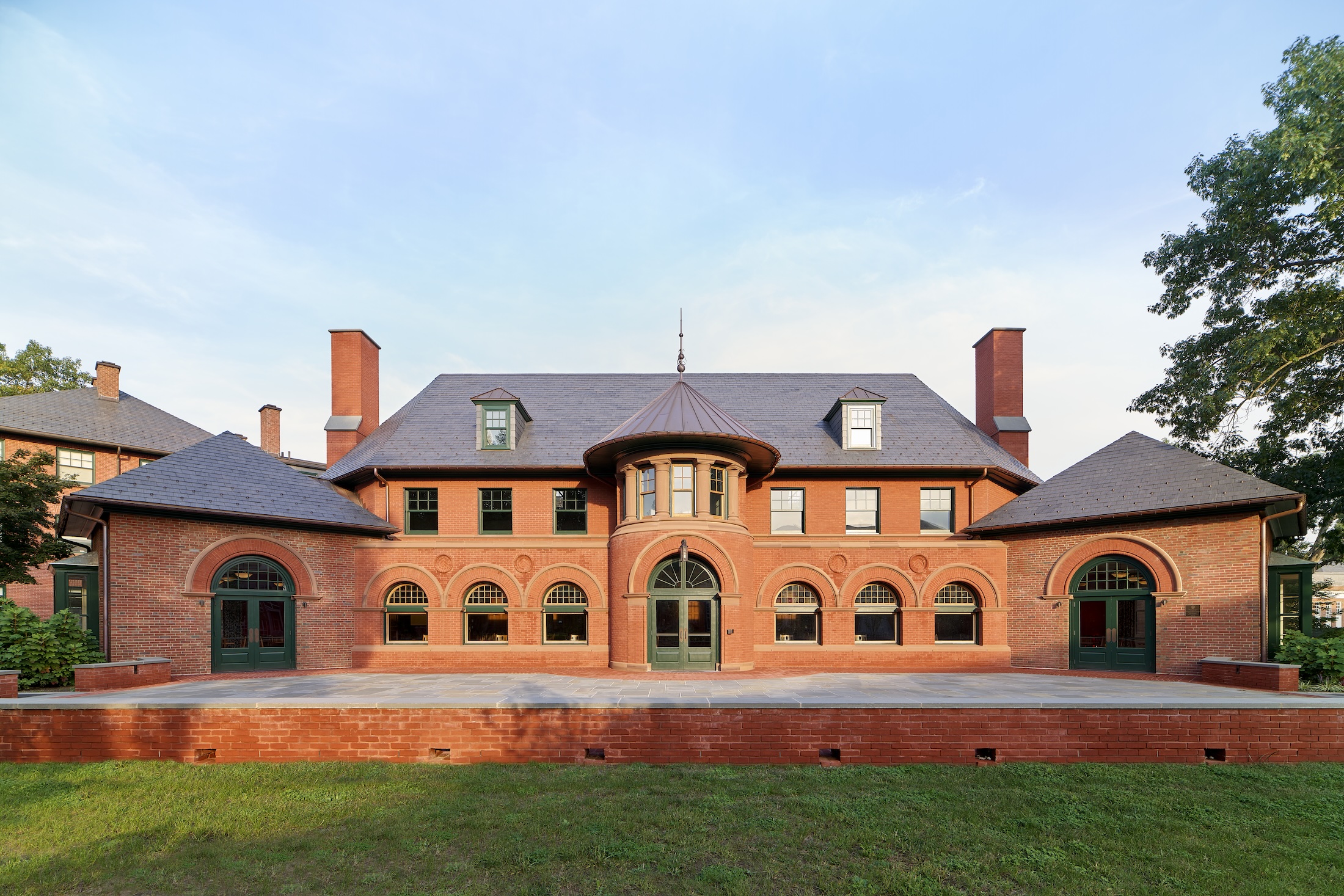
TRANSCRIPT
00;00;00;02 - 00;00;05;07
Doug Pat (DP)
Let's go inside the vault. The design vault.
00;00;05;10 - 00;00;30;11
Daniela Holt Voith (DHV)
Part of our design philosophy is to really make more of a home, both in terms of individual buildings, but also in terms of the context. And this design really is right up our alley in the sense that we love to combine mission and image. There is a strong mission to get the dining hall, which is for the fifth formers, a chance to rebond.
00;00;30;13 - 00;03;05;12
DP
This is my guest, Daniela Holt Voith. I'll share more about her shortly. In this episode from the Design Vault, we highlight Voith and MacTavish Architects Abbott Dining Hall in Lawrenceville, New Jersey. The Abbott Dining Hall is located at the Lawrenceville School in Lawrenceville, New Jersey. The renovation of the 1960s era dining hall exclusively serves senior or fifth form students in their last year on campus.
The project responds to the style of the adjacent upper house dorm and other Peabody and Sterns architecture and reminds one of both Shingle Style and Richardsonian Romanesque architecture. VMA’s reconfiguration blends seamlessly into the Lawrenceville esthetic with new brick facades, pitch slate roof and vaulted interior ceilings supported by glulam hammer beam trusses. In addition to a complete redesign of the kitchen and servery, custom white oak furniture and booth seating clad the interior, white oak paneling, terrazzo floor and over scaled fireplaces complete the vision.
Hi, I'm Doug Pat and this is Design Vault. Daniela Holt Voith is an architect and founding principle of Voith and MacTavish Architects and Director of Design. She holds degrees from Yale University School of Architecture and Bryn Mawr College. Since the early 1980s, she's taught at Yale University as a TA, University of Pennsylvania, Drexel University, and has developed and taught Bryn Mawr College's Design Studio program.
Mayor Michael Nutter appointed her to serve on the city's award winning 2008 zoning code Commission, which revised the city's 50-year-old zoning code. Danielle is currently president of the Institute for Classical Architecture and Art, Philadelphia Chapter director of the Carpenters Company of Philadelphia and Board member of the Design Leadership Foundation. Daniela has dedicated her career to promoting the advancement of design for educational environments.
Her client-focused practice supports leading edge pedagogical thought and encourages mindful ways of living and learning. Daniela loves to travel, bike and ride trains. She speaks French and German, travels frequently and collects early 20th century train lithographs. So welcome, Daniela. It's nice to have you with us today. So tell us a little bit about Voith and MacTavish Architects or VMA in Philadelphia.
So where in the city are you guys located? What's the size of the firm? How long has it been around and what type of work do you do?
00;03;05;15 - 00;03;41;14
DHV
Our firm has been celebrating its 35th year this year. We are located just on the edge of Center City on the Schuylkill River. So we have fabulous views of the river and city skyline. We are about 40 people, I think maybe 41 just this minute. And our primary focus is on design for education from pre-K to post-collegiate. But that encompasses a wide range of services, preservation, planning, architecture, as well as we have an interior studio and a wide range of projects, which is why this client type is so exciting for me.
00;03;41;19 - 00;03;45;14
DP
Interesting. So the firm size has grown over the years, I would assume.
00;03;45;17 - 00;03;55;08
DHV
Yes, we started off as two people and now our, as I said, almost 40. We actually grew during the pandemic. I have no explanation for it.
00;03;55;11 - 00;03;58;08
DP
That's incredible. And was that mainly in school work?
00;03;58;13 - 00;04;33;09
DHV
Almost exclusively, we do architecture planning, interiors and preservation, and we service school work primarily, but we do other work for other institutions, primarily nonprofit. For example, we're just completing a almost 100,000 square foot renovation of some factory buildings for an organization called Philadelphia Youth Basketball. So it has seven basketball courts, classrooms, leadership training, those sorts of facilities up in one of the more disadvantaged areas of Philadelphia.
00;04;33;11 - 00;04;35;10
DP
And do you guys do any residential work?
00;04;35;14 - 00;04;45;27
DHV
We do, actually. Thanks for asking. We just brought on three new partners, one of whom is Scott O’Barr, and he is heading up our residential studio. It's fairly new for us.
00;04;46;00 - 00;04;48;11
DP
Well, that's great. That's actually my, that's what I do. I do.
00;04;48;11 - 00;04;55;25
DHV
All right. Well, we started off doing residential but grew out of that and now we're coming back to residential again with the addition of Scott.
00;04;56;02 - 00;05;04;22
DP
That's great work. Good for you. So tell us a little bit about yourself. How long have you been practicing and what's your role in the office as a principal and director of design?
00;05;04;24 - 00;06;15;06
DHV
Well, my first job in architect's office was when I was 19 at the Architects Collaborative. I got an internship between my sophomore year and junior year at Bryn Mawr, and I loved it so much I took a year off and stayed there. Sadly, that firm doesn't exist anymore, but it was a great introduction to very high level design.
I graduated from architecture school in ‘81 and I've been working pretty much since I formed a partnership with my first employer, Toni Atkins. So it became Atkin Voith and Associates. So that existed for sadly only about three years. We were doing great, but somehow the relationship just wasn't going as well as it should have been. So I broke away and formed a new firm with one of the people that was an employee at the previous firm.
So Cameron MacTavish, who is a wonderful human being and very talented person, and I just bought him out about five years ago because he wanted to do other things and we're still great friends. That's amazing. And just this January took on three new partners. One of the people who was a partner previously, John Cluver, heads up the Preservation Studio.
So there are now five of us, the VMA five.
00;06;15;08 - 00;06;28;12
DP
Well, it sounds like your firm clearly has grown and you do wonderful work. I've been on your website and we'll talk about that a little bit later. So let's talk a little bit about this project. How did your office get the project?
00;06;28;15 - 00;07;12;00
DHV
Well, just as we usually do, it's a competitive business. I think we won it at the interview. The RFP was one of the most unusual ones that we've ever gotten because the brief was written about love and loyalty and how can architecture help young students form a really strong bond with a place. There is also a lot of humor involved at Lawrenceville.
There are a funny bunch, they love to joke, and so in our visual response that we sent in with our portfolio, we photoshopped the head and face of the CFO, who had written the RFP into almost every photo that had people in it. So he only found five of them.
00;07;12;02 - 00;07;13;04
DP
Where's Waldo?
00;07;13;07 - 00;07;28;24
DHV
It was exactly like Where's Waldo? But we tried to approach the interview in responding exactly to that. How do you create a sense of belonging and a sense of fascination and otherness in a place?
00;07;28;27 - 00;07;30;25
DP
So you didn't know the clients and you got the job?
00;07;30;26 - 00;07;31;17
DHV
That's correct.
00;07;31;17 - 00;07;38;05
DP
That's wonderful. Good for you. So let's talk a little bit about the history of the location you said is kind of special.
00;07;38;07 - 00;09;17;03
DHV
So Lawrenceville is one of the premier boarding schools in the country. It has a long tradition. Its original campus was laid out by Olmstead, and a lot of the architecture was done, as you mentioned, by Peabody and Stearns. Originally, it was laid out in a circle as many older boarding schools are. And as it grew, the planning paradigm became more oriented around quads.
This dining hall was built as an addition to a Peabody and Stearns dormitory. It had a flat roof, a pretty unsympathetic brick, big glass curtain wall that faced West, which you can only imagine was sun beating in at dinner time. So they pulled the curtains. So it was almost always dark. And so there was a lot to improve, but they didn't really want to diverge too much from the footprint of the building.
But essentially we took the building down to its foundations. We left the steel, took off the roof and kept these two side wings that are almost square and planned and put a new roof and new structure. As you mentioned, the big glulam trusses that look like heavy timber and then made a basically a six foot addition on the Western facade to create some really deep windows so that that West facing sun would get mitigated as it comes in and then really responded to the facade of the original dormitory on the other side.
So the facade is characterized by a round tower which forms the entry and six Romanesque arched windows, three on either side. So it has this very heavy look about its sense of gravitas.
00;09;17;06 - 00;09;23;05
DP
So this building really looked nothing like what it does today. Is that correct? The facades are completely new.
00;09;23;09 - 00;09;25;00
DHV
Completely new.
00;09;25;02 - 00;09;41;01
DP
So what's interesting about that, as I'm reading about your renovation 1960s building, I'm thinking this was clearly a very talented architect in the sixties. Now, that's amazing, right? So this building, he just took it down to the foundations. Okay, Now it all makes perfect sense.
00;09;41;01 - 00;09;41;19
DHV
Pretty much.
00;09;41;19 - 00;09;44;16
DP
My goodness.
00;09;44;16 - 00;09;47;00
DHV
It was a flat roof, 1960s building with a curtain wall.
00;09;47;06 - 00;09;53;05
DP
Yeah. Wow, that. Okay, that's pretty cool. So you guys know what you're doing? This thing is beautiful.
00;09;53;05 - 00;10;36;19
DHV
Thank you. Thank you. Well, part of our design philosophy is to really make more of a home, both in terms of individual buildings, but also in terms of the context. And this design really is right up our alley in the sense that we love to combine mission and image. As I said before, there is a strong mission to get the dining hall, which is for the fifth formers, their culminating year at the school, a chance to rebond. The school is organized so that there's a freshman dorm, but then they divide up into houses and they're in those houses for two years and then they come back together again as a class. So it's a chance to rebond.
00;10;36;21 - 00;10;41;22
DP
So tell me a little bit about the scope or programmatic requirements of the project from the beginning.
00;10;41;29 - 00;11;53;02
DHV
Right? So the dining hall seats about 250 to 300. The servery was a very old fashioned cafeteria line, which is way outdated in terms of food service. So the kitchens had to be upgraded, the servery completely renovated, the loading dock assisted and that sort of thing. So they also wanted to be able to use the room as an event space.
So it needed to handle various different seating configurations, a lot of AV component ends, video, that sort of thing. And they wanted to be able to clear out the room, as I said, for some events like dances. So I worked very closely with Thomas Moser. There's a fine mill worker up at Maine to develop a table. It looked like a very heavy wooden table.
It is a very heavy wooden table, but the top flips and you can put it up onto skateboards essentially and move them away. So it's now called the Daniela table, and it's available on their contract side if you're looking for a nesting trestle table. And that was really about it. It serves three meals a day other than the events that they do.
So one of the first was a wedding for the head of school, his daughter.
00;11;53;05 - 00;11;59;26
DP
So they must have had a decent budget for the project, right? They ended up making some custom furniture.
00;11;59;28 - 00;12;15;24
DHV
I think by most standards it was decent. The project in the end all in was $8 million. It's a 13,000 square foot building, so it's not incredibly expensive by residential short, but a lot of value I think, for what they invested in this building.
00;12;16;00 - 00;12;29;03
DP
So let's go backwards a little bit and talk about the building stylistically. So you mentioned, I mentioned earlier, Peabody and Stearns Architecture. I guess they may have been well known for shingle style architecture.
00;12;29;09 - 00;12;44;00
DHV
They were they were a firm of big reputation. And so I think the board members must have nabbed them from New York and brought them down to Lawrenceville. Shingle style definitely. But also this kind of masonry structures as well.
00;12;44;02 - 00;13;06;21
DP
So let's talk a little bit about project restrictions. So I don't know a whole lot about how to get a building built on a boarding school campus. What was that like? And are you working with the town and zoning ordinances there? And you're also working with the school and with esthetic issues. And are there any historical challenges other than trying to match certain architecture?
00;13;06;28 - 00;14;22;12
DHV
The zoning was easy because we were really staying pretty much within the same footprint. We're not adding impervious coverage. The construction logistics were tricky and we essentially cut a new entrance road onto the campus, a construction entrance, and fenced off the construction area. Obviously, student safety is a huge concern. Embedded into our specification are behavioral guidelines, no smoking, shirts on, no swear words.
There's a lot of that sort of thing that's required by most school campuses, actually. The construction needed to happen within a year. They only took that dining hall offline for just one school year, basically a real tricky part of the project was that the original contractor was somebody that we had done maybe 15 to 20 projects with, went out of business in the middle of the project.
So that was heartbreaking because they were such good contractors and caused a huge hiccup and because they were having such trouble, there was construction work that was done that wasn't necessarily supervised, and the school wanted some work to continue. So there was a lot of logistical issues that happened in transferring to another contractor.
00;14;22;19 - 00;14;27;29
DP
Did you have to hire like a construction manager to come in and help put it all back together?
00;14;28;01 - 00;14;48;15
DHV
No, the school, you know, was fairly sophisticated in terms of construction. Many schools are not, but there was insurance involved. And so there was insurance oversight. There was banking issues. There were a lot of things in transferring all that knowledge from one contractor to another. Not having the backup was challenging, but they did an amazing job in the end.
00;14;48;18 - 00;14;52;03
DP
So how long did the planning and design process take?
00;14;52;06 - 00;15;28;09
DHV
Probably just about a year, maybe a smidge longer. There's always that moment. We go through the design. We made models, we did beautiful drawings. There wasn't, like there often is, a hiatus for fundraising because the project was fully funded from the get go, so a single donor basically anteed up. So it was a fairly smooth process from the beginning of concept through the construction documents, the construction documents were a thing of beauty.
The Millwork was so detailed, the brickwork is so detailed. There is a lot to that set. I'd love to show them to you at some point.
00;15;28;12 - 00;15;34;22
DP
I'd love to see that. So what was the size of the team that you had working on the project?
00;15;34;24 - 00;15;47;17
DHV
Core team of myself, the project manager, Sennah Loftus, the architect, Andrew Lipschitz. And then there were probably two other people who were helping. So that's 5.
00;15;47;17 - 00;15;51;06
DP
And did you guys work in 2D and 3D?
00;15;51;08 - 00;16;03;20
DHV
This is a project that was done entirely in CAD so much detail that it not a lot of repetition and so many one off kinds of details that working in Revit would have hindered us.
00;16;03;20 - 00;16;11;29
DP
I think and you guys presented I'm assuming, drawings and ultimately maybe even models to the clients along the way. Did they enjoy that?
00;16;12;01 - 00;16;24;23
DHV
Of course, there's nothing like a model. So we actually made a model where we could take the roof off. The client could actually understand the roof structure and then see the space inside and then put the roof back on.
00;16;24;25 - 00;16;27;01
DP
Did you guys hire that out or did you make them?
00;16;27;01 - 00;16;43;09
DHV
We did it in-house. We have a great shop where we can do both woodworking, we have a laser cutter and also 3D printing. I think we're in the midst of phasing out the woodshop, sadly. But the other aspects of it is that prototyping is really important to us.
00;16;43;12 - 00;16;55;01
DP
So that's a good segway to the building esthetics. So I'm looking at some photos of the architecture. Did you guys replicate some of the archways that you found on campus and other buildings?
00;16;55;09 - 00;17;44;11
DHV
The main arches that are on this facade are derived directly from the front of the original dormitory. It's called Upper House. So from the upper house facade. But the curved tower entry was something that, you know, we studied Peabody and Stern a fair amount and we thought that would be appropriate. It, of course, was very tricky construction and detailing wise because not only is it curved, but we also put an arched top over the main doors.
So that arch is curving in elevation and in plan. Interestingly, if you flatten it out, it's actually and ellipse and the underside of the arch as you get into the door itself actually expands from the doorframe to the door head. It gets steeper because the curve is coming around.
00;17;44;13 - 00;17;46;09
DP
So they built formwork for that?
00;17;46;11 - 00;18;34;12
DHV
No? Well, I'm sure they did in terms of having an arch to lay everything up on. But the arches are actually true arches and we wanted that really deep window recess. So the brick is laid up on a facing block. So it's actually an eight inch facade on top of the structural law we have that depth really makes those arches read.
The arches have a stone arch on the outside. Then there's another arch on the inside that's made up of a header and a stretcher. So it's that deep. And then there's a hinge brick underneath that has a molded shape on it, basically, not quite a full round, but I guess a three quarter around section. And then it goes back into the return, which as I said, varies in depth as it goes around.
00;18;34;14 - 00;18;38;11
DP
Did you have any trouble finding a mason to do that work?
00;18;38;14 - 00;19;20;00
DHV
So we didn't find the mason, the contractors did. And the Masons on this job were really good, so we were happy. The brick is kind of a orangish red. The way we've laid it out has a very, almost monolithic feel because we picked a mortar that blends with the brick. It doesn't highlight each individual brick. So the mortar itself has that a similar coloration to the brick.
There's not much of just facade and it's laid up in running bond. In between the arches we have round medallions that are also made of brick. And then the center those medallions are a herringbone pattern. So there's an incredible amount of richness in the brickwork and it's highlighted by these masonry elements.
00;19;20;02 - 00;19;25;09
DP
I would imagine you did a lot of drawings in house of what this, ultimately, the facades were going to look like.
00;19;25;09 - 00;19;28;04
DHV
And then the shop drawings were amazing.
00;19;28;06 - 00;19;31;01
DP
And did you do many mock ups in the field?
00;19;31;04 - 00;19;54;24
DHV
So we did a mock up of the wall and a return. We did not do a full on mock up with the window inserted. We often do, but in this case we didn't. Tricky part was putting one of these arched openings into the existing brick of those sidings that I mentioned To start with. The brick actually is slightly different than the 1960s brick. That's the only bit of facade that remained.
00;19;54;27 - 00;19;59;01
DP
So the brick facade remained on those wings and then you matched?
00;19;59;07 - 00;20;04;06
DHV
Now we didn't match their contrasting sixties. Brick has more variation in it.
00;20;04;10 - 00;20;06;13
DP
It looks a little redder in the photos.
00;20;06;16 - 00;20;21;19
DHV
Yeah, it's just has a little bit more variation in the brick. But we tried to choose a brick that would blend both with the original Peabody and Sterns and those existing pieces of wall. I mean, in the end we could have just taken them down and started over, but we didn't.
00;20;21;21 - 00;20;36;24
DP
Right. You always, at least in my experience, you kind of pick and choose what you're going to keep and what you're not going to keep. And you look back, you're like, man, we probably spent more money keeping things than just tearing it down to the foundation gradually.
00;20;36;25 - 00;20;50;17
DHV
Absolutely. But part of the transformation of this building was not only this incredibly detailed facade, but also the very, very steeply pitched roof that's all slate. The dormers have copper on them and the tower itself has some copper on it.
00;20;50;19 - 00;20;55;14
DP
They must have loved that, the peak roof, the idea that they were getting rid of this flat roof.
00;20;55;14 - 00;21;04;21
DHV
Absolutely. I'm still hearing, I mean this was finished a number of years ago, and I still hear from people who've been on campus how amazing the space is.
00;21;04;24 - 00;21;13;14
DP
Let's talk a little bit about the trusses on the interior, even though they're not masonry. So in my experience those are called hammer beam trusses. Am I incorrect?
00;21;13;16 - 00;21;51;24
DHV
No, but basically this is a modern building and the span was fairly large. And so our engineers wanted this to be self-supporting. So they're made up of glulam pieces and then bolted together. There is a lot of concern actually by the client when they first saw the trusses go up because they weren't stained yet. And it has these heavy bolts in the plates and they're really worried that this is going to get too industrial looking.
And we painted the steel bits in a color that kind of calms down the contrast between the steel and the wood. And by the time the roof went on and everything else was going on, everybody's in love.
00;21;51;26 - 00;21;57;02
DP
You would never know. And I looked at those photos online. You'd never know there was any steel.
00;21;57;04 - 00;22;07;02
DHV
Yeah, it's just the balls. Sometimes we've done roofs that look like they're heavy timber but are actually steel clad. But in this case, the wood is actually self-supporting.
00;22;07;05 - 00;22;08;23
DP
Yeah, the interior's stunning.
00;22;08;26 - 00;22;09;10
DHV
Thank you.
00;22;09;10 - 00;22;14;21
DP
Is that one large rectangular space on the first floor other than the wing?
00;22;14;21 - 00;23;21;18
DHV
Yeah, other than the wings, it's not quite rectangular because the ends have sort of apses. They're angular. And so in the middle of each and there's an enormous fireplace, we pulled the base of the fireplace up off the floor so that you could see in to the fireplaces from the seated position. And then we had these incredible carvings done that are representative of themes on the campus.
And then, they're not wood burning their gas, but they certainly give this incredible warmth to events and the floor is made of terrazzo. And we carefully made a pattern of the terazzo. So but I said, these people are jokesters, right? And so one of the things that you can do with terrazzo, so it's imbed brass shapes into it.
We found a number of shapes again of animals and other things that are kind of spread through the Lawrenceville law. And then we put cockroaches on the floor. That's so there's like five or six cockroaches. So there's the question always is, well, where's the cockroach?
00;23;21;20 - 00;23;23;03
DP
I'd love to see that.
00;23;23;05 - 00;23;25;04
DHV
I can send you a photograph.
00;23;25;12 - 00;23;31;03
DP
Please do. So, did your team learn anything interesting through the design and construction process? Anything kind of new for you?
00;23;31;05 - 00;24;04;08
DHV
One of the things that we were very interested in anyway was the issue of the Western exposure. And we're a firm that is oriented towards sustainability. It kind of is part and parcel of every project that we do. And so the light mitigation was a big piece of it. So we did a number of lighting studies to see how deep we needed to make the niches to really be able to cut off the direct glare to the inside.
That was an interesting piece of work for us. The combination of computer modeling, lighting, simulation and facade design.
00;24;04;11 - 00;24;18;24
DP
Very cool. So, Daniela, you've been an architect and educator for some time. Based on what you know today about being an architect, do you have any words of advice for your younger self or maybe for young people coming up in the field today?
00;24;18;27 - 00;25;06;09
DHV
So everybody has to find their own selves. And I mentor a lot of women. Our office is more than 50% women. Being an architect on the job site is always a challenge. I found my own way, partially because I played a lot of basketball growing up and I played a lot of basketball with men. I already had this kind of knowledge of both teamwork, competitiveness, defensiveness, all of that all plays out in sports and then into real life.
But most people don't have that experience. They're not as big as tall as I am. I try and say, You're going to have to find your own way. But ultimately on the job site anyway, the person who signs the requisition for payment has the power. So I think my biggest piece of advice is learn to trust yourself and stand on your own two feet.
00;25;06;16 - 00;25;23;26
DP
It's great advice. When I think about myself as a young architect, a young human being for that matter, I was always looking for answers from someone else, always asking someone, How do I do this or How do I get to where I want to go? Or what do I even want to do with my life.
00;25;23;28 - 00;25;25;09
DHV
That only comes from inside.
00;25;25;15 - 00;25;36;22
DP
But it takes a long time to figure that out. And it's really nice that there are people that come alongside you and say, Hey, you know what? You have to look inside. The answers are actually all there already.
00;25;36;24 - 00;25;37;27
DHV
Correct. Nice way to put it.
00;25;38;00 - 00;25;47;18
DP
Well, I'm glad you've been there for lots of other women. So, Daniela, it's been great to have you here. Thanks for your time. Where can people go to learn more about VMA and yourself?
00;25;47;20 - 00;26;08;14
DHV
Our website is cumbersome in terms of its name, but its VoithandMacTavish.com. There's lots of information. If you want to know more about me, search Daniela Voith I think will get you there. You don't have to add my middle name, Holt. I even have a Wikipedia page. So there's a lot of information out there to be had about me.
00;26;08;20 - 00;26;12;18
DP
That's pretty cool. Well, thank you very much for your time today.
00;26;12;25 - 00;26;15;11
DHV
It's been a pleasure. Thank you so much for inviting me.
00;26;15;14 - 00;26;42;05
DP
Our pleasure.
You May Also Be Interested In
We Can Help With Your Next Project
Discover the latest + greatest in design trends, industry news & pro tips from pros.
For all of your project needs, you’ll find everything you need at a Supply Center.
Let Us Know How We Can Help!